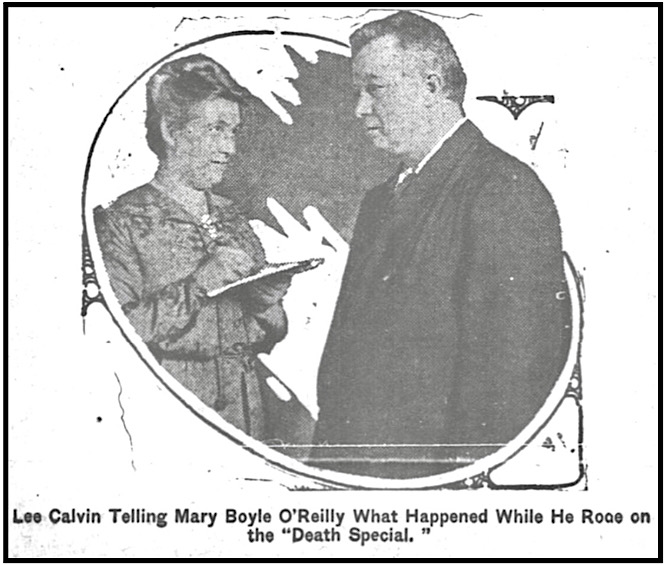
Hellraisers Journal – Sunday June 22, 1913 Miss Mary Boyle O’Reilly Interviews Lee Calvin in West Virginia
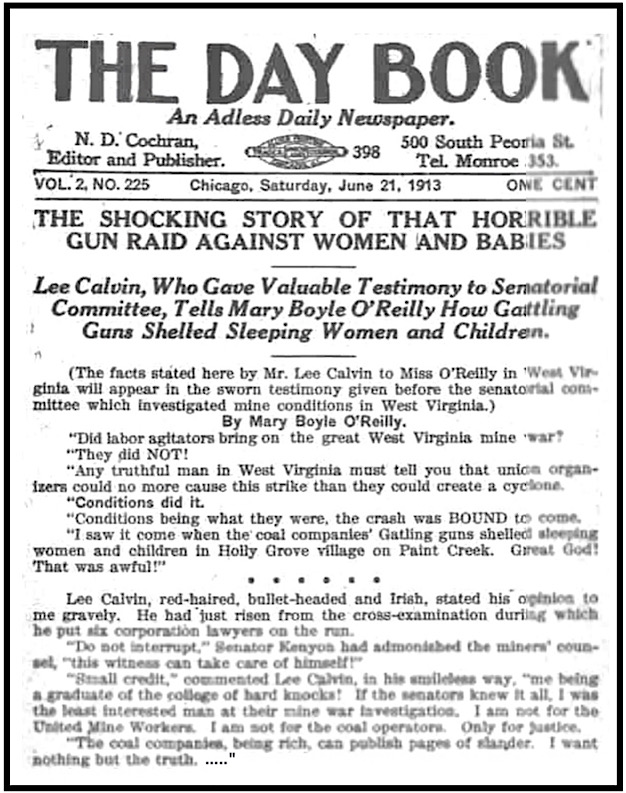
From The Day Book of June 21, 1913:
[Lee Calvin stated to Miss O’Reilly that he wanted to tell her about the “Death Special” and the shooting up of “SLEEPING” women and children.
On board the steel armored train were Sheriff Bonner Hill and ten deputies, a machine gun, a dozen B. & F. mine guards acting as Chesapeake & Ohio detectives, Quinn Morton, millionaire mine owner, and his general manager, M. McClanahan.
Morton armed the men with 30-30’s, Winchester man-killers. Lee Calvin refused the offer of a rifle.]
[Lee Calvin continued…]
With that we came near Holly Grove. Someone turned out the car lights. The engineer gave two short whistles.
Being an old railroad man I knew it for a signal.
And before you could think the maachine gun in the armored car opened a continouous stream of fire on the strikers’ tents near the track.
George A. Lentz, chief detective of the C. & O. detectives, worked the gun.
It was near 11 night. The miners almost to a man, had slipped into the hills. But the moans of women and children were heart-rending.
Esco Estop was shot dead.
Mrs. Hall’s leg was shot off.
Two women gave premature birth to dead children.
Almost at once the town of tents took fire.
That was near midnight of Feb.7. Women and children shrieked all night. God only knows what they thought had come upon them in their sleep!
But Quinn Morton, general manager for the Imperial Colliery Co., to whom all these people must look to live, came running down the car from the rear-cheering-CHEERING!
“Sheriff Hill,” he cried, “let us stop the train, turn on the lights, reload and back up to give them another dose. I guess that will end the strike on Paint Creek.”
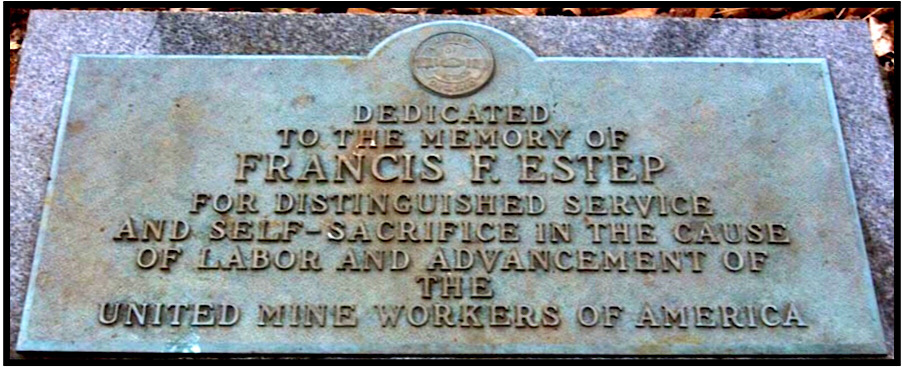
WE NEVER FORGET Night of February 7, 1913, Holly Grove, West Virginia Francis Estep Shot Down by Gunthugs, Survived by Pregnant Wife and Small Child
United Mine Workers of America marker to honor Francis Estep, placed at his grave at Holly Grove, WV, many years after his death:
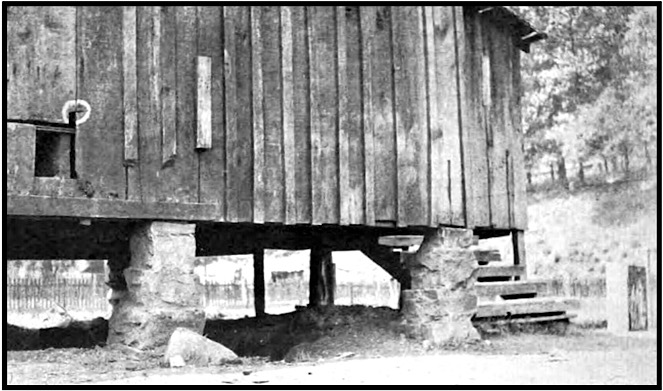
The Estep home at Holly Grove, 1913:
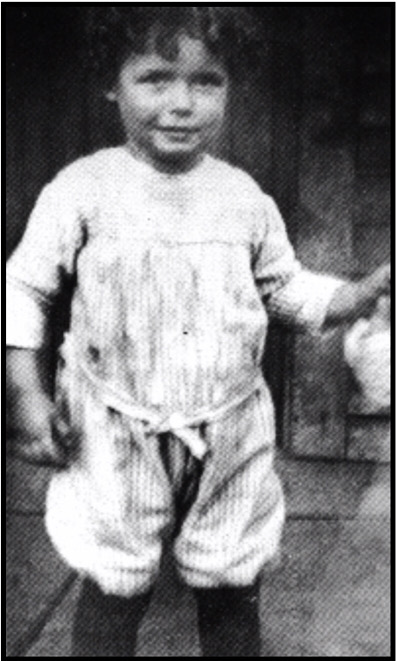
Clifford Allan Estep, son of Francis Estep, about 1913:
Poem written for little son of Cesco Estep, Martyr of Holly Grove
THE STRIKER’S ORPHAN CHILD
-by Walter Seacrist
My father was a striker back in nineteen and thirteen. He was the sweetest daddy; he never treated us mean. He worked in dark and danger, almost day and night To earn for us a living, to bring us all up right.
We all were Oh so happy. We were so wondrous blest. The Union issued a strike call. Dad came out with the rest To better his condition, that he might not be a slave, That they might have a Union, and get a living wage.
They cared no more for the miner than a cat does for a mouse. They came on cold and rainy days and throwed them from their house. Mothers with newborn babies, so innocent and so sweet, Without the least protection were cast out in the street.
And as I look around me and see the same thing near, I wonder what would happen if Daddy could be here With some of his old buddies of nineteen and thirteen For he could not stand to see little children treated mean.
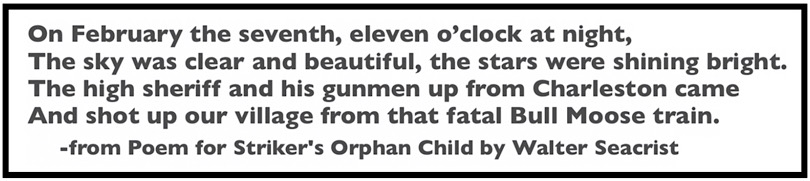
On February the seventh, eleven o’clock at night, The sky was clear and beautiful, the stars were shining bright. The high sheriff and his gunmen up from Charleston came And shot up our village from that fatal Bull Moose train.
My Daddy heard the shooting and rushed us from our bed And a few moments later he was found dead. While trying to get us to safety and find for us a place An explosive rifle bullet had torn away his face.
Don’t weep for me or Mother, although you might feel bad, Just try to help keep alive some other boy’s dad. And when we meet in heaven, on that golden strand, Then you can see my Daddy and clasp his blessed hand.
Hellraisers Journal – Friday June 20, 1913 Charleston, West Virginia – Senate Investigation to be Transferred to Washington
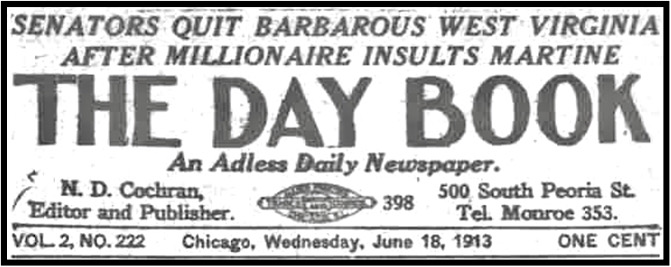
From the Chicago Day Book of June 18, 1913:
—–
Senate Committee to Investigate West Virginia’s Coal Mine War
—–
SENATORS QUIT BARBAROUS WEST VIRGINIA AFTER MILLIONAIRE INSULTS MARTINE
Charleston, W. June 18,-The United States senate investigation of the reign of terror imposed on the coal miners of West Virginia by Standard Oil has come to an almost unbelievable end.
A United States senator, one of the committee of investigation, was insulted openly yesterday by a Standard Oil capitalist
He was prevented from retaliating physically only by the strenuous efforts of another United States senator.
Now the members of the senate committee decline to stay on the ground and show that it does not pay to insult a senator of the United States in the discharge of his duty to the people.
The senate probe into the coal mine strike and the red sign of the mine guards is to be transferred to Washington immediately.
It is needless to say that the United States senator who was insulted yesterday was Martine of New Jersey.
The other members of the subcommittee that has been investigating the strike and the reign of the mine guards are Swanson and Kenyon. Swanson is a corporation man; Kenyon is a lawyer.
Martine is a farmer, and an honest man, and a human being. For which several reasons he tried to get the truth about the West Virginia situation, and on finding it, spoke his mind about it
The man who insulted him was Quinn Morton, millionaire coal mine owner, who used to ride on the armored train from which the mine guards devastated the villages of the miners and which the miners called the “Death Special.”
Here are the things that led up to Quinn Morton’s insult of yesterday:
Annie Hall, of Holly Grove, miner’s wife, had told the committee how the mine owners’ armored train, with all lights extinguished, had swept through Holly Grove on the night of February how she had got her children out of bed at the first sound of the mine owners’ machine guns and hidden them in the fireplace, before which she herself had taken her stand, and how, despite her precautions, she was shot in the foot by a stray bullet.
Other witnesses had told similar stories of this night of terror with an armored train, carrying two machine guns, swept through a sleeping village.
Tom L. Feltz, head of the Baldwin-Feltz detective agency, which supplied the mine owners with thugs, had testified that the machine guns used on the armored train were supplied to his men by the mine owners.
Lee Calvin, who formerly worked for the mine owners as a guard, but got sick of his job, had sworn that Quinn Morton, millionaire’ mine owner, was aboard the armored train the night the machine guns raked Holly Grove.
Calvin also had sworn that after the armored train, with all its lights extinguished, had swept through the little tent village of miners, Quinn Morton turned around to Sheriff Bonner Hill and told him to “turn back and give them another shot.”
“If it had not been for Sheriff Bonner Hill this would have been done,” said Calvin.
Calvin gave this testimony last Saturday night.
“God, what kind of a man is this Morton?” asked Senator Martine at the time, and the hired attorneys of the Standard Oil coal mine owners, cried aloud in protest
Morton himself then was called to the stand yesterday.
Senator Kenyon began questioning him, and Senator Kenyon, being a lawyer, was very gentle, with the witness.
But the memory of that darkened armored train sweeping through Holly Grove was rankling in Senator Martine’s mind.
SoMartine interrupted to ask whether Morton had countenanced the use of the machine guns on the armored train and what his opinion was of such “barbarous methods as shooting up tents occupied by women and children.”
Hellraisers Journal – Thursday June 19, 1913
Charleston, West Virginia – Summary of Testimony before Senate Committee
From The Omaha Daily News of June 18, 1913:
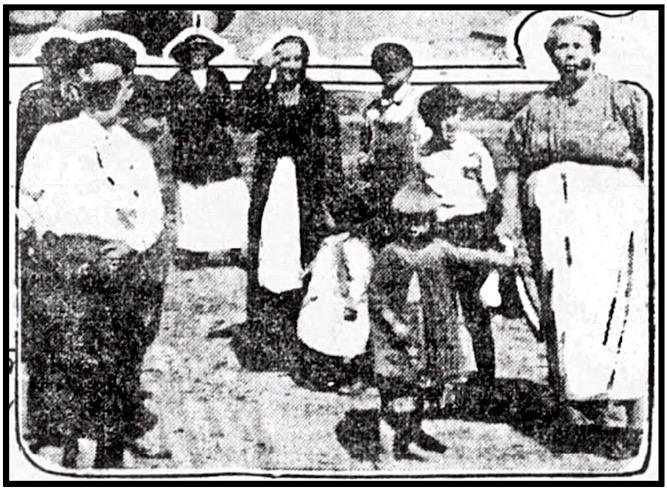
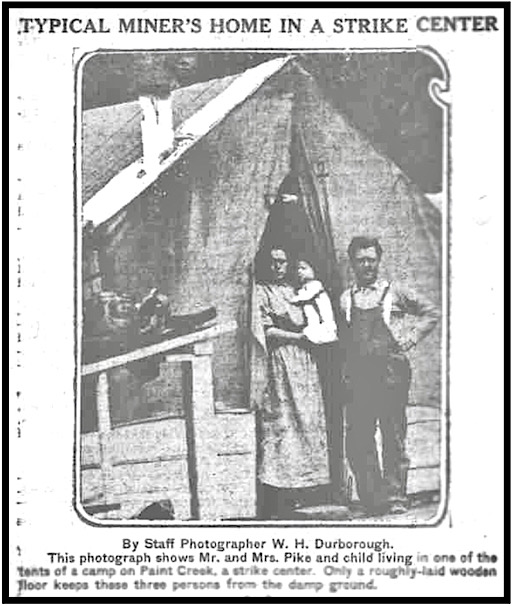
United States Senate Committee Taking Testimony in the Kanawha Hotel, Charleston, West VirginiaGroup of Paint Creek Coal Miners’ Wives and Children
Tuesday June 10, 1913
Charleston, West Virginia – First Session of the Senate Investigating Committee
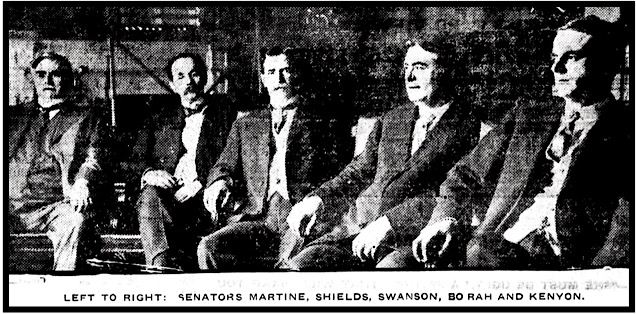
The Senate Investigating Committee began taking testimony this morning in Charleston. Five U.S. Senators make up this committee: Senator Swanson, the Chairman, and Senators Martine, Shields, Borah, and Kenyon. Together they are more formally known as the Subcommittee of the Committee on Education and Labor of the United States Senate. They are here to investigate conditions in the Paint Creek District of West Virginia. Also present were the attorneys representing the United Mine Workers and the coal operators. Bonner S. Hill, Sheriff of Kanawha County was also represented by counsel.
—————
Friday June 13, 1913, Afternoon Session Charleston, West Virginia – Testimony of Maud Estep, the widow of Francis Estep
Maud Estep was called as a witness before the Senate Investigating Committee. She was sworn in by Senator Kenyon. Mrs. Estep is the widow of Francis Estep, the striking miner who was shot down during the attack on the Holly Grove Strikers’ Colony last February.
This is a summary of her testimony:
She continues to reside at Holly Grove. Before the strike she lived on Cabin Creek and Acme. Her husband died on the 7th of February of this year. Her husband was shot by gunmen from the Bull-Moose Special as it passed by their house.
Well, he was shot from the train, I suppose; the train went up there, and they were shooting from the train at the house..Between 10 and 11 o’clock, some time; I don’t just exactly know what time; that was by my time.
At the time of the shooting, they were living in house across from the station, near the creek.
She describes the panic as shots were fired at the house:
He was in the house when the train commenced shooting down on the other side. We were all in the house sitting there carrying on and talking. We heard the train come shooting, and he hollered for us to go to the cellar, and he went out the front door – him and some more boys that were in there; they ran out of the front door, and I went through the kitchen way, and I never got any farther than the kitchen door; we were all trying to get to the cellar. He was standing right at the corner of the cellar near the kitchen door where I was standing hollering for me to go and get into the cellar. It was so dark that I could just see the bulk of him. It scared me so – and I had a little one in my arms – that I could not go any farther.His cousin was there on a visit, and after the train commenced shooting he took hold of me and told me not to fall, and about that time a shot struck him [the cousin] in the leg.
The cellar of the house was right off the ground. The house was elevated a few feet above the ground.
There had been a cellar under there, and it was torn down, and they were fixing it up, so if any trouble started I could go there.
She was pregnant at the time, and that baby is 2 months old now. The child that she was holding as her husband was shot will be 2 years old on the 16th of September.
The first thing we heard was shots from the train. I suppose it started from the train. It was away below our house. We live up above the first town where the station is…We heard [the train] after it commenced shooting. We had not heard it before. We had our doors closed.
She learns that her husband is dead:
I didn’t know he was killed until after the train quit shooting, and I heard some of them speak to him and call his name, and I never heard him answer…[His body was] right on the outside of the house, pretty near to the back corner of the house.
She has never been back to that house since the night her husband was killed.
Her husband did have gun, but she is unsure if he was holding it when he was shot.
Her husband’s last words:
The last I heard him he was hollering for me to go in and get in the cellar. Hessie Willis was in there with me, and me and her went out the back way, and he was standing there; I could just see him in the dark; I could just see the bulk of him in the dark, and he was saying: “You women get in right quick; get in the cellar.”
Hellraisers Journal – Wednesday June 18, 1913
Charleston, West Virginia – Wives of Miners Testify before Senate Committee
From the Chicago Day Book of June 17, 1913:
MOTHERS AND BABIES WERE VICTIMS OF THE WAR
IN THE KINGDOM OF WEST VIRGINIA
By Mary Boyle O’Reilly.
Charleston, W. June 17.-The laws of war among all civilized nations and most savage tribes prescribe the removal of all women and children from the peril of the firing line.
For a year West Virginia has been in a state of war, the war of the twentieth century struggle of workers and organized capital.
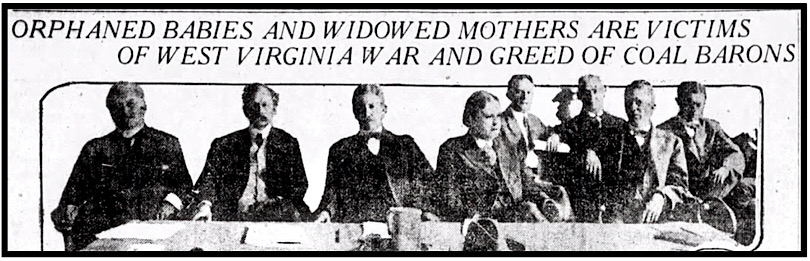
The U. S. Senate sub-committee on labor, now hearing testimony concerning the Paint Creek coal mine war, sits in a long, low banquet room in the Kanawha Hotel here. Pale blue walls without, decoration, cheap deal tables for the committee and the various counsel, indicate the grim business-like atmosphere of the place.
The room is crowded to suffocation with blue-shirted miners, standing, for once, shoulder to shoulder, with burly railway detectives and rat-faced mine guards whose hunched-up coats indicate the holsters holding loaded arms.
About the tables on either side gather the opposing counsel the sleek, tame solicitors of great coal corporations summery in pale gray and fawn-colored clothes; the half-dozen alert, coatless young lawyers of the United Mine Workers of America whose team-work under their chief, Judge Monnett, former attorney general of Ohio, is the one bright spot in the proceedings.
And at the committee table, facing the room, sit the senators-Martine, the living portrait of a cavalier, whose tongue is a rapier; Swanson, the senator long on corporation concern, but short on human sympathy, and Kenyon of Iowa, on whose calm judgment the troubled citizens of Kanawha county instinctively have their hope.
* * * * * * *
[Friday, June 13th, afternoon session:] The packed hearing room was insufferably hot. Long, familiar evidence dragged. A witness testifying of outrages perpetrated on unoffending strikers by the coal corporations mine-guards used the word, “Thugs.” A florid “company counsel” protested. A junior among the miners’ lawyers seemed to acquiesce. Then-
“Mrs. Parker,” he called.
“Mrs. Estep-Mrs. Seville.”
They came at once-three miners’ wives, typical women of the coal valleys, arid tidy and self-respecting, in heavy, long-sleeved shirtwaist belted with pleated alpaca skirts.
WE NEVER FORGET – Tuesday June 10, 1913 Ipswich, Massachusetts – Nicholetta Paudelopoulou, 27, Shot Down by Police on IWW Picket Line
New York Tribune June 12, 1913
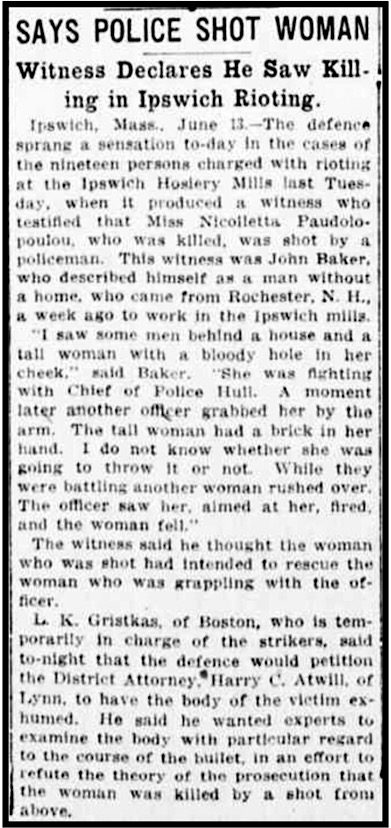
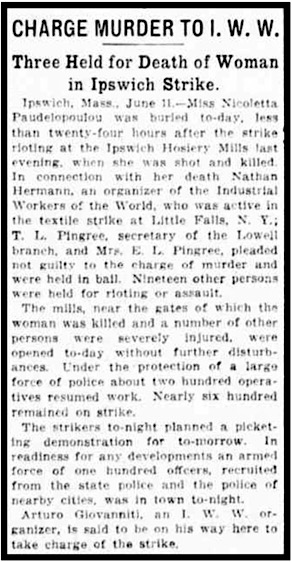
On Tuesday June 10, 1913 in Ipswich, Massachusetts, Nicholetta Paudelopoulou left Brown’s Essex Mill at the end of her work day and walked down the street to the Ipswich Hosiery Mill. Here she stopped to observe a picket line of I.W.W. strikers. The Industrial Workers of the World had been conducting a strike at this mill for seven weeks. Five hundred of the strikers were Italians, and one hundred were Greeks, perhaps friends of hers. Sadly, five hundred English-speaking workers had chosen to scab on their fellow workers.
Suddenly, the police opened fire on the picketers, wounding eight. They later gave the excuse that the “foreign” strikers were “jostling” the English-speaking strikebreakers. Seven of the wounded were taken to a hospital in Salem. Miss Paudelopoulou was shot in the top of the head. She was taken to a nearby doctor’s office where she died just before 8 PM without regaining consciousness.
Nicholetta Paudelopoulou was 27 years old. She was survived by her mother, six sisters and a brother in New York, and her father and brother-in-law in Greece.
—————-
From The Boston Globe of June 12, 1913:
Funeral of Miss Pandelopulos.
[…..]
New York Tribune June 14, 1913
The funeral of Miss Pandelopulos, the only victim of the engagement of last night, was held this afternoon. A large company of men and women of her race gathered in the tenement at 22½ Market st, where she lived with her mother, six sisters and a brother, at 3:30 for prayers. Subsequently, they followed the body to the Greek Orthodox Church on Agawam Heights, where the services were conducted by Rev. Paulikop Marinika.
The ritual was punctuated by the pitiful lamentations of the members of the family of the young woman. Later, at the grave in the Highland Cemetery, the burial service of the church was supplemented by demonstrations of grief by the sisters of the deceased, the rending of the fabric of their waists and the mutilation of their braided hair.
The dead woman had been the sole support of her mother, five sisters and brother. All but the youngest girls worked in the mills, and all save the girl now dead were on strike. The father is in Greece and the husband of one of the sisters is serving in the Grecian Army.
Nicolata Pandelopulos, when shot, was an innocent witness of the encounter between the police and her striking countrymen.
[Newsclip and emphasis added.]
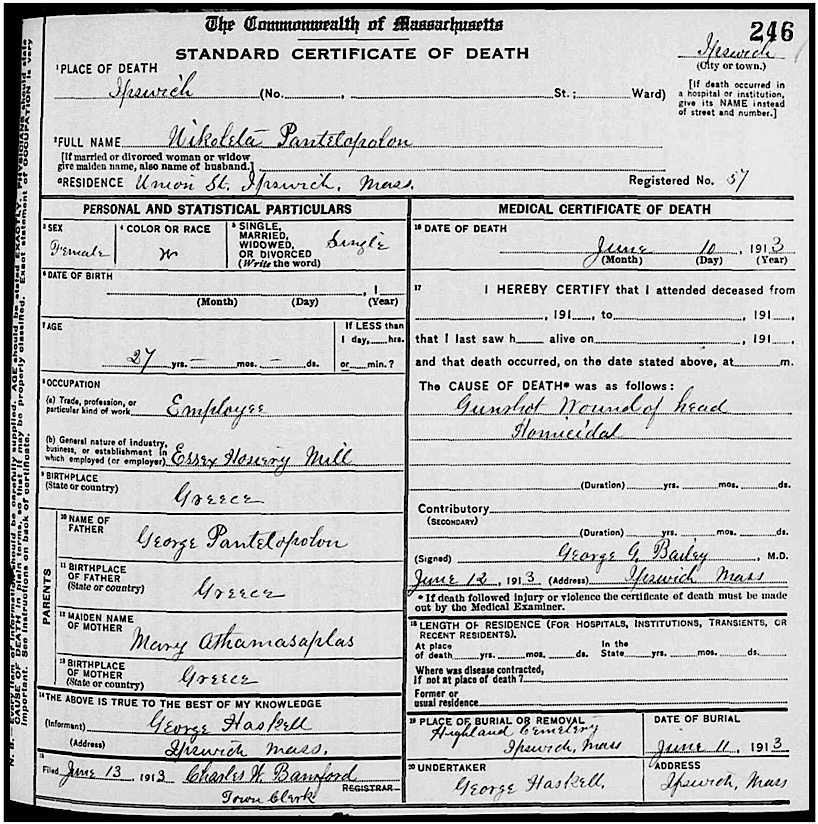
Massachusetts Death Certificate for Nikoleta Pantelopolou
Hellraisers Journal – Sunday June 15, 1913
Ipswich, Massachusetts – Police open fire on picket line, one woman killed.
On Tuesday, June 10th, police here opened fire on the strikers’ picket line at the Ipswich Hosiery Mill killing Nicholetta Paudelopoulou, 27, and wounding seven others. The wounded were taken to a hospital in Salem. Miss Paudelopoulou was taken to a nearby doctors office where she died of a bullet wound to the head.
Fifteen strikers were arrested, including the local leaders of the I.W.W.Nathan Hermann, I.W.W. organizer, Mr. E.L. Pingree, Secretary of the Lowell I.W.W., and Mrs. Pingree have been charged with inciting to riot resulting in murder. Thomas J. Halliday, National Secretary of the textile branch of the Industrial Workers of the World, has arrived to take charge of the strike.
The strike at the Ipswich mill has been on for the past seven weeks. At this time, 500 Italians and 100 Greeks remain on strike. Sadly, most of the 500 English-speaking workers have chosen to cross the picket line.
Hellraisers Journal – Saturday June 14, 1913
Paterson, New Jersey – Socialists Party Members Support Strike of Silk Weavers
From the International Socialist Review of June 1913:
What the Reds are Doing
in Paterson
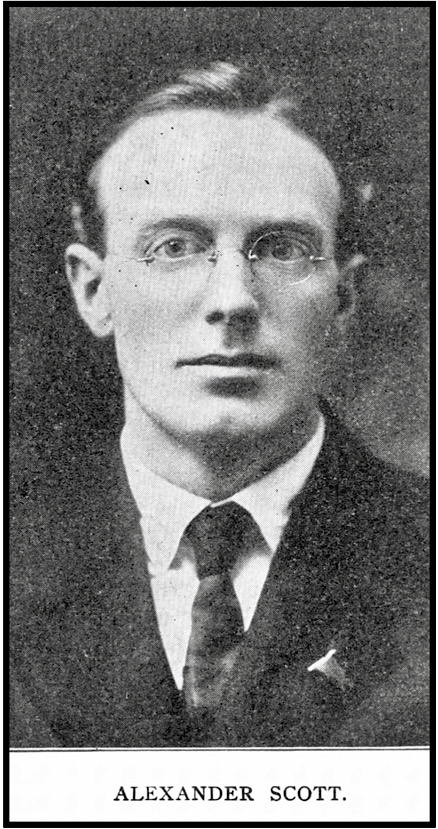
By Alexander Scott
Editor of The Weekly Issue, Socialist Party Paper of Passaic County.
THE Socialists of Paterson have from the beginning of the silk strike taken an active part and have performed real service for the strikers. How could they help doing so? The fight of the 25,000 silk workers, organized in the I. W. W., was their fight. A majority of the party members are themselves silk workers.
When the general strike was called, the Socialists rolled up their sleeves, ready for any emergency. No question arose as to whether the workers were being organized by the I. W. W., the A. F. of L., or S. L. P. That did not matter then.
Had the strike been called by the A. F. of L.-much as some of us might doubt the sincerity of the organizers of that organization, and dubious as we might be of the outcome of the strike-there is no doubt but that the Paterson Socialists would have as readily jumped into the fray. In fact, when a year or so ago, the Detroit faction of the I. W. W. (S. L. P.) attempted, or pretended to organize the textile workers of the Passaic county, the Socialist Party members assisted, and when it was seen that the workers had been defeated through petty political trickery, they just as readily denounced them as traitors to the working class.
In the present strike, the two arms of the revolutionary labor movement have worked in unison. The Industrial Workers of the World and the Socialist Party have demonstrated the tremendous power of their organizations when united to fight a common enemy. No force is powerful enough to overcome them.
It is the opinion of the writer that the strike would have been lost had we not all fought together, throwing the weight of our organization and press in with the I. W. W.
Let it here be understood that this article is not written with the purpose of showing the superiority of political action over direct action, but with the view of showing the necessity of both political and industrial union action in the struggle of the working class for emancipation.
The general strike was called for February 28. “Nip the strike in the bud,” ordered the mill owners.“Righto. At your service,” replied the city administration, the police, the press and some of the clergy.
The police gave orders that all halls be closed against the I. W. W., and got their clubs in readiness. The newspapers put their lying pens to work, and the clergy prepared sermons to suit the occasion. The strikers had already engaged Turn Hall as their headquarters, and the police had ordered this closed, too, and, moreover, intended to enforce the order by means of their clubs and guns, if necessary.
On the first day of the general strikea few hundred strikers filed out of Turn Hall and proceeded peacefully along the sidewalk in double file, when they were brutally attackedby a gang of blue-coated, brass-buttoned ruffians, headed by their Chief. Clubs were swung right and left, and no discrimination was made as to sex or age. One girl was struck and her cries could be heard two blocks distant.
“Well done!” said the silk bosses, and their editorial lackeys echoed, “Well done!” The bosses’ papers appeared with headlines announcing, “Rioting Strikers Suppressed by Timely Work of Chief of Police Bimson and his Squad of Men-Strike Being Nipped in the Bud.”

 —————
—————
 —————
————— —————
————— The Senate Investigating Committee began taking testimony this morning in Charleston. Five U.S. Senators make up this committee: Senator Swanson, the Chairman, and Senators Martine, Shields, Borah, and Kenyon. Together they are more formally known as the Subcommittee of the Committee on Education and Labor of the United States Senate. They are here to investigate conditions in the Paint Creek District of West Virginia. Also present were the attorneys representing the United Mine Workers and the coal operators. Bonner S. Hill, Sheriff of Kanawha County was also represented by counsel.
 —————
——————–
[…..]
 —————
—————

 —————
—————