Hellraisers Journal: International Socialist Review: The Conviction of Alexander Scott, Editor of the Weekly Issue of Passaic Co.

Share

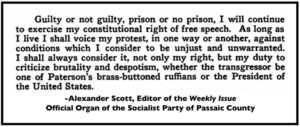
Quote Alexander Scott re Conviction n Free Speech, ISR p11, July 913—————-

Hellraisers Journal – Thursday July 3, 1913
The Conviction of  Alexander Scott, Editor of the Weekly Issue

From the International Socialist Review of July 1913:

The Conviction of Alexander Scott

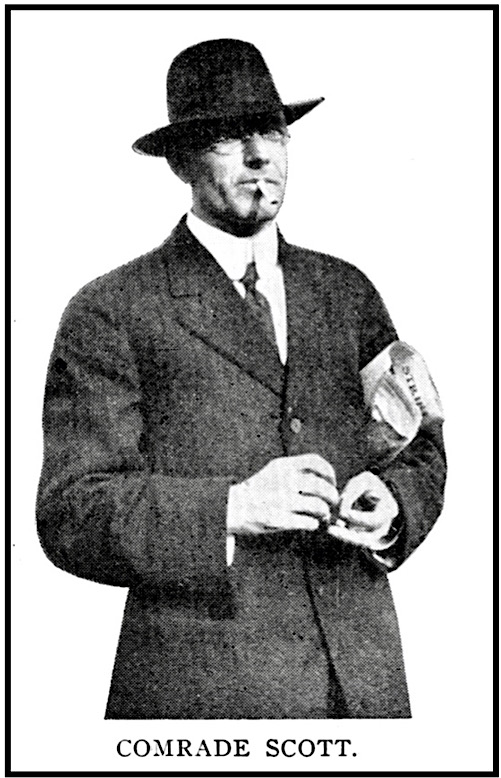
Alexander Scott, ISR p10, July 1913

A STATES Prison sentence of not more than fifteen years nor less than one year, with a fine of $250, was imposed, June 6th, on Alexander Scott, editor of the Weekly Issue, official organ of the Socialist party of Passaic County, who was convicted on June 3rd on a charge of “aiding and abetting hostilities to the government of the City of Paterson,” by Judge Klenert in the Court of Quarter Sessions.

No sooner was sentence announced when Henry Carless, a Socialist attorney of Newark, and Henry Marelli, both of whom defended Scott, filed notice that a writ of error had been applied for, a copy of which notice was presented to the judge. Bail of $3,000 was fixed and Scott was later released when Samuel Ginsburg, of Passaic, furnished the bond.

Scott was found guilty and sentenced under a law placed on the statute books in 1902 shortly after the assassination of President McKinley, but never before invoked in the State of New Jersey. Scott’s indictment was caused by the publication of editorials and pictures in the Issue in which the police, especially Chief Bimson, was characterized as the “boss anarchist” and the “boss strike-breaker.”

Scott’s conviction practically makes it a crime for any paper to criticize public officials, and makes the constitutional guarantee of free press a dead letter. In the prosecution of the case the state contended that the police were a part of the city government and that ridiculing the police was ridiculing the government.

“If we can’t criticize a policeman for his brutality, we might as well give up publication of newspapers in this country,” remarked a prominent newspaper man who was a visitor in court when sentence was imposed on Scott. He was highly indignant over the sentence, and said he would start a nation-wide movement to have the Scott verdict reversed.

That the authorities of Paterson have made up their minds to suppress the Issue was evidenced by the fact that they forced the sentence of Scott as soon as he was convicted. Though Patrick L. Quinlan, the silk strike leader, was convicted several weeks ago, the authorities made no move to sentence him, but they hurried the sentence of Scott.

While Scott’s case was rushed through, the authorities have made no move to prosecute the policemen who stole an edition of the Issue by breaking in the Socialist party headquarters and taking possession of 5,000 copies of the paper. The policemen are now out on $200 bail each, while Scott’s bail is fixed at $3,000.-N. Y. Call.

While the lawyers were arguing over technicalities, Scott, unconcerned, was busily engaged noting the proceedings in a notebook. “I am in the fight to win, and I am confident of exoneration in the higher courts,” said Scott. “They cannot suppress the Issue”

But the Socialists and Industrial unionists do not propose that Scott should serve one month in prison if they can help it. The S. P. of New Jersey, will appeal to the National Socialist Party to take up the Scott case and make a nation-wide fight in his behalf.

Solidarity, the I. W. W. organ has issued a call for protest meetings. “Scott has stood by the I. W. W. and the I. W. W. must stand by him,” writes Justus Ebert.
Continue reading “Hellraisers Journal: International Socialist Review: The Conviction of Alexander Scott, Editor of the Weekly Issue of Passaic Co.” →

Hellraisers Journal: From the International Socialist Review: “The Paterson Strike Pageant” by Phillips Russell, Part II

Share

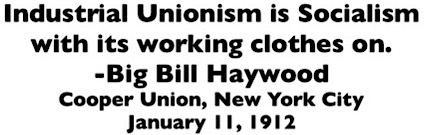
Quote BBH, IU Socialism w Working Clothes On, NYC Cooper Union Debate w Hillquit, Jan 11, 1912

—————-

Hellraisers Journal – Wednesday July 2, 1913
“The Paterson Strike Pageant” by Phillips Russell, Part II

From the International Socialist Review of July 1913:

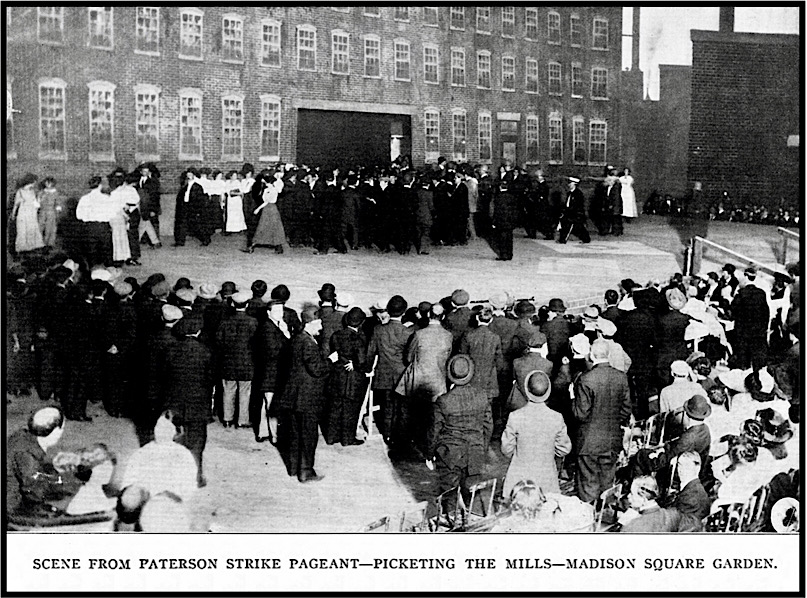
HdLn Paterson Pageant by P Russell, ISR p7, July 1913Scene fr Paterson Pageant, ISR p6, July 1913

[Part II of II]

The New York Press the next day said:

“The Garden has held many shows and many audiences, from Dowie to Taft to Buffalo Bill, but it is doubtful if there ever was such an assemblage either as an audience or as a show as was gathered under the huge rafters last night. In fact, it was a mixed grouping that at times they converged and actor became auditor and auditor turned suddently into actor. When more than 10,000 sang and shouted within, 5,000 outside clamored for admittance and were willing to pay double the prices to get in.”

The New York Evening World said:

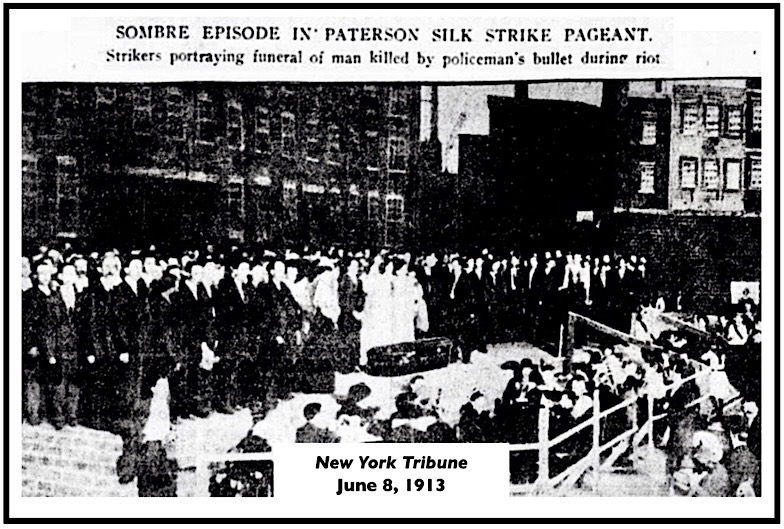
“Fifteen thousand specators applauded with shouts and tears the great Paterson Strike Pageant at Madison Square Garden. The big mill aglow with light in the dark hours of early winter morning, the shrieking whistles, the din of machinery-dying away to give place to the Marseillaise sung by a surging crowd of 1,200 operatives, the fierce battle with the police, the sombre funeral of the victim, the impassioned speech of the agitator, the sending away of the children, the great meeting of desperate hollow-eyed strikers-these scenes unrolled with a poignant realism that no man who saw them will ever forget.”

No spectacle enacted in New York has ever made such an impression. Not the most sanguine member of the committee which made the preparations for the pageant believed that its success would be quite so overwhelming. It is still the talk of New York, most cynical and hardened of cities, and will remain so for many days.

There were times when the committee were assailed with oppressive doubts. When one sat down and thought it over in cold blood, the idea of arranging for and carrying through such a thing in two weeks’ time seemed almost grotesque. Outside of the mechanical difficulties involved, the multitudinous details to be attended to, the advance outlay of money that would be necessary seemed to present an insuperable obstacle. There was the single item of $1,000 to be put down for the rental of one night, the $750 needed for scenery, the huge sum for advertising, all to be provided.

After plunging in with enthusiasm for the first few days, a bad reaction seized the promoters. They called a meeting in which the most gloomy forebodings were indulged in. There were disturbing reports of the small advance sale of tickets and there were serious proposals to give the whole thing up.

It was the workers themselves who stepped into the breach. Delegates from the New York silk strikers, whose cause has almost been lost sight of in the more spectacular struggle of Paterson, arose indignantly.

“What?” they cried. “Give this thing up after our people have set their hearts upon it? Never! Is it money you need? Leave it to us-we’ll raise that! We are poor. We are on strike. But a lot of us still have a few dollars left in the savings bank that we’ve been putting by through many years. We’ll get it out and lump it together. We will go to our business men and say: ‘Here, we’ve been trading with you a long time. We have helped to make your profits. Now you help us or we won’t trade with you any more.’ Never mind. You leave it to us-we will raise the money.”

And they did. Other generous people, more richly upholstered with ready cash, also came forward with contributions and in four days there was ample money with which to cover all deposits.

And it was found that the result was worth all the toil and trouble involved. The lives of most of us are sordid and grey. So tightly are we tied to the petty round of toil to which our galley-masters bind us, that most of us probably are born, live and die without experiencing one deep-springing, surging, devastating emotion. We are either afraid to feel or we have lost the capacity.

The Paterson pageant will be remembered for the sweeping emotions it shot through the atmosphere if for no other reason. Waves of almost painful emotion swept over that great audience as the summer wind converts a placid field of wheat into billowing waves. It was all real, living, and vital to them. There were veterans of many an industrial battle in that audience, though the cheeks of many still held the pink of youth.

Continue reading “Hellraisers Journal: From the International Socialist Review: “The Paterson Strike Pageant” by Phillips Russell, Part II” →

Hellraisers Journal: From the International Socialist Review: “The Paterson Strike Pageant” by Phillips Russell, Part I

Share

Quote BBH, IU Socialism w Working Clothes On, NYC Cooper Union Debate w Hillquit, Jan 11, 1912—————

Hellraisers Journal – Tuesday July 1, 1913
“The Paterson Strike Pageant” by Phillips Russell, Part I

From the International Socialist Review of July 1913:

HdLn Paterson Pageant by P Russell, ISR p7, July 1913Scene fr Paterson Pageant, ISR p6, July 1913

[Part I of II]

JUNE 7, 1913, was a red letter day in New York. Literally, too. For when dusk fell on Madison Square, high up on the tower of Madison Square Garden, shone the giant letters “I. W. W.,” glowing red in the sky and sending scarlet beams through the smoke that drifts incessantly across the face of Manhattan Island.

It was the first time that those significant letters have ever been given so conspicuous a place. Their mission was to announce something new under the sun, a labor play in which laborers themselves were the actors, managers and sole proprietors, portraying by word and movement their own struggle for a better world. 

Imagine a great auditorium, the largest in New York, filled with one of the hughest audiences that ever gathered in the metropolis, gazing on the largest amateur production ever staged, with the biggest cast-1,029 members-that ever took part in a play, enacting a life-drama calculated to raise to the highest pitch the most powerful human emotions-and one gets a faint idea of the event in Madison Square Garden on the evening of June 7.

In order to give the reader a mental picture of what happened that night on the stage-which alone cost $600 to build -it might be well to outline the six episodes composing the pageant as given in the official program, which itself made a good propaganda pamphlet of 32 pages with a lithographed cover:

Scene: Paterson, N.J. Time: A. D. 1913.

The Pageant represents a battle between the working class and the capitalist class conducted by the Industrial Workers of the World (I. W. W.), making use of the general strike as the chief weapon. It is a conflict between two social forces-the force of labor and the force of capital.

While the workers are clubbed and shot by detectives and policemen, the mills remain dead. While the workers are sent to jail by hundreds, the mills remain dead. While organizers are persecuted, the strike continues, and still the mills are dead. While the pulpit thunders denunciation and the press screams lies, the mills remain dead. No violence can make the mills alive-no legal process can resurrect them from the dead. Bayonets and clubs, injunctions and court orders are equally futile.

Only the return of the workers to the mills can give the dead things life. The mills remain dead throughout the enactment of the following episodes.

Continue reading “Hellraisers Journal: From the International Socialist Review: “The Paterson Strike Pageant” by Phillips Russell, Part I” →

Hellraisers Journal: From Solidarity: Hunger Wolf Menaces 25,000 Paterson Silk Strikers; Relief Committee Appeals for Aid

Share

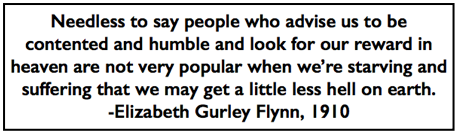
Quote EGF, Heaven n Hell, ISR p617, Jan 1910—————

Hellraisers Journal – Monday June 30, 1913
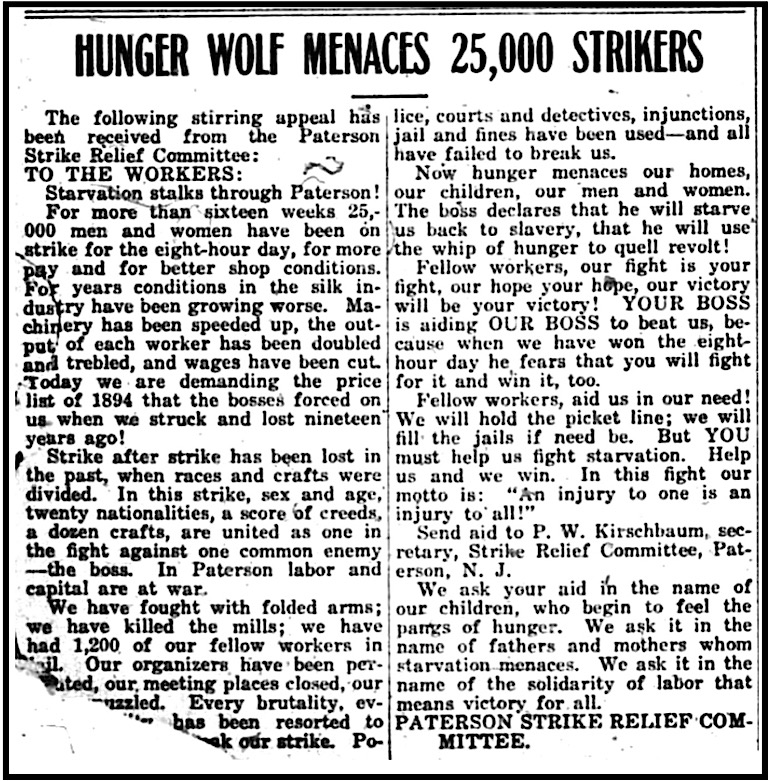
Paterson, New Jersey – Hunger, the Great Strike Breaker, Menaces Silk Strikers

From Solidarity of June 28, 1913:

Paterson Silk Strikers Starving, Sol p1, June 28, 1913

Continue reading “Hellraisers Journal: From Solidarity: Hunger Wolf Menaces 25,000 Paterson Silk Strikers; Relief Committee Appeals for Aid” →

Hellraisers Journal: Mother Jones Leads Parade of Tender Babes in Philadelphia; Speech Heartens Textile Strikers

Share

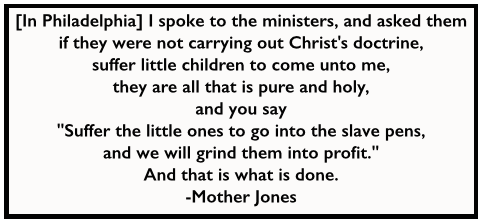
Mother Jones Quote ed, Suffer Little Children, CIR p10641, May 14, 1915—————

Hellraisers Journal – Monday June 29, 1903
Mother Jones Speaks to Philadelphia Textile Strikers

From the Duluth Labor World of June 27, 1903:

TENDER BABES IN LARGE PARADE.
———-

BURNING DISGRACE OF PENNSYLVANIA
MANUFACTURERS.
———-

TEXTILE WORKERS FIRM FOR 55 HOURS.
———-
Mother Jones Makes Many Impassioned Speeches
and Heartens Her Hearers.

———-

Mother Jones Leads Child Workers in March to City Hall, Phl Iq p2, June 18, 1903

Philadelphia, June 26.- The events of the week here, in the textile strike, were the speeches of “Mother” Jones to crowds and the parade of the men, women and children who are heroically striving for a shorter work-day. In one day Mother Jones addressed three large meetings of textile workers, and she did much to put heart into the movement and cheer the men and women engaged in the struggle. Her impassioned addresses are just what these workers need. They hang on to her sentences, and one cannot listen to a group of strikers without hearing her terse sentences repeated.

To Strike is Honorable.

[She told them in one of her speeches:]

Americans are strikers by inheritance. The Pilgrim Fathers and the Colonists were strikers. George Washington and Thomas Jefferson were the great strikers of their day, and you workingmen and women of Philadelphia need not be ashamed to strive and struggle for what is yours by right, and what must be won by you if you expect to be worthy of the inheritance handed down by your fathers.

[She continued:]

This is a city of “Brotherly Love,” indeed. There’s a whole lot of that here. Rather, it’s a city of brotherly thieves! Yes; I came here to hammer you, and I am going to do it. It serves you right that you are on strike today to get a reduction in your working hours. You elect the same old crowd year after year.

I sat in the Senate Chamber in Washington not long ago, and in one hour seven bills were passed conferring still greater powers on railroad corporations. Compare that incident with the action of some of your own representatives when the poor miners went to them to see if they couldn’t do something for the cause of labor. You should have seen the looks of cold disdain with which they were treated. They were told plainly that it was no use for them to come there and were advised strongly to go back to work.

While 147,000 miners were strike in Pennsylvania and 40,000 in West Virginia the last Congress went into the pocket of the American workingman and took $45,000-think of it, $45,000-to defray the expenses of a six weeks’ tour of a prince around the country, just because he was of royal blood! How greatly Senators Quay and Penrose and all the rest of them venerate royal blood! Fifty thousand dollars offhand for the entertainment of a prince, but not a single piece of legislation that would be likely to better the condition of the American workingman.

But it’s your own fault. Whenever you get tired of these things you’ll remedy them.

Mother Jones closed by advising the strikers to remain idle until their demands had been granted.

[She said:]

You need not fear starvation. They thought to starve the miners out, but they didn’t succeed. You are going to have plenty to eat, even if you are on strike.

Thomas Fleming, chairman of the executive committee, who, with several other strike leaders, accompanied Mother Jones to Frankford, in introducing her referred to her as “the old lady.”

Mother Jones, in reply, said:

I am not so old that I do not expect to live long enough to see you and your wives and children live as free men should, not as slaves.

Parade of Striking Children.

The parade of the strikers, Wednesday, was an object lesson that will long be remembered by those who saw it. There may have been 25,000 in line, but this was not so remarkable as was the sight of regiment after regiment of little children, some of them so small that they had to be provided with conveyances, for they could not otherwise have been in the procession. All kinds of vehicles had been tendered from the stylish coupe to the common express wagon. Many of the poor little tots were not old enough to realize what all the excitement was about. They were the living representatives of a system so cruel and merciless that future generations will wonder what sort of beasts employers were in the beginning of the twentieth century that they could for a single moment allow their machinery to be manipulated by the wan and immature flesh of what were not much better than suckling babes.

Banners That Mean Something.

The transparencies carried were plentiful and appropriate. Many touched on the question of shorter hours and of child labor. One elderly man staggered along with a banner reading:

Let God’s curses dwell with employers or parents who consign
little children to the living death of factory life.

Continue reading “Hellraisers Journal: Mother Jones Leads Parade of Tender Babes in Philadelphia; Speech Heartens Textile Strikers” →

Hellraisers Journal: Chairman Frederick Boyd Reports: Pageant Yields Deficit of $1,996 Rather Than Profit of $6,000

Share

quote BBH Weave Cloth Bayonets, ISR p538—————

Hellraisers Journal – Saturday June 28, 1913
New York, New York – Frederick Boyd Issues Financial Report on Paterson Pageant

From The New York Times of June 25, 1913:

DEFICIT OF $1,996 FROM STRIKE SHOW

———-
Instead of Making Rumored $6,000 Profit,
Paterson I.W.W. Lost by Pageant at Garden.
———-

MANY LOANS STILL UNPAID
———-
But All Who Cannot Afford Loss Got Their Money
-Good Seats Sold for Almost Nothing.
———-

Scene from Paterson Pageant WNF, NY Tb p4, June 8, 1913

Despite the statements, made after the Paterson strike pageant in Madison Square Garden, that it would net $6,000 to the strike fund, the Executive Committee of the strike announced yesterday that when all expenses were paid there would be a deficit of $1,996.45.

The greater part of this is due to sympathizers who advanced money to help the show, but the committee says that the loans still unpaid were furnished by people in comfortable circumstances who could afford the loss, while the loans from actual strikers had been paid back already.

Frederick Sumner Boyd, Chairman of the Executive Committee, had a conference yesterday with Miss Jessie Ashley, a lawyer, of 27 Cedar Street, who was Treasurer of the Entertainment Committee, and others, and a statement of the receipts and expenditures was prepared to show the Paterson strikers where all the money went to. The Socialist Party has nothing to do with the Industrial Workers of the World, but individual Socialists are members of the I. W. W., and Miss Ashley is one of these.

In discussing yesterday’s criticisms of the managers of the pageant and the questions which had been asked as to what had become of the rumored $6,000 profit, she said it was outrageous to hint that there had been dishonesty on the part of the strike leaders, unless figures could be produced to show that there had been irregularities.

Frederick Sumner Boyd, after the conference in Miss Ashley office, said for the committee:

“Miss Ashley was the first treasurer of the pageant, but becoming tied up with other duties, Mrs. Florence Wise of the Women’s Trades Union League took her place. At first it looked as if the pageant would be a source of profit, when the expenses began to pile up, and we were uncertain of a paying audience, we began to be afraid of a breakdown. At one time we had practically decided to abandon the pageant, but as we had made contracts and had incurred expenses we should have to meet in any case, we decided to pull the entertainment through.

“We had to raise $3,000 for expenses, so we called a meeting of the entire committee and of five delegates of the New York silk strikers. We told them the entertainment could not be brought off-but the delegates insisted that it must be. It was decided to raise the $3,000, and within twenty-four hours John Steiger brought in $1,600 and Miss Mabel Dodge collected $600. About $1,000 more was raised from various sources. Then we went ahead.”

Boyd then went on to explain the deficit, he said that neither Haywood, Reed, Miss Dodge, or others associated with them directly had anything to do with handling the money, except to sell a few tickets.….

[Newsclip and emphasis added.]

Continue reading “Hellraisers Journal: Chairman Frederick Boyd Reports: Pageant Yields Deficit of $1,996 Rather Than Profit of $6,000” →

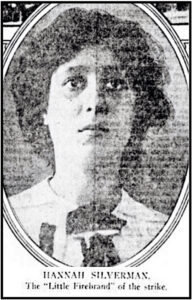
Hellraisers Journal: Hannah Silverman, “The Firebrand” of the Paterson Silk Strike, Receives Stern Warning from Judge Klenert

Share

—————-

Hellraisers Journal – Friday June 27, 1913
Paterson, New Jersey – Hannah Silverman Threatened by Judge Klenert

From The New York Times of June 21, 1913:

Hannah Silverman, Paterson Firebrand, NY Tb p4, June 8, 1913

The thirty-one strikers who were convicted of unlawful assemblage a few weeks ago appeared before Judge Klenert to-day. Each was sentenced to three months in the County Jail at hard labor, and then sentence was suspended during good behavior. Judge Klenert advised each of the defendants that he was at liberty to leave the country if he did not like its laws. When the case of Hannah Silvermann, the seventeen-year-old girl, who was styled the Joan d’Arc of the silk strike by Elizabeth Gurley Flynn, was called, Judge Klenert addressed her separately, advising her that her conduct had caused great sorrow to her parents. Because of her youth, he said, he would excuse her this time. If she offended again, the Judge warned her, she would be sent to the State Home for Girls at Trenton.

[Photograph and emphasis added.]

Continue reading “Hellraisers Journal: Hannah Silverman, “The Firebrand” of the Paterson Silk Strike, Receives Stern Warning from Judge Klenert” →

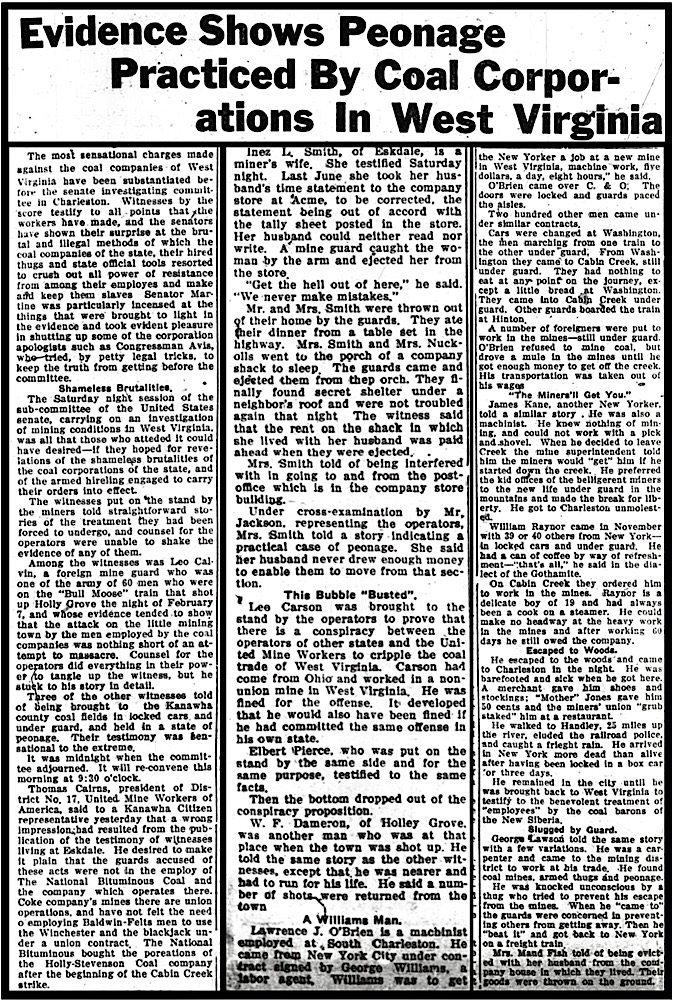
Hellraisers Journal: The Wheeling Majority: “Evidence Shows Peonage Practiced by Coal Corporations in West Virginia”

Share

Quote Mother Jones, Powers of Privilege ed, Ab Chp III—————

Hellraisers Journal – Thursday June 26, 1913
Charleston, West Virginia – Testimony Before Senate Committee Reveals Peonage

From The Wheeling Majority of June 19, 1913:

Continue reading “Hellraisers Journal: The Wheeling Majority: “Evidence Shows Peonage Practiced by Coal Corporations in West Virginia”” →

Hellraisers Journal: Textile Strikers of Philadelphia Gather for All-Day Picnic at Central Park; Mother Jones Speaks

Share

Quote Mother Jones, Child Labor Silk Mills, WB Dly Ns p1, May 11, 1901—————

Hellraisers Journal – Thursday June 25, 1903
Philadelphia, Pennsylvania – Mother Jones Speaks to Textile Strikers at Central Park

From The Philadelphia Inquirer of June 23, 1903:

Mother Jones Speaks to Philly Textile Strikers, Phl Iq p2, June 23, 1903

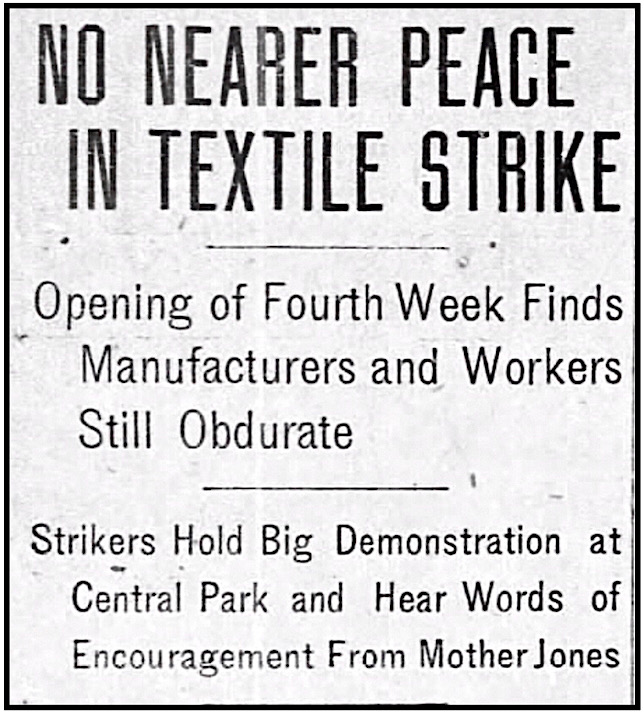
The opening of the fourth week of the big textile strike yesterday found no change in the conditions that have prevailed since June 1. From all sections of the city it was reported that the workers are still out in force, and there is every reason to believe that their ranks will remain unbroken until ordered back to the mills by the strike leaders.

The idle mill hands journeyed from all parts of the city yesterday to attend the all-day picnic and demonstration at Central Park, Fifth and Wyoming streets. More than a thousand of the strikers met at the headquarters of the executive committee, Kensington avenue and street, shortly after 9 o’clock in the morning and paraded to the picnic grounds. They carried banners and American flags, and as they marched up Fifth street to the park their ranks were almost doubled by the strikers dropping in line at various points. More than 5000 of the idle workers reached the park by noon, and when the mass meeting was opened in the afternoon it was difficult for all present to hear the speakers.

Mother Jones Gave Surprise

Thomas Fleming, chairman of the executive committee, was the first speaker, and announced that Mother Jones would not be present, as she had not yet returned from the coal regions. When the picturesque leader appeared at the park a few minutes later, however, she was given an ovation greater than any she has yet received since her arrival in the city.

The picnic lasted all day and the various unions played match base ball games. In addition to Mother Jones addresses were also made by F. Devlin, president of the Burlers and Menders’ Union, and D. L. Mulford.

The continuance of the strike has brought many Kensington families face to face with poverty and starvation. Although the unions are looking after their members many of the strikers are poorly organized and are dependent upon Ways and Means Committee of the Central Textile Union for support. The latter is greatly in need of funds, and the following appeal was issued yesterday:

The Ways and Means Committee, which is providing relief for the textile strikers who are in need, has had collectors in the field for more than a week, and although the response has been generous, still the amount of money received has barely exceeded the applications sent in. Therefore the Ways And Means Committee has decided to make a general appeal to the public of Philadelphia and vicinity.

There are upwards of 80,000 wage earners now idle in this city. A large proportion of these people are well organized and the various unions are taking care of them. But there are also a great number who have been recently organized and who have no funds in their treasuries, consequently they are unable to make any provision for their members. The various branches of the industry in which these recently organized people are employed are dependent upon the older organized branches, therefore when they stopped work the entire trade was at a standstill. Donations of any kind, either money, groceries or provisions, will be gratefully received by the Ways and Means Committee at the northeast corner of Third and Somerset streets.

JOHN J. PALMER,
Secretary and Treasurer.

Continue reading “Hellraisers Journal: Textile Strikers of Philadelphia Gather for All-Day Picnic at Central Park; Mother Jones Speaks” →

Hellraisers Journal: Philadelphia Textile Strikers March to City Hall with Child Workers in the Lead; Mother Jones Speaks

Share

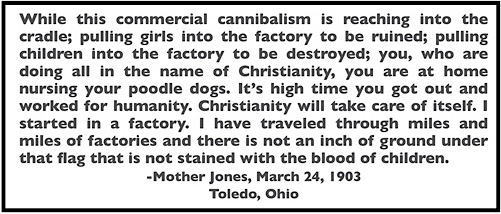
Quote Mother Jones, Blood of Children n Christian Society Women, Toledo Mar 24, 1903—————

Hellraisers Journal – Wednesday June 24, 1903
Philadelphia, Pennsylvania – Textile Strikers March to City Hall

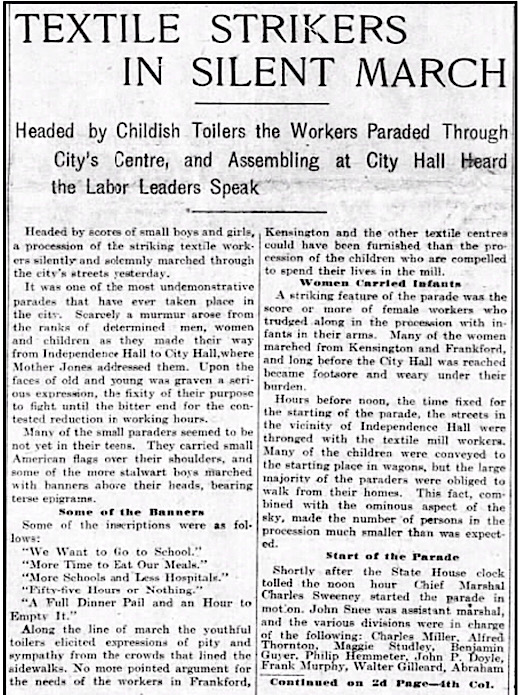
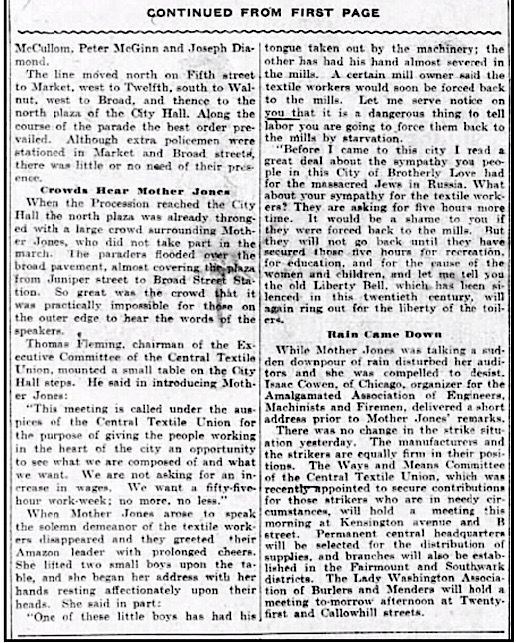
From The Philadelphia Inquirer of June 18, 1903:

Continue reading “Hellraisers Journal: Philadelphia Textile Strikers March to City Hall with Child Workers in the Lead; Mother Jones Speaks” →