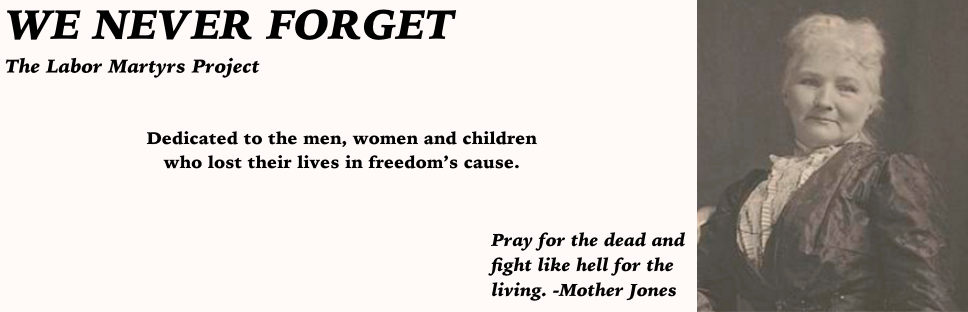

Thursday June 1, 1905
From the Montana News: “Dates for Tour of Mother Jones Rapidly Being Filled”
Hellraisers Journal: Mother Jones to WFM: “Awaken the slumbering giant from his long dream of ages.”
Thursday June 1, 1905
From the Montana News: “Dates for Tour of Mother Jones Rapidly Being Filled”

SOCIALIST NEWS FROM STATE HEADQUARTERS. Dates for Mother Jones are rapidly being filled; any local wishing a date, and have not applied for same, had better do so at once if they do not wish to be disappointed.
From the Montana News
of May 31st:
SOCIALIST NEWS FROM STATE HEADQUARTERS. Dates for Mother Jones are as follows; Red Lodge May 30, Billings May 31, Livingston June1, Fridley June 2, Aldridge June 3, Chestnut June 5, Bozeman June 6, Butte June 7 other dates will be announced later.
Exactly when she plans to arrive in Montana, we do not know, but on May 29th, we do know that Mother was in Wyoming for she sent this greeting to the Western Federations of Miners, now in convention in Salt Lake City:
Dietz, Wyoming,
May 29, 1905
Convention Hall, Salt Lake
To the brave officers and miners in convention, greeting. May your deliberations awaken the slumbering giant from his long dream of ages.
Mother Jones
From The Salt Lake Tribune of June 1, 1905:
MINERS FAVOR A NEW MOVE
—–
Surprise Manifested at the Vote.
—–
Federation Is Committed
to Industrial Union Movement.
—–
Vote on the Crucial Resolution
Was Not Unanimous by Any Means.
—–By far the most important action that is likely to be taken by the Western Federation of Miners at its national convention was the adoption of a resolution yesterday committing the federation to the industrial union movement. From the beginning there has been no serious question that the movement would be indorsed. It has only been a question of the majority. The showing of opposition was something of a surprise to those who have believed the federation to be practically unanimous.
Vote a Surprise. The vote on the crucial resolution was 175 1/2 for and 49 1/2 against. But the “nay” vote will give more comfort to the defenders of old-fashioned craft unionism than it should. It did not, in a great many instances, signify opposition to the principle of industrial unionism, but merely indicated that the delegate voting objected to some technical feature of the manifesto calling for a meeting in Chicago June 7 [27], of the wording of the resolution.Message From Mother Jones. At the opening of the morning session, the following message was read from “Mother” Jones, the woman agitator and organizer, who visited Utah during the coal strike:
Deitz, Wyo., May 29, 1905.-Convention Hall, Salt Lake: To the brave officers and miners in convention, greeting. May your deliberations awaken the slumbering giant from his long dream of ages. Mother Jones.
Was Heartily Cheered. This communication was heartily cheered, but not more heartily than a message from Denver to the effect that the meeting held in the Coliseum by President Gompers of the American Federation of Labor was a frost, with only about 500 persons in attendance. This item of news was hailed as a straw showing the times to be ripe for the industrial organization plan.Voted on Section by Section. The industrial union resolution was voted on section by section. Section 2 was amended to read:Five delegates be elected from the floor, and they are hereby appointed as delegates to represent the W. F. M. in convention to be held in Chicago, June 27, 1905, for the purpose of forming the said industrial economic organization. That they be authorized to unite the W. F. M. as an integral part of the proposed industrial union in the industrial department, to which it logically belongs in the general plan of organization.
[…]This resolution was adopted in reply to certain charges that have been made against the Miners’ union from American Federation sources:
Replies to Charges. Wereas, It has been persistently rumored by the enemies of the Western Federation of Miners that this organization makes a practice of ignoring the union labor products of unions affiliated with the American Federation of Labor, andWhereas, It is a well-known fact that no other organization on the American continent makes a more vigorous and determined demand for the union label than the Western Federation of Miners and that many Eastern factories and unions composed of their employees owe their existence to this demand created by our members in the Rocky mountain and Pacific coast States, therefore be it
Resolved, That we denounce the above-mentioned rumors as false and untrue in every particular, and be it further
Resolved, That the thirteenth annual convention hereby renews its pledge for the future to all members of organized labor, regardless of national affiliation, the same continuous and insistent demand for union label products on the part of the members of the Western Federation of Miners that they have shown in the past.
—– [Photographs added.]


More from The Salt Lake Tribune:
Boom Haywood for Head New Organization
—–He Will Be Urged for President
of Industrial Union Soon to Be Launched.
—–In the judgment of the delegates to the national convention of the Western Federation of Miners W. D. Haywood is the right man to pit against Samuel Gompers in the struggle for supremacy in the labor world. Quite a boom has been started for Mr. Haywood as president of the Industrial union organization that is to be launched in Chicago June 27. His friends point to his record as a leader of the miners in their struggle with the Mine Owners’ association in Colorado and insist that no better head can be found for the new national body.
What Haywood Says. “You may say that I am not a candidate,” remarked Mr. Haywood last night. “This is not a movement for the purpose of making places for office seekers.”“Will you say that you would not accept the presidency of the new organization?”
“Just say that I am not a candidate. I can’t tell now how things will shape up, and so I prefer not to say any more.”
“Have you any choice as to the presidency of the Industrial union.”
“No. I have not. It is too early to talk about officers now. The first work we have on hand is to get the movement organized.”
Debs Is a Candidate. In addition to Mr. Haywood, Eugene V. Debs, the organizer of the American Railway union and twice the Socialist candidate for President of the United States, and Dan McDonald, president of the American Labor union, are spoken of as possible selections for the presidency of the new labor body.—– [Photographs added.]

SOURCES
Montana News
(Helena, Montana)
-May 24, 1905
http://www.newspapers.com/…
-May 31, 1905
http://www.newspapers.com/…
The Salt Lake Tribune
(Salt Lake City, Utah)
-June 1, 1905
http://www.newspapers.com/…
IMAGES
Socialist Party of America Button
http://www.marxists.org/…
WFM Seal, 1912 Convention Proceedings
https://books.google.com/…
Mother Jones, Appeal to Reason, Mar 11, 1905
http://www.newspapers.com/…
Big Bill Haywood, 1904
http://www.rebelgraphics.org/…
Debs for President,
Appeal to Reason, Oct 29, 1904
http://www.newspapers.com/…
See also:
DK search: Utah + quarantine + JayRaye
for more on Mother Jones in Utah
during coal strike mentioned above.
http://www.dailykos.com/…
The American Federationist, Volume 12, Issue 1
American Federation of Labor, 1905
https://books.google.com/…
AF of June 1905
https://books.google.com/…
Note: The link at “President Gompers” above leads to a speech given while
Gompers was in Denver in May of 1905. I could find no news coverage of a
speech given by Gompers at the Coliseum in Denver. With the approach of the Chicago
Convention of Industrial Unionist, Gompers became increasing shrill in his denunciation
of those planning to take part in founding the new industrial organization, as can be
found in the June 1905 edition of the American Federationist.
““““““““““““““““““““““““““““““““““““““““`
One Big Industrial Union – May Day Chorus of Asheville
PAINT ‘ER RED!
Come with us you workingmen and join the rebel band
Come you discontented ones and lend a helping hand
We march against the parasite to drive him from the land
With One Big Industrial Union
Chorus:
Hurrah! hurrah! we’re gonna paint ‘er red!
Hurrah! hurrah! The way is clear ahead!
We’re gaining shop democracy and liberty and bread
With One Big Industrial Union.
In factory and field and mine we gather in our might
We’re on the job and know the way to win our hardest fight
For the beacon that shall guide us out of darkness into light
Is One Big Industrial Union.
Come on you fellows, get in line, we’ll fill the boss with fears
Red’s the colour of our flag, it’s stained with blood and tears,
We’ll flout it in his ugly mug and raise our loudest cheers
For One Big Industrial Union.
“Slaves”, they call us, “working plugs”, inferior by birth
But when we hit their pocketbooks, we’ll spoil their smiles of mirth
We’ll stop their dirty dividends and drive them from the earth
With One Big Industrial Union.
We hate their rotten system more than any mortals do
Our aim is not to patch it up but build it all anew
And what we’ll have for government when finally we’re through
Is One Big Industrial Union.
-Ralph Chaplin/Elmer Rumbaugh
““““““““““““““““““““““““““““““““““““““`
Sunday June 4, 1905
From the Chicago Broad Ax: Race Rioting Erupts During Teamsters Strike
Hellraisers Journal: The Broad Ax: “Race Rioting in Chicago.”
We do not want to find fault with each other,
but to solidify our forces and say to each other:
“We must be together; our masters are joined together
and we must do the same thing.”
-Mother Jones
Sunday June 4, 1905
From the Chicago Broad Ax: Race Rioting Erupts During Teamsters Strike
From The Broad Ax of May 27, 1905:
RACE RIOTING IN CHICAGO
—–
The Police Without the Slightest Interference on Their Part
Permitted White Citizens to Erect a “Dead Line”
at 27th Street and Wentworth Avenue
For the Afro-Americans.
—–Last Saturday evening near 27th street and Princeton avenue, race riots broke out in dead earnest and they continued in and near that vicinity all that night, all day Sunday and Sunday night.It appears that shortly after 6 o’clock on Saturday evening, while John Williams, his brother George Williams, and several other colored men employed by the Peabody Coal Company, were passing 26th street and Princeton avenue, a crowd of real white gentlemen attacked them, and after they had knocked them down, beat and kicked them in the face, and otherwise mistreated them, John Williams drew his revolver and fired into the rioters, and the result was that Bernard Engstrani, one of the ring leaders of the mob was so severely wounded that he was taken to Wesley hospital where he passed on into the next world with all his imperfections resting on his head.
The remainder of Saturday evening crowds of half drunken white men experienced much pleasure in mobbing defenseless colored men, and in several instances the police throughout what is called the “Black District” made no effort to protect the colored people from the onslaughts of those composing the superior race.
On Sunday morning, a number of white citizens erected a “Dead Line” across 27th street and Wentworth avenue, for all Afro-Americans. They had signs painted in large black letters, which were fastened on either side of the rope: “Negroes not allowed to cross this Dead Line,” while that scene was being enacted, four or five stall-fed Policemen stood around and without the slightest interference on their part, they permitted the strike sympathizers and the race rioters to erect the “Dead Line” and by their silence and inactivity they encouraged crime and lawlessness.
Throughout the South Side and even on the West Side, on Sunday, innocent and law abiding colored people were assaulted, spat upon, dragged from street cars and beat into insensibility by the striking teamsters, and their followers. A regular pitched battle took place between the two races in and in front of Ludwig Lewi’s Saloon, 29th and Armour avenue, and before the riot ended Harry Bernstein, a bartender for Lewi, without any provocation whatever, according to many of the eye witnesses to the affray, shot and instantly killed a colored man by the name of James Gray.
In the meantime Robert Tinsley, a colored Policeman, reached the scene and began shooting at Bernstein one bullet struck him in the back, another hit him in the arm, breaking it and another wended its way into his groin. Officer Tinsley’s bravery prevented a crowd of furious colored men from tearing Bernstein into a thousand pieces, who at the same time completely wrecked the saloon, and as its owner, Ludwig Lewi, and his friend, Newton Johnson, were escaping from the rear of his saloon, they were sat upon and beat and stoned by the colored men.
Inspector P. J. Lavin, who is fair and liberal minded, justified the actions of officer Tinsley in shooting Bernstein, and Inspector Lavin has stated “that Tinsley’s life was in danger, and he only did his duty in attempting to quell the disturbance, and he cannot be blamed for the part he took in the fight.” Inspector Lavin deserves to be highly commended for standing by his brave colored officers.
At Root and State streets a mob of white gentlemen ran into Charles Sneed, a colored man who was employed by Mrs. C. Northrup, 4231 Prairie avenue. They knocked him down and beat and cut him in the face very badly, and a crowd of ruffin Sunday school boys played football with his blood stained hat. No arrests were made by the police.
Black Jack Taylor, a colored driver for the Peabody Coal Company, ran into three white gentlemen at 24th and Wentworth avenue. They ordered him to fall down on his knees but instead of doing so he pretended as though he would shoot them with his revolver. The three white gentlemen started on a dead run, and they ran into the outstretched arms of Policeman Kelly, who did not attempt to arrest them, but he lit out after Taylor, who did not have a gun when he was arrested by this supposed peace officer.
Thursday, Frank Flint, 2302 Dearborn street, a colored stationary fireman, was walking on Princeton avenue between 27th and 28th streets, minding his own business, and without the slightest warning a crowd of white gentlemen rushed upon him. They broke his nose, and several ribs, kicked him in the face, and on the head with their heavy boots, and fractured his skull. Mr. Flint, who was not a strike breaker, but a peaceable hard-working citizen, was conveyed to Provident Hospital, and no arrests were made by the Police.
The majority of the policemen in what is called the “Black District,” for some cause or other, think they have no higher mission to perform than to arrest all colored men with fire-arms and to permit white men to go heavily armed, so that they can beat up and shoot the colored people down like Jack Rabbits, and if this state of affairs continues to exist there will be serious trouble between the two races, and much blood-shed before the teamsters’ strike ends.
—– [Paragraph breaks and photograph added.]

SOURCE
The Broad Ax
(Chicago, Illinois)
-May 27, 1905
http://chroniclingamerica.loc.gov/…
IMAGE
The Broad Ax, Julius F. Taylor, editor
http://chroniclingamerica.loc.gov/…
““““““““““““““““““““““““““““““““““““““““`
The racist approach of the A. F. of L. leadership was expressed most sharply in their efforts to place the blame on the Negroes themselves for their lack of organization and in the Jim-Crow setup in the Federation. In September 1905, Gompers wrote in the American Federationist that organized labor desired no controversy with Negroes, “but if the colored man continues to lend himself to the work of tearing down what the white man has built up, a race hatred far worse than any ever known will result. Caucasian civilization will serve notice that its uplifting process is not to be interfered with in any way.” About the same time, he told a trade union gathering in St. Paul: “The Caucasians are not going to let their standard of living be destroyed by negroes, Chinamen, Japs or any others.”[…]
Actually, the whole issue of Negro strikebreaking was exaggerated by the A. F. of L. leaders as an excuse for their own failure to organize the Negro workers. Had these men spent half as much time informing the membership of the A. F. of L. of the heroic role Negroes played in the strike struggles, of the fact that in such viciously anti-union centers as West Virginia the membership of the United Mine Workers was predominantly Negro and that many of the Negro miners made desperate sacrifices to insure the success of the union, as they did in repeatedly declaiming against Negro strikebreaking, the American labor movement would have greatly benefitted. In many cases where white as well as Negro strikebreakers were used, the presence of Negroes was emphasized and exaggerated.
This was the case in Chicago in 1905 during the great teamsters’ strike. Of 5,800 strikebreakers used, it was estimated that 5,000 were white. And yet, although the white strikebreakers outnumbered the Negroes by more than 6 to 1, the A. F. of L. leaders singled out the Negroes for special abuse.
[Emphasis, paragraph break and photograph added.]

WE NEVER FORGET William Dodson William Clark Richard Clayton
History of the Labor Movement In the United States Vol. 3
The Policies and Practices of the American Federation of Labor 1900-1909
-by Philip S Foner
International Pub, 1964IMAGE
Samuel Gompers from the Oakland Tribune of May 17, 1905
http://www.newspapers.com/…
““““““““““““““““““““““““““““““““““““““““`
Solidarity Forever
-Angela Kelly & Troy Coman of UAW Local 898/Rawsonville
““““““““““““““““““““““““““““““““““““““`
Monday June 5, 1905
From the Chicago Broad Ax: Race Riots Are a Disgrace to the City
Hellraisers Journal: The Broad Ax: “Whose Race War Is It?”
We do not want to find fault with each other,
but to solidify our forces and say to each other:
“We must be together; our masters are joined together
and we must do the same thing.”
-Mother Jones
Monday June 5, 1905
From the Chicago Broad Ax: Race Riots Are a Disgrace to the City
From The Broad Ax of May 27th:
WHOSE RACE WAR IS IT? It is only in a figurative and exaggerated sense that there is any race war in Chicago. If the Negroes were as numerous here as they are in the south they would probably be treated worse than they are there, and we should have a race war in the literal sense, but at present all we have is a series of riots between whites and blacks, accompanied by murder, which are a disgrace to the city.It is possible that these disturbances have been occasioned by the Negroes who were brought to the city by the Employers’ Teaming association, but they were only the innocent occasion of them, just as the apostle Paul’s appearance in Ephesus was the occasion of the tumult involving the whole population. The Negroes came here to earn an honest living by honest work and they had just as much right to come to this city as President Roosevelt had.
Most of these Negroes were peaceable and went about their work in the most orderly and well-behaved manner possible. It was not until scores of them had been frightfully beaten and several of them murdered that they showed any pugnacity. If they have even now exhibited any riotous inclinations it is because they have been slugged, stabbed and shot into resentment by white men.
It follows that the blame of the so-called race war rests upon these white men and still more on the yellow newspapers of William R. Hearst, which have for several weeks past systematically incited them to violence. The white men referred to are the pickets and other members of the teamsters’ union and the means by which they have been incited to assault, beat and kill these honest workmen are hideous pictures, the shameless falsehoods and the reckless denunciations of Hearst’s newspapers.
Without justifying in the least any act of violence of which these colored teamsters may have been guilty, we must say that there is nothing surprising in their lawless attitude nor in the riotous excitement that prevailed last Sunday among the colored people of Armour avenue. It is exactly what might have been expected from two scurrilous newspapers whose circulation is chiefly among Negroes and among white people who are a much lower class than the Negroes, and the worst of Negroes at that.
The police department is entitled to great credit for the summary manner in which they put down the “race war” last Sunday, and we hope Mayor Dunne and Chief O’Neill will not feel hurt if we remark that it was in sharp contrast with the manner in which they utterly failed to put down the strike riots.
Our police force is always brave and effective except when it is opposed by the labor union rioters and murderers.-The Chicago Chronicle.
The Chronicle deserves the highest commendation for possessing the courage to speak the absolute truth in these exciting times, while racial prejudice is running very strong against all classes of colored people residing in this city.
In the majority of cases the whites are to blame themselves for the unlawful acts and crimes committed on the part of the Negroes. For since the beginning of the teamsters’ strike it has been impossible for any respectable colored man, woman or child to ride or walk in any section of the city without being grossly insulted and many times assaulted by that class of whites who claim to be educated and civilized.
In many instances the police have stood idly by and permitted the so-called better element of the whites to assault colored people-to drag them from the street cars-to beat them up and otherwise mistreat them, simply to furnish them with amusement, and as long as some of the police encourage lawlessness on the part of the whites respecting the colored people; the only wonder is that more Negroes do not commit acts of violence and arm themselves to protect their wives, their children and their lives.
Lastly, let the decent Afro-Americans from henceforth absolutely refuse to support in any manner, shape or form, such Negro-hating sheets and The Chicago American and The Chicago Tribune.
—–
The Broad Ax on the Role of Clarence Darrow:
Clarence S. Darrow Is Attorney For The Chicago American,
Mayor Edward F. Dunne, and the Striking Teamsters.Clarence S. Darrow, at the present time, is the one man in Chicago who is between the devil and the deep sea, for he is the attorney for the Chicago American and as such he is closer to William R. Hearst than any other living man and if he was inclined, he could change the policy or the course of the “Nigger” hating sheet and breeder of race riots, anarchy and lawlessness in the twinkling of an eye.As the attorney for Mayor Dunne, Mr. Darrow could advise him to adopt a more vigorous policy in dealing with the striking teamsters and the lawless element which are backing them up, and either crush out or end the strike at once, or call out the state troops to handle the strikers and to fill every man full of lead and powder who participates in race riots and other unlawful acts in connection with the strike.
And as the attorney for the striking teamsters and their leaders, he should advise them, that other people residing in this city, possess some rights which they should be taught to respect, even if it is necessary to resort to fire-arms in the hands of expert marksmen in order to shoot this idea into their heads.
If, Mr. Darrow is actuated by a high sense of honor, it ought to be perfectly apparent to him that he cannot successfully serve three separate and distinct masters at the same time, and if he wants to continue to represent the striking teamsters and The Chicago American, which should be spurned aside by all respectable colored people, then let him cut loose from Mayor Dunne.
—–

From the Duluth Labor World of June 3, 1905:
Hellraisers was pleased to find a voice from the labor movement which addressed the evils of race prejudice. However, we do feel that the violence perpetrated against the Afro-American strikebreakers, their families, and even their communities in Chicago should have been strongly condemned and in no uncertain terms. Hellraisers is against all strikebreaking under all circumstances. But violence against scabs is never justified.
We should never forget that once the strike is over, the scab becomes our fellow worker once more, and all of our efforts should then be directed toward reconciliation with and organization of those fellows workers.
RACE PREJUDICE. Among the many vexed questions which this nation has to face none is more prominent nor the solution thereof more vague or uncertain than is the race problem. This question is all the more serious owing to its complexity, involving, as it does, political, social and economic phases.The prejudice against the colored man in America-for it exists nowhere else-has two causes: the first of these is the former status of the negro as a slave, and of the white man as master. Slavery has ceased to exist and before the law all races are equal, yet the reluctance of the dominant class to receive on equality that class which it so recently held in bonds, and which has not yet emerged from its degradation, is as natural as it is unchristian. Time, bringing with it the culture of the individual, both black and white, alone can aid here. This cause includes the social and political aspects of the question.
The second occasion of prejudice against the negro is economic, and arises in the breast of the white wage-earner from the presence of the colored man as a competitor in the field of labor. All too frequently examples of this are seen as in the Chicago teamsters’ strike. Under the existing industrial system, which engenders a surfeit of labor, each additional competitor in the labor market, forced by necessity to offer his labor power for the bare price of sustenance, forces down the level of wages and becomes an embarrassment and menace to every other labor. This is particularly true of the negro, whose scale of living is generally lower than that of the white. As he can, and will work for less wages, so proportionately is the animosity of his white fellow worker kindled against him.
This latter occasion for prejudice can be removed by granting absolute economic equality for white and black, covering perfect uniformity not only in opportunities for labor and the admission of both races into trade unions on equal terms, but also in all those public services, such as education, transportation, entertainment, etc., which may be collectively rendered.
The other is more difficult. The drawing of social caste distinctions must be left to the private individual alone. The white man may gradually learn that, real as his feeling of repulsion for his black brother may be, it is a base and ignoble thing, an occasion not of pride but of shame. The negro must learn that no legal mandate can confer on him a standing or secure for him a consideration he has not as an individual fully earned and wholly merited. Even then he must accustom himself to denial, while still asserting with courage and persistence the justice of his claims.
—– [Paragraph break added.]

SOURCES
The Broad Ax
(Chicago, Illinois)
-May 27, 1905
http://chroniclingamerica.loc.gov/…
The Labor World
(Duluth, Minnesota)
-June 3, 1905
http://www.newspapers.com/…
IMAGE
Clarence Darrow
http://darrow.law.umn.edu/…
““““““““““““““““““““““““““““““““““““““““`
[Many requests are received at headquarters of the American Federation of Labor from men in the ranks of labor intensely interested in the study of the labor movement and the economic problem with which it deals. These inquiries also come frequently from professors, students, and others engaged in the study of the economic problem. Most of these requests for information are coupled with an inquiry as to the attitude of the American Federation of Labor. It is with the object of furnishing this information in the most concrete and public form that the following addresses and talks on labor are published.] TALKS ON LABOR.
—–
ADDRESSES AT ST. PAUL AND MINNEAPOLIS.
By Samuel Gompers.SURROUNDED on the stage by many of the most active of the leaders of the union movement, Samuel Gompers, president of the A. F. of L., made his bow on Wednesday [May 24th] evening at Mozart Hall before the St. Paul public. Among those present who are not identified with the movement of organized labor was Mayor Robert A. Smith, who was evidently much pleased with the address of President Gompers. He was quick to applaud every strong point made by the speaker throughout….
The speaker declared he was always ready to assert his patriotism on behalf of the colored man, saying: “‘Tis true that some white men have been angered at the introduction of black strike breakers. I have stood as a champion of the colored man and have sacrificed self and much of the movement that the colered man should get a chance. But the Caucasians are not going to let their standard of living be destroyed by negroes. Chinamen, Japs, or any others.”
Mr. Gompers said that the stories about the riot and bloodshed accompanying labor strikes reminded him of the moving pictures which had been presented to the audience that evening. The pictures themselves were but small, but when brought under the influence of the light played on them they were vastly increased in the proportion the various figures were made to assume. The boy and the girl took on the proportions of the man and woman, the man and woman were giants, and the cow was a hippopotamus. Such was an illustration of the light in which the daily press presented everything that might operate to the discredit of the union movement…
—Union Advocate, St. Paul, Minn.[…]
SPEAKS TO BIG AUDIENCE IN MINNEAPOLIS. Samuel Gompers, president of the A. F. of L., delivered a masterly address on the labor problem to over 2,500 people who crowded the big Auditorium. The address was a practical demonstration of the subject from a labor point of view.It was enlivened with witty sallies, and the attention of the audience was held by the speaker every moment throughout his discourse.
Mr. Gompers is a man of fine figure and striking appearance. Upon taking the stage, he is one who at once creates a favorable impression….
Attitude Toward Strikes. The speaker spoke of the right of organized labor to strike. He said that labor must be in a position to go to battle when war is forced upon it.Mr. Gompers spoke pointedly of the strike breaking in Chicago by negroes. He stated that organized labor desired no controversy with the negroes; “but,” he said, “if the colored man continues to lend himself to the work of tearing down what the white man has built up, a race hatred worse than any ever known before will result. Caucasian civilization will serve notice that its uplifting process is not to be interfered with in any such way.”…
-Minneapolis Journal, May 24.
Minneapolis Journal
(Minneapolis, Minnesota)
-May 25, 1905
(Source for date of St Paul speech.)
http://www.newspapers.com/…American Federationists
(Washington, DC)
-September 1905
https://books.google.com/…
“Talks on Labor” by S. Gompers
https://books.google.com/…
““““““““““““““““““““““““““““““““““““““““`
A Change Is Gonna Come, Sam Cooke
““““““““““““““““““““““““““““““““““““““`
Friday June 9, 1905
From the Montana News – Mother Jones to Speak at Miners Union Day Celebration
Hellraisers Journal: Mother Jones, Labor’s Joan of Arc, to Speak in Helena on Miners’ Union Day.
and the priests and the ministers were hammering me,
but I am alive yet,
I am still here, hammering them.
-Mother Jones
Friday June 9, 1905
From the Montana News – Mother Jones to Speak at Miners Union Day Celebration
The June 7th edition of the Montana News, the voice of the Socialist Party in that state, announced in a large headline across the front page that Mother Jones will be joining the miners and their families in Helena for a celebration of Miners Union Day:
Mother Jones at the Park 13th, Auditorium 14th
From the Butte Evening News: “Mother” Jones, whom the coal miners of the East lovingly call Joan of Arc, will arrive in Butte in time to speak Wednesday evening, June 7, at the Auditorium, under the auspices of the Mill & Smeltermen’s union, on industrial conditions. She will then leave for the eastern part of the state.
For Fifty Years. “Mother” Jones is 65 years of age, and for 50 years has been in the fight for betterment of industrial conditions, among the working class generally, and particularly the coal miners of the eastern states. Whenever the coal miners are on strike “Mother” Jones is sure to put in an appearance, striving to lead them on to victory. Her influence among them is second to none. The foreigner who does not understand English, nevertheless know of “Mother” Jones and her work, and with him hers is a name to conjure with.Deported by Peabody. During the strike in the southern coal fields of Colorado this gray-haired old woman was loaded in a boxcar and deported by the militia, acting under orders from Peabody and the mine owners.She does not work for pay. Money is a secondary consideration with her. When she lay sick in Trinidad and was told that she was about to die, she gave the savings of her life-time, amounting to about $500, to the Western Federation of Miners to carry on the Cripple Creek strike.
She began life among the coal mines and is said to have worked in the breakers when a mere child. There is nothing of the grandstand style about her speeches. She speaks with the simple earnestness of one who has given her whole life to a cause.
During the A. L. U. [A. R. U.?] strike she was a prominent figure and Debs has declared in public that she was one of the most active and unselfish soldiers in the ranks of unionism.
For the Children. The child-labor law of Pennsylvania owes its place on the statute books to the efforts of this old woman and she accomplished it in spite of opposition within her own ranks.“Mother” Jones is now engaged in the work of building up the industrial union movement which holds its convention in Chicago in June.
[Photograph added.]
More from the Montana News of June 7, 1905:
The report of the secretary of the Western Federation of Miners shows the organization to have a membership of 58,000. Of this number 9,906 were taken into the organization during the past year. It is expected that the proper steps will be taken during the national convention at Salt Lake which is being held this month for the organization to align with the new industrial union movement to be launched in Chicago in June.The W. F. of M., has three times in convention, declared for the principles of Socialism. What their alignment with the proposed Chicago Socialist union movement will amount to, can only be told by the future.
““` [Photograph and paragraph break added.]
 Father Hagerty
““`Comrades:-
I have to report that under date of April 15th, I sent a letter to Comrade Thomas J. Hagerty addressed Room No. 3 Haymarket building, Chicago, Ill., containing the following questions: 1. Are you a member of the Socialist Party? 2. If so, with what Local are you affiliated?
I believe the above letter executes your wishes as indicated by the motion passed at your recent meeting as follows: “That owing to the inquireis received, the National Secretary be instructed to inquire of Thomas J. Hagerty of what Local he is a member. Carried.”
Further I would inform you that, to date, I have not received an acknowledgment or reply to said letter.
J. MAHLON BARNES,
National Secretary.“““` The Social Democrat Herald of Milwaukee says: “If the preachers who prayed for justice in the Philadelphia gas steal had less cowardice, they would cease to throw the burden of such a clearly secular miscarriage of justice on their Creator, and come out boldly urging men to change the social system that is the procuring cause of this as well as the myriads of other wrongs and horrors and indecencies of our present civilization. But they are afraid to come out for Socialism. It is not yet ‘respectable’ enough. And, besides, their rich pew holders wouldn’t like it!”
From Pennsylvania’s Wilkes-Barre Record of June 7, 1905:

“Mother” Jones. New York Tribune: “Mother” Jones, in her incendiary talks to the Wyoming miners, is setting an example that may be urged with effect against the participation of women in public affairs. It would not be safe for any man to use such language in Wyoming, or elsewhere in the United States, and it ought not to be safe even for “Mother” Jones to use it.
It seems that the language objected to was used by Mother Jones in a speech given earlier this month in Sheridan, Wyoming. The San Francisco Call
of June 3rd reported on the speech as follows:
“MOTHER” JONES DECLARES PRESIDENT SHERIDAN, Wyo., June 2.-“Mother” Jones, a notorious agitator, in a speech in the City Hall advised the shooting of all officers of the law, not excepting President Roosevelt, who opposed the principles advocated by her and her associates. She spoke of President Roosevelt in a sneering manner at least a dozen times and deplored the fact that educational and property qualifications are required of voters in the various States.
SHOULD BE SHOT
—–
Notorious Agitator Makes an Anarchistic
Speech Before an Audience
in Sheridan, Wyoming.Intense feeling was aroused by her speech, her audience feeling that she overstepped all bounds in her tirade against officers of the law and especially against the President.
““`
SOURCES
Montana News
(Helena, Montana)
-June 7, 1905
http://www.newspapers.com/…
http://www.newspapers.com/…
http://www.newspapers.com/…
The Wilkes-Barre Record
(Wilkes-Barre, Pennsylvania)
-June 7, 1905
http://www.newspapers.com/…
The San Francisco Call
(San Francisco, California)
-June 3, 1905
http://www.newspapers.com/…
IMAGES
Mother Mary Harris Jones, Miners Angel
http://www.biography.com/…
Western Federation of Miners Button
http://www.nps.gov/…
Advertisement for Helena’s
Miners’ Union Day Celebration of 1905
http://www.newspapers.com/…
Father Thomas J Hagerty
http://www.iww.org/…
Mother Mary Harris Jones Standing
http://theadvocateonline.com/…
““““““““““““““““““““““““““““““““““““““““`
The Spirit of Mother Jones – Andy Irvine
Mother Jones, the Miners’ Angel must be treated with respect
She’s an old fashioned lady, and you never would suspect
That this gown and this bonnet would fill a rich man full of dread
“She’s the most dangerous woman in America,” they said.
-Andy Irvine
See Also:
Spirit of Mother Jones Festival July 2014
““““““““““““““““““““““““““““““““““““““`
Saturday June 10, 1905
Denver, Colorado – John O’Neill Reports on Convention of W. F. of M.
Hellraisers Journal: Western Federation of Miners to Send 5 Delegates to Industrial Union Convention
-Motto of the Western Federation of Miners
Saturday June 10, 1905
Denver, Colorado – John O’Neill Reports on Convention of W. F. of M.
From South Dakota’s Lead Daily Call of June 7th:
TO UNITE ALL WORKERS
—–
Leaders of the Western Federation of Miners
and their Plan
—– John O’Neill
“““““ Charles Moyer
“““““DENVER, June 7.-President Charles H. Moyer and Secretary William D. Haywood of the Western Federation of Miners, who are in Salt Lake City attending the thirteenth annual convention of that organization, are not expected to return, as the convention proper, which is likely to adjourn Thursday, will be followed by a meeting of the executive board, which will occupy some days.On June 2 the Utah State Federation of Labor held its annual celebration at Saltair beach, near Salt Lake city, and Moyer and Haywood made the principal addresses.
According to John M. O’Neil, who is in charge of the headquarters in Denver during the absence of Moyer and Haywood, one of the principal things acted upon by the Salt Lake City convention was the indorsement of the projected organization of the Industrial Workers’ union, for which a first, or organizing, convention will be held in Chicago, June 27. Five delegates, or representatives, were selected to attend at Chicago, with full power to make the Western Federation of Miners an integral part of the new union. [The five delegates elected are: Charles Moyer, William D. Haywood, Charles H. McKinnon, Albert Ryan, and J. A. Baker.]
The aim of this new labor order will be to have each body of workers elect a secretary and treasurer, who shall be members of the cabinet or central body. A president of the entire organization will probably be elected by the mass of the workers assembled in convention from time to time.
It is expected that when once the present plans of the union are effected along the lines indicated no such a crisis for labor can again arise as is now on in Chicago with the strike of the teamsters. On the contrary, at such a time under the new plan, not a man in the city of Chicago, of whatever trade, would be at work.
It is said that a great many of the leading students of the labor problem of the United States and Canada have signified their intention of attending the Chicago convention as individuals for the purpose of keeping in touch with the new movement.
The Salt Lake City convention has pledged the moral and financial support of the Western Federation of Miners to the striking teamsters and also to the striking brewery workers of the state of Washington, and are now working on a plan to organize the mineral districts in the states east of the Mississippi river, as President Moyer advised in his address to the convention.
—– [Photograph added.]
CONVENTION IS OVER
—–
Charles H. Moyer Unanimously Re-Elected President
of Western Federation of Miners Yesterday.
—– Big Bill Haywood
Salt Lake City, June 8.-The annual convention of the Western Federation of Miners which began here three weeks ago, came to an end to-night. The convention today voted to continue the federation’s permanent headquarters at Denver and to hold the next annual convention in Denver in June next. San Francisco also asked for the next convention. President Charles H. Moyer and Secretary W. D. Haywood were re-elected by unanimous vote. The old executive committee was retained in office . Its members will remain here in session for several days, and then will go to Chicago in a body to take part in the organization of the industrial union which will be launched on June 27. The delegates to-night attended a reception and banquet tendered by the local federation of labor.
—– [Photograph added.]
From The Salt Lake Tribune of June 9, 1905:
DAMAGES FOR DEPORTING.
—–
Western Federation Files Big Claims for Miners.DENVER. June 8.-Claims for damages amounting to $400,000 were filed today with State Auditor Bent by Attorney John H. Murphy, counsel for the Western Federation of Miners, on behalf of sixty-seven men who were deported last year from the Cripple Creek, Telluride and Las Animas ming districts. Each claim is accompanied by an affidavit, reciting the great suffering undergone by the men who were taken from their homes and run out of the State by troops under command of Adjt.-Gen. Sherman Bell.[Photograph added.]
We count over two hundred miners who were deported from the strike zones of Cripple Creek and Telluride during 1903 & 1904. The following list is provided by Mrs. Langdon, who wrote the book on the Cripple Creek Strike, and has been made an honorary member of the Western Federation of Miners.
List of Deported
H. A. Allen, Fred Aspgrain, George Andrews, Ernest Allen, George Anderson.Frank Brewer, James Brown, J. J. Brothers, A. L. Bolsoc, Tom Brick, W. F. Benton, J. R. Bean, James Beck, John Bubolo, M. P. Basinger, John Burns, Harry Boaz, Benjamin Irwin Beatty, G. C. Briggs, W. G. Bradley.
W. J. Carter, Gus Carlson, H. Curwen, Walter Curwen, Geo. E. Cooper, John Castello, William J. Carter, Joseph T. Campbell, Joseph W. Cooper, Peter Campbell, Robert Coughlin, Patrick Callahan, M. Cloud, M. Comstock, Angus Campbell, Ed Corbett, Patrick Carey, Walter Costello, Eugene B. Cox, C. H. Conway.
T. J. Devenney, S. M. Dickey, Henry Davis, James Dennis, Richard Dunn.
Thomas W. Edwards, John Edwards, Arthur Evans, Charles E. Erwin,John Eigle, Joe Egger, alias Joe Krauz.
N. D. Frey, J. E. Fish, Frank Fayhan, Garfield Force, John Flees, Bert Fuller.
Alf Given, Joe Green, Joe Gilhooley, James Grant, Delfido Gonzales, John Gallagher, Eugene C. Gilfillan, William E. Gorman, Frank Gardner, Eugene C. Gilfillan (re-deported), Gus F. Girardot.
W. H. Hoover, George Howard, Ed Hart, Hans Hansen, Chris Hansen, L. F. Hebner, Joe Hamilton, E. A. Hess, John Backward, John Hanifan, Jamesi Hennessey, J. K. Henderson, Mike Harrington, Gilen C. Hard, Seligman Herz, Higby Holtzolaw, John Harper.
J. C. Jensen, Charles James, Emil Johnson, F. E. Jones, Henry Clay Johnson, Charles Johnson, Claudy E. Johnson, A. F. Jordan.William D. Ketchum, H. P. Kean, Jerry Kelly, Joe Kreig, Thomas Kearns, Thomas Kuhlman, John S. Kelly, H. L. Kane, Thomas Kilker, Chris Keagy, Pat Kennedy, Martin Keating Buron Kohn, Henry King, Thomas Kirkpatrick, L. E. Krotz, Virgil King, Joe Krautze, alias Joe Egger.
John E. Logan, S. E. Lutz, W. T. Lynch, W. C. Ludlow, Arthur Lanterman, Joe Lemeraux, Hugh Lee, Otto Liss, W. F. Lally, J. H. Lampson, Edward J. Labitsky, Thomas Layden.
William McCall, E. L. McParland, Dennis McBride, T.’ L. McChesney, Sylvester McAvoy, Mike McGuire, Phi MeCaughney, R. C. McCarty, Tim McCarty, P. J. McNulty, Albert McLean, Peter McDonald, R. H. McMann, Alex McIsaac, Dan McLeod, Patrick McCarvill, J. F. McGuire, B. J. McArdle, J. B. McIntyre.
Doy Miller, Sherman Miller, Walter Muir, Frank Murnane, Mike Maher, Anthony Milroy, William Murphy, Norman S. Martin, John Michael Mullen, Santiago Martinez, H. W. Moore, Thomas Marnoch, Tom A. Murphy, Jack I. Maulsby.
William Nelson.
D. C. O’Neill, James O’Neill, Tom O’Brien, Joe O’Brien, W. W. O’Bryan.
N. V. Paddock, A. J. Payner, T. I. Post, A. C. Paxson, Alfred Peterson, E. H. Parrott, Henry Paul, L. L. Palmer.
N. P. Reinhard, Frank Riley, Ed Ruet, Judge W. C. Reilly, John Roach, John Retallac, John Retallac, Jr., Max Reisener, Sam Renner, Thomas J. Rinker, Tom Rocks, Charles Riley, Joe Rigg, Harry Robinson, Thomas Rumney, Peter Roberts.
G. B. Simms, D. W. Schutt, C. A. Sullivan, John Spiker, Nick Schmidt, J. T. Saunders, Rudolph Sixtleman, James Stapleton, Harvey Starbuck, A. T. Simpson, W. H. Smith, C. S. Scott, W. A. Shafer, D. P. Sackett, Mike Shelley, John P. Shea, Mike (M. J.J Sullivan, Jim Sullivan, William Shoemaker.
W. F. Trainer, J. L. Topping, Fred Trevette, Mike Tolan, Peter Tiernan.
Howard Ullmer.
Reese Williams, J. E. Wilkins, James Wright, John H. Wilcox, A. A. West, David Ward, H. H. Wherry, Charles Weld, Walter Warner, Fred Wright, Daniel Warren, George Williams, Tom Wilson.
Joseph Zuban.
[Photographs added.]
SOURCES
Lead Daily Call
(Lead, South Dakota)
-June 7, 1905
http://www.newspapers.com/…
The Topeka Daily Capital
(Topeka, Kansas)
-June 9, 1905
http://www.newspapers.com/…
The Salt Lake Tribune
(Salt Lake City, Utah)
-June 9, 1905
http://www.newspapers.com/…
The Cripple Creek Strike
A History of Industrial Wars in Colorado, 1903-4-5
-by Emma F Langdon
“Being a Complete and Concise
History of the Efforts of
Organized Capital
to Crush Unionism”
The Great Western Publishing Co.
Denver,Colorado, 1905.
http://www.rebelgraphics.org/…
IMAGES
Miners Magazine, Cover Detail, 1913-14
http://books.google.com/…
John M ONeil
http://www.rebelgraphics.org/…
Charles Moyer, President WFM
http://www.rebelgraphics.org/…
William Haywood, Secretary-Treasurer WFM
http://www.rebelgraphics.org/…
WFM Seal, July 1912 Convention Proceedings
https://books.google.com/…
1904 Deportation of Union Men from Telluride
http://darrow.law.umn.edu/…
Cripple Creek Deportations June 1904
http://www.rebelgraphics.org/…
Cripple Creek Strike of 1903-04 Deportations
http://www.rebelgraphics.org/…
Western Federation of Miners Button
http://www.nps.gov/…
See also:
A report on labor disturbances in the state of Colorado,
from 1880 to 1904, inclusive, with correspondence relating thereto
-by United States. Bureau of Labor; Wright, Carroll Davidson, 1840-1909
Washington, 1905
https://archive.org/…
““““““““““““““““““““““““““““““““““““““`
A Miner’s Life- Kilshannig

Stand up tall and stand together;
Victory for you prevails.
Keep your hand upon your wages
And your eye upon the scale.Note: This song is about the coal miners, but is here used to honor the metalliferous miners of the Western Federation of Miners who stood together through the long months of terror inflicted upon them by the Colorado militia under the command of General Sherman Bell and Governor James H. Peabody during the Cripple Creek and Telluride Strikes of 1903-04.
““““““““““““““““““““““““““““““““““““““`
Wednesday June 14, 1905
From The Broad Ax: “The Teamsters’ Strike Seems to be Fizzling Out.”
Hellraisers Journal: The Broad Ax Declares Chicago Teamsters Strike is “Fizzling Out.”
Wednesday June 14, 1905
From The Broad Ax: “The Teamsters’ Strike Seems to be Fizzling Out.”
The Broad Ax, an Afro-American newspaper of Chicago edited by Julius F. Taylor, recently reported that the Teamsters’ strike in that city appeared to be “fizzling out.”
From The Broad Ax of June 3rd:
The Teamsters’ Strike
—–
Seems to be Fizzling Out.
—–From the beginning of the great teamsters’ strike, which seems to be fizzling out, down to the present time, everything which has appeared in these columns in reference to Marshall Field & Company, Mandel Bros., and the head officials of the Employers’ Teaming Co., had no further use for the Negroes, they induced to come here from the far South and other sections of the country except to use them like so many slaves, as strikebreakers, for the Secretary of Employers’ Teaming Company was the first among his Negro hating associates to formulate plans to dispense with the services of the colored men whom they had promised steady work and good wages, and even today before the strike has been finally settled it is a rare thing to see a colored man driving a team through the streets belonging to those firms whose regular drivers are on a strike.Marshall Field and Mandel Bros., were the first to discharge their colored drivers who they regarded a their slaves for the time being and their places have been filled with white men and many of them are hard-looking characters.
Many other concerns who at the beginning of the teamsters’ strike were glad to avail themselves of the services of the colored drivers were quick to follow suit, and in a short space of time the sentiment has become so strong against permitting the Negro to have anything more to do with the present strike, that the first of this week, none of the strike-bound firms would employ one Negro, and the white drivers for A. M. Rothschild and Company, refused to set in the same seats on the wagons with colored policemen, this race prejudice protest on the part of the drivers for Rothschild and Company, was hailed with delight by the drivers for other firms, and on Monday the lumber merchants in the lumber district on the west side, sent their solemn protest, and a long petition to Chief O’Neill, against sending colored policemen into their district for the purpose of guarding their property.
The actions of the lumber merchants in this respect should have been or ought to be treated with the greatest contempt by Mayor Dunne and Chief O’Neill, for as long as the city is willing to furnish police to them to prevent their property from being destroyed by mobs, they have no moral right to dictate to its authorities whom to send or whom not to send for such purposes, as long as the men discharge their sworn duty, and the color of their skin or nationality should cut no figure whatever.
There is no desire on our part to discourage any citizen from doing his duty in times of trouble but for our part we would prefer to be shot down like a common traitor rather than permit ourself to raise our little finger to protect the property of any citizen or individual who are always ready and willing to foster and manufacture race prejudice, at the expense of any race of people.
In the past our sympathies have been with the striking teamsters, but as long as they and their followers will persist in waging an unholy warfare upon those who have never harmed them in the slightest degree, it is time to call a halt and it is the duty of all law abiding citizens to array themselves on the side of law and order.
—–
From the Rock Island Argus of May 29, 1905:
RESUME TEAMING
—–
Nonunion Men Put to Work in the
Lumber Districts at Chicago.
—–
GRAND JURY AT WORK
—–
Shea Deprived of Management of the
Contest by the Teamsters Union.
—–Chicago, May 29.-Efforts toward a general resumption of teaming in the lumber districts met with considerable success today. Non-union drivers were put upon wagons. As a result, three more large firms claimed to be doing business on a good sized scale.Attempts to involve the box manufacturers in the lumber dealers’ lockout movement against the teamsters have failed.
Grand Jury Investigates. The grand jury began the investigation of the strike today, particularly of charges of “graft” made by some employers, who allege the strike could have been averted if money had been paid.Out of Shea’s Hands. Chicago, May 29.-The general executive board of the Teamsters’ union has taken the management of the strike out of the hands of President Shea, and it will be managed hereafter by the members of the executive board and the local strike committee. After assuming control of the strike the executive board issued a statement indicating an intention to conduct the strike along the same general lines as in the past.—–
From the Rock Island Argus of May 30, 1905:
HEADS OFF PEACE
—-
President Shea Able to Defeat Possible
Solution of Chicago Trouble.
—–
TEAMSTERS WANT TO VOTE
—–
Let Members of Union of Entire Country
Decide-Memorial Day Quiet.
—–Chicago, May 30.-The Daily News today says:
Conservative members of the executive board of the International Brotherhood of Teamsters want to submit a proposition calling off the strike to a referendum vote of teamsters throughout the country. According to information which leaked out today, this move is being blocked by President Shea. Shea is being supported by two members of the board.
Peace for a Day. Memorial day was calm, and the peace affected the teamsters strike today, insuring other sides temporary relief from distressing conditions. The big mercantile houses remained closed and nonunion strike breakers obtained their first holiday since the strike began, 54 days ago.Decide on Lockout. Chicago, May 30.-Thirty-five sash, door and blind manufacturers affiliated with the Planing Millmen’s association in the combination of wood industries, have decided to lockout their 200 drivers.—–

From the Rock Island Argus of May 31, 1905:
COAL DRIVERS OUT
—–
Discharged for Refusing to Deliver to
Express Companies at Chicago.
—–
MORE DRIVERS SLUGGED
—–
Police Fear Incendiarism and Increase Guard-
Court Grind Resumed.
—–Chicago. May 31.-Three more coal yards were affected by the spread of the strike today when drivers for the Weaver Coal company refused to deliver fuel to the American Express company and were discharged. Their places were filled by men from the Employers’ Teaming company.
Fear Fires. Fear of incendiarism has caused the police to reinforce the guard at the lumber yards of several large concerns.Slugging of strike breakers is continued. James Spencer, a Kansas City non-union driver, was reported to the police today as having been attacked by three men and left unconscious on the prairie.
Resume Court Cases. Court proceedings and legal steps in connection with the teamsters strike were resumed today. Sixty men were cited by Judge Kohlsaat to appear to answer to charges of violation of injunctions.—– [Copy of advertisement added.]

From the Rock Island Argus of June 1, 1905:
CHANGE TACTICS
—–
Teamsters Begin Negotiations With
Individual Employers at Chicago.
—–
SHEA IS READY TO TESTIFY
—–
Will Explain to Grand Jury About $25,000-
Offered $10,000 to Call Strike.
—– Albert Young
Chicago, June 1.-A committee consisting of three members of the department store delivery drivers’ union, appointed by the teamsters’ joint council today opened negotiations with individual members of the Employers’ association in an effort to settle the strike.
Ready to Explain. President Shea and Albert Young, former president of the teamsters’ union, announced today they were ready to go before the grand jury and explain how $25,000 was paid into the treasury of the organization by certain agents of the Employers’ association.Offered Money to Call Strike. Shea reiterated his statement made to the grand jury that two years ago he was offered $10,000 by an official of the associated teaming interests to call a strike against the mail order house of Sears, Roebuck & Co.[Photograph added.]
From the Rock Island Argus of June 3, 1905:
AGAIN PLANNING TO SETTLE STRIKE
—–Chicago, June 3.-Negotiations along new lines for a settlement of the teamsters’ strike were under way today. A committee of five appointed by the teamsters’ joint council with full power to effect a peace compact with the department stores awaited the appointment of a similar committee to act for the merchants. The committee will get together this afternoon if possible. President Shea denied any knowledge of the new plan of settlement.
President Shea Says He Has
No Knowledge of Meeting
of Committees.
—–—–
The Chicago Daily Tribune of June 3rd shows off that newspaper’s typical anti-union bias:
The Broad Ax
(Chicago, Illinois)
-June 03, 1905
http://chroniclingamerica.loc.gov/…
Rock Island Argus
(Rock Island, Illinois)
-May 29, 1905
http://chroniclingamerica.loc.gov/…
-May 30, 1905,
http://chroniclingamerica.loc.gov/…
-May 31, 1905
http://chroniclingamerica.loc.gov/…
-June 01, 1905
http://chroniclingamerica.loc.gov/…
-June 03, 1905
http://chroniclingamerica.loc.gov/…
IMAGES
The Broad Ax African-American Newspaper
of Chicago Illinois X2
http://chroniclingamerica.loc.gov/…
http://chroniclingamerica.loc.gov/…
Cornelius P Shea, Harpers Weekly, June 17, 1905
https://books.google.com/…
International Brotherhood of Teamsters,
Charter with AFL
http://teamster.org/…
Scab Teamsters Wanted,
Chicago Daily Tribune, June 6, 1905
http://www.newspapers.com/…
Albert Young about 1902
http://teamster.org/…
Chicago Teamsters Strike, Detail, Patrol Wagons Guard Trucks,
Daily Tribune, Apr 9, 1905
http://www.newspapers.com/…
Chicago Teamsters Strike, Grand Dukes of Chicago
http://www.newspapers.com/…
““““““““““““““““““““““““““““““““““““““““`
The Road I Must Travel – Tom Morello
““““““““““““““““““““““““““““““““““““““`
Thursday June 15, 1905
Chicago, Illinois – Update on the Teamsters’ Sympathetic Strike
Hellraisers Journal: News from Chicago: “Unless Fresh Developments Occur Teamsters Will Lose Fight.”
Thursday June 15, 1905
Chicago, Illinois – Update on the Teamsters’ Sympathetic Strike

““`
The delivery of goods in Chicago was almost normal today, and but for the presence of policemen and deputy sheriffs on the wagons there was no evidence of the teamsters’ strike. Neither the teamsters’ organization nor the Employers’ association is apparently doing anything except waiting.
From the Rock Island Argus of June 6, 1905:
ARE ONLY RUMORS
—–
Reports of Peace in Chicago Teamsters’ Strike
Have No Foundation.
—–
ALL MUST AGREE TO TERMS
——
Else Employes Will Not Consider Them-
President Shea in Jail Two Hours.
—–Chicago June 6.-There are rumors of peace in the teamsters’ strike, but it is not in sight; in fact, it is no nearer than it was May 20, when the teamsters’ council refused the plan then as reported.
Try to Settle in Part. A committee representing the rank and file called on some of the employers today with a view of settling the strike with individual employers. The condition of settlement was the non-delivery to railway express companies. The committee was given to understand the settlement must be with all the employers or none.The international executive board was in session considering means of settlement, but President Shea said the strike will go on, the rank and file being opposed to a “dishonorable settlement.”
Two Hours in Jail. Chicago, June 6.-Cornelius P. Shea spent two hours in the county jail last night. With him as his cellmate was Hugh McGee, president of the Truck Drivers’ union. The two were arrested at 7 o’clock and taken to the county jail at 8. For two hours they were occupants of cell 523 in that institution. Then they were released on bonds signed by Alderman Thomas Carey and John E. Fitzpatrick, proprietor of the saloon in which they were arrested.Shea’s arrest was due to his failure to give himself up when he knew that capiases had been issued for him on the charge of conspiracy.
Tide for Peace. Chicago, June 6.-The peace tide in the teamsters’ strike set in strongly again yesterday. Before night it had reached a point where the employers practically had agreed to meet the teamsters once more to make another try at a settlement. This conference, it was said, might take place today.The employers, before consenting to another meeting, made on iron bound condition. They absolutely refused to go into conference with any union committee not fully empowered to act. They stipulated that peace emissaries from the teamsters’ joint council must bring written credentials to this effect.
—–
From the Rock Island Argus of June 8, 1905:
REACH NO TERMS
—–
Another Conference to Settle Teamsters’
Strike Proves Futile.
—–
MEN YIELD NO POINTS
—–
Employers Flatly Refuse to Consider
Propositions They Advance.
—–Chicago, June 8.-Peace in the teamsters’ strike is as far off as ever. The railway express companies are still firm, and policemen and deputy sheriffs will not be withdrawn from trucks and wagons, if the Employers’ association can prevent their withdrawal.
Shea in Control. President Shea seems to be in full control of the teamsters again. He is expecting $22,000 to be contributed for strike benefits, and this, he says, will keep the strike alive for at least two or three more weeks. Plans are said to have been matured by the teamsters to continue the strike “all winter.”Conference Fails. Chicago, Ill., June 8.-After a conference lasting five hours between the Employers’ association and the teamsters’ committee having full power to settle the strike, all negotiations were declared off at 9 o’clock last night, and there is no immediate probability of a settlement.Propositions Rejected. The union submitted a number of propositions which the employers flatly refused to consider at all. Among these were:That if the strike is declared off all police and deputy sheriffs now protecting non-union men should be withdrawn.
That the business houses refuse to receive from or deliver to express companies any merchandise.
That all the strikers be given positions before any new non-union men are hired.
—–

From the Rock Island Argus of June 12, 1905:
LEADERS ACCUSED
—–
Strike Directors Promise to Become
Involved in Blackmail Charges.
—–
GRAND JURY TO HEAR STORY
—–
Said to Have Secured Large Sums During Strike
From Chicago Business Houses.
—–Chicago, June 12.-Nothing was done today towards the settlement of the teamsters’ strike. No negotiations are in progress, and there is no talk of any in future. Interest is centered in the investigation of the grand jury and some sensational testimony has been promised regarding the spending of large sums of money by labor leaders. The money is secured, it is alleged by blackmailing business houses.
Killed by Strike Guard. Chicago, June 12.-Samuel Rohiston, a paper hanger, was shot and instantly killed Saturday night by Frank Austin, a new colored policeman, who was guarding a wagon, owned by Rothschild & Co.Vote Down Lockout. The threatened lockout of 8,000 teamsters by the employers in the Chicago Team Owners’ association will not materialize. An overwhelming vote was registered yesterday against this policy.—–
From the Rock Island Argus of June 13, 1905:
STRIKE DIES OUT
—–
Unless Fresh Developments Occur
Teamsters Will Lose Fight.
—–
NEITHER SIDE IS ACTING
—–
Deliveries Almost Normal and Presence of
Guards Only Evidence of Trouble.
—–Chicago, June 13.-The teamsters’ strike has come to a stage where it it will die a natural death unless new life is injected into it by the strikers.During the past 24 hours nothing of any importance whatever has developed, neither side to the controversy having made any aggressive move. According to the employers involved in the trouble, they have succeeded in getting their business back to almost normal conditions, and that in a very short time the strike will be a forgotten incident with them.
Delivery Almost Normal. Chicago, June 13.-The delivery of goods in Chicago was almost normal today, and but for the presence of policemen and deputy sheriffs on the wagons there was no evidence of the teamsters’ strike. Neither the teamsters’ organization nor the Employers’ association is apparently doing anything except waiting.—–
From the Rock Island Argus of June 14, 1905:
ATTENTION IS DIVERTED
—–
Strike Issues Pale Before
Charges of Graft.
——
DRISCOLL TELLS ALL
—–
Payments to Labor Leaders to Secure Peace
He Declares Common.
—–Chicago, June 14.-The teamsters strike, according to the secretary of one of the unions, seems to be taking care of itself. Both the teamsters’ joint counsel and the Employers’ association are doing nothing. Meanwhile deliveries were being made as if there were no strike.
Strike Lost Sight Of. Chicago, June 14.-The teamsters’ strike proper has almost been lost sight of, the situation of both sides of the controversy being occupied more with the charges of bribery in connection with labor unions in Chicago than with the real issue. Within the next 24 hours, it is said, a history of the secret transactions of the labor unions in Chicago, for the past four years will be made public, and that the information will implicate many labor leaders, who it is asserted have accepted bribes to call off strikes, The man who is expected to give this information is John C. Driscoll, former secretary of the coal team owners’ association, who has been intermediary between the employers’ and teamsters’ unions in this city for the past four years.Has Documentary Evidence. Today Driscoll said that he would appear before the grand jury with documentary evidence showing that several labor leaders have been receiving large sums of money through Driscoll, which it is declared by the latter, employers were forced to pay to prevent the employees being called out on strike. To substantiate his statements Driscoll displayed last night a bank check book, the stubs on which he said corresponded to the amounts paid these labor leaders. The method used by Driscoll according to his own statement was this:Bribes Aggregate $80,000. An employers, or an organization of employers affected by a strike or who were likely to be, would ask him to use his influence to bring about an adjustment of the difficulty. The fees according to Driscoll, paid to union men, ranged from $100 to thousands, the aggregate being estimated by him at $80,000. Driscoll declares that he never received a dollar of this money for his efforts in averting trouble except from organizations of which he was secretary.—–
SOURCE
Rock Island Argus
(Rock Island, Illinois)
-June 6, 1905
http://chroniclingamerica.loc.gov/…
-June 8, 1905
http://chroniclingamerica.loc.gov/…
-June 12, 1905
http://chroniclingamerica.loc.gov/…
-June 13, 1905
http://chroniclingamerica.loc.gov/…
-June 14, 1905
http://chroniclingamerica.loc.gov/…
IMAGES
Rock Island Argus, Union Label, June 12, 1905
http://chroniclingamerica.loc.gov/…
Cornelius P Shea, Harpers Weekly,
June 17, 1905
https://books.google.com/…
International Brotherhood of Teamsters, sign at HQ
http://teamster.org/…
International Brotherhood of Teamsters, Charter with AFL
http://teamster.org/…
Chicago Teamsters Strike, Detail,
Patrol Wagons Guard Trucks
http://www.newspapers.com/…
Chicago Teamsters Stike, 1905, guarding scabs
http://teamster.org/…
See also:
Encyclopedia of U.S. Labor and
Working-Class History, Volume 1
-Eric Arnesen
Taylor & Francis, 2007
https://books.google.com/…
“The Chicago Teamsters Strike, (1905)”
https://books.google.com/…
““““““““““““““““““““““““““““““““““““““““`
Solidarity Forever
-Angela Kelly & Troy Coman of UAW Local 898/Rawsonville
““““““““““““““““““““““““““““““““““““““
Friday June 16, 1905
Helena, Montana – Mother Jones Speaks at Union Miners’ Day Celebration
Hellraisers Journal: Mother Jones Speaks in Helena, Montana, at Celebration of Union Miners’ Day
He who will not fight for liberty has no right to liberty.
He has no right to enjoy the beauties of liberty.
-Mother Jones
Friday June 16, 1905
Helena, Montana – Mother Jones Speaks at Union Miners’ Day Celebration

Look to the conditions and on one side you see the working class and on the other the parasite. Misery on one side and luxury on the other. Now, if I can get you workers to understand that you should stand together, we need not mind about the parasite for we will take care of him.
From the Montana News of June 14, 1905:
Mother Jones was the legitimate attraction at the Miners’ union celebration at Central Park yesterday. All the rest was a purely capitalistic graft doled out to the Park management by the Miners’ Union. We say graft proposition for the simple reason that universal dissatisfaction was expressed by the union men when they learned that the speaker was to be taken into the ball grounds to speak and that an admission charge was to to be made for the same. This was where the sports were also to take place. Mother Jones
To the Workers
—–The News has no criticism of the people who handle the park part of the program, but the criticism cannot be too strong on or against union men who grant a franchise of the organized workers to meet at some certain place, then to be grafted in return of the parasite class digging up the premium money. The park proposition appears to be a free and easy beer garden graft run in connection with the street car line.
—— The Address by Mother Jones was in part as follows:We assembled here for a purpose. Not so much for pleasure as for instruction. If more would interest themselves in the conditions they could change things so as to have more pleasure. Look around us and we find that every thinker knows that we are face to face with a conflict of the classes. A war at home and a war abroad. An industrial war at home and a commercial abroad. It is the war that will doom the tyrants of the world for the workers are aligning as they have never before. The world’s workers, the world’s producers, are the ones who produce all the wealth and they are fast learning this.Look to the conditions and on one side you see the working class and on the other the parasite. Misery on one side and luxury on the other. Now, if I can get you workers to understand that you should stand together, we need not mind about the parasite for we will take care of him.
You assume that you live in a republic, but it is a mistake; you live under the flag of an oligarchy. Your president and congress does not represent the people. They represent the robber class, and do not represent the working class. Mr. Robber take your medicine. (applause). The wealth that I produce is mine and it does not make any difference to me how I am robed. I am opposed to being robbed. Your labor does not only support the parasite class of this country, but extends across the waters to the European aristocracy. You slaves pay in tribute to King Edward every year $5,000,000; you wage slaves pay to the Emperor of Germany the sum of $4,000,000; and you contribute through the system $2,000,000 to the ruler of Austria. A total of $11,000,000. The workers produce all this wealth and while they produce it we do not enjoy it. You do not live in a republic.
Some of you workers would lick the feet of your boss to get a job, and don’t you know, that you never owned a job. The other fellow owns the job. The capitalist class own the means of production and distribution and therefore own your job by owning these means of livelihood. In the industries of this country in the last fiscal year the workers produced wealth valued at $800,000,000. You made the machines and then you run them and you fail to receive the fruit of them.
You knock at the door of these places in the morning asking for a job. And let me say we laborers are organizing to take that machine. Now the anxious fellow wants to know at once how are you going to take those machines? How can you pay for them? Let and run them for you? You have given us the bull pen, the bayonet and the scaffold.
We look back to the time of Babylon and see the first triumph of labor. And while the ministers teach you as they do to-day, Jesus said in his time to tear down their houses….Does the rich class obey law and order? What is law and order? Law and order is the say of the last judge, and that say is in the interest of the capitalist class.
My brothers think. I look to your congress to see how many laws they have passed for the laborers. They passed the Dick bill that makes you a soldier if between the ages of 18 years and 45. You to be forced to align and go tonight and shoot the Butte miners if so directed by the capitalist power (applause).
When I get you fellows lined up I will attend to the other fellow. It is the worker that must be lined up and stand together. You got the eight hour law because your masters were fighting among themselves, and it was this fight of theirs that gave you the law, and you all know it.
You women are as much to blame as the men. You don’t think only about an opera, or a dime novel, or something of that kind. I know you. The civilization of today is based upon womanhood, and I beg you women to wake up. Look at the children’s condition of this country. Raised to be placed under the wheels of commercialism. Your children raised to continue the work of you slaves who sleep on a pallet of straw and respond to the whistle in the morning; working long hours. Seventy thousand must be taken each year to supply the demand of the child slave market.
Mother Jones at the start of the Children’s Crusade.
““`Why, my working brothers, the rich class cur dog has a better time than you. A short time ago they had a dog marriage and paid the preacher $100. You never see the prosperity told of by the leader of the gang. But on the tail end of the train you will find him riding in luxury. If he will come with me I will show him a class that he will not claim prosperity for.When a foreign prince came to this country the congress voted $40,000 to dine him and you workers were looking for an old round steak to put in your jaw. You are told of the full bucket, but all the full bucket you get contains a little bit of bread and a few spoonsful of beans.
I want to call the attention of you Montana people that since ’96 wages, according to government statistics, have advance 8 percent, and food stuffs have advance 40 per cent, according to the same report. Therefore, wages have gone down 32 per cent. You workers got no raise. Now, you smart alex, you ask a girl to marry you and you have not even got a job. What difference does it make to you whether you get $10 per day if your expenses to live are $10. Why after you ask the girl to marry you, you have not got enough to pay for a good spree.
They say you miners and workers get drunk and spend your money. You should stop that and put the same in the bank and give the banker the graft off the same.
Talk about drinking; let me say that as long as exploitation makes a profit of 14 cents in a two cent glass of whiskey the drinking will continue. But when we stand aligned as we should we will not be supporting the capitalist system of exploitation. There will not be a Miners’ day then, for every day will be Miners’ day. We workers are marching on. The conflict is on. Will the workers be ready to meet it? Yes you will. You are learning.
I have faced the capitalist government of today; I have faced the bayonets; I have held your bleeding heads in my lap; what of tomorrow? What of your children? I know the feeling of the power that belongs to yourselves out of your own hands. The capitalist class is disfranchising you all over the country. A Socialist, elected a mayor in Wisconsin, found that he could not hold the office unless he owned property, so he bought some land in a graveyard.
My days are not long on this earth, but I shall continue the fight for your children if you are too bigoted or too cowardly to do it yourself (applause).
Brace up for the fight, and in the words of a patriot, “Give me liberty or give me death.” He who will not fight for liberty has no right to liberty. He has no right to enjoy the beauties of liberty.
Women study and read. Let us settle this question of the class struggle without bloodshed. A peaceable solution awaits you for this question.
Go to your homes workers and study the question. Don’t go to the saloons, don’t go to the gambling rooms, but go to your own firesides and study the question. I thank you. Good-bye.
[Paragraph break and photographs added.]
SOURCE
Montana News
(Helena, Montana)
-June 14, 1905
http://www.newspapers.com/…
IMAGES
Mother Mary Harris Jones, Miners Angel
http://www.biography.com/…
Mother Mary Harris Jones Standing
http://theadvocateonline.com/…
Cripple Creek Strike, Colorado: The Bull Pen
http://www.rebelgraphics.org/…
Mother Jones at start of Children’s Crusade, June 1903
https://books.google.com/…
See also:
“Hellraisers Journal: Mother Jones, Labor’s Joan of Arc,
to Speak in Helena on Miners’ Union Day.” by JayRaye
http://www.dailykos.com/…
““““““““““““““““““““““““““““““““““““““““`
Fire in the Hole-Hazel Dickens
Daddy died a miner and grandpa he did too,
I’ll bet this coal will kill me before my working days is through
And a hole this dark and dirty an early grave I find
And I plan to make a union for the ones I leave behind
Stand up boys, let the bosses know
Turn you buckets over, turn your lanterns low
There’s fire in our hearts and fire in our soul
but there ain’t gonna be no fire in the hole
There ain’t gonna be no fire in the hole
-Hazel Dickens
Note: written for the coal miners, used here to honor the founders of Butte Miners’ Union No. 1.
““““““““““““““““““““““““““““““““““““““`
Saturday June 24, 1905
Chicago, Illinois – Possible Settlement in Sight for Teamsters Strike
Hellraisers Journal: Settlement Appears Likely in Chicago Teamsters Strike. Praise for Police Chief
Saturday June 24, 1905
Chicago, Illinois – Possible Settlement in Sight for Teamsters Strike
Today Hellraisers offers an update on the Chicago Teamsters Strike. The strike appears to be weakening and efforts to settle the strike are underway. We take most of our coverage from the Rock Island Argus of Rock Island, Illinois. But first, we will take a look at an article from the Chicago Broad Ax of June 17th:
CHIEF O’NEILL AND THE COLORED POLICEMEN. As the great teamsters’ strike seems to be drawing to a close, it may not be out of place to note that Francis O’Neill, Chief of the Chicago Police force was one man who could not be swayed by the tin-horn politicians-their lackeys, and who absolutely refused to bow down in front of the altar of race prejudice.For throughout the teamsters’ strike in spite of bull-dozing, brow-beating and much bluffing on the part of certain individuals high up in the affairs of this city, Chief O’Neill could not be moved and he firmly adhered to his first or original idea of selecting colored men to serve as special policemen, and the result is that between five and six hundred colored men are serving as special police officers at the present time, and with few exceptions they are rendering better service than any other class of men sworn in.
Chief O’Neill realizes the fact that some bad colored men as well as some very bad white men have been sworn in to do police duty who are utterly unfit to service in that capacity. But he is fair-minded enough not to blame nor hold all colored people responsible for the contemptible conduct on the part of some of the tough characters belonging to the Afro-American race.
It can be truthfully said to the credit of Chief O’Neill that he is unlike Sheriff Thomas E. Barrett. For when the representatives of The Chicago American and a few other big fellows whispered in Sheriff Barrett’s ears against selecting colored men to serve as deputy sheriffs he weakened and declared that “He wold not appoint any colored deputy sheriffs, that in case he did, race riots would break out, human blood would flow through the streets and the “niggers” would all be killed,” or words to that effect.
But it was not so with the sturdy and courageous Chief of Police of Chicago, who boldly declared that as long as colored men were full fledged American citizens, they had the undisputed right like any other class of citizens to serve as extra or permanent policemen and when the lumber merchants protested to him against sending colored policemen into the lumber district the Chief plainly intimated to them that they had no right to dictate to the city as to the color or the nationality of the men it selected to guard or to protect their property and his plain words cooled them off, and it is no trouble to observe plenty of colored policemen throughout the lumber district.
Chief O’Neill is all right and if Mayor Dunne knows which side his bread is buttered on he will permit him to remain at the head of the Police force of Chicago.
—– [Photograph added.]
From the Rock Island Argus of June 15, 1905:
AGENT FOR PEACE
—–
J. G. Hanrahan, of Firemen in Chicago,
on Strike Business.
—–
WILL USE HIS INFLUENCE
—–
Testimony of Driscoll Before Grand Jury
Less Sensational Than Was Expected.
—— Emblem of the
Brotherhood of Locomotive Firemen
“““““Chicago, June 15.-While apparently there was no surface change in the teamsters’ strike today, a powerful agent for peace was at work. Grand Master J. G. Hanrahan [John J. Hannahn], of the Brotherhood of Locomotive Firemen arrived in the city and after a conference with the mayor announced he would use his good offices to settle the strike.
May Have Tip. Some strike leaders who take kindly to Hanrahan, think he has had an intimation from high railroad officials that it is an opportune moment for the effort.Driscoll Talks. Chicago, June 15.-John C. Driscoll, the much desired witness in the bribery probe being conducted by the grand jury in connection with strike troubles in Chicago, appeared before the inquisitors yesterday afternoon and for three hours was subjected to close questioning. The proceedings were kept secret, but it was said that Driscoll did not tell all the startling stories of corruption accredited to him.Testimony Kept Secret. At the adjournment of the jury Assistant State’s Attorney Fake said that he was well pleased with the results thus far obtained from Driscoll. The latter is to be recalled today and is to be cautioned against making any statement as to what transpired in the jury room or to discuss the nature of his testimony.Promises Inside History. Driscoll did not appear at the criminal court building until the state’s attorney had threatened to send detectives after him. Before going before the jury Driscoll was in conference with State’s Attorney Healy. At this meeting Driscoll agreed to tell what he knew of strikes, their beginning, their causes and their settlements, especially as to methods pursued in settling labor controversies.—– [Photograph added.]
From the Rock Island Argus of June 16, 1905:
BOTH SIDES IMPLICATED
—–
State’s Attorney Says Chicago Will be
Shaken to Foundation
—–
BY FACTS IN STRIKE
—–
Claims Proof of Vast Corruption Has Been
Placed Before Grand Jury.
—– John C. Driscoll
“““““Chicago, June 16.-The grand jury room, where witnesses are being examined as to payment of money for settlement of strikes and regarding assaults upon non-union drivers, is still the center of interest in the teamsters strike. Nothing was heard today about peace, and there is no evidence of the strike on the streets. Deliveries of goods in all lines are almost normal.
Promises Sensation. Chicago, June 16.-The greatest scandal that Chicago has ever seen, according to States’s Attorney Healy, is to follow disclosures made yesterday before the grand jury by John C. Driscoll, when the former secretary of the Associated Building Trades and Coal Team Owners’ association revealed the entire history of dealings between employers and the union labor leaders, particularly that branch of union labor represented by the Chicago Teamsters’ union.Startling Results Expected. Healy declared that the bribery and conspiracy charges dropped into comparative insignificance beside the accusations which have been brought to the attention of the grand jury. The state’s attorney said:More serious offenses have been committed than bribery and conspiracy and evidence presented has been of an extremely sensational character. It is very important and will lead to startling results. The names mentioned by the witnesses are those of prominent men on both sides. If I thought there would be no results from this investigation I would call a halt immediately. If necessary all docket cases will be sidetracked because of the great importance I attach to results of the present inquiry.
Had Documentary Evidence. Driscoll took before the jury yesterday several check books which, together with cancelled checks are expected to prove many charges made by him against business men and labor leaders. It was evident by the appearance of the state’s attorney and members of the jury after adjournment that Driscoll had given some very remarkable testimony. The state’s attorney, his assistant and several members of the jury were highly agitated and they admitted passively that evidence of the gravest importance had been given but everybody was sworn to secrecy. Driscoll also was much agitated as he left the building. He refused, however, to discuss the nature of his testimony.Shea Accepted $8,000. It was learned late last night that one of the statements made by Driscoll to the jury was that President Shea of the teamsters’ union accepted $8,000 at the time of the stock yards’ strike last summer. This strike began on July 12 and lasted nine weeks. About 26,000 men were thrown out of employment, and millions of dollars were lost by the packers in business and by the men in wages. According to Driscoll’s story he went to Shea to see if the teamsters could not be prevented from going out on a sympathetic strike. Shea, is said by Driscoll, to have replied: “It will cost $8,000 to keep them at work.”—– [Photograph added.]
From the Rock Island Argus of June 17, 1905:
LABOR MEN WAR ON SHEA
——
Trying to Secure Pledges to
Settle Teamsters’ Strike.
—–
ARRANGE A CAUCUS
—–
Hope to Go Before Joint Council
With Assurance of Success.
—– Cornelius Shea, President
International Brotherhood of Teamsters
“““““Chicago, June 17.-A demand for the settlement of the teamsters’ strike is expected to be framed before night at a meeting of the anti-Shea delegates in the Teamsters’ joint council.
Leaders Break Away. Several leaders of drivers are alleged to have broken away from the strike leader, President Shea, and arranged a caucus at which they plan to canvass the situation and secure pledges enough for calling off the strike, and to go before the Teamsters’ joint council Monday with the assurance of success.Strong Case Made Out. Chicago, June 17.-State’s Attorney Healy this afternoon announced as a result of the grand jury investigation of alleged corrupt practices in labor matters the state expects to make a strong case of conspiracy against some of the men intimately connected with the teamsters’ strike.Fatal Shooting. Frank Davis, aged 17, was shot and probably fatally injured today by a driver of the American Express company’s wagon. The driver was attacked by a crowd just before the shooting. After the shooting the mob fled and the driver surrendered.—– [Photograph added.]
From the Rock Island Argus of June 19, 1905:
WANT OLD POSITIONS
—–
Striking Teamsters Ask Reinstatement,
but Are Refused.
—–
EMPLOYERS TO CONFER
—–
Peace Party Among Men Expect to
Carry Tonight’s Meeting.
—– Patrol Wagons Guard Trucks
“““““Chicago, June 19.-A pronounced break in the ranks of the strikers occurred today, when a large number of striking teamsters applied individually for their former positions without waiting for the strike to be formally declared off. This was especially true of the lumber yards.
None Taken Back. None of the teamsters who applied for reinstatement were given employment, as the employers stated they wished to consult other members of the Employers’ association before giving answer.The “peace party” of the striking teamsters was busy today outlining plans for forcing an end of the strike. Tonight the “steering committee,” appointed Saturday at the meeting of the anti-Shea and anti-strike element, will endeavor to carry its point in the teamsters’ joint council meeting, even if it has to keep the deliberations in progress all night.
All Called Out. Calls have been sent to command a full attendance at the joint council, and there are many who predict that a way for peace in the industrial situation will be paved at tonight’s session.Want It Referred. Beebe, head of the “steering committee,” will lead the fight for peace. The first move of the anti-strike teamsters will be to have the whole matter referred to the national executive board of the International Brotherhood of Teamsters, with full power to act. If the steering committee fails to force others in the council to adopt this program, it will essay the task of getting a new council committee with plenary powers.—– [Photograph added.]
From the Rock Island Argus of June 20, 1905:
IS GIVEN POWER
—–
Committee of Teamsters Authorized by
Joint Council to Settle Strike.
—–
SHEA WILL NOT OBJECT
—–
Railroad Express Companies Resume Regular
Deliveries on South Water Street.
—–Chicago. June 20.-At a meeting of the teamsters’ joint council last night it was decided to appoint a committee to confer with the executive committee of the International Brotherhood of Teamsters and decide upon terms to be offered the employers. A meeting between these two committees will be held. President Shea declared that he would not interfere and if the committees bring about a settlement of the strike it will be binding upon the teamsters.
Two More Victims Die. Two more victims of strike violence died yesterday in the county hospital, making the total since the trouble began 19. The latest were: John Radek, 48 years old; Cleave White.Resume Regular Deliveries. Chicago, June 20.-Railroad express companies resumed their long delayed regular deliveries of produce to South Water street merchants today. Commission Wagon drivers made no protest.—– HORRIBLE TORTURE FOR STRIKE BREAKER Chicago, June 20.-Edward Bickett, a nonunion teamster employed by the National Express company, was subjected to torture early today by four alleged strike sympathizers.
—–
Chicago Nonunion Teamster’s Fingers Broken
and Nails Pulled Off.
—–Bickett was attacked in front of the teamsters’ union headquarters. After being knocked down by the men, it is said the fingers of his right hand were broken and two finger nails torn off. The victim was found unconscious in the street by a policeman.
—– [Photograph added.]
From the Rock Island Argus of June 24, 1905:
ALL OBSTACLES OUT OF THE WAY
—–
Teamsters and Employers Complete
Preliminaries to Strike Settlement.
—–Chicago, June 24.-All obstacles which have prevented ending of the teamsters’ strike appear to have been eliminated and indications are that unless something unforeseen develops, hostilities will cease within a short time. At a meeting between a committee representing the strikers and J. V. Farwell, for the Employers’ association, the question of conspicuous display of the union button, which has been opposed by the employers during the peace negotiations has been settled. This question is to be left with the employers individually, the association agreeing to withdraw its demand for the elimination of the union emblem.As the button proposition has been the chief stumbling block during the latest efforts to reach a peaceable settlement of the difficulty, it is the general belief that the trouble is drawing to a close, as all other terms of settlement made by the employers have been accepted by the strikers’ representatives. The matter will now go before the unions’ general committee and then be referred to a referendum. This vote undoubtedly will favor a settlement.
—– [Photograph added.]

SOURCESThe Broad Ax
(Chicago, Illinois)
-June 17, 1905
http://chroniclingamerica.loc.gov/…
Rock Island Argus
(Rock Island, Illinois)
-June 15, 1905
http://chroniclingamerica.loc.gov/…
-June 16, 1905
http://chroniclingamerica.loc.gov/…
-June 17, 1905
http://chroniclingamerica.loc.gov/…
-June 19, 1905
http://chroniclingamerica.loc.gov/…
-June 20, 1905
http://chroniclingamerica.loc.gov/…
-June 24, 1905
http://chroniclingamerica.loc.gov/…
IMAGES
The Broad Ax, Julius F. Taylor,
editor, May 27, 1905
http://chroniclingamerica.loc.gov/…
Logo of the Brotherhood of Locomotive Firemen
https://en.wikipedia.org/…
John C. Driscoll
http://faculty.maxwell.syr.edu/…
Cornelius P Shea, Harpers Weekly,
June 17, 1905
https://books.google.com/…
Chicago Teamsters Strike, Patrol Wagons Guard Trucks,
Daily Tribune, Apr 9, 1905
http://www.newspapers.com/…
Chicago Teamsters Strike, 1905, guarding scabs
http://teamster.org/…
International Brotherhood of Teamsters,
Charter with AFL
http://teamster.org/…
International Brotherhood of Teamsters, logo
https://en.wikipedia.org/…
““““““““““““““““““““““““““““““““““““““““`
Solidarity Forever
-Angela Kelly & Troy Coman of UAW Local 898/Rawsonville
““““““““““““““““““““““““““““““““““““““`
Wednesday June 28, 1905
Chicago, Illinois – Haywood Calls to Order “Continental Congress of the Working Class”
Hellraisers Journal: “Fellow Workers: This is the Continental Congress of the working class.”
———-
We are here to confederate the workers of this country into a working class movement
that shall have for its purpose the emancipation of the working class
from the slave bondage of capitalism.
-Big Bill Haywood
Wednesday June 28, 1905
Chicago, Illinois – Haywood Calls to Order “Continental Congress of the Working Class”
———-
Fellow Workers: In calling this convention to order I do so with a sense of the responsibility that rests upon me and rests upon every delegate that is here assembled. This is the Continental Congress of the working class. We are here to confederate the workers of this country into a working class movement that shall have for its purpose the emancipation of the working class from the slave bondage of capitalism.
Below the fold, our readers will find the report from Hellraisers
on the first day of the convention. But first we offer this item from yesterday’s Chicago Daily Tribune which issues the dire warning to the citizens of Chicago that the the nation’s #1 Socialist, Eugene Debs, will be in attendance at the convention and that the new organization “may be able to control economic powers of the country.” We welcome the news that Comrade Debs will attend the convention, and we can only hope that the economic powers of the nation will one day be controlled by those who produce the nation’s wealth.From the Chicago Daily Tribune of June 27, 1905:
FORMING A LABOR TRUST.
—–
INDUSTRIAL UNION CONVENTION
HAS BIG PROJECT.
—–
Eugene Debs and Other Delegates Meet at Brand’s Hall This Morning to
Undertake Enlisting All Crafts in a Single Organization That May
Be Able to Control Economic Powers of the Country-
Deny Rivalry with Present Federation.
—–An attempt to form an industrial organization, to be composed of every class of craftsmen in American, and one that may ultimately control the economic powers of this country, will be made at the conference of Industrial Unionists, which opens at Brand’s hall, on North Clark street, this morning. Socialists and labor leaders from all parts of the country will attend as delegates.The present form of labor organization, the leaders declare, has outgrown its usefulness to combat with the financial powers that now exist. This condition, they claim, is due to the division of crafts.
Manifesto to Be Indorsed. A manifesto which was issued at a conference held in Chicago last January, and which this conference is expected to indorse, says that a movement to fulfill these conditionsmust consist of the industries, providing for craft autonomy locally, industrial autonomy internationally, and working class unity generally. It must be founded on the class struggle and conducted in harmony with the recognition of the irrepressible conflict between the capitalist and the worker.
Eugene V. Debs, who is here to take part, said yesterday:
I am in accord with the movement, and it seems to be absolutely necessary that we have an industrial form of government for labor founded upon the class struggle. This organization will deny the alleged identity of interest between employer and employe.
C. O. Sherman, general secretary of the United Metal Workers, echoed Mr. Debs’ indorsement.
Western Miners Support Movement. W. D. Haywood, general-secretary-treasurer of the Western Federation of Miners, will be present to bring the support of the organization which he represents to the movement. The leaders unanimously declare that the proposed organization will not be a rival of the American Federation of Labor, but rather a cooperator.——- [Photograph added.]

““`
Inside Brand’s Hall, the Convention of Industrial Unionists was called to order at 10 AM by the temporary chairman, William D. Haywood, who pounded his gavel and declared:
Fellow Workers: In calling this convention to order I do so with a sense of the responsibility that rests upon me and rests upon every delegate that is here assembled. This is the Continental Congress of the working class. We are here to confederate the workers of this country into a working class movement that shall have for its purpose the emancipation of the working class from the slave bondage of capitalism. (Applause).There is no organization, or there seems to be no labor organization, that has for its purpose the same object as that for which you are called together to-day. The aims and objects of this organization should be to put the working class in possession of the economic power, the means of life, in control of the machinery of production and distribution, without regard to capitalist masters. (Applause).
The American Federation of Labor, which presumes to be the labor movement of this country, is not a working class movement. It does not represent the working class. There are organizations that are affiliated, but loosely affiliated with the A. F. of L., which in their constitution and by-laws prohibit the initiation of or conferring the obligation on a colored man; that prohibit the conferring of the obligation on foreigners. What we want to establish at this time is a labor organization that will open wide its doors to every man that earns his livelihood either by his brain or his muscle. There is a great work to be accomplished at this convention, and every one of you must recognize the responsibility that rests upon you.

““`
The temporary secretary, W. E Trautman, then read the temporary convention rules:
MR. W. E. TRAUTMANN, SECRETARY: The temporary Executive Board of the January conferees proposes to this convention the following rules:1:—Convention to open at ten o’clock Tuesday, June 27, by Chairman W. D. Haywood.
2:—Secretary of the temporary Executive Board to act as temporary Secretary of the preliminary meeting and read rules governing formation of the convention.
3:—Original conferees to constitute temporary Credential Committee to act upon the credentials of those delegates who are clothed with full power to install international, national or local unions, assemblies or alliances as working parts of the proposed economic organization.
4:—The Convention, as then constituted, shall elect a Credential Committee to pass upon the credentials of such of the original conferees as represent only themselves as individuals.
5:—The Convention, as then constituted, shall elect a final Credential Committee to examine the credentials of those delegates who, while they represent international, national or local unions, assemblies or alliances, are not authorized to install their respective organizations as working parts of the proposed economic organization.
6:—This final Credential Committee shall then act upon the credentials of general individual delegates.
7:—Election of chairman of Convention.
8:—Election of permanent Secretary and Assistant Secretary of the Convention.
9:—Election of a Committee on Rules.
The original conferees of January who are here seated upon the stage will constitute the first Credential Committee to act upon the credentials of those delegates who have the power to install their respective local organizations, national or international organizations or alliances, into this economic organization to be formed.

““`
The Manifesto was read by Delegate
A. M. Simons.Also read was this statement of principles:
INDUSTRIAL ORGANIZATION OF THE WORKERS. A labor organization to correctly represent the working class must have two things in view.First—It must combine the wage workers in such a way that it can most successfully fight the battles and protect the interests of the working people of to-day in their struggle for fewer hours, more wages and better conditions.
Secondly—It must offer a final solution of the labor problem—an emancipation from strikes, injunctions and bull-pens.
Study the Chart and observe how this organization will give recognition to trade and craft divisions; yet provide perfect Industrial Unionism and converge the strength of all organized workers to a common center, from which any weak point can be strengthened and protected.
Observe, also, how the growth and development of this organization will build up within itself the structure of an Industrial Democracy—a Workers’ Co-Operative Republic—which must finally burst the shell of capitalist government, and be the agency by which the working people will operate the industries, and appropriate the products to themselves.
One obligation for all.
A union man once and in one industry, a union man always and in all industries.
Universal transfers.
Universal label.
An open union and a closed shop.
Haywood then called for the delegates to pass in their credentials and the convention adjourned until 2 p.m.First Day, June 27, 1905, Afternoon Session.
The first report of the Temporary Committee on Credentials was read:
The following delegates or unions with full power to install have submitted credentials to the Conference Credentials Committee:Bakers’ and Confectioners’ Union No. 48, Montreal, Canada, represented by R. J. Kerrigan and W. T. Leach, thirty-five votes.
United Mine Workers’ Union No. 171, forty-three votes.
Industrial Workers Club, Cincinnati, Max Eisenberg, seventy-eight votes.
Industrial Workers Club, Chicago, fifty-four votes.
Workers’ Industrial and Educational Union, Pueblo, Colo., thirty votes.
United Mine Workers of America, Pittsburg, Kan., forty votes.
Western Federation of Miners, 27,000 votes, represented by W. D. Haywood, Chas. H. Moyer, Chas. H. McKinnon, Albert Ryan and J. A. Baker.
United Brotherhood of Railway Employes, represented by J. Fitzgerald, Thos. De Young, E. T. Eastman, A. H. Williamson, J. Churchfield, J. S. McDonald, Fred Dean, M. E. White, Fred Hopkins, Frank McCabe, William Hickey, A. W. Morrow, H. M. Kyle, Wm. Denning, Thos. Hansberry, W. L. Hall, W. L. Bradley, Fred Henion and John Plummer, 2,087 votes.
Journeyman Tailors’ Union of America, No. 102, Pueblo, Colo., ten votes.
United Metal Workers’ International Union of America, 3,000 votes.
Journeyman Tailors’ Protective and Benevolent Union, San Francisco, 400 votes.
American Labor Union, 16,750 votes, represented by Daniel McDonald, William Shurtleff, W. D. Haywood, David C. Coates, John Riordan, Henry S. Davis, Clarence Smith, Charles H. Moyer, F. W. Cronin, Fred Clemens.
Punch Press Operators’ Union, No. 224, Schenectady, N. Y., J. W. Roff, 168 votes.
Socialist Trade & Labor Alliance, 1,450 votes, represented by Duncan McEachren, August Gilihaus, Samuel French. Thos. J. Powers, H. Jackson, Paul Dinger, Theodore Bernine, H. J. Brimble, John T. J. Remley, Joseph Scheidler, Octave M. Held, Daniel De Leon, Carl U. Starkenberg, Walter Goss.
Flat Janitors’ Local Union, Chicago, No. 502, 165 votes, represented by Andrew Anderson and George A. Newmiller.
These are all the delegates with accredited credentials with power to install their respective organizations into this new economic organization.
[Photograph added.]
After some debate, this report was accepted, and those named above were accepted as official convention delegates These delegates were then seated at the two center tables in order to be “distinguished from those persons not yet entitled to seats as delegates.”These official delegates then voted to accept into their ranks as delegates those present who had signed the Manifesto as individuals: A. M. Simons, John M. O’Neil, Mother Jones, W. E. Trutmann, and Eugene V. Debs.
The delegates voted to have Haywood appoint a permanent Committee on Credentials. Haywood appointed: White [M. E. White of the United Brotherhood of Railway Employes], Clemens [Fred Clemens of the American Labor Union], Goss [Walter Goss of the Socialist Trade & Labor Alliance], McKinnon [Charles H. McKinnon of the Western Federation of Miners], and Knight [William K. Knight of the Workers’ Industrial and Educational Union of Pueblo, Colorado].
Communications of support were read by Secretary Trautmann.
There was some debate over accepting the credentials of M. P. Haggerty of the Mill and Smeltermen’s Union No. 74, Butte, Mont. Haggerty was sent by his union, a local of the Western Federation of Miners, to represent his local. It was pointed out that the membership of that local was already counted in the votes granted to those men sent by the W. F. M. convention as representatives to the convention. Haggerty was seated by the convention, but the number of votes that will be granted him will be decided at a later time.
At 4:25 p. m. the Permanent Credentials Committee reported that they were still not ready to report to the convention. A telegram of support from the Socialist Labor Party of San Francisco was read and greeted with applause.
The convention then adjourned, to meet again Wednesday morning at 9 a. m.
Proceedings of the First Convention of the Industrial Workers of the World
-Industrial Workers of the World, Big Bill Haywood
Merit Publishers, 1905
https://books.google.com/…
Chicago Daily Tribune
(Chicago, Illinois)
-Jun 27, 1905
http://www.newspapers.com/…
IMAGES
Brands Hall, Chicago,
http://nucius.org/…
Debs for President, 1904 Elections,
Appeal to Reason, Oct 29, 1904
http://www.newspapers.com/…
Big Bill Haywood, 1904
http://www.rebelgraphics.org/…
William E Trautmann
https://libcom.org/…
A. M. Simons, International Socialist Review
http://en.wikipedia.org/…
WFM Seal, July 1912 Convention Proceedings
https://books.google.com/…
Mother Mary Harris Jones, Miners Angel
http://www.biography.com/…
Unionism and Socialism by Eugene V Debs, Cover, 1904
https://books.google.com/…
.jpg?1405528124)
See also:Unionism and Socialism: A Plea for Both
-by Eugene Victor Debs
Standard Publishing Company, 1904
http://books.google.com/…
Report to Gompers by Luke Grant:
First Day, June 27, 1905
http://www.gompers.umd.edu/…
In 1905 Luke Grant, the labor editor of the Chicago Inter Ocean, attended the founding convention of the Industrial Workers of the World. A member of the Amalgamated Society of Carpenters, which was an AFL affiliate at the time, Grant kept Gompers informed of the convention’s progress.
CONVENTION Industrial Workers of the World.
FIRST DAY. Tuesday, June 27, 1905.
MORNING SESSION.
https://www.marxists.org/…CONVENTION Industrial Workers of the World
FIRST DAY. Tuesday, June 27, 1905.
AFTERNOON SESSION
https://www.marxists.org/…
““““““““““““““““““““““““““““““““““““““““`
Modern Day Wobblies Sing Solidarity Forever
All the world that’s owned by idle drones is ours and ours alone
We have laid the wide foundations, built it skyward stone by stone
It is ours, not to slave in, but to master and to own
While the union makes us strong
-Ralph Chaplin
““““““““““““““““““““““““““““““““““““““`
Thursday June 29, 1905
Chicago, Illinois – The Convention of Industrial Unionists is Organized
Hellraisers Journal: “I entered here to represent..outraged humanity.” ~Delegate Lucy E. Parsons
because we had eyes to see misery,
we had ears to hear the cry of
the downcast and miserable of the earth,
we had a heart that was sympathetic,
and we believed that we could come here
and raise our voice and mingle it with yours
in the interest of humanity.
-Lucy Parsons
Thursday June 29, 1905
Chicago, Illinois – The Convention of Industrial Unionists is Organized

Following the account given by the Tribune, our readers can find the Hellraisers report from the second day of the Convention.
From the Chicago Daily Tribune
of June 29, 1905:
SOCIALISTS BAR A LAWYER
——
REFUSE CREDENTIALS AND CALL ATTORNEYS PARASITES.
——
L. B. Boudin, Delegate to “Industrial Union” Convention, Excluded
Because He Is an Attorney-Motion to Send All Except Members to Gallery
Nearly Clears the Hall-Finally Compromise Organization Plan Is Adopted
and Officers Chosen.
—–
 Louis B Boudin
—–The convention of the “industrial unionists” at Brand’s hall, Erie and Clark streets, yesterday was marked by the airing of internal dissensions. After a heated discussion lasting for hours Attorney L. B. Boudin, a well known socialist of New York, was not recognized as a delegate “because he was a lawyer.” His credentials were returned to him and he withdrew from the hall.Daniel de Leon, leader of the Socialist Trade and Labor alliance, objected to his affiliation with the organization.
“it is not that I object to the man personally, as I do not know whether he has our interests at heart or not but he is a lawyer, and lawyers are parasites among parasites, and we want nothing whatever to do with the human leeches,” said De Leon.
“I second that motion. All that lawyers can do is file the injunctions,” cried Mrs. L. M. [Lillian] Forberg.
Makes a Counter Accusation. Almost a score of delegates sprang to their feet and clamored for recognition. A. M. Simmons [Simons], editor of the International Socialist Review, was at last recognized and he began accusing De Leon of personal reasons for objecting to Boudin.“Boudin was a short time ago one of the directors of the S. T. and L. A., of which De Leon is the head, and if he was eligible for that office I can see no reason why he cannot be admitted here,” said Simmons. “Besides De Leon is himself a lawyer.”
Simmons’ effort, however, was wasted, as the vote against admitting the lawyer was overwhelming.
At this juncture a delegate noticed that there was at exceedingly large attendance at the convention. It was also noted that the voting was heavy in comparison to the lists of names on the official roll of the secretary. It was then requested that all visitors retire to the gallery. To the astonishment of the chairman almost half of the “delegates,” including Cornelius P. Shea, left their seats and sought places in the gallery.
Compromise Report Adopted. After more discussion over the adoption of the report of the committee on credentials a compromise was effected, by which it was agreed that the chairman should appoint half the members of the standing committees and the delegations would elect the other members. The report was then adopted.The permanent officers for the convention were elected as follows:
Chairman. B. [D.] Haywood.
Secretary-William Trautmann.
Recording secretary-Miss Emma Langdon.Today will be spent in selecting a name for the new association and the discussion of its objects and purposes.
——
Convention of Industrial Unionists-
Day Two-June 28, 1905
Morning Session
The convention was called to order by Chairman Haywood at 9 a. m.
The Report of the Credentials Committee was read and it was decided to seat as delegates those recommended by the Committee, and to refer objections to the seating of certain delegates back to the committee.
Elections of permanent officers of the convention were held. William D. Haywood was elect to the Chair, W. E. Trautmann was elected as Secretary, and on the motion of Mother Jones, Miss Emma F. Langdon was appointed as assistant secretary.

““`
Due to the commendable foresight of Daniel De Leon and other representatives of the Socialist Trade and Labor Alliance, a stenographer was in place and busy at work. The ST&LA had voted $200 in order for the stenographer to begin his work. After some debate, the convention decided to keep the stenographer at work and to appoint a special ways and means committee to raise enough money to continue funding a stenographic report.
Much debate followed, and by 12:30 p. m., the question not being settled, the convention adjourned until 2 p. m.
Afternoon Session
During this debate, Delegate Lucy E. Parsons made the following speech:

““`
DEL. LUCY E. PARSONS: A great deal has been said here about the number of votes that the different delegates carry around in their pockets. I am not here for the purpose of raising a note of inharmony or disunion among these delegates. I am simply here in the interest of truth as I see it. Now, this idea of mere force of numbers sounds too much to me like “Might makes Right.” Mere force of numbers never made a right on earth, and, thanks to justice, never can. What is right, what is just and justice, is simply the result of the best minds of all the ages. Whatever right we have in society is simply a heritage handed down to us by those who had only disinterested motives.Now, I am one of those who entered my name as an individual delegate. I had to do so because I had to subscribe to the technicality of the clause that has been read by the delegate before the last. I entered myself as an individual delegate, but let me assure you that I for one had no such idea of entering my name as an individual delegate. Now, a great many of you represent your unions, and I certainly do believe in organized labor or I would not be here; organization of a purely economic nature. I entered my name believing that I did not represent a mere body that met within the four walls of any hall, but that I represent that great body that has its face to the foremost ends of the earth.
Now, I entered my name here, and I think others did, because we had eyes to see misery, we had ears to hear the cry of the downcast and miserable of the earth, we had a heart that was sympathetic, and we believed that we could come here and raise our voice and mingle it with yours in the interest of humanity. So that is the great audience that I represent. I represent those people, those little children who, after my twenty-five years residence in Chicago, I know are in the factories. I entered here as a delegate to represent that great mass of outraged humanity, my sisters whom I can see in the night when I go out in Chicago, who are young and fair and beautiful, but who are compelled to sell the holy name of womanhood for a night’s lodging.
I am here to raise my voice with them, and ask you to put forth from this organization a declaration of principles and a constitution that shall give them hope in the future, that they shall be enrolled under the banner of this organization. Had I simply come here to represent myself, I might as well have remained at home and not taken up the time of your deliberative body. Let me say to you—I will take but a few moments of your time—that it matters not to me personally what you shall finally decide. I am perfectly willing to leave my case in the hands of this convention as to whether I and the rest of the individual delegates shall be admitted.
I wish simply to say to you, God speed you in your effort, and that there might come some good at least from your organization. I wish to state in conclusion that some of the delegates seem to lay some capital up or put some stress upon what some delegate or some people here have lost in the interest of labor. Let me say to you that I think that is the last stock in trade that any delegate should talk about in this hall. It matters not if there is a man in this hall who has lost a limb in the interest of labor, he has not lived in vain. If there are some here who have lost their liberty temporarily in the interest of labor, they have not spent their time in vain.
And if there are some who have lost their dearest gift of all, life, in the interest of labor, that cause is justified and their lives have not been sacrificed in vain. And so let me say to you brothers and sisters, don’t engage in any personalities, but simply remember that we are here as one brotherhood and one sisterhood, as one humanity, with a responsibility to the down-trodden and the oppressed of all humanity, it matters not under what flag or in what country they happened to be born. Let us have that idea of Thomas Paine, that “The world is my country, and mankind are my countrymen.” (Applause.)
[Paragraph breaks added.]
The convention then decided that each affiliated organization would elect one representative to each committee, and that the chair would appoint three of the individual delegates to each committee.
This is where the debate on admitting the lawyer as a delegate took place. This debate was not nearly as acrimonious as the Tribune reported [see above]. As Chair, Haywood declared:
We will cut out all personalities and confine the debate to the question at issue.
The attorney was then admitted as a fraternal delegate without a vote.Del. De Leon stated:
It has been said the this Boudin as a lawyer was a member of the Socialist Trade & Labor Alliance. I wish to say that there is no truth in that statement.
The installed organizations were asked to have their representatives elected for the designated committees before the next day’s session in order that the individual delegates could then be appointed by the chair.
A list of organizations was read:
Western Federation of Miners, five delegates, 27,000 votes.Socialist Trade & Labor Alliance, 1,450 votes.
Industrial Workers Club, Cincinnati, 78 votes.
Industrial Workers Club, Chicago, 54 votes.
Workers’ Industrial Educational Union, Pueblo, 30 votes.
United Metal Workers, 3,000 votes.
United Brotherhood of Carpenters and Joiners.
Montreal, Can., Bakers and Confectioners.
United Mine Workers of America, 27 votes.
Flat Janitors’ Local, Chicago.
Journeyman Tailors’ Union.
Metal Polishers’ and Buffers’ Union.
Journeyman Tailors’ Protective and Benevolent Union, San Francisco, 400 votes.
American Labor Union, 16,780 votes.
Punch Press Operators’ Union, 242, Schenectady, 160 votes.
Tailors of Montreal, 22 votes.
Paper Hangers’ Union No. 584, Chicago, 87 votes.
United Mine Workers, Pittsburg, Kas.
Origin of the Manifesto
and the Proceedings of the January Conference
Clarence Smith read into the record a document called “Origin of the Manifesto” which explained how the January Conference was organized. The minutes of the January Conference were also read into the record of the Convention. Also read into the record were communications to and from the planning committee which had been sent and received prior to the convention.
The Credential committee then distributed badges, and delegates rose to accept their badges as their names were called out.
The Convention adjourned at 5:10 p. m. until 9 a. m. the next morning.
Proceedings of the First Convention of the Industrial Workers of the World
-Industrial Workers of the World, Big Bill Haywood
Merit Publishers, 1905
https://books.google.com/…
Chicago Daily Tribune
(Chicago, Illinois)
June 29, 1905
http://www.newspapers.com/…
IMAGES
Emma F Langdon
http://www.rebelgraphics.org/…
Louis B Boudin
https://en.wikipedia.org/…
Daniel De Leon
http://spartacus-educational.com/…
Lucy Parsons
https://en.wikipedia.org/…
See also:
CONVENTION Industrial Workers of the World
SECOND DAY—Wednesday, June 28
MORNING SESSION.
https://www.marxists.org/…
CONVENTION-Industrial Workers of the World
SECOND DAY-Wednesday, June 28
AFTERNOON SESSION
https://www.marxists.org/…
Report to Gompers by Luke Grant:
First Day, June 27, 1905
http://www.gompers.umd.edu/…
Grant’s Report on 2nd Day
http://www.gompers.umd.edu/…
In 1905 Luke Grant, the labor editor of the Chicago Inter Ocean, attended the founding convention of the Industrial Workers of the World. A member of the Amalgamated Society of Carpenters, which was an AFL affiliate at the time, Grant kept Gompers informed of the convention’s progress.
““““““““““““““““““““““““““““““““““““““““`
Annie Laurie – John McDermott
(Sung by Albert Parsons for Lucy Parsons the night before he was executed.)
““““““““““““““““““““““““““““““““““““““`
Friday June 30, 1905
Chicago, Illinois – Convention Delegates Speak on Reasons for Issuing Manifesto
Hellraisers Journal: “We are here for the purpose of uniting the workers.” ~Comrade Eugene Debs
““`
Union labor is already disrupted.
We are here for the purpose of uniting the workers.
-Eugene Debs
Friday June 30, 1905
Chicago, Illinois – Convention Delegates Speak on Reasons for Issuing Manifesto
““`
From the Chicago Daily Tribune of June 30, 1905:
UNIONS FLAYED BY DEBS.
—–
GOMPERS AND SHEA ARE CALLED
MISLEADERS OF LABOR.
—–
Prime Mover in Socialist Industrial Organization
Makes Stirring Speech in Convention-
Editor Simons Says Proletariat Is Ready to
Use Bullets if Necessary,
and Declares Greatest Battle in History Has
Already Begun in the United States.
—–The convention of the socialist industrial unionists at Brand’s hall, North Clark and Erie streets, resolved itself yesterday into, a general “talk fast,” in which most of the 200 delegates participated.Eugene V. Des, head and front of the “industrial unionist” movement, was the principal speaker, and his appearance on the floor was greeted with cheers and applause. He denounced what he termed “pure and simple” trade unions as having outlived their usefulness, and called Samuel Gompers and other labor leaders the “misleaders of the working class.”
[Debs said:]We are here to perform a task so great that it appeals to our best thought…a task in the presence of which weak men may falter and despair, but which we may not give up without betraying the entire working class.
In taking a survey of the industrial field today we are at once impressed with the total inadequacy of the present form of labor organizations. Pure and simple unionism has long since outlived its usefulness. It is in truth reactionary and auxiliary to the capitalist class.
Attacks Misleaders of Labor. It has been charged that we wish to disrupt union labor. Union labor is already disrupted. We are here for the purpose of uniting the workers. The trade union movement is today in control of the capitalists and is teaching capitalist economics. All the important strikes of the last few years have been lost. Look at the Fall River strike, the stockyards strike, and the present teamsters’ strike.There must be something wrong with this sort of unionism, a unionism that is in alliance with the civic federation an organization whose mission it is to chloroform the workers. There is but one way to remedy this condition and that is to sever connection with the American Federation of Labor and form a union that will truly represent the interests of the workers.
The supreme need of the hour is for such and organization, based on the class struggle. I am satisfied that the great body of American workers desire such an organization. The leaders, or, rather, the misleaders of labor know that their doom is sealed if this convention is successful.
Urges Proletariat to Revolt. A. M. Simons, editor of the International Socialist Review, followed Debs in the same strain.The proletariat of America,” he said, “stands ready to grasp any weapon the ballot, the strike, the boycott, and the bullet, if necessary.
This outburst was followed by cheering and noisy demonstrations of approval.
[He continued:]Let no man put his hand to the plow if he would turn back…this is the beginning of the greatest battle in history.
Daniel De Leon of New York. T. J. Haggerty [Hagerty], John M. O’Neill, editor of the Western Miners’ Magazine, and W. H. [D.] Haywood of the Western Federation of Miners also spoke.
—–
Convention of Industrial Unionists-
Day Three-June 29, 1905
MORNING SESSION.
““`
The convention was called to order at 9.20 A. M. with Big Bill Haywood in the Chair.Communications of support where read by Secretary Trautmann.
Credentials were accepted from unionists from Chicago and Cleveland, and three more men were seated as delegates.
There are millions in this country that we want to organize, and if we have got any money let us send the agitator and the organizer rather than print a report that will not be read by anybody. (Applause.)
Sherman’s objections notwithstanding, the convention voted to discharge the special ways and means committee and to refer the financing of the stenographic report to the standing Ways and Means Committee.
The various organizations (previously installed as official members of the Industrial Unionists) came to the session with representatives elected for the various committees. The Secretary called the roll of the organizations, and the Chairman then appointed the three individual members to each committee (as previously provided for by the decision of the Convention.) The committees were then announced:
COMMITTEE ON CONSTITUTION.
Western Federation of Miners—Charles H. Moyer.
S. T. & L. A.—Thomas J. Powers.
Paper Hangers’ Union—John M. Vail.
U. B. R. E.—E. H. Williamson.
American Labor Union—John Riordan.
United Metal Workers—C. O. Sherman.
Industrial Workers’ Club, Chicago—T. J. Hagerty.
Red Lodge Miners’ Union—Alex. Fairgrieve.
Punch Press Operators, Schenectady—C. W. Roff.
Industrial Club, Cincinnati—Max Eisenberg.
Cloak Makers, Montreal—R. J. Kerrigan.
Flat Janitors’ Union, Chicago—C. H. Cranston.
Individuals appointed by Chairman—T. W. Rowe, Flint Glass Workers; W. C. Critchlow,
Laborers; J. C. Sullivan, Miners’ Union, Victor.COMMITTEE ON RESOLUTIONS.
Western Federation of Miners—Albert Ryan.
S. T. & L. A.—Paul Dinger.
Paper Hangers’ Union—No selection.
U. B. R. E.—J. P. Fitzgerald.
A. L. U.—D. C. Coates.
United Metal Workers—James Smith.
Flat Janitors—C. H. Cranston.
Cloak Makers—R. J. Kerrigan.
Industrial Workers’ Club, Cincinnati—Max Eisenberg.
Punch Press Operators—C. W. Roff.
Industrial Workers’ Club, Chicago—R. C. Goodwin.
Individuals—Eugene V. Debs, Frank R. Wilke, W. F. Weber.ORGANIZATION COMMITTEE.
Western Federation of Miners—J. A. Baker.
S. T. & L. A.—J. T. L. Remley.
U. B. R. E.—Fred H. Hopkins.
A. L. U.—D. McDonald.
United Metal Workers—C. Kirkpatrick.
Flat Janitors—C. H. Cranston.
Cloak Makers—R. J. Kerrigan.
Punch Press Operators—C. W. Roff.
Paper Hangers—John A. Ayers.
Individuals—A. F. Germer, Mother Jones.WAYS AND MEANS COMMITTEE.
Western Federation of Miners—C. H. McKinnon.
S. T. & L. A.—Octave Held.
U. B. R. E.-A. W. Morrow.
A. L. U.—H. S. Davis.
United Metal Workers—J. W. Rowe.
Industrial Workers’ Club, Chicago—Mrs. Bohlmann.
Flat Janitors—Charles McKay.
Punch Press Operators—C. W. Roff.
Cloak Makers—R. J. Kerrigan.LITERATURE AND PRESS COMMITTEE.
Western Federation of Miners—W. D. Haywood.
S. T. & L. A.—H. J. Brimble.
U. B. R. E.—Fred Henion.
A. L. U.—Clarence Smith.
United Metal Workers—C. McKay.
Industrial Workers’ Club, Chicago—Mrs. Lillian Forberg.
Pueblo Tailors—A. Klemensic.
Cloak Makers, Montreal—R. J. Kerrigan.
Punch Press Operators—C. W. Roff.
Flat Janitors—Chas. McKay.
Paper Hangers, Chicago—F. D. Pryor.
Tailors—J. Samuels.
Individuals—A. M. Simons, Pat O’Neil, Fred R. Shotak.
Chairman Haywood then stated:
That is all of the standing committees as provided for by your Committee on Rules. The chair would suggest that there is one other very important committee that should be appointed by this convention, and that is a Label and Emblem Committee.
The Convention voted to accept this proposal and further decided that that committee would be formed in the same manner as the other standing committees. The organizations were put on notice to elect their representatives for the Label and Emblem Committee.
THE CHAIRMAN: The business before the convention at this time, inasmuch as the standing committees have been disposed of, is the discussion as provided for by your Committee on Rules of Order And Business. Your committee suggests that the following topics be taken up: Reasons for the Manifesto; name of organization; tactics and methods; the first of May as International Labor Day; agreements vs. contracts; international relations. Reasons for the Manifesto will be the first topic tinder discussion, and the chair will not confine the delegates to the topics set forth in the rules of order; that is to say, the convention will not be closely confined to any particular topic during this discussion.
Secretary W. E. Trautmann gave a long address entitled: “INDICTMENT AGAINST THE AMERICAN FEDERATION OF LABOR.” We would like to print the entire address here, but space doe not permit. The address sums up the complaints of the Industrial Unionist regarding the Craft Unionism practiced by the A. F. of L., particularly this portion of the address:
In the days of the small manufacturer trades unions were able to wrest from the owner of the tools certain rights and concessions without, however, any protest against the basic principles of profitmaking. Here and there, workingmen made demands which invaded the inner sanctuary of exploitation and, as a result of strikes and lockouts, the machinery of capitalism was threatened with serious damage. Many of the far-seeing members of the capitalist class perceived the importance of making the craft unions serve the purposes of commerce by keeping them within the bounds of capitalist economics. To accomplish this end it is plain that the workers must be held in ignorance of the true reasons which draw them together into unions. The very nature of craft unionism made this end easy of achievement, and developed unscrupulous men who performed the service for the capitalist class of keeping the laboring class divided by trade aristocracies and endless jurisdiction quarrels and by preaching, in season and out of season, the doctrine of the community of interests— between the workers and the shirkers.Thus, in the official publication of the St. Louis, Mo., Exposition, 1904, of the American Federation of Labor Exhibit in Social Economy Building, Samuel Gompers, president of the A. F. of L., argues:
“It is not without reason that the members of this vast federation have been inspired with confidence in the ability and devotion of their officers, All of these latter are working officers of the most successful national unions, and as such have proved their capacity before being promoted to their present positions. It should be remembered that it was the council of the American Federation of Labor, acting in conjunction with the chiefs of the railway brotherhoods, which refused to participate in the great strike on the railroads centering in Chicago in 1894, and thus averted a bloody and disastrous conflict with the military forces of the United States. It was this same council that in refusing to affiliate with the Central Federation of New York, with its fifty-nine local unions and some 18,ooo members, because it included a branch of the Socialist Labor Party, struck the key-note of resistance against the dangerous delusion that the emancipation of the working class can be achieved by placing in the hands of shallow politicians the business enterprises now conducted by private persons. And it was the same council whose policy after an envenomed conflict of five years’ duration, was vindicated in open convention by a decisive vote of 1,796 against 274 and the programme of the common ownership of all the means of production and distribution was declared alien to the trade union movement.”
And here is the document (holding up printed report). And it is the same story in the railway strike of 1894. So you men who were in the battles then, you have it under the seal of the American Federation of Labor, with the signature of Samuel Gompers attached, that he was one of the lieutenants of capitalism who broke the strike.
“By the systematic pursuit of a policy as above illustrated, the American Federation of Labor has demonstrated to the world that the spirit of the trade union is essentially conservative, and that in the measure of its conservation it has become the most valuable agent of social progress. This is a truth only grasped by the most capable minds, and it is the recognition of this truth, and its practical application in the industrial world, that has enabled the American Federation of Labor to transform the old-time trade union forces and tactics into a disciplined army, only engaging in industrial war when diplomacy has utterly failed.”
In this statement Mr. Gompers outlines what has been evidently agreed upon between him and his colleagues in the National Civic Federation: namely, that the craft union movement is to act as the Praetorian Guard of the capitalist system. Indeed, the very purpose of the National Civic Federation and the reason of its existence is to use, and in the using to corrupt, the labor movement to the lasting enslavement of the working class.
Mother jones was called to the chair during Trautmann’s address, and she presided until Comrade Trautmann completed his address, at which time the convention adjourned until one o’clock.
AFTERNOON SESSION.
Chairman Haywood called the Convention to order at 1 p. m., and the discussion on the reasons for the manifesto was continued. Many fine speeches were given, and we regret that we cannot print them all.
Haywood Puts the Press on Notice
Following the speech of T. W. Rowe, and before the speech of Lucy E. Parsons, Chairman Haywood put the press on notice, the Chicago Daily Tribune, in particular:
THE CHAIRMAN: I want to take this opportunity of telling the representatives of the press that are here, and others that may be in the audience, that the least that this convention expects from the press is the truth. (Applause). And also that this convention will not tolerate the representatives of the press if they misrepresent, and that when the reporter in the Tribune said that many bottles or glasses of beer had been brought up here from the saloon below, that he knew he was writing a contemptible lie. (Applause). It only adds proof of a purpose to misrepresent.
DEL. LUCY E. PARSONS: I can assure you that after the intellectual feast that I have enjoyed immensely this afternoon, I feel fortunate to appear before you now in response to your call. I do not wish you to think that I am here to play upon words when I tell you that I stand before you and feel much like a pigmy before intellectual giants, but that is only the fact. I wish to state to you that I have taken the floor because no other woman has responded, and I feel that it would not be out of place for me to say in my poor way a few words about this movement.We, the women of this country, have no ballot even if we wished to use it, and the only way that we can be represented is to take a man to represent us. You men have made such a mess of it in representing us that we have not much confidence in asking you; and I for one feel very backward in asking the men to represent me. We have no ballot, but we have our labor. I think it is August Bebel, in his “Woman in the Past, Present and Future”—a book that should be read by every woman that works for wages—I think it is Bebel that says that men have been slaves through-out all the ages, but that woman’s condition has been worse, for she has been the slave of a slave. I think there was never a greater truth uttered. We are the slaves of the slaves. We are exploited more ruthlessly than men. Wherever wages are to be reduced the capitalist class use women to reduce them, and if there is anything that you men should do in the future it is to organize the women.
And I tell you that if the women had inaugurated a boycott of the State street stores since the teamsters’ strike they would have surrendered long ago. (Applause). I do not strike before you to brag. I had no man connected with that strike to make it of interest to me to boycott the stores, but I have not bought one penny’s worth there since that strike was inaugurated. I intended to boycott all of them as one individual at least, so it is important to educate the women. Now I wish to show my sisters here that we fasten the chains of slavery upon our sisters, sometimes unwittingly, when we go down to the department store and look around for cheap bargains and go home and exhibit what we have got so cheap. When we come to reflect it simply means the robbery of our sisters, for we know that the things cannot be made for such prices and give the women who made them fair wages.
I wish to say that I have attended many conventions in the twenty-seven years since I came here to Chicago’ a young girl, so full of life and animation and hope. It is to youth that hope comes; it is to age that reflection comes. I have attended conventions from that day to this of one kind and another and taken part in them. I have taken part in some in which our Comrade Debs had a part. I was at the organization that he organized in this city some eight or ten years ago. Now, the point I want to make is that these conventions are full of enthusiasm. And that is right; we should sometimes mix sentiment with soberness; it is a part of life. But, as I know from experience, there are sober moments ahead of us, and when you go out of this hall, when you have laid aside your enthusiasm, then comes solid work.
Are you going out with the reflection that you appreciate and grasp the situation that you are to tackle? Are you going out of here with your minds made up that the class in which we call ourselves, revolutionary Socialists so-called—that that class is organized to meet organized capital with the millions at its command? It has many weapons to fight .us. First it has money. Then it has legislative tools. Then it has its judiciary; it has its army and its navy; it has its guns; it has armories; and last, it has the gallows. We call ourselves revolutionists. Do you know what the capitalists mean to do to you revolutionists? I simply throw these hints out that you young people may become reflective and know what you have to face at the first’ and then it will give you strength. I am not here to cause any discouragement, but simply to encourage you to go on in your grand work.
Now, that is the solid foundation that I hope this organization will be built on; that it may be built not like a house upon the sand, that when the waves of adversity come it may go over into the ocean of oblivion; but that it shall be built upon a strong, granite, hard foundation; a foundation made up of the hearts, and aspirations of the men and women of this twentieth century who have set their minds, their bands, their hearts and their heads against the past with all its miserable poverty, with its wage slavery, with its children ground into dividends, with its miners away down under the earth and with never the light of sunshine, and with its women selling the holy name of womanhood for a day’s board. I hope we understand that this organization has set its face against that iniquity, and that it has set its eyes to the rising star of liberty, that means fraternity, solidarity, the universal brotherhood of man.
I hope that while politics have been mentioned here I am not one of those who, because a man or woman disagrees with me, cannot act with them—I am glad and proud to say I am too broad-minded to say they are a fakir or fool or a fraud because they disagree with me. My view may be narrow and theirs may be broad; but I do say to those who have intimated politics here as being necessary or a part of this organization, that I do not impute to them dishonesty or impure motives.
But as I understand the call for this convention, politics had no place here; it was simply to be an economic organization, and I hope for the good of this organization that when we go away from this hall, and our comrades go some to the west, some to the east, some to the north and some to the south, while some remain in Chicago, and all spread this light over this broad land and carry the message of what this convention has done, that there will be no room for politics at all. There may be room for politics; I have nothing to say about that; but it is a bread and butter question, an economic issue, upon which the fight must be made.
Now, what do we mean when we say revolutionary Socialist? We mean that the land shall belong to the landless, the tools to the toiler, and the products to the producers. (Applause.) Now, let us analyze that for just a moment, before you applaud me. First, the land belongs to the landless. Is there a single land owner in this country who owns his land by the constitutional rights given by the constitution of the United States who will allow you to vote it away from him? I am not such a fool as to believe it. We say, “The tools belong to the toiler.” They are owned by the capitalist class.
Do you believe they will allow you to go into the halls of the legislature and simply say, “Be it enacted that on and after a certain day the capitalist shall no longer own the tools and the factories and the places of industry, the ships that plow the ocean and our lakes?” Do you believe that they will submit? I do not. We say, “The products belong to the producers.” It belongs to the capitalist class as their legal property. Do you think that they will allow you to vote them away from them by passing a law and saying, “Be it enacted that on and after a certain day Mr. Capitalist shall be dispossessed?” You may, but I do not believe it.
Hence, when you roll under your tongue the expression that you are revolutionists, remember what that word means. It means a revolution that shall turn all these things over where they belong to the wealth producers. Now, how shall the wealth producers come into possession of them? I believe that if every man and every woman who works, or who toils in the mines, the mills, the workshops, the fields, the factories and the farms in our broad America should decide in their minds that they shall have that which of right belongs to them, and that no idler shall live upon their toil, and when your new organization, your economic organization, shall declare as man to man and women to woman, as brothers and sisters, that you are determined that you will possess these things, then there is no army that is large enough to overcome you, for you yourselves constitute the army. (Applause).
Now, when you have decided that you will take possession of these things, there will not need to be one gun fired or one scaffold erected. You will simply come into your own, by your own independence and your own manhood, and by asserting your own individuality, and not sending any man to any legislature in any State of the American Union to enact a law that you shall have what is your own; yours by nature and by your manhood and by your very presence upon this earth.
Nature has been lavish to her children. She has placed in this earth all the material of wealth that is necessary to make men and women happy. She has given us brains to go into her store house and bring from its recesses all that is necessary. She has given us these two hands and these brains to manufacture them suited to the wants of men and women. Our civilization stands on a parallel with all other civilizations. There is just one thing we lack, and we have only ourselves to blame if we do not become free. We simply lack the intelligence to take possession of that which we have produced. (Applause).
And I believe and I hope and I feel that the men and women who constitute a convention like this can come together and organize that intelligence. I must say that I do not know whether I am saying anything that interests you or not, but I feel so delighted that I am talking to your heads and not to your hands and feet this afternoon. I feel that you will at least listen to me, and maybe you will disagree with me, but I care not; I simply want to shed the light as I see it. I wish to say that my conception of the future method of taking possession of this is that of the general strike: that is my conception of it.
The trouble with all the strikes in the past has been this: the workingmen like the teamsters in our cities, these hard-working teamsters, strike and go out and starve. Their children starve. Their wives get discouraged. Some feel that they have to go out and beg for relief, and to get a little coal to keep the children warm, or a little bread to keep the wife from starving, or a little something to keep the spark of life in them so that they can remain wage slaves. That is the way with the strikes in the past. My conception of the strike of the future is not to strike and go out and starve, but to strike and remain in and take possession of the necessary property of production. If any one is to starve—I do not say it is necessary—let it be the capitalist class. They have starved us long enough, while they have had wealth and luxury and all that is necessary.
You men and women should be imbued with the spirit that is now displayed in far-off Russia and far-off Siberia where we thought the spark of manhood and womanhood had been crushed out of them. Let us take example from them. We see the capitalist class fortifying themselves to-day behind their Citizens’ Associations and Employers’ Associations in order that they may crush the American labor movement. Let us cast our eyes over to far-off Russia and take heart and courage from those who are fighting the battle there, and from the further fact shown in the dispatches that appear this morning in the news that carries the greatest terror to the capitalist class throughout all the world—the emblem that has been the terror of all tyrants through all the ages, and there you will see that the red flag has been raised. (Applause).
According to the Tribune, the greatest terror is evinced in Odessa and all through Russia because the red flag has been raised. They know that where the red flag has been raised whoever enroll themselves beneath that flag recognize the universal brotherhood of man; they recognize that the red current that flows through the veins of all humanity is identical, that the ideas of all humanity are identical; that those who raise the red flag, it matters not where, whether on the sunny plains of China, or on the sun-beaten hills of Africa, or on the far-off snow-capped shores of the north, or in Russia or in America—that they all belong to the human family and have an identity of interest. (Applause). That is what they know.
So when we come to decide, let us sink such differences as nationality, religion, politics, and set our eyes eternally and forever towards the rising star of the industrial republic of labor; remembering that we have left the old behind and have set our faces toward the future. There is no power on earth that can stop men and women who are determined to be free at all hazards. There is no power on earth so great as the power of intellect. It moves the world and it moves the earth.
Now, in conclusion, I wish to say to you—and you will excuse me because of what I am going to say and only attribute it to my interest in humanity. I wish to say that nineteen years ago on the fourth of May of this year, I was one of those at a meeting at the Haymarket in this city to protest against eleven workingmen being shot to pieces at a factory in the southeastern part of this city because they had dared to strike for the eight-hour movement that was to be inaugurated in America in 1886. The Haymarket meeting was called primarily and entirely to protest against the murder of comrades at the McCormick factory. When that meeting was nearing its close some one threw a bomb. No one knows to this day who threw it except the man who threw it. Possibly he has rendered his account with nature and has passed away. But no human being alive knows who threw it.And yet in the soil of Illinois, the soil that gave a Lincoln to America, the soil in which the great, magnificent Lincoln was buried in the State that was supposed to be the most liberal in the union, five men sleep the last sleep in Waldheim under a monument that, has been raised there because they dared to raise their voices for humanity. I say to any of you who are here and who can do so, it is well worth your time to go out there and draw some inspiration around the graves of the first martyrs who fell in the great industrial struggle for liberty on American soil. (Applause).
I say to you that even within the sound of my voice, only two short blocks from where we meet to-day, the scaffold was erected on which those five men paid the penalty for daring to raise their voices against the iniquities of the age in which we live. We are assembled here for the same purpose. And do any of you older men remember the telegrams that were sent out from Chicago while our comrades were not yet even cut down from the cruel gallows? “Anarchy is dead, and these miscreants have been put out of the way.” Oh, friends, I am sorry that I even had to use that word, “anarchy” just now in your presence, which was not in my mind at the outset.
So if any of you wish to go out there and look at this monument that has been raised by those who believed in their comrades’ innocence and sincerity, I will ask you, when you have gone out and looked at the monument, that you will go to the reverse side of the monument and there read on the reverse side the words of a man, himself the purest and the noblest man who ever sat in the gubernatorial chair of the State of Illinois, John P. Altgeld. (Applause).
On that monument you will read the clause of his message in which he pardoned the men who were lingering then in Joliet. I have nothing more to say. I ask you to read the words of Altgeld, who was at that time the governor, and had been a lawyer and a judge, and knew whereof he spoke, and then take out your copy books and copy the words of Altgeld when he released those who had not been slaughtered at the capitalists’ behest, and then take them home and change your minds about what those men were put to death for.
Now, I have taken up your time in this because I simply feel that I have a right as a mother and as a wife of one of those sacrificed men to say whatever I can to bring the light to bear upon this conspiracy and to show you the way it was. Now, I thank you for the time that I have taken up of yours. I hope that we will meet again some time, you and I, in some hall where we can meet and organize the wage workers of America, the men and women, so that the children may not go into the factories, nor the women into the factories, unless they go under proper conditions.I hope even now to live to see the day when the first dawn of the new era of labor will have arisen, when capitalism will be a thing of the past, and the new industrial republic, the commonwealth of labor, shall be in operation. I thank you. (Applause.)
[Paragraph breaks added.]

The last three speakers were: William K. Knight, J. S. Schatzke of Denver, and C. C. Ross.The convention adjourned at 6 p. m. until the next morning at 9 o’clock.
Proceedings of the First Convention of the Industrial Workers of the World
-Industrial Workers of the World, Big Bill Haywood
Merit Publishers, 1905
https://books.google.com/…
Chicago Daily Tribune
(Chicago, Illinois)
-June 30, 1905
http://www.newspapers.com/…
IMAGES
Brands Hall, Chicago
http://nucius.org/…
Debs for President, 1904 Elections,
Appeal to Reason, Oct 29, 1904
http://www.newspapers.com/…
William E Trautmann
https://libcom.org/…
Lucy Parsons
https://en.wikipedia.org/…
Albert Parsons
https://en.wikipedia.org/…
Haymarket Monument, Chicago
http://www.oprfhistory.org/…
See also:
CONVENTION-Industrial Workers of the World
THIRD DAY-Thursday, June 29
MORNING SESSION
https://www.marxists.org/…
CONVENTION-Industrial Workers of the World
THIRD DAY-Thursday, June 29
AFTERNOON SESSION
https://www.marxists.org/…
Report to Gompers by Luke Grant:
http://www.gompers.umd.edu/…
Grant’s Report on 3rd Day
http://www.gompers.umd.edu/…
In 1905 Luke Grant, the labor editor of the Chicago Inter Ocean, attended the founding convention of the Industrial Workers of the World. A member of the Amalgamated Society of Carpenters, which was an AFL affiliate at the time, Grant kept Gompers informed of the convention’s progress.
““““““““““““““““““““““““““““““““““““““““`
WE NEVER FORGET: The Haymarket Martyrs
““““““““““““““““““““““““““““““““““““““`
situs togel
link slot
kampungbet
situs togel
situs toto
situs togel
situs toto
bandar togel
link gacor
kampungbet
situs slot
kampungbet
situs toto
situs togel
kampungbet
kampungbet
situs gacor
toto togel
toto togel
toto togel
situs togel
kampungbet
situs gacor
slot gacor
kampungbet
kampungbet
toto togel
kampungbet
toto hk
slot gacor
situs slot
situs hk
situs hk
situs toto
slot gacor
link gacor
situs toto
situs togel
toto
link gacor
slot gacor
link gacor
situs gacor
toto togel
situs toto
situs togel
situs toto
toto togel
situs togel
situs togel
kampungbet
kampungbet
kampungbet
kampungbet
kampungbet
kampungbet
kampungbet
kampungbet
situs gacor
kampungbet
kampungbet
kampungbet
kampungbet
kampungbet
kampungbet