Hellraisers Journal – Friday June 13, 1913 Paterson, New Jersey – 15,000 Striking Silk Workers Cheer the I. W. W.
From the International Socialist Review of June 1913:
On the Paterson Picket Line
By William D. Haywood
[Part II of II]
Industrial Worker May 8, 1913
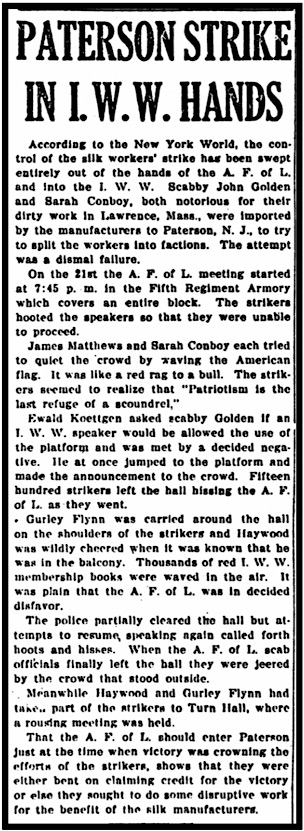
The night preceding this silent manifestation of protest against capitalist brutality the wildest demonstration of the strike took place in Armory Hall, where John Golden and Sarah Conboy, of the American Federation of Labor, escorted by manufacturers and policemen, came to try to repeat the infamous strikebreaking tactics they attempted a year ago in Lawrence. They came heralded by the local press, by the civil authorities, by the clergy, and the employers as the instruments through which the great silk strike would be settled. The armory had been obtained for them through state officials. The state militia had been called out and stood in the ante-rooms with guns loaded for action. Chief of Police Bimson and his entire force were on hand. The fire department had been ordered to hold themselves in readiness and had their hose attached to hydrants in the immediate vicinity.
The striking silk workers were invited to attend this meeting. It had been previously arranged that they would attend in a body and listen to what the A. F. of L. had to say, providing that they would be given a chance to reply to state the position of the strikers and the principles of the Industrial Workers of the World.
15,000 Cheer for I. W. W.
When organizers of the I. W. W. appeared in the hall, the 15,000 people present went wild. For minute after minute they yelled and cheered with ever-increasing -volume. The floor and gallery was a waving forest of the red membership books of the I. W. W. held aloft by what seemed to be countless thousands. After a time Organizer Ewald W. Koettgen of the I. W. W., appeared on the platform and announced that the I. W. W. speakers would not be allowed to present their side. Or rather, he intended to announce this, but he got no further than “I. W. W.”-when the audience leaped to its feet, and for perhaps fifteen minutes drowned every utterance with frantic cheers. Koettgen at last managed to make himself heard and said: ”Let’s all go home.” As one man the audience arose and began to file out. As these departed thousands on the outside who had not been able to enter, rushed in and soon the armory was again filled. Those who left went to their own halls where they greeted every utterance of their speakers with roars of applause.
For an hour and three-quarters Golden and Mrs. Conboy tried to speak, only to be drowned down by the unceasing cheers that the audience sent up for the I. W. W. In desperation Mrs. Conboy tried the appeal-to-home-mother-and-patriotism stunt and seizing an American flag, waved it from the stage, which act was greeted by another outburst of derisive cheers. When Golden finally made himself heard about 300 persons stayed to listen, the hall having been cleared by police clubs.
It was the funeral of the A. F. of L., so far as Paterson was concerned. It was remarked afterward that it was indeed fitting and appropriate that the A. F. of L. should choose an armory, the training quarters of the bayonet-carrying murderers of the capitalist class, as its own burying place.
Hellraisers Journal – Thursday June 12, 1913
Paterson, New Jersey – Silk Workers on Picket Line, Braving Death, Standing Firm
From the International Socialist Review of June 1913:
On the Paterson Picket Line
By William D. Haywood
[Part I of II]
FIVE o’clock every morning finds thousands of Paterson silk workers on the picket line with spirits as dauntless as ever despite the fact that after twelve weeks of struggle, starvation is staring them in the face. Some of them have been out in front of the battle for sixteen weeks.
The picket line is the modern barricade. It is there that the strike will be either lost or won. It is the picket line that has taught the Paterson silk workers the meaning of the class struggle. Here men and women daily meet the guns of hired thugs and the clubs of policemen. Braving death, suffering indignity and humiliation, nearly 800 strikers have been arrested on trumped-up charges and thrown into jail. Some of them have been jailed a number of times.
It takes courage to face a term in the Paterson bastile. It was built in 1854, before the era of alleged prison reform began. In the cellhouse where most of the strikers have been thrown the cells are narrow, with two bunks, one above the other. The ventilation is bad and the sanitation worse. The food is on a par with the usual prison fare.
Before being transferred to this county jail, the prisoners are, as a rule, compelled to spend a night in the city jail before appearing before Recorder Carroll’s court. The conditions that have been imposed on the strikers in the city jail are beyond description, reminding one of accounts of the hell-holes of Russia. Here seven and eight men have been crowded into a single cell intended to be occupied by one. No bedding of any kind is provided and no food is furnished. One group of strikers reported they were held for nineteen hours without even water.
Hellraisers Journal – Thursday June 11, 1903
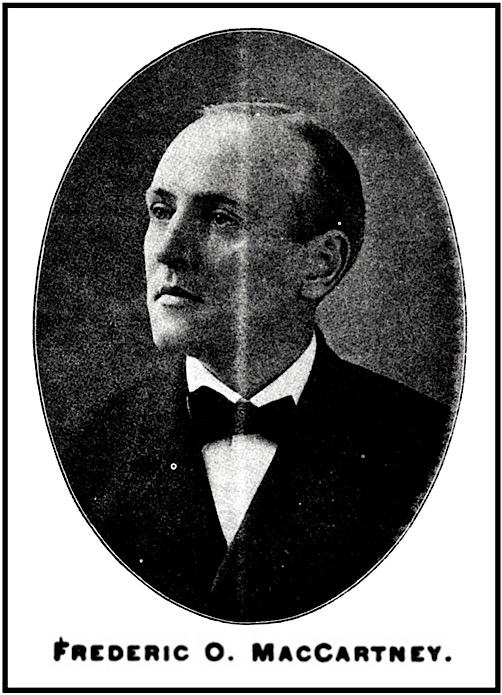
Eugene Debs Pays Tribute to Frederic O. MacCartney, Gone Too Soon
From the Social Democratic Herald of June 6, 1903:
—–
A COMRADE’S TRIBUTE!
Eugene V. Debs on the Tribune of the Proletaire:
Frederic O. MacCartney.
It is hard to write of the death of Frederic O. MacCartney. He belongs to the living, not the dead, and it will be long before we can realize that his eloquent voice is hushed and his great heart stilled forever. In the very spring of life-the ripening glory of his powers-he was cut down, and with such swiftness did the fatal blow descend that we who now stand over his prostrate flesh are so shocked and stunned that we cannot realize that death has come so near and snatched from us in all the flush of youth a comrade so loved and honored of us all.
Frederic MacCartney was an interesting, unique, and towering figure in the socialist movement. He had brain and heart, soul and conscience in large measure and fine proportion. He was a clear, clever, and versatile writer, a ready and resourceful debater, and as an orator had few equals in the movement.
MacCartney was born in Wisconsin, educated in Iowa, and received his theological training at Andover. It is fortunate that in his youth he came under the influence of George D. Herron, who then held the chair of Applied Christianity at Iowa College. The bright, honest, warm-hearted youth was soon impregnated with the new social philosophy and progressive spirit which at that time permeated the institution.
With such qualities of head and heart and such environment and training it is not strange that soon after he entered the ministry he concluded that creeds were cold and pulpits narrow. The more he thought about it the less theology satisfied the hunger of his soul. He sorrowed with the poor and wept with the oppressed and heavy laden. Something was surely wrong that this fair earth should be so scarred with misery. He investigated social conditions and studied economic science, gradually the darkness in which he groped was dispelled. The scales fell from his eyes and his vision was now clear. A new sun had risen for him. Henceforth his duty was plain and he would apply himself to his task with all the strength he could summon to his command.
Too honest to profess what he was not, he made without fear the full avowal of his convictions and as a sequence cleared the pulpit that was too narrow and dogmatic to hold him.
From the beginning he became a factor in the movement. He was filled to the brim with the spirit of international socialism. He felt himself aroused as if by Jehovah’s own command. He burned with the social passion for freedom, equality, and brother-love, and from his own intensity scattered the sacred fire among his fellow men.
At Rockland, his home, MacCartney was the idol of the working class; they loved and laureled him as their own hero, and even those opposed to him were moved to pay to him the tribute of respect.
The legislative labors of our comrade need no notice here, the General Assembly of Massachusetts will be poorer far without him and the people may well feel that they have lost a friend. With his two Socialist colleagues, MacCartney was a tower of strength in the legislative halls of the old Bay State. From the day they entered a new and distinctive power has been felt-a power with portent for the reign of capitalist corruption-the beginning of the end.
What pity, what pathos that such a brilliant career should be snuffed out at its very sunrise!
Ah, nature is forever the same-neither merciful nor vindictive-always inexorable.
Our dear comrade’s zeal exceeded his discretion. He had no thought that powers of endurance have limitations. Early and late, in legislative debate and committee room, on the rostrum, the street corner, anywhere, everywhere, all the time at work, pleading protesting, appealing, with tongue and pen in the name of oppressed and suffering humanity, his drafts upon nature were too deep and frequent and the inevitable protest followed, the protest sealed by death.
Hellraisers Journal – Sunday June 8, 1913 New York, New York – John Reed Recalls Time Spent in Passaic County Jail, Part II
From The Masses of June 1913:
The Paterson Evening News April 28, 1913
[Part II of II]
And so it was that I went up to the County Jail. In the outer office I was questioned again, searched for concealed weapons, and my money and valuables taken away. Then the great barred door swung open and I went down some steps into a vast room lined with three tiers of cells. About eighty prisoners strolled around, talked, smoked, and ate the food sent in to them by those outside. Of this eighty almost half were strikers. They were in their street clothes, held in prison under $500 bail to await the action of the Grand Jury. Surrounded by a dense crowd of short, dark-faced men, Big Bill Haywood towered in the center of the room. His big hand made simple gestures as he explained something to them. His massive, rugged face, seamed and scarred like a mountain, and as calm, radiated strength. These slight, foreign-faced strikers, one of many desperate little armies in the vanguard of the battle-line of Labor, quickened and strengthened by Bill Haywood’s face and voice, looked up at him lovingly, eloquently. Faces deadened and dulled with grinding routine in the sunless mills glowed with hope and understanding. Faces scarred and bruised from policemen’s clubs grinned eagerly at the thought of going back on the picket-line. And there were other faces, too-lined and sunken with the slow starvation of a nine weeks’ poverty—shadowed with the sight of so much suffering, or the hopeless brutality of the police—and there were those who had seen Modestino Valentine shot to death by a private detective. But not one showed discouragement; not one a sign of faltering or of fear.As one little Italian said to me, with blazing eyes: “We all one bigga da Union. I. W. W.—dat word is pierced de heart of de people!”
“Yes! Yes! Dass righ’! I. W. W.! One bigga da Union”—they murmured with soft, eager voices, crowding around.
[Introduced to Quinlan and Strikers by Big Bill]
I shook hands with Haywood, who introduced me to Pat Quinlan, the thin-faced, fiery Irishman now under indictment for speeches inciting to riot.
“Boys,” said Haywood, indicating me, “this man wants to know things. You tell him everything”—
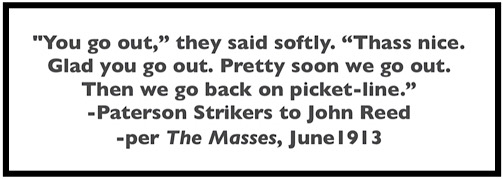
They crowded around me, shaking my hand, smiling, welcoming me. “Too bad you get in jail,” they said, sympathetically. “We tell you ever’t’ing. You ask. We tell you. Yes. Yes. You good feller.”
And they did. Most of them were still weak and exhausted from their terrible night before in the lockup. Some had been lined up against a wall, as they marched to and fro in front of the mills, and herded to jail on the charge of “unlawful assemblage”! Others had been clubbed into the patrol wagon on the charge of “rioting,” as they stood at the track, on their way home from picketing, waiting for a train to pass! They were being held for the Grand Jury that indicted Haywood and Gurley Flynn. Four of these jurymen were silk manufacturers, another the head of the local Edison compony—which Haywood tried to organize for a strike—and not one a workingman!
“We not take bail,” said another, shaking his head. “We stay here. Fill up de damn jail. Pretty soon no more room. Pretty soon can’t arrest no more picket!”
It was visitors’ day I went to the door to speak with a friend. Outside the reception room was full of women and children, carrying packages, and pasteboard boxes, and pails full of dainties and little comforts lovingly prepared, which meant hungry and ragged wives and babies, so that the men might be comfortable in jail. The place was full of the sound of moaning; tears ran down their work-roughened faces; the children looked up at their fathers’ unshaven faces through the bars and tried to reach them with their hands.
“What nationalities are all the people!” I asked. There were Dutchmen, Italians, Belgians, Jews, Slovaks, Germans, Poles—
“What nationalities stick together on the picket- line?”
A young Jew, pallid and sick-looking from insufficient food, spoke up proudly. “T’ree great nations stick togedder like dis.” He made a fist. “T’ree great nations—Italians, Hebrews an’ Germans”—
“But how about the Americans?”
They all shrugged their shoulders and grinned with humorous scorn. “English peoples not go on picket-line,” said one, softly. “’Mericans no lika fight!” An Italian boy thought my feelings might be hurt, and broke in quickly: “Not all lika dat. Beeg Beell, he ‘Merican. You ‘Merican. Quin’, Miss Flynn, ‘Merican. Good! Good! ‘Merican workman, he lika talk too much.”
This sad fact appears to be true. It was the English-speaking group that held back during the Lawrence strike. It is the English-speaking continent that remains passive at Paterson, while the “wops” the “kikes,” the “hunkies”—the ‘degraded and ignorant races from Southern Europe”—go out and get clubbed on the picket-line and gaily take their medicine in Paterson jail.
But just as they were telling me these things the keeper ordered me to the “convicted room,” where I was pushed into a bath and compelled to put on regulation prison clothes. I shan’t attempt to describe the horrors I saw in that room. Suffice it to say that forty-odd men lounged about a long corridor lined on one side with cells; that the only ventilation and light came from one small skylight up a funnel-shaped airshaft; that one man had syphilitic sores on his legs and was treated by the prison doctor with sugar-pills for “nervousness;” that a seventeen-year-old boy who had never been sentenced had remained in that corridor without ever seeing the sun for over nine months; that a cocaine-fiend was getting his “dope” regularly from the inside, and that the background of this and much more was the monotonous and terrible shouting of a man who had lost his mind in that hell-hole and who walked among us.
Hellraisers Journal – Saturday June 7, 1913 New York, New York – John Reed Recalls Time Spent in Passaic County Jail
From The Masses of June 1913:
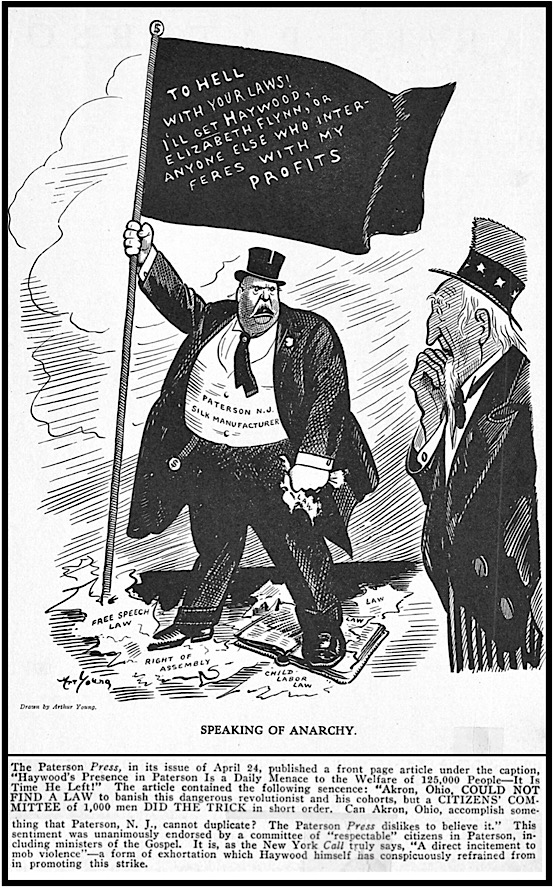
“Speaking of Anarchy” by Art Young
[Part I of II]
There’s war in Paterson. But it’s a curious kind of war. All the violence is the work of one side—the Mill Owners. Their servants, the Police, club unresisting men and women and ride down law-abiding crowds on horseback. Their paid mercenaries, the armed Detectives, shoot and kill innocent people. Their newspapers, the Paterson Press and the Paterson Call, publish incendiary and crime-inciting appeals to mob-violence against the strike leaders. Their tool, Recorder Carroll, deals out heavy sentences to peaceful pickets that the police-net gathers up. They control absolutely the Police, the Press, the Courts.
Opposing them are about twenty-five thousand striking silk-workers, of whom perhaps ten thousand are active, and their weapon is the picket-line. Let me tell you what I saw in Paterson and then you will say which side of this struggle is “anarchistic” and “contrary to American ideals.”
At six o’clock in the morning a light rain was falling. Slate-grey and cold, the streets of Paterson were deserted. But soon came the Cops-twenty of them—strolling along with their nightsticks under their arms. We went ahead of them toward the mill district. Now we began to see workmen going in the same direction, coat collars turned up, hands in their pockets. We came into a long street, one side of which was lined with silk mills, the other side with the wooden tenement houses. In every doorway, at every window of the houses clustered foreign-faced men and women, laughing and chatting as if after breakfast on a holiday. There seemed no sense of expectancy, no strain or feeling of fear. The sidewalks were almost empty, only over in front of the mills a few couples—there couldn’t have been more than fifty-marched slowly up and down, dripping with the rain. Some were men, with here and there a man and woman together, or two young boys. As the warmer light of full day came the people drifted out of their houses and began to pace back and forth, gathering in little knots on the corners. They were quick with gesticulating hands, and low-voiced conversation. They looked often toward the corners of side streets.
Suddenly appeared a policeman, swinging his club. “Ah-h-h!” said the crowd softly.
Six men had taken shelter from the rain under the canopy of a saloon. “Come on! Get out of that!” yelled the policeman, advancing. The men quietly obeyed. “Get off this street! Go home, now! Don’t be standing here!” They gave way before him in silence, drifting back again when he turned away. Other policemen materialized, hustling, cursing, brutal, ineffectual. No one answered back. Nervous, bleary-eyed, unshaven, these officers were worn out with nine weeks’ incessant strike duty.
On the mill side of the street the picket-line had grown to about four hundred. Several policemen shouldered roughly among them, looking for trouble. A workman appeared, with a tin pail, escorted by two detectives. “Boo! Boo!” shouted a few scattered voices. Two Italian boys leaned against the mill fence and shouted a merry Irish threat, “Scab! Come outa here I knocka you’ head off!” A policeman grabbed the boys roughly by the shoulder. “Get to hell out of here!” he cried, jerking and pushing them violently to the corner, where he kicked them. Not a voice, not a movement from the crowd.
A little further along the street we saw a young woman with an umbrella, who had been picketing, suddenly confronted by a big policeman.
“What the hell are you doing here?” he roared. “God damn you, you go home!” and he jammed his club against her mouth. “I no go home!” she shrilled passionately, with blazing eyes. “You bigga stiff !”
Silently, steadfastly, solidly the picket-line grew. In groups or in couples the strikers patrolled the sidewalk. There was no more laughing. They looked on with eyes full of hate. These were fiery-blooded Italians, and the police were the same brutal thugs that had beaten them and insulted them for nine weeks. I wondered how long they could stand it.
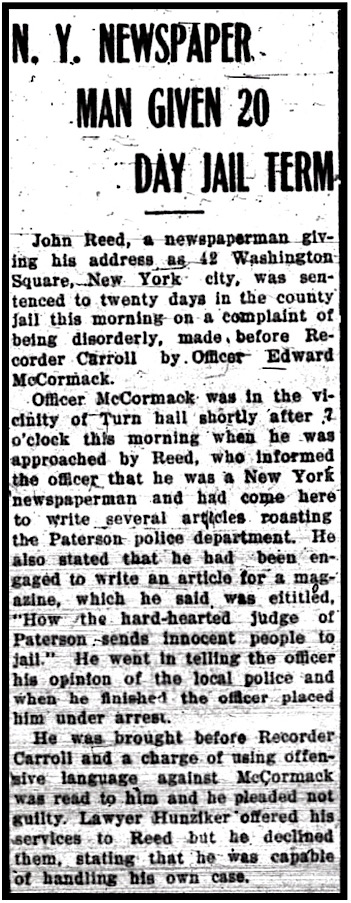
It began to rain heavily. I asked a man’s permission to stand on the porch of his house. There was a policeman standing in front of it. His name, I afterwards discovered, was McCormack. I had to walk around him to mount the steps.
Suddenly he turned round, and shot at the owner: “Do all them fellows live in that house?” The man indicated the three other strikers and himself, and shook his head at me.
“Then you get to hell off of there!” said the cop, pointing his club at me.
“I have the permission of this gentleman to stand here,” I said. “He owns this house.”
“Never mind! Do what I tell you! Come off of there, and come off damn quick!”
“I’ll do nothing of the sort.”
With that he leaped up the steps, seized my arm, and violently jerked me to the sidewalk. Another cop took my arm and they gave me a shove.
“Now you get to hell off this street!” said Officer McCormack.
“I won’t get off this street or any other street. If I’m breaking any law, you arrest me!”
Officer McCormack, who is doubtless a good, stupid Irishman in time of peace, is almost helpless in a situation that requires thinking. He was dreadfully troubled by my request. He didn’t want to arrest me, and said so with a great deal of profanity.
“I’ve got your number,” said I sweetly. “Now will you tell me your name?”
“Yes,” he bellowed, “an’ I got your number! I’ll arrest you.” He took me by the arm and marched me up the street.
He was sorry he had arrested me. There was no charge he could lodge against me. I hadn’t been doing anything. He felt he must make me say something that could be construed as a violation of the Law. To which end he God damned me harshly, loading me with abuse and obscenity, and threatened me with his night-stick, saying, “You big — — lug, I’d like to beat the hell out of you with this club.”
I returned airy persiflage to his threats.
Other officers came to the rescue, two of them, and supplied fresh epithets. I soon found them repeating themselves, however, and told them so. “I had to come all the way to Paterson to put one over on a cop !” I said. Eureka! They had at last found a crime! When I was arraigned in the Recorder’s Court that remark of mine was the charge against me!
Hellraisers Journal – Friday June 6, 1913 Clarksburg, West Virginia – Comrade Kintzer’s Plea for Help
From the International Socialist Review of June 1913:
Hatfield’s Challenge to the Socialist Party
By Leslie H. Marcy
[Part III of III]
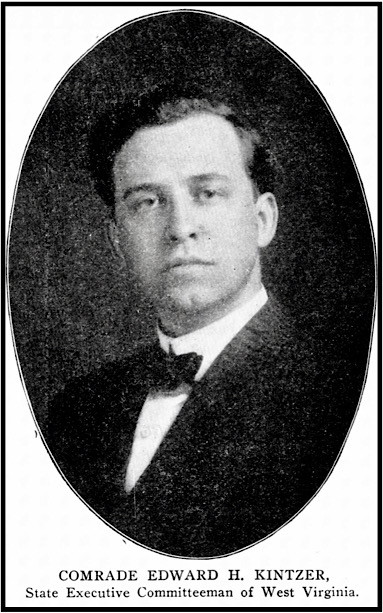
The National Committee received the following plea for help at its meeting held in Chicago, May 10th, and it is up to the rank and file of the party to force immediate action in this crisis. The conditions are so well known that investigating committees are only an insult to the intelligence of the comrades in West Virginia and elsewhere. What they ask for is regular or volunteer organizers. Why should not their request be granted immediately?
The Plea for Help
Clarksburg, W. Va., May 9, 1913.
To the National Committee, Socialist Party, Chicago:
Dear Comrades-Owing to the temporary absence of State Secretary Houston, the State Executive Committee motion following was instituted by myself, asking that the four comrades send their vote upon the motion to Executive Secretary Work, so that in the event it carries it may be properly put before you at the annual convention. The committeemen are widely scattered, and there is a possibility that their votes upon the motion will fail to arrive in time.
Following is the motion and comment by myself:
“That the National Committee, in session of May 11, be requested to furnish a number of regular or volunteer organizers to be routed through West Virginia, for the purpose of apprising the people of the outrages upon life, liberty and constitutional right, perpetuated and practiced by government officials, with Hatfield’s consent. That the financial deficit, if any, be borne by the national organization.”
COMMENT:
Comrade John W. Brown, National Committeeman, is now held incommunicado, in the county jail at Clarksburg, by order of Governor Hatfield. When I last saw him we spoke of this plan of reaching the people of West Virginia.
We all are aware of the subsidy of our state press, and now that Governor Hatfield has set the gauge of battle for the Socialists, having eliminated every other element, we must accept the fight or be conquered.
“In this state issue is involved the greatest violation of constitutional guarantees the American labor movement ever experienced. If we submit tamely we deserve the galling chains of slavery. If we fight as a united working class, we mark another mile post on the road to economic freedom.”
Hellraisers Journal – Thursday June 5, 1913
Huntington, West Virginia – Comrades Expose Military Despotism
From the International Socialist Review of June 1913:
Hatfield’s Challenge to the Socialist Party
By Leslie H. Marcy
[Part II of III]
The following letters from comrades tell the story of the suppression of Socialism in Huntington:
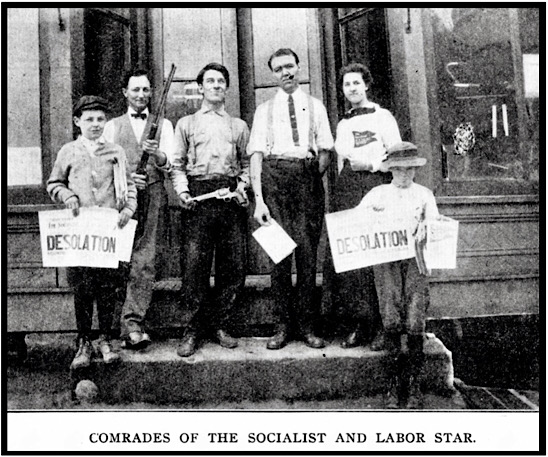
I inclose a picture of the Huntington Socialist and Labor Star’s force with its fighting clothes on. During the flood half our population was homeless. Two companies of militia, withdrawn from Paint Creek strike zone, where they had been on duty seven months, were quartered on the helpless city. They showed us what military law in the Kanawha county had been. They confiscated whiskey and with their hides full of rot-gut, and their hands full of deadly weapons, they staggered about fighting both the citizens and each other, stealing everything that was not nailed down, and breaking into homes and carrying off what they wanted. The Socialist and Labor Star exposed the outrages of these scab-herders, who formed a plot for the destruction of the Star plant. Fortunately, the comrades were tipped off in time and when, in the night, 150 soldiers started out to demolish our machinery, they found the shop had been converted into a fort. Comrades living near had been summoned and the building was in the hands of twenty determined workingmen armed with Winchesters. The gallant warriors decided to delay the attack. The picture inclosed shows the mechanical force with their tools taken the day after the attack.
———-
Huntington, May 5, 1913.
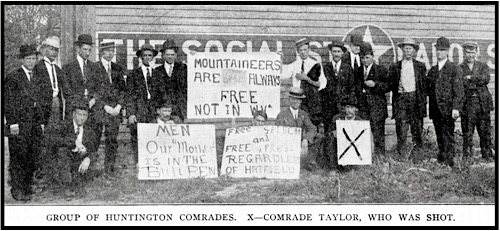
At a mass meeting being held by the Trades and Labor Assembly, May 5th, to protest against the Russianizing of West Virginia, the crowd was fired into by Baldwin-Feltz mine guards sent from the strike zone for that purpose. Comrade W. R. Taylor, aged 60, was shot through the head, while several others, including women and children, narrowly escaped death in the rain of bullets. Comrade George W. Gillespie, member of the S. P. State Executive Committee, had just started to speak to the 3,000 people when the firing began. Although the names of the detectives are known, the authorities have made no attempt to arrest them.
Hellraisers Journal – Wednesday June 4, 1913
Charleston, West Virginia – Governor Hatfield Vows to Jail or Deport Socialists
From the International Socialist Review of June 1913:
Hatfield’s Challenge to the Socialist Party
By Leslie H. Marcy
[Part I of III]
Governor Hatfield has declared that every active Socialist in West Virginia shall be jailed or deported. Wholesale arrests of Socialists without warrants have already been made; trials by jury denied; our papers confiscated; presses wrecked and Editors jailed. Shall we stand for our comrades being absolutely within the power of this tool of the Coal Trust and the tin soldiers whom he commands?
AFTER a reign of terror and absolute lawlessness on the part of the mine owners and some of the constituted authorities in West Virginia for many months, the United Mine Workers of America have signed a truce with Governor Hatfield.
The representatives of the miners on Paint and Cabin Creeks and Coal River, after a stormy session, acceded to the Governor’s recommendation as a basis for a settlement of the strike.
The convention roll was made up of ninety-three delegates, of which eighty-five were native West Virginians. At no time until the fourth day could those who favored the Governor’s recommendation have secured a majority vote. In fact, many of the delegates came to the convention instructed to vote against the recommendation. On the final ballot a number of the delegates requested to be recorded as having voted against adoption, despite the fact that the sixteen representatives of the United Mine Workers, both state and national, with the exception of two, exerted their influence in favor of the recommendation, as did the attorneys of the organization. They yielded to the Governor’s demands with great reluctance.
In accepting the proposition of the Governor, the miners called his attention to the fact that each of the promises made by him, with the exception of the nine-hour day and semi-monthly payday, to which the operators acceded, are statutory rights granted the miners by law.
The Governor promised that the guard system should be abolished under his administration.
The recommendations were as follows:
Rights of miners to select check weighman.
Nine-hour day, at same scale of wages as now paid.
No discrimination.
Prices at commissary stores same as elsewhere.
Semi-monthly payday.
There are many who do not believe the Governor will carry out his promises, but in the meantime the miners have gone back to work.
War on the Socialist Party.
Socialists in West Virginia write that nearly all of the imprisoned striking miners, who are not active in the Socialist Party, have been released. Mother Jones also has been set at liberty.
In writing Senator Kern, she says:
I do not yet know that I am free, but I am inclined to think it was none of his (the Governor’s) good wishes.
In the meantime Governor Hatfield has waged a relentless war against all active Socialists. No other one has been released. The Governor has sworn to DRIVE SOCIALISM from the state.
John F. Parsons, A. D. Lavender, E. B. Vickers, Tom Miskel, Charles Kenney, Cleave Vickers, John Sachrist, G. W. Lavender, Nelson Treadway, John Brown, National Committeeman of the S. P ., Charles H. Boswell, editor of the Labor Argus, all Socialists, are still held incommunicado.
Fred Merrick,editor of the Pittsburgh Justice, who was filling Boswell’s place on the Argus, was seized, thrown into prison by the Governor’s orders and the paper confiscated.

 —————
—————
 —————
————— —–
—–
 —————
————— —–
—– —–
—–
 —————
—————
 —————
—————
 —————
—————