Hellraisers Journal – Tuesday May 27, 1919
Prisons and Jails of the U.S.A. Now Hold the “Best and Bravest”
From The Messenger of May-June 1919:
POLITICAL PRISONERS
Fellow Worker Ben Fletcher —–
The recent conviction and sentenced of the national Socialist officials, the Supreme Court’s confirmation of the convictions of Eugene V. Debs and of Kate Richards O’Hare, definitely stamp the United States as the most archaic, antiquated and reactionary of the alleged civilized nations. In addition to these popular and well-known characters, there are 1,500 political and class prisoners in the prisons. Practically all other countries have granted amnesty to their political prisoners, but the U. S. is sentencing them more savagely now than during the War.
Men like Victor Berger, Adolph Germer, Louis Engdahl, Irwin St John Tucker and Charles Kruse have each been sentenced to imprisonment for twenty years for speaking a word in favor of human liberty and for making statements concerning profiteering and patriotism, the truth of which has been amply corroborated by the Federa Trade Commission and the Federal Income Tax Reports. Among the 1,500 political and class prisoners are men of practically all races and nationalities.
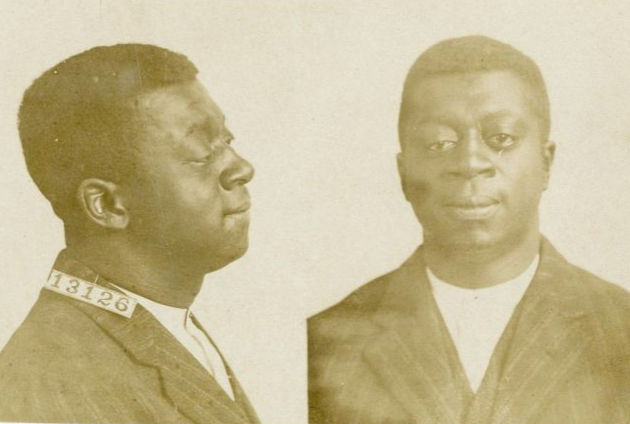
Negro men like Ben Fletcher, who have done more to improve the actual economic and social life of Negro workers than the much heralded so-called leaders, are in prison for fifteen and twenty years. There is no race, color or sex line involved. The best and bravest, the noblest and most courageous, are in the dark and cavernous prison cells of this country.
Hellraisers Journal – Thursday May 22, 1919
Lawrence, Massachusetts – Textile Strikers Stand Firm
From The Liberator of May 1919:
The Lawrence Strike
[by Ruth Pickering]
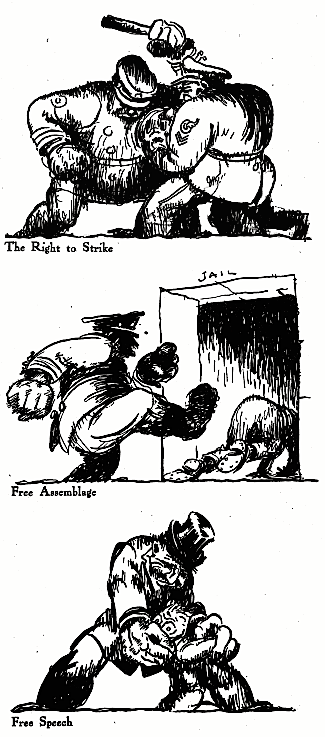
THE causes of the Lawrence strike are the most elemental in the whole history of the labor movement. It is a struggle simply for a living wage. But the “law and order” fraternity are doing their best to bring on what they so much fear-a revolution. Partly as an excuse for breaking the strike, partly out genuine nervousness, they are attempting to obscure the primary issues in the fog of “Bolshevism.” And the more they advertise the revolution as something which they hate, as something so manifestly dangerous to them, the more do the workers wonder: “If they hate this thing so-whatever it is-it must have something in it for us.” Fear of Bolshevism and memories of 1912 have made the Lawrence citizens and the press applaud all repressive measures. Mounted police have been imported from Lynn, and stray recruits have been added which cost the city 3,000 extra dollars per week to maintain. Their horses are scrawny and rickety and they ride with some difficulty, but what pride they lose in their consciousness of these facts, they take out on the pickets.
Men come in from the picket-line with their heads cut open and blood covering their shirt fronts. That the strikers have a legal right to maintain the picket-line is out of the question. Liberty has come to be a joke. There is no law for the “damned Bolshevik foreigner.” The brave mounted police ride up on the sidewalk cursing and swinging their sticks. The pickets retreat before these onslaughts-but they will never forget.
Hellraisers Journal – Saturday May 17, 1919
Mother Jones News for April 1919, Part II
-Found Speaking in Peoria, Illinois
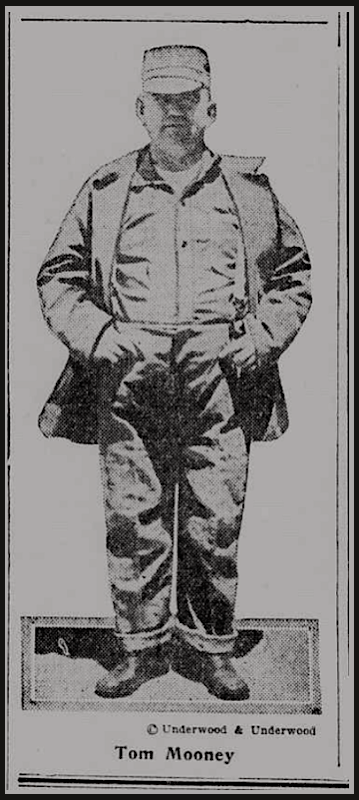
On Sunday April 6th, Mother Jones spoke at the Peoria Coliseum on behalf of Tom Mooney. She shared the stage with Duncan MacDonald and T. H. Tippett, both of whom also delivered addresses.
Sunday April 6, 1919, Peoria, IL
Mother Jones Speaks at “Mooney Day” Event
Friends, fellow workers, we are living today in the greatest age the world has ever passed through in human history. The whole world is ablaze with revolt. The uprising among the unfortunate workers is suppressed in the daily press. I took a clipping while in New York the other day, out the New York World, which said that the human race has never in human history passed through an age like this.
There was once back in Greece, a young man, two hundred years after the world’s greatest agitator was marred, crucified, hung, maligned, vilified, by the powers there. There arose in Carthage an agitation and the courts became uneasy. They sent down to Carthage in those days a force that arrested all those who were in the agitation movement which was eighteen hundred years ago. We have not changed the program very much since. We have talked a lot about Christianity, but we have never seen any Christianity yet. There has never been any Christianity on the earth and there is not going to be any for a while yet! They held them in slavery or sold them, if they did not need them, and so, they brought them into court.
Among those was a young man and the judge said to him “Who ar you?” He said, “I am a man,” a member of the human family. The judge asked, “Why do you carry on this agitation” The boy replied, “Because I belong to a class that in human history have always been crucified, robbed, murdered, jailed, maligned, vilified, starved and because I belong to that class, I feel it is my duty to awaken that class to their power and their duty.” He was sentenced, of course.
Hellraisers Journal – Saturday May 15, 1909
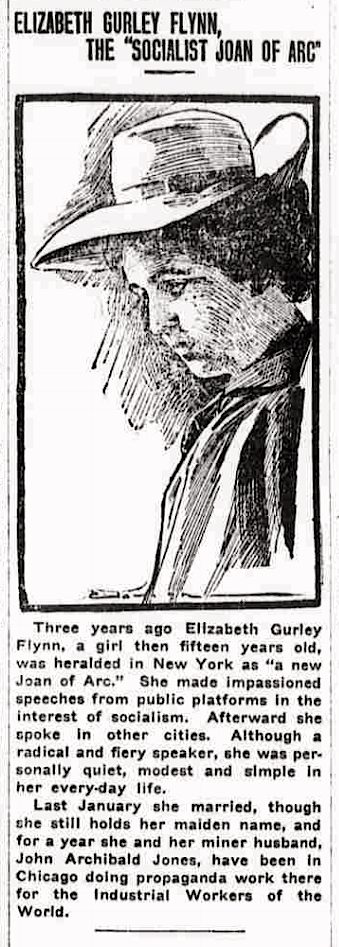
Western Tour of Elizabeth Gurley Flynn from May to July
From the Spokane Industrial Worker of May 6, 1909:
LECTURE TOUR OF MISS E. G. FLYNN
—–
INDUSTRIAL WORKERS OF THE WORLD
—–
General Administration,
310 Bush Temple, Chicago.
—–
Labor Produces All Wealth-
Labor Is Entitled to All It Produces-
An Injury to One Is an Injury to All
—–
Fellow Worker: The crying need of the hour with the working class is a form of organization that will create and maintain solidarity. To gain this means constructive work of great proportion. It needs correct education as well as correct form of organization. It means laying the foundation for the rule of the working class. It means the building of an organization that will enable its membership to successfully cope with the employing class in its everyday struggle. It means building an organization that will supplant the capitalist system and secure for the workers the full product of their labor.
Can this work be accomplished?
Can this organization be built?
It can and will!
It must be built!
Industrial Unionism on revolutionary lines will furnish the organization needed.
Agitation, education and organization on industrial lines is first required.
The Industrial Workers of the World is arranging a tour of the West for
Elizabeth Gurley Flynn.
Miss Flynn is one of the cleverest and best posted industrial unionists before the country today. Her exposition of the aims and objects of Industrial Unionism can be understood by all.
Hellraisers Journal – Wednesday May 14, 1919
Upton Sinclair Exposes the Barbaric Sedgwick County Jail
From the Appeal to Reason of May 10, 1919:
Hell Holes in America
In the Amnesty Edition of the Appeal I reproduced a circular sent out by the I. W. W. boys, describing the terrible conditions in the Sedgwick county jail at Wichita, Kans. I made no investigation of their statements, but acted on my general impulse to believe the worst about American jails. Those which I have investigated in past times have disposed me to believe that nobody could possibly exaggerate their evils. But soon after this article appeared in the Appeal I received letters from several correspondents who reported that they had complained to the Governor of Kansas about the matter, and had received from him a report of a confidential investigation which he had had made into this Wichita jail. The report stated that conditions in the jail were excellent, and that all the accounts sent out by the I. W. W. were false.
Now the Governor of Kansas, Henry J. Allen, is a progressive politician and a gentle man. I feel acquainted with him from reading “The Martial Adventures of Henry and Me,” by William Allen White-Governor Allen being the Henry” of that book. So I began to feel real bad about what I had published, and made ready to apologize to Governor Allen, and also to the readers of the Appeal for the blunder I had made.
But I studied that report again and noted that the Governor’s investigator denied that the I. W. W. boys had been arrested for trying to call a strike of the oil workers. He said they had been arrested for hindering the prosecution of the war. I have encountered that official bunk so often that I know the type of mind that swallows it.
And then I recalled the many, many times in my life when I had followed the work of official investigators, in cases with which I myself was entirely familiar. I recalled, for example the statement given out about the county jail here in Los Angeles, that the prisoners had had lice brought in and put them on their bodies prior to my inspection! I recalled Major Louis L. Seaman of the United States army, who investigated the Chicago stockyards for Collier’s Weekly, at the time when the Appeal to Reason was publishing “The Jungle.” Major Seaman was a gentleman of undoubted integrity, and he reported that everything was lovely in that inferno of graft. You see, these gentlemen of undoubted integrity have their class point of view, and they let themselves be escorted around, and they only see what they are shown-and even then, most of the time they don’t realize what they are seeing!
So I decided that before I apologized to Governor Allen, I would inquire a little farther. I wrote to Caroline Lowe, a woman who has interested herself in the defense of political prisoners, and asked if she happened to know anything about this particular jail. In reply came a letter which speaks for itself and which I quote:
Regardless of any denial made by the Governor of the State of Kansas, I can testify of my own knowledge that the conditions not only in the Wichita jail but in the jail at the State capitol at Topeka, Kans., beggar description. The rotary tank in the jail at Wichita is a relic of barbarism. I have been in the jail many times and have seen this tank in operation.
Hellraisers Journal – Tuesday April 29, 1919
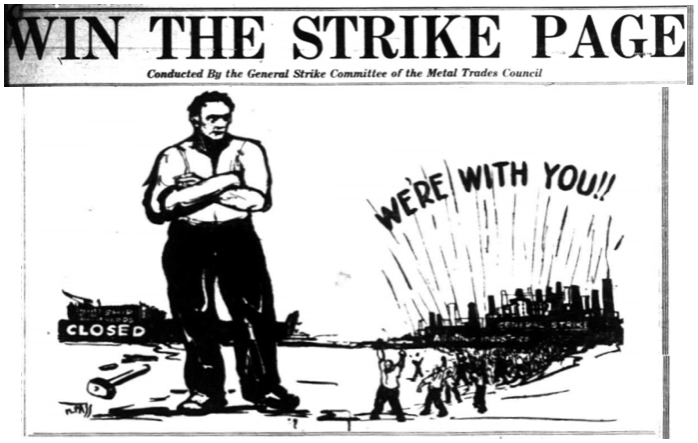
Seattle General Strike: Revolution? -60,000 Striking Workers Run the City
From the New York Liberator of April 1919:
When Is a Revolution Not a Revolution
Reflections on the Seattle General Strike
by a Woman Who Was There
“A GENERAL STRIKE, called by regular unions of the American Federation of Labor, cutting across contracts, across international union constitutions, across the charter from the American Federation of Labor,”-this was what the chairman of the strike committee declared it to be. A General Strike in which the strikers served 30,000 meals a day, in which the Milk Wagon Drivers established milk stations all over town to care for the babies, in which city garbage wagons went to and fro marked “Exempt by Strike Committee”; a General Strike in which 300 Labor Guards without arms or authority went to and fro preserving order; in which the Strike Committee, sitting in almost continuous session, decided what activities should and should not be exempted. from strike in the interests of public safety and health, and even forced the Mayor to come to the Labor Temple to make arrangements for lighting the city.
Yet almost any member of the Strike Committee will tell you, in hot anger, that “this was no revolution, except in the Capitalist papers; it was only a show of sympathy and solidarity for our brothers in the shipyards.” And so in truth it was, in intention. It would seem that the beginnings of all new things take place, not through conscious intention, but through the inevitable action of economic forces.
Hardly yet do the workers of Seattle realize all the things they did.
The shipyard workers of Seattle struck, 35,000 strong, on [Tuesday] January 21st.On January 22, a request was brought to the Central Labor Council for a general strike in sympathy with the Metal Trades. This was referred to the various unions for referendum. By the following Wednesday, January 29, the returns were pouring in.
Hellraisers Journal – Sunday April 27, 1919
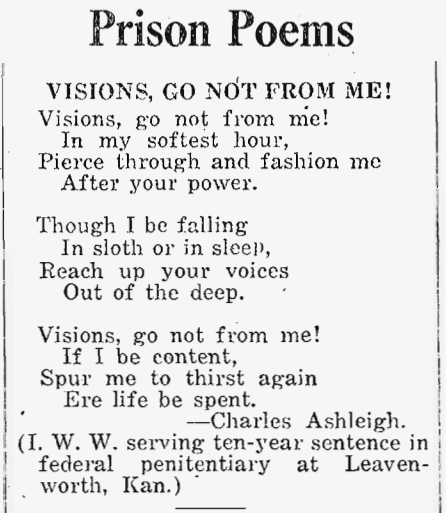
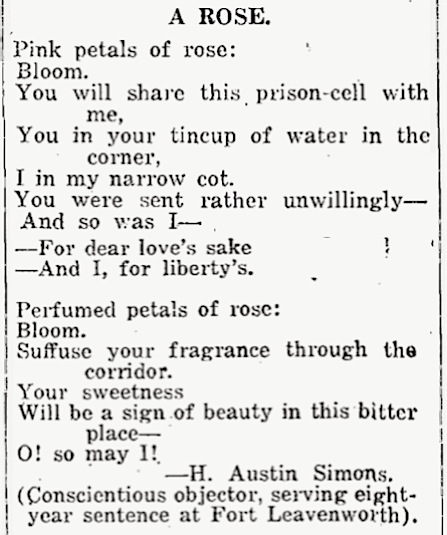
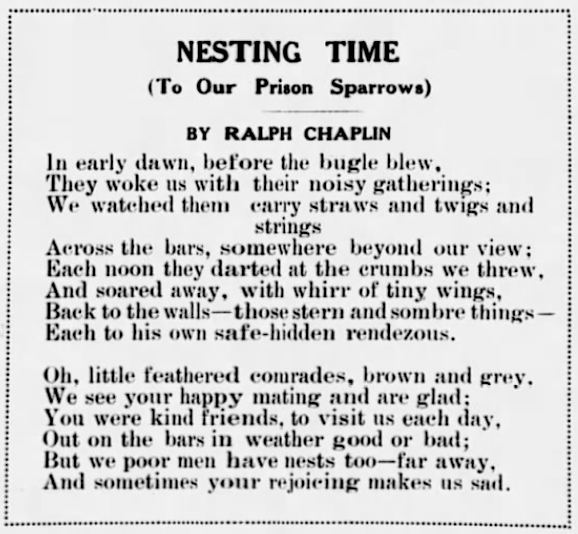
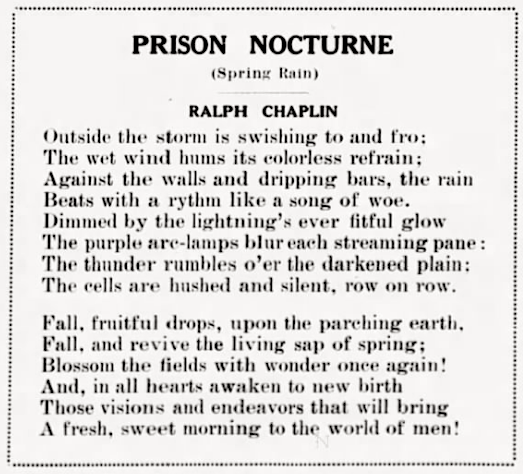
From Leavenworth Prison – Poetry of Charles Ashleigh and H. Austin Simons
The following three poems appeared in the Ohio Socialist of April 23, 1919. The first is by Fellow Worker Charles Ashleigh and the second is by H. Austin Simons, Conscientious Objector. The third is by Mary O’Reilly, Socialist of Chicago.

 ———-
———-
 ———-
———-
 ———-
———-
 ———-
———-
 ———-
———-
 ———-
———-