Hellraisers Journal: From International Socialist Review: “Victory at McKees Rocks” by Louis Duchez, Part II

Share

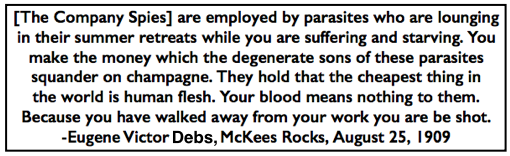
Quote EVD to McKees Rocks Strikers, Aug 25, Butler PA Ctzn p1, Aug 26, 1909———-

Hellraisers Journal – Sunday October 10, 1909
Louis Duchez on Victory of McKees Rocks Strikers, Part II

From the International Socialist Review of October 1909:

IWW McKees Rocks, Victory by L Duchez, ISR p289, Oct 1909

[Part II of II.]

—–

On August 15th, the I. W. W. advertised a mass meeting to be held on Indian Mound. Large posters printed in five different languages were displayed. Eight thousand men attended the meeting—nearly all strikers, and many railroad men and trade unionists and laborers from Pittsburg.

William E. Trautman first addressed the meeting in English and German, after which the men were parcelled off in lots. Nine different nationalities were spoken to—besides these two—and to each man his own tongue.

To Ignatz Klavier, a Polander and member of the Socialist Party who speaks five languages fluently, much credit is due for enlightening the McKees Rocks strikers on the principles of industrial unionism. It was Klavier who, during the second week of the strike, brought out clearly the distinction between the A. F. of L. and the I. W. W. He was ably assisted by Henyey, a Hungarian, and Max Forker, a German.

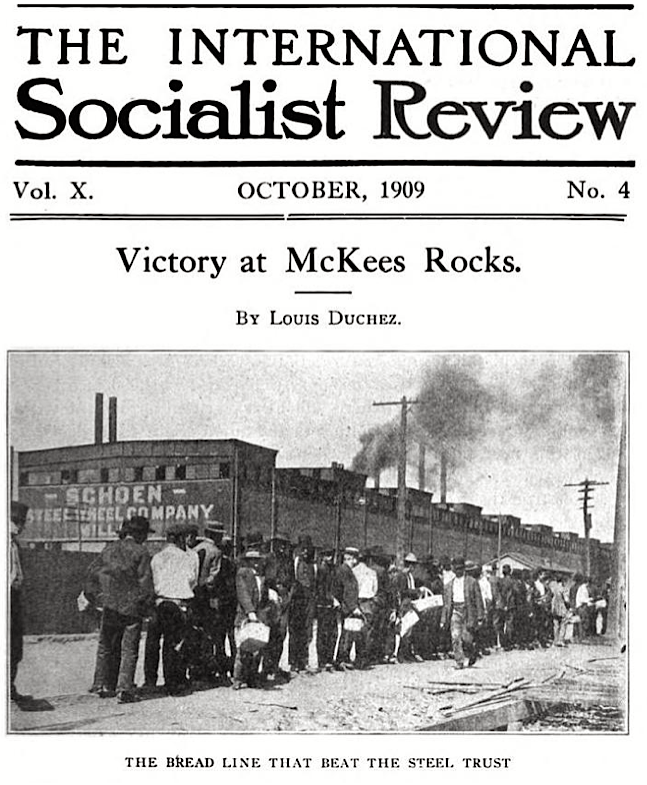
A wonderful spirit of solidarity was shown by the trainmen of the Pittsburg, Ft. Wayne and Chicago and on the Pittsburg and Lake Erie roads—the only railroads running into McKees Rocks, when the trainmen refused to haul scabs to the plant. This is the first time in the history of labor troubles in the United States that this has been done. This was another example of the tactics of industrial unionism directly due to I. W. W. propaganda and education. Not only did the railroad men lend their aid to the strikers but the crews on the two company steamers, “The Queen” and “The Pheil,” refused to haul the scabs. This also is due to the work of the Unknown Committee and the great wonderful spirit of solidarity that is spontaneously stirring the wage slaves of the world. Even the school children of “Hunkeytown” refused to attend school until the strike was settled.

Continue reading “Hellraisers Journal: From International Socialist Review: “Victory at McKees Rocks” by Louis Duchez, Part II”

Hellraisers Journal: From International Socialist Review: “Victory at McKees Rocks” by Louis Duchez, Part I

Share

Quote EVD to McKees Rocks Strikers, Aug 25, Butler PA Ctzn p1, Aug 26, 1909———-

Hellraisers Journal – Saturday October 9, 1909
Louis Duchez on Victory of McKees Rocks Strikers, Part I

From the International Socialist Review of October 1909:

IWW McKees Rocks, Victory by L Duchez, ISR p289, Oct 1909

[Part I of II.]

—–

Letter I, ISR p289, Oct 1909N this article the writer is not going to give much space to a recitation of the crimes of the capitalist class at McKees Rocks and the other strike points in Pennsylvania. It is unnecessary. The capitalist press has done that more effectively—regardless of the motives that may have prompted them—than he is able to do. The class struggle is a historic fact and the diametrically opposed interests have long ago been proven. Such practices as were exposed during the last few weeks are only the logical result of the capitalist system of society at this stage of working class activity.
Readers of the Review want something more than a mere account of the cruelties of the Pressed Steel Car Company. They want to know something about the spirit and growth of solidarity and industrial organization among the striking wage slaves in Pennsylvania.

Continue reading “Hellraisers Journal: From International Socialist Review: “Victory at McKees Rocks” by Louis Duchez, Part I”

Hellraisers Journal: From One Big Union Monthly: “White Terror” and “Serious Times Ahead” by IWW Cartoonist Sam

Share

Quote IWW ID Prisoner Charles L Anderson, OBU p10, Oct 1919———-

Hellraisers Journal – Friday October 3, 1919
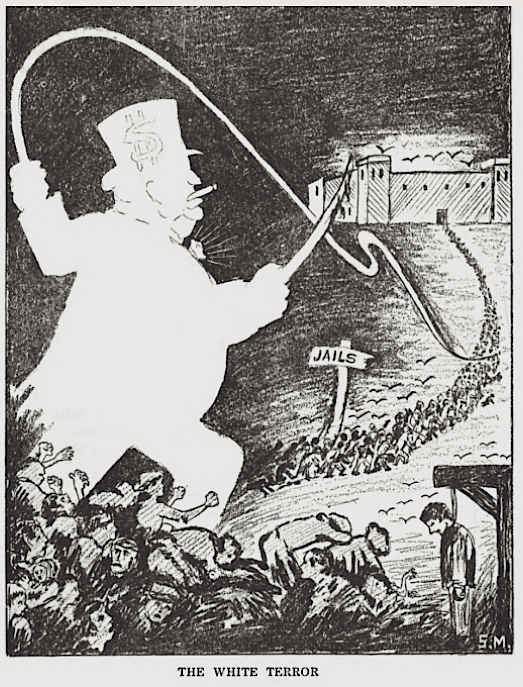
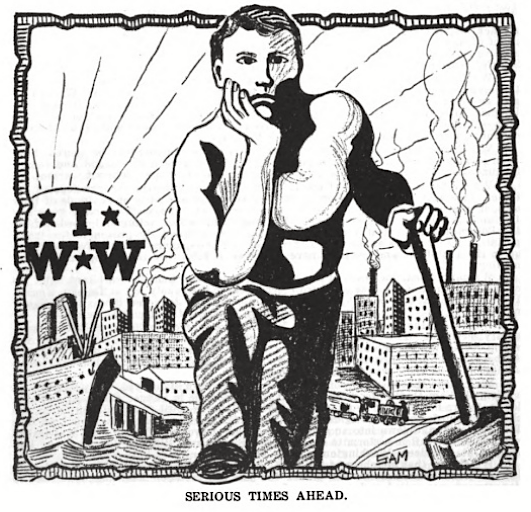
I. W. W. Cartoonist Sam on White Terror and Serious Times

From The One Big Union Monthly of October 1919:

CRTN, White Terror Whip to Jails, SM, OBU p4, Oct 1919

—–

CRTN, Serious Times Ahead, Sam, OBU p8, Oct 1919

Continue reading “Hellraisers Journal: From One Big Union Monthly: “White Terror” and “Serious Times Ahead” by IWW Cartoonist Sam”

Hellraisers Journal: Socialists of New Castle Form “Flying Squadron” to Get Out 10,000 Copies of “The Free Press”

Share

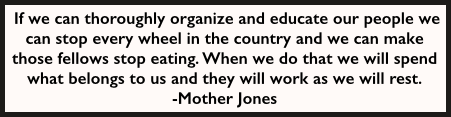
Quote Mother Jones, We Will Rest, UMWC Jan 27, 1909———-

Hellraisers Journal – Saturday October 2, 1909
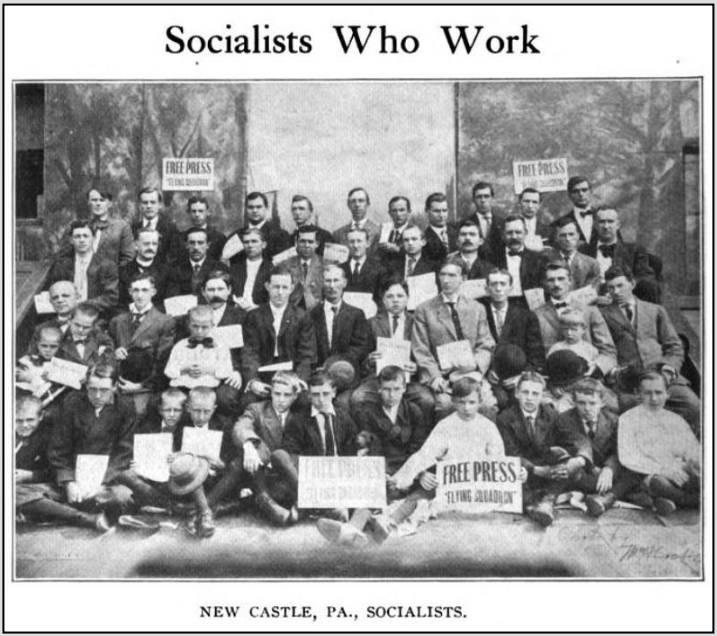
New Castle, Pennsylvania – Socialists Flying Squadron and Free Press

From the International Socialist Review of October 1909:

Socialists of New Castle PA, ISR p374, Oct 1919
—–

“THE FLYING SQUADRON” of the Socialist Party of New Castle, Pa., is one of the best disciplined and the most progressive group of revolutionists in the state. About a year ago the idea struck them to start a weekly paper. This was done. No one had any great amount of money to put into it—there were no millionaire socialists in the local—but the paper has been carried through and The Free Press, which is published bi-weekly, is self-supporting.

Continue reading “Hellraisers Journal: Socialists of New Castle Form “Flying Squadron” to Get Out 10,000 Copies of “The Free Press””

Hellraisers Journal: Butte Daily Bulletin: History of IWW Has Been Written “With Drops of Blood” by Wm. D. Haywood

Share

Quote BBH IWW w Drops of Blood, Sept Oct 1919———-

Hellraisers Journal – Monday September 29, 1919
History of I. W. W. Written with “Drops of Blood” and “Bitter Tears of Anguish”

From The Butte Daily Bulletin of September 27, 1919:

IWW BBH w Drops of Blood, Btt Dly Bltn p5, Sept 27, 1919

By WM. D. HAYWOOD.

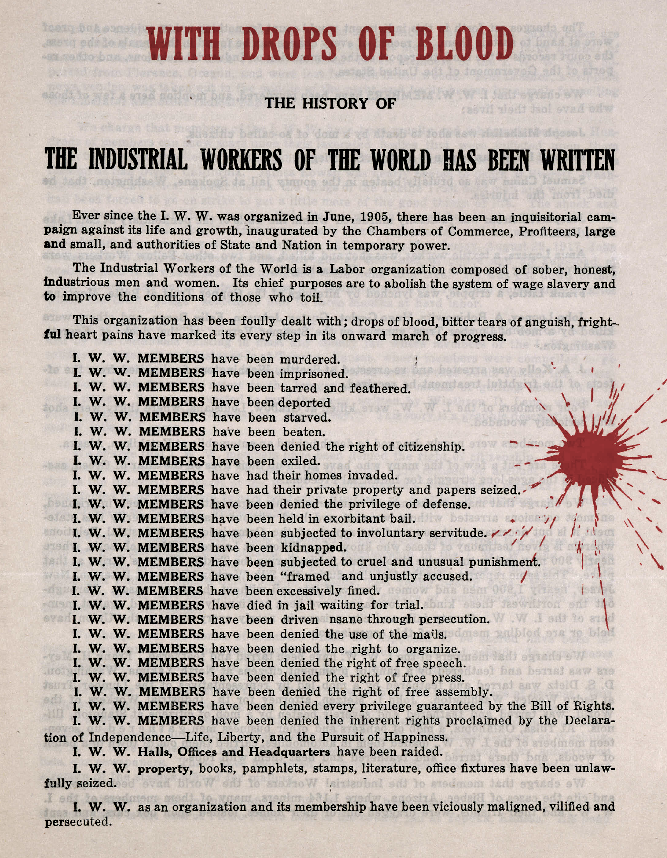
Ever since the I. W. W. was organized in June, 1905, ther has been an inquisitorial campaign against its life and growth, inaugurated by the chambers of commerce, profiteers, large and small, and authorities of state and nation in temporary power.

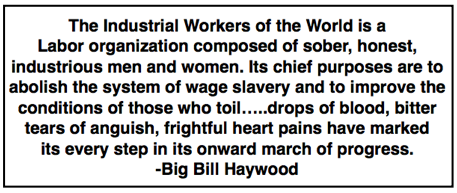
The Industrial Workers of the World is a labor organization composed of sober, honest, industrious men and women. Its chief purposes are to abolish the system of wage slavery and to improve the conditions of those who toil.

This organization has been foully dealt with; drops of blood, bitter tears of anguish, frightful heart pains have marked its every step in its onward march of progress…..

[Emphasis added.]

———-

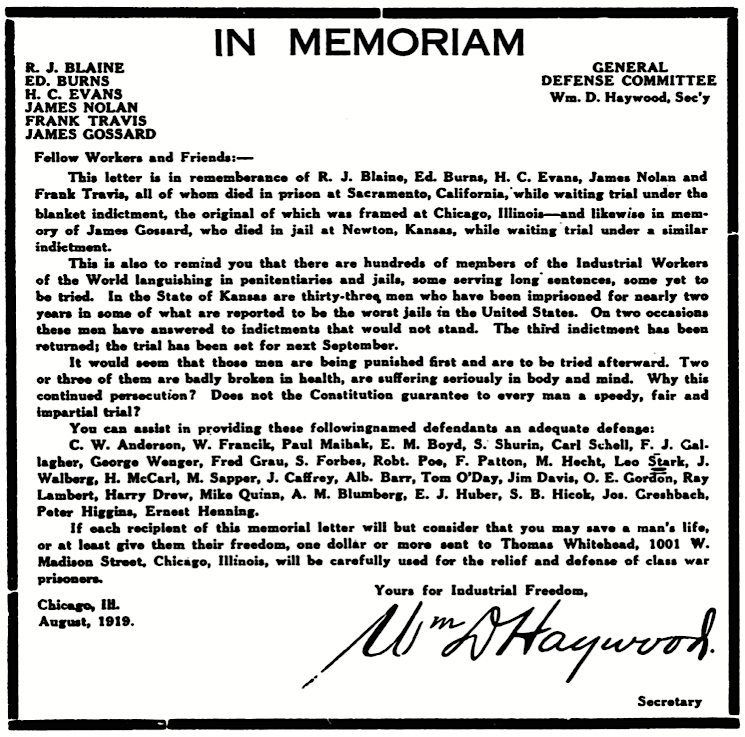
Appeal for Funds by Wm. D. Haywood
-on Behalf of I. W. W. General Defense Committee

IWW BBH w Drops o Blood 1, Sept Oct 1919

—–

Continue reading “Hellraisers Journal: Butte Daily Bulletin: History of IWW Has Been Written “With Drops of Blood” by Wm. D. Haywood”

Hellraisers Journal: Winthrop D. Lane for The Survey: “Uncle Sam: Jailer” – IWWs in Kansas Hell Holes-Insanity & Death

Share

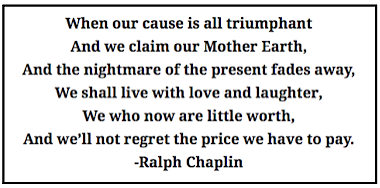
Quote Ralph Chaplin, When we claim our Mother Earth, Leaves 1917———-

Hellraisers Journal – Thursday September 11, 1919
I. W. W.’s Languish in Kansas Hell Holes, Part V & VI of Series by W. D. Lane

From The Survey of September 6, 1919:

IWW KS, Uncle Sam Jailer by WD Lane, Survey p806, Sept 6, 1919
—–
IWW KS, Investigation by WD Lane, Survey p806, Sept 6, 1919
—–

[Parts V & VI of VI.]

V

Several times in this account I have referred to the jails described as having been “chosen” by the United States government for the confinement of prisoners awaiting trial. Let us see what justification there is for the use of this word.

The thirty-four men held under the Wichita indictment were originally taken into custody November 21, 1917. These men were all engaged in the oil industry in Kansas. They were, for the most part, young men, some of them married, some not. Judging from their names-Anderson, Boyd, Gordon, Forbes, Stark, Sapper, Barr, Poe, Gossard, Davis, etc.—many of them were of American or Allied extraction; some foreign names were among them, but only five, so far as I learned, were accused of being enemy aliens. The indictment against them charged violation of the espionage law, the food control law and the selective service law.

On March 10, 1918, a motion to quash this indictment was filed by their attorneys. No ruling on this motion was ever made. The attorneys stood ready, therefore, to go to trial on September 24, the day set. To their surprise, a new indictment was returned on that very day. This was drawn on lines similar to the previous Chicago indictment, which had resulted in sending nearly a hundred I. W. W.’s to prison for terms varying from a few days to twenty years. The attorneys could not at once accept trial on this new indictment, and so they were granted until March 10, 1919, in which to plead.

The men who, in September, had already spent ten months in jail awaiting trial, thus faced another five and a half months of confinement. Miss Lowe, their attorney, undertook to find as comfortable jails as possible, in which, she hoped, they might be allowed to spend the winter. They were then in the Sedgwick county jail, having been transferred to it for the trial. Sheriff Sprout, at Hutchinson, agreed to take twelve of the men, and the sheriff in Winfield, where there was a modern, sanitary jail, agreed to take sixteen. Thinking that she had thus arranged accommodations for twenty-eight, Miss Lowe reported her action to the United States district attorney, Fred Robertson, who was prosecuting the case. Mr. Robertson turned a deaf ear to her plea. In vain did she dwell upon the physical condition of the men and the consequences of spending another five months amid overcrowding and filth. Mr. Robertson said that prisoners had no voice in choosing their places of incarceration, and declared.that he intended to ask Judge John C. Pollock, judge of the United States district court for Kansas, to have all of the men placed in the Wyandotte county jail in Kansas City. This was one of the worst in the state.

Continue reading “Hellraisers Journal: Winthrop D. Lane for The Survey: “Uncle Sam: Jailer” – IWWs in Kansas Hell Holes-Insanity & Death”

Hellraisers Journal: Winthrop D. Lane for The Survey: “Uncle Sam: Jailer” – IWWs in Kansas Hell Holes-Sedgwick County Jail

Share

Quote Ralph Chaplin, When we claim our Mother Earth, Leaves 1917———-

Hellraisers Journal – Wednesday September 10, 1919
I. W. W.’s Languish in Kansas Hell Holes, Part III & IV of Series by W. D. Lane

From The Survey of September 6, 1919:

IWW KS, Uncle Sam Jailer by WD Lane, Survey p806, Sept 6, 1919
—–
IWW KS, Investigation by WD Lane, Survey p806, Sept 6, 1919
—–

[Parts III & IV of VI.]

III

Another jail chosen by the United States for the confinement of its prisoners awaiting trial is the Wyandotte county jail at Kansas City, Kan. I shall not go into detail about this. As at Topeka, the men are kept in an inside stockade or “tank;” this has fourteen or sixteen cells and a somewhat larger bull pen than the other. The pen is artificially lighted. Little attention is paid to ventilation. Although there were upwards of thirty men in the jail at the time of my visit, only one of the thirty-six windows was opened wide and another was opened about two inches. The men complained bitterly of the cold nights, a complaint that I could readily understand when I saw what was provided them for covering. For two nights I had been cold underneath three thicknesses of blanket and a spread, and on one of these nights had got up and placed my overcoat over me. Yet these men had a single blanket apiece, which they could fold at most into two thicknesses.

The toilets, located in an end cell, were dirty and had broken seats. The men ate their meals in their cells, after wards washing their own pans and dishes. The only places where they could wash these were in the bathtub or in the tub in which they washed their clothes. The smell of garbage was almost constantly in their nostrils, since the can for the refuse from their meals was kept inside the tank and was emptied only two or three times a week. It was full when I saw it and gave off a strong odor.

Continue reading “Hellraisers Journal: Winthrop D. Lane for The Survey: “Uncle Sam: Jailer” – IWWs in Kansas Hell Holes-Sedgwick County Jail”

Hellraisers Journal: Winthrop D. Lane for The Survey: “Uncle Sam: Jailer” – IWWs in Kansas Hell Holes-Shawnee County Jail

Share

Quote Ralph Chaplin, When we claim our Mother Earth, Leaves 1917———-

Hellraisers Journal – Tuesday September 9, 1919
I. W. W.’s Languish in Kansas Hell Holes, Part II of Series by W. D. Lane

From The Survey of September 6, 1919:

IWW KS, Uncle Sam Jailer by WD Lane, Survey p806, Sept 6, 1919
—–
IWW KS, Investigation by WD Lane, Survey p806, Sept 6, 1919
—–

[Part II of VI.]

II

To begin with the Shawnee county jail at the state capital of Kansas, Topeka. Ten members of the I. W. W. were confined there at the time of my visit. These were held under what has come to be known as the Wichita indictment. Their original arrest had occurred in November, 1917, so that they had been continuously confined in one jail or another for a year and two months. All of this time they were awaiting trial.

The Shawnee jail is a typical county lock-up in structure. Its outer walls are of brick. Men are confined in a sort of room within a room, formed by constructing a rectangular stockade inside the brick walls. The walls of this stockade are of steel lattice work, the bars of the lattice being about two inches wide and the holes about two inches square. It is through these holes that light and air enter. The cells are built in two facing rows inside the stockade. Their rear walls are the walls of the stockade itself and they open toward its center. In length the stockade is about thirty-five feet, in width twenty-six.

There are five cells in each row. Each cell is seven feet wide, seven feet long and seven feet high. Ordinarily two men are placed in each of these, but when the jail is crowded additional bunks are slung from the sides and four men sleep in this space. The central part of the stockade, that not occupied by cells, is thirty-five feet long and twelve feet wide. This is the prisoners’ livingroom, the only area besides their cells to which they have access. Light enters the jail proper through windows in the outer brick walls. These windows are frosted. The light must, therefore, pass through these frosted windows, through the steel lattice work and travel the length of the cells before it reaches this inner space. The result is that no daylight ever reaches this part of the stockade. The sun was shining brightly on the day of my visit, but its rays did not penetrate to this central area. A single electric bulb burned in the ceiling and shed a ghostly glimmer over the faces of the men; this bulb is kept lighted day and night. It was possible to read in only three of the cells and then only by standing close to the latticework. On cloudy days the men light candles.

Continue reading “Hellraisers Journal: Winthrop D. Lane for The Survey: “Uncle Sam: Jailer” – IWWs in Kansas Hell Holes-Shawnee County Jail”

Hellraisers Journal: Winthrop D. Lane for The Survey: “Uncle Sam: Jailer” – IWWs Locked Up in the Hell Holes of Kansas

Share

Quote Ralph Chaplin, When we claim our Mother Earth, Leaves 1917———-

Hellraisers Journal – Monday September 8, 1919
I. W. W.’s Languish in Kansas Hell Holes, Part I of Series by W. D. Lane

From The Survey of September 6, 1919:

IWW KS, Uncle Sam Jailer by WD Lane, Survey p806, Sept 6, 1919
—–
IWW KS, Investigation by WD Lane, Survey p806, Sept 6, 1919
—–

[Part I of VI.]

I

EARLY this summer, a dozen lines in an eastern news paper conveyed the news that a hundred members of the I. W. W., migratory workers in the oil fields and wheat belt of Kansas, had been locked up in the jails of that state, and that more would be locked up as soon as they came out of the “jungle” into the towns and cities. This information was significant for reasons not appearing on the surface. It meant, if the experience of other members of the I. W. W. during the two years preceding was any guide, that these men faced an indefinite confinement in Kansas jails awaiting trial; that they would be kept in semi-dark and disease-breeding cells; that they would be fed insufficiently; that they would live with rats and vermin; that they would be crowded into quarters too small for them and would spend their days within smell of their own excreta; that they would be kept absolutely idle and that their faculties would suffer from disuse; that at times their only protection against physical abuse would be the strength of their own numbers; that for months at a stretch they would not see the real light of day, much less be allowed out-of-doors; and that some of their number would in all probability go insane or attempt suicide or die.

That is what it is to live in many Kansas jails today.

The evidence for these statements is to be found in the conditions under which other members of the I. W. W. have lived in Kansas jails for two years past. I went to these jails last January and saw the conditions under which these men lived with my own eyes. My purpose was not to befriend the I. W. W., with the philosophy or tactics of which I had no personal concern, but to answer the question: What kind of jailer is Uncle Sam?

Continue reading “Hellraisers Journal: Winthrop D. Lane for The Survey: “Uncle Sam: Jailer” – IWWs Locked Up in the Hell Holes of Kansas”