Hellraisers Journal: Whereabouts and Doings of Mother Jones for March 1902, Part II: Found Speaking in Huntington, West Virginia, and Terre Haute, Indiana

Share

Quote Mother Jones Mine Supe Bulldog of Capitalism—————

Hellraisers Journal – Tuesday April 8, 1902
Mother Jones News Round-Up for March 1902, Part II
Found in Huntington, West Virginia, and Terre Haute, Indiana

From the Baltimore Sun of March 20, 1902:

MINE WORKERS ARE STRONG
———-
Half The Miners In The Virginias
Said To Belong To Union.

(Special Dispatch to the Baltimore Sun.)

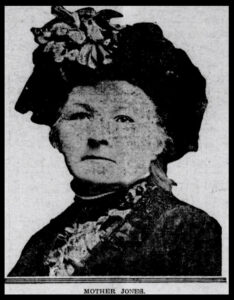
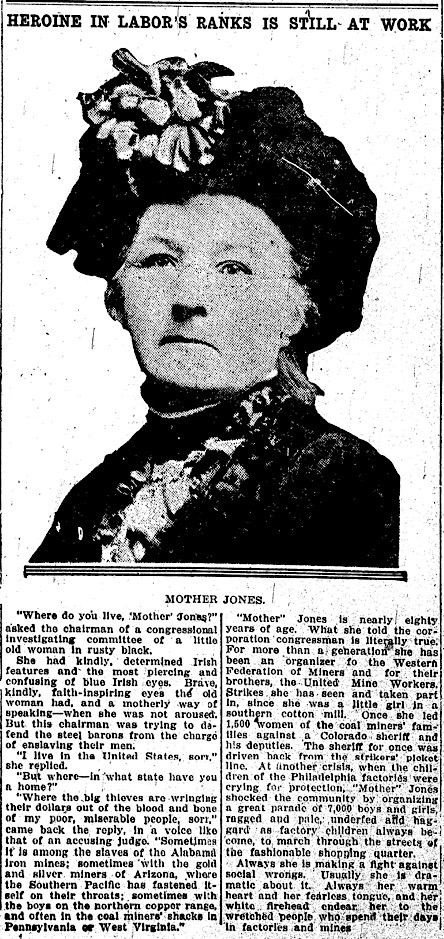
Mother Jones, Ipl Ns p11, Jan 21, 1902

HUNTINGTON, W. Va., March 19.-Reports today made to the United Mine Workers of Virginia and West Virginia, in session here, showed a membership of more than 14,000. This is said to be more than half the number employed in the two States.

The election of officers this evening resulted as follows:

President, John Richards, of Loup Creek; vice-president, L. H. Jackson, of Norwood; secretary, Clark Johnson, of Montgomery; member of national executive committee, J. W. Carroll, of Glen Jean.

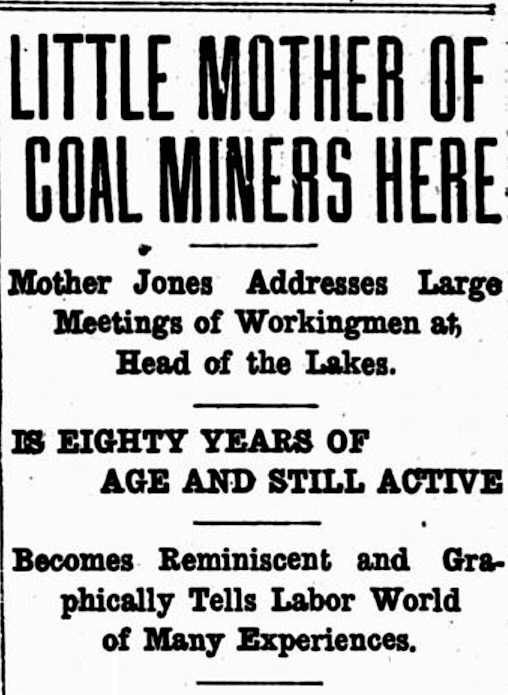
Headed by the famous Temperance Brass Band, of Sewell, W. Va., the miners, together with all organized labor of the city, gave a street parade, after which a big labor mass-meeting was held. “Mother” Mary Jones, of national fame, was chief speechmaker.

The sessions of the convention will probably close tomorrow.

—————

[Photograph added.]

Continue reading “Hellraisers Journal: Whereabouts and Doings of Mother Jones for March 1902, Part II: Found Speaking in Huntington, West Virginia, and Terre Haute, Indiana”

Hellraisers Journal: Whereabouts and Doings of Mother Jones for March 1902, Part I: Praised for Her Work on Behalf of the Socialists of Erie, Pennsylvania

Share

Quote JA Wayland, Mother Jones, AtR p1, Mar 17, 1900—————

Hellraisers Journal – Monday April 7, 1902
Mother Jones News Round-Up for March 1902, Part I
Praised for Her Efforts on Behalf of the Socialist Party of Erie, Pennsylvania

From the New York Worker of March 2, 1902:


HdLn re Mother Jones to Erie PA Feb, NY Wkr p1, Mar 2, 1902———-

Mother Jones, Ipl Ns p11, Jan 21, 1902

The city campaign in Erie, Pa., closed on Tuesday, Feb. 18, after more than two months of the most energetic work, and the results are such as to satisfy the most sanguine. The vote for Mayor stands:

Hardwick, Rep, 4,291.
Warde, Socialist, 3,164.
Warfel, Dem., 1,512.
S. L. P., 163.

The campaign has been one of “boring from within” in the trade union movement-that is, it has been a campaign of education on the Socialist view of the labor question, carried on in the closest harmony with the trade unions, without fear and without compromise. The ticket was composed of men tried in the work of the unions and proven true, headed by Geo. N. Warde of Cigar Makers No. 107, Jas. Wilson, Jr., of the Pattern Makers, H. C. Gould of Typographical No. 77, Julius Erstfeld of the Machinists’ Union, T. H. Mosher of the Carpenters, and G. F. Hibeck of the Molders.

The campaign was waged entirely on educational lines. Meetings were held every night, and in nearly every union hall in the city, and the addresses of the candidates and other speakers were of the straight, uncompromisingly Socialist order. The efforts of the local comrades were most effectively supplemented by Comrades Nic Geiger, A. M. Simons, August Klenke, and Mother Jones. Geiger was with us for ten days, Simons a week, and Klenke two weeks. Mother Jones stopped over with us three days, insisted on paying all her own expenses, and made two of her characteristic speeches, which were of incalculable value to the movement, one at the big labor carnival, the other in C. L. U. hall. The services of these comrades cost us nothing-because they were Socialists.

And Mrs. A. M. Simons [May Wood Simons] should not be omitted. She was with us for two weeks and did effective work for the cause, besides speaking a number of times. We could not utilize her to the extent she desired; because at this stage most of our meetings were held at noon time in the shops; but these two noble women have dispelled the prejudice against “women agitators,” and prepared the field for comrades of their sex. Mrs. Simons made the address at the carnival on ladies’ night. It was pronounced a masterly effort. She also made a deep impression at a big mass meeting in the Second Ward…..

[Photograph and emphasis added.]

Continue reading “Hellraisers Journal: Whereabouts and Doings of Mother Jones for March 1902, Part I: Praised for Her Work on Behalf of the Socialists of Erie, Pennsylvania”

Hellraisers Journal: International Socialist Review: One Big Union Wins Great Victory at Lawrence, Massachusetts, Part IV

Share

Quote Lawrence Strike Committee, Drunk Cup to Dregs, Bst Dly Glb Eve p5, Jan 17, 1912—————

Hellraisers Journal – Saturday April 6, 1912
Lawrence Textile Strikers Win Great Victory with I. W. W., Part IV of IV

From the International Socialist Review of April 1912:

ONE BIG UNION WINS

By LESLIE H. MARCY and FREDERICK SUMNER BOYD

Lawrence Committee of Ten, ISR p628, Apr 1912

In the eighth week of the strike the bosses made an offer of five per cent wage increase. The A. F. of L. scabs accepted it and went back. The I.W. W. strikers turned it down flat. The offer was made on a Thursday, and it was hoped that thousands of strikers would break ranks and stampede to the mills on the following Monday. When the mills opened they had actually fewer scabs, and looked out on a picket line numbering upwards of twenty thousand.

At the end of the following week the bosses discovered they meant an average increase of seven, and later seven and a half per cent, and that they would amend the premium system, paying fortnightly instead of by the month as had been the practice, resulting in the loss to a large part of the workers of the entire premium. Again on the following Monday the mills had still fewer scabs, and the picket line was stronger than ever.

When the Committee of Ten left for Boston on March 11th, for the fourth and final round with the bosses, every one realized that the crisis had been reached. Led by the indomitable Riley the Committee forced the mill owners to yield point by point until the final surrender was signed by the American Woolen Company.

The Committee reported at ten o’clock at Franco-Belgian Hall the next day. The headquarters were packed and hundreds stood on the outside. Words are weak when it comes to describing the scenes which took place when the full significance of the report became known. For the workers, united in battle for the first time in the history of Lawrence, had won. The mill owners had surrendered—completely surrendered.

A great silence fell upon the gathering when Haywood arose and announced that he would make the report for the sub-committee in the temporary absence of Chairman Riley. He began by stating that tomorrow each individual striker would have a voice in deciding whether the offers made should be accepted. He said:

Report of Committee.

The committee of 10 reported in brief that the workers will receive a 5 per cent increase for the higher paid departments and 25 per cent for the lower paid departments. There will be time and a quarter overtime and the premium system has been modified so that its worst features are eliminated.

Your strike committee has indorsed this report and has selected a committee to see all the other mill owners who will be asked to meet the wage schedule offered by the American Woolen Company. In the event that the other mills do not accede to the demands, the strike on those mills will be enforced.

You have won a victory for over 250,000 other textile workers, which means an aggregate of many millions of dollars each year for the working class in New England. Now if you hope to hold what you have gained you must maintain and uphold the Industrial Workers of the World, which means yourselves.

Continue reading “Hellraisers Journal: International Socialist Review: One Big Union Wins Great Victory at Lawrence, Massachusetts, Part IV”

Hellraisers Journal: International Socialist Review: One Big Union Wins Great Victory at Lawrence, Massachusetts, Part III

Share

quote BBH Weave Cloth Bayonets, ISR p538—————

Hellraisers Journal – Friday April 5, 1912
Lawrence Textile Strikers Win Great Victory with I. W. W., Part III of IV

From the International Socialist Review of April 1912:

ONE BIG UNION WINS

By LESLIE H. MARCY and FREDERICK SUMNER BOYD

DRWG Sturges Lawrence Endless Chain Picket Line, ISR p622, Apr 1912

5,000 to 20,000 Strikers Formed the Endless Chain Picket Line
Every Morning from 5 to 7:30 A. M., Rain or Shine.-Boston Globe

Brute force was not, however, the only weapon used by the bosses to try to crush the workers. They had allied with them the A. F. of L., the Catholic church and the Civic Federation a very holy trinity!

Two days after the strike was called John Golden, a member of the Militia of Christ, wired Mayor Scanlon, who had called for militia, asking whether he could be of any assistance to the authorities in suppressing the “rabble,” which he described as anarchistic. Golden and the Lawrence Central Labor Union, affiliated with the A. F. of L., joined in praising the authorities for importing soldiers, and declared that their presence was necessary for “the preservation of order.”

Neither by word nor deed did Golden or the C. L. U. condemn the authorities or their tools for the barbarities and atrocities committed. Vice President Ramsden of the C. L. U., whose two daughters were scabbing in the Arlington mill, when interviewed by the writer was loud in his praises of the militia and the authorities, referred to the I. W. W. as an anarchistic organization that fomented violence and lawlessness, and declared it should be suppressed. He asserted that there was no strike and no organization-only a rabble. When he was asked about the dynamite plot engineered by the bosses through their tool John J. Breen, he naturally refused to comment.

Golden publicly declared that the program of the I. W. W. had acted very much to the advantage of the Textile Workers Union, as it was bringing the latter in closer touch with the mill owners, who understood that it would be more to their interests to deal with the organization, he, Golden, represented rather than with the revolutionary and uncompromising I. W. W.

After having wired, proffering his assistance to the chief of police, Golden got busy in other directions. The mule spinners, numbering according to their own officials, some 180 men, were the only body organized in Lawrence that was affiliated with the A. F. of L. Golden’s union did not have a single member in the whole city. Nevertheless he, in conjunction with Joe R. Menzie, president of the C. L. U., issued circulars to all C. L. U. bodies asking for funds to aid the strike and expressly asking them not to send assistance to the I. W. W.

Then the C. L. U. opened a separate fund. So, too, did Father Melasino, and a man by the name of Shepherd appeared on the scene with some sort of free lunch counter, also appealing for funds.

These various appeals for financial assistance, all made in the name of the strikers of Lawrence, and all calculated to injure the I. W. W. succeeded in diverting large sums of money, the C. L. U. benefiting largely at the expense of the I. W. W. Several times committees from the I. W. W. went to the C. L. U. with evidence that money had been misdirected, but restitution was invariably refused.

Here it may be said that in the seventh week of the strike the C. L. U. strike relief station was practically suspended, applicants being told that the strike was off and that they should return to the mills.

Golden’s next move was to endeavor to organize rival labor unions based on the many crafts in the mills. For several days strenuous attempts were made to divide the workers in the old, old way. Meetings were called by Golden and Menzie, a great deal of money was spent on so-called organizing which had been contributed to the relief funds, and every effort was made to break the solidarity of the workers and get them to return piecemeal.

These efforts failed, the only result being that when the bosses made an offer of five per cent increase over the cut rates—equivalent to an increase of one and one-eighth per cent—a handfull of double-dyed scabs whom Golden had secured to do his work went into the mills.

Golden has shown himself in this fight in his true light, and all the world knows him for a traitor to the working class, and his craft unions are a thing of the past. What Golden did was merely in accord with the policy and doings of the official A. F. of L., and many of the rank and file of the Federation have already woke up to the game of their alleged leaders.

The Ironmolders’ Union that was affiliated with the Lawrence C. L. U. denounced in a resolution the doings of Golden and his gang and withdrew their affiliation. A motion denouncing Golden and his tactics was lost in the Boston Central Labor Union by a vote of 18 to 16. The Central Federated Union of New York City, one of the slimiest haunts of the professional labor crooks in America, even passed a resolution virtually telling Golden to keep his hands off. The Philadelphia Textile Workers’ Union, which had received the Golden appeal, reprinted the I. W. W. appeal for funds and sent several thousand dollars to the I. W. W. war chest.

The latest development in Philadelphia is that 2,000 textile workers have requested I. W. W. organizers to go there and organize a local. All over the country local A. F. of L. unions have denounced Golden and his official friends, and the rank and file of the A. F. of L. has gone on record solidly in favor of their class and against their officials.

Continue reading “Hellraisers Journal: International Socialist Review: One Big Union Wins Great Victory at Lawrence, Massachusetts, Part III”

Hellraisers Journal: International Socialist Review: One Big Union Wins Great Victory at Lawrence, Massachusetts, Part II

Share

Quote Lawrence Strike Committee, Drunk Cup to Dregs, Bst Dly Glb Eve p5, Jan 17, 1912—————

Hellraisers Journal – Thursday April 4, 1912
Lawrence Textile Strikers Win Great Victory with I. W. W., Part II of IV

From the International Socialist Review of April 1912:

ONE BIG UNION WINS

By LESLIE H. MARCY and FREDERICK SUMNER BOYD

Lawrence General Strike Com, ISR p617, Apr 1912

On January 11, anticipating some difficulty on pay day, the Secretary of Local 20, I. W. W. wired to Joseph J. Ettor, member of the National Executive Board, who was then in New York City, to go to Lawrence. He left the next afternoon, and arrived on the night of January 12.

Plans were then laid for the conduct of the strike. A general strike committee was formed that met daily, each nationality on strike being represented on it by three delegates. In addition there were three representatives each from the perchers, menders and burlers, the warp dressers, Kunhardt’s mill, the Oswoco mill, the paper mill, the workers in which had struck in sympathy with the textile workers and presented similar demands, and from time to time other sections were represented that were gradually merged as occasion demanded. The general strike committee thus numbered 56 men and women, all of them mill workers.

The first work of the committee was to devise means for carrying on the fight and caring for the strikers. There were no funds when the strike was declared, but in a week or ten days money began to dribble in from surrounding New England towns, and as the strike continued contributions came in from every State in the Union, from all parts of Canada and even from England.

Lawrence Relief Station, ISR p618, Apr 1912

The money in the shape of strike pay would not have lasted a week, but this battle was conducted on a different basis from former fights. Each nationality opened relief stations and soup kitchens, and was responsible for the care of its own people. The Franco-Belgians had had a co-operative in operation long before the strike, and food purchases were made through its machinery. Money was paid over to the various national committees as it became necessary by the general finance committee, with Joseph Bedard as Financial Secretary. With this money the purchasing committee bought goods, and the national committees took their portion.

Meals were provided twice a day at the various stations for the strikers who needed them, and in this manner the Franco-Belgian station at the Mason street headquarters provided 1,850 meals twice daily, the Italians 3,500, the Syrians 1,200, Lithuanians 1,200, the Poles 1,000, and soon, the Germans took care of 150 families and several hundred single workers.

Lawrence Children w Bread, ISR p618, Apr 1912

Continue reading “Hellraisers Journal: International Socialist Review: One Big Union Wins Great Victory at Lawrence, Massachusetts, Part II”

Hellraisers Journal: International Socialist Review: One Big Union Wins Great Victory at Lawrence, Massachusetts, Part I

Share

Quote Lawrence Strike Committee, Drunk Cup to Dregs, Bst Dly Glb Eve p5, Jan 17, 1912—————

Hellraisers Journal – Wednesday April 3, 1912
Lawrence Textile Strikers Win Great Victory with I. W. W., Part I of IV

From the International Socialist Review of April 1912:

HdLn BBH n re Lawrence Victory, ISR p613, Apr 1912

THE greatest victory in American labor history has been won by the Industrial Workers of the World in Lawrence, Mass., in a pitched battle of nine weeks’ duration against the most powerful cotton and woolen corporations in the world.

For fifty years the great textile corporations had reigned in New England practically unchallenged, save when ten years ago Tom Powers of Providence, R. I.. led a fierce battle against the American Woolen Company.

During the nine weeks of the fight in Lawrence every barbarity known to modern civilization had been perpetrated by police, military, courts and detectives, the willing tools of the bosses. Pregnant women were clubbed and their children delivered prematurely. Children were beaten in the streets and jails. Men were shot and bayonetted, the jail cells were filled, three year sentences were imposed for comparatively trivial offences, and machine guns were brought into the city.

And despite the abrogation without a shadow of legality of every constitutional right, including those of free speech and free assemblage, and despite the provocation offered by the presence of the bosses tools, twenty-two thousand strikers preserved, under the leadership of the Industrial Workers of the World, a self possession and a self-restraint that was little short of marvelous. Not one overt act was committed by the strikers. Not one desperate deed of an infuriated individual was proved against a striker.

For the first time in America’s labor history it has been demonstrated that a bitterly-fought battle between capitalists and workers can he conducted without the workers resorting to any form of violence. If any triumph is to be claimed for the I. W. W. this is one of the foremost of many.

Soldiers v Lawrence Strikers, ISR p 614, Apr 1912

The strike took its rise in hunger and was fought against hunger in the first place, and against excessive exploitation in the second. Sixty years ago, when Lawrence was little more than a village, and the mills were few and small, the daughters of New England farmers came from the farm to the mill to earn pin money. But as the years passed and the mills grew larger and more powerful there came into the city around the mills a class of people who depended entirely upon the mill for a living. They were first English, Irish and Scotch.

Later Germans and French Canadians began to enter and take their place in the mills. and for years these were the only nationalities to be found. Because the labor market was comparatively restricted and the mill owners were greedy for profits they sent lying emissaries through Europe, particularly to Italy, telling of the wealth of America. These men scattered literature broadcast, and showed pictures of the pleasant homes to be gained in the new land. One picture in particular showed a mill worker leaving the mill and on the way to a bank opposite.

Thus the Italian workers were lured to New England, and after them came in quick succession representatives of almost every nationality in Europe and Asia Minor, until today among others there are Syrians, Armenians, Russians, Portugese, Poles, Greeks, Franco-Belgians, Lithuanians, Letts [Latvians], Jews, Turks and Bohemians.

Continue reading “Hellraisers Journal: International Socialist Review: One Big Union Wins Great Victory at Lawrence, Massachusetts, Part I”

Hellraisers Journal: Jack Sellins, Seeks Justice for His Mother, Martyred Mine Workers’ Organizer, Fannie Sellins

Share

Quote M. Robbins, for Fannie Sellins, Wkrs Wld p4, Nov 28, 1919—————

Hellraisers Journal – Sunday April 2, 1922
Jack Sellins Seeks Justice for Murder of Fannie Sellins and Joseph Starzeleski

From the United Mine Workers Journal of April 1, 1922:


SON SEEKS JUSTICE
———-

ASKS THAT SLAYER OF HIS MOTHER,
MRS. FANNIE SELLINS,
BE BROUGHT TO JUSTICE
———

WNF Sellins Starzeleski Monument, The Woman Today p9, Sept 1936

Editor of the Journal: I am writing you concerning the bringing to justice the persons responsible for the death of Fannie Sellins and Joseph Starzeleski, who were murdered in wanton cold blood over two and a half years ago.

For this length of time every effort has been made to find the persons responsible for this crime, and on January 26, last, three deputy sheriffs were arrested for the murder. Even on the information on which the arrests were made the court granted them their liberty on bail, which was only $2,500. However, on February 14, the grand jury returned an indictment against the three, and we are now waiting for a date for the trial to be set.

The three men indicted are: Edward Mannison, John Pierson and James Reilly, former deputy sheriffs.

A copy of a resolution is herewith enclosed asking that the two attorneys we have employed be appointed as special district attorneys. I would like to see this resolution adopted by local unions over the country and be sent to president judge of the Allegheny County courts.

Fraternally yours,
JACK SELLINS.

The writer of the above is a son of Mrs. Fannie Sellins, so brutally murdered by deputy sheriffs in the Brackenridge mine strike. He has had a heroic effort to have the slayers of his mother brought to justice, and says he is taking no chance of a failure of prosecution in the hands of the district attorney’s office.

The resolution is as follows:

Whereas, The District Attorney of Allegheny County has failed to proceed with the prosecution of the murderers of Fannie Sellins and Joseph Starzeleski, or to take any action to bring these offenders to trial, said murders having been committed at West Natrona, Pa., on Aug. 26, 1919;

Be it Resolved, That we believe that private counsel should be employed for that purpose, and that the court be asked to appoint two attorneys as special deputy district attorneys to take charge of said prosecution, and, further, we recommend that the court appoint John S. Robb, Jr., Esq., of Pittsburgh, Pa., and Victor B. Benton, Esq., of New Kensington, Pa., as such special deputy district attorneys, and that a copy of this resolution be mailed to the president judge of Allegheny County courts.

—————

[Photograph and emphasis added.]

Continue reading “Hellraisers Journal: Jack Sellins, Seeks Justice for His Mother, Martyred Mine Workers’ Organizer, Fannie Sellins”

Hellraisers Journal: Children of Lawrence Textile Strikers Back in Arms of Parents, Welcomed Home with Monster Parade

Share

Quote Lawrence Children Home, Ptt Prs p2, Mar 31, 1912—————

Hellraisers Journal – Monday April 1, 1912
Lawrence, Massachusetts – Strikers’ Children Welcomed Home

From The Boston Sunday Globe of March 31, 1912:

HdLn n Photo Lawrence Children Home Parade, Bst Glb p1, Mar 31, 1912

BY FRANK P. SIBLEY.

LAWRENCE. March 30-Into the swarming hundreds round the railroad station the train moved slowly, its bell ringing constantly. With shouts the police forced open a passage across the platform from the station door to the train steps. Women fought to get through that line of police. And then the children passed between train and station and were loaded into the waiting wagons.

If one shut his eyes and disregarded the temperature and forgot that the cries which shivered the air into raucousness were of joy and not of rage, he could imagine that the scene of the morning of Feb. 24 was being enacted again.

But no man could shut his eyes, and nobody could mistake the shouts of delight and the laughter and the excited chatter in a dozen tongues, and nobody could mistake the wine of Spring in the air for the bitter cold of a Winter morning, and if he could, the half-dozen enthusiastic bands which were tooting joyously in the background would tell him that this was the return of the children of the textile operatives to the battle ground where their fathers [and mothers] have won.

—————

Continue reading “Hellraisers Journal: Children of Lawrence Textile Strikers Back in Arms of Parents, Welcomed Home with Monster Parade”

Hellraisers Journal: Children Working in the Textile Mills of Lawrence, Mass., Must Pay the Bosses for a Drink of Water

Share

Mother Jones Quote ed, Suffer Little Children, CIR p10641, May 14, 1915—————

Hellraisers Journal – Sunday March 31, 1912
Lawrence, Massachusetts – Child Workers Must Pay Boss for Drink of Water

From The Coming Nation of March 30, 1912:

CRTN Lawrence MA Child Textile Worker Pays for Water, Cmg Ntn p16, Mar 30, 1912

“Do you have to pay for drinking water in the mills?”
“Yes. Every two weeks I pay ten cents.”
(Excerpt from the statement of a child worker in the mills at Lawrence before the House Committee on Rules in Washington.) – Kansas City Post.

———-

[Detail:]

CRTN Detail Lawrence MA Child Textile Worker Pays for Water, Cmg Ntn p16, Mar 30, 1912

“Drop a nickel in the slot for a drink water.”

Continue reading “Hellraisers Journal: Children Working in the Textile Mills of Lawrence, Mass., Must Pay the Bosses for a Drink of Water”

Hellraisers Journal: Big Bill Haywood with Child Strikers of Lawrence, Mass: Joseph Stefanck, James George and James Marzur

Share

Quote BBH Dream of One Big Union, Bst Glb p4, Jan 24, 1912—————

Hellraisers Journal – Saturday March 30, 1912
Child Strikers of Lawrence, Massachusetts, with Big Bill Haywood

From the Waxahachie Daily Light (Texas) of March 23, 1912:

BBH w Child Strikers of Lawrence, Waxahachie Dly Lt p6, Mar 23, 1912—–

In furtherance of the plans by which money is raised for the benefit of the striking textile workers of Lawrence, Mass, mass meetings are being held in various cities. These gatherings are addressed by representatives of the strikers, and delegations of the younger operatives also participate. The figure at the right in the illustration is William D. Haywood, who is acting in an advisory capacity to the strikers. The boys, mill workers who appeared before the congressional investigatory at Washington as well as at New York and other mass meetings, are, from left to right Joseph Stefanck, James George and James Marzur.

Continue reading “Hellraisers Journal: Big Bill Haywood with Child Strikers of Lawrence, Mass: Joseph Stefanck, James George and James Marzur”