Hellraisers Journal – Sunday April 30, 1922 Mingo County, West Virginia – Miners’ Tent Colony Saved, for Now
From the Duluth Labor World of April 29, 1922:
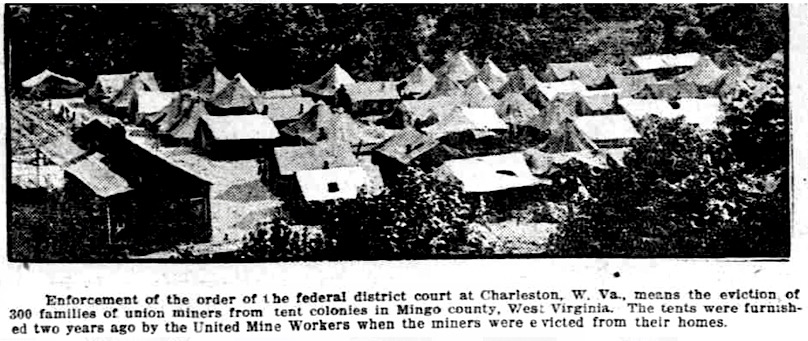
TENT-SMASHING JUDGE CHECKED BY HIGH COURT ———- Circuit Court Stays Order to Drive Miners and Families From Tented Homes. ———-
RICHMOND, Va., April 27.—Federal Judge McClintic’s injunction to smash the Mingo tent colony has been ordered held up by Hon. Martin A. Knapp, judge of the federal court of appeals, fourth circuit.
Judge Knapp’s decision stays this order until it can be heard by the court of appeals. McClintic is also ordered to scrap his injunction machine until the court of appeals reviews his acts.
Several years ago this federal court of appeals set aside the notorious “yellow dog” decision by Federal Judge Dayton, since deceased. This decision legalized the individual contract whereby each worker accepting employment agreed not to join a trade union. The reasoning of the court of appeals was rejected by the United States supreme court, which upheld the “yellow dog.”
—————-
CHARLESTON, W. Va., April 27. —In holding up Federal Judge McClintic’s injunction to destroy the Mingo tent colony and stop union organizing, the federal court of appeals at Richmond has temporarily clipped the wings of a judge who is openly charged with receiving his present position as a reward for subserviency to coal owners while he was a member of the West Virginia state senate.
McClintic is recognized as the author of the West Virginia jury law which permits the prosecution to take a man charged with crime out of his county into another county for trial.
Under this law, which is now in effect, the trial of a striking miner can be transferred to a county like Logan, which is under the complete domination of Baldwin-Feltz gunmen.
When McClintic was appointed last year the A. F. of L. made strong objection because of his bias in favor of coal owners. The latest exhibition of this bias was shown by his issuance of an injunction that would oust hundreds of miners and their families from the only homes they have and which are located on land leased by the union.
The trade, unionists, made no progress in blocking McClintic’s indorsement by the senate because he was supported by the two West Virginia senators-Messrs. Sutherland and Elkins.
Hellraisers Journal – Saturday April 29, 1922 Charles Town, West Virginia – Rev. John E. Wilburn to be Witness at Trial of Miners
From The West Virginian of April 28, 1922:
PASTOR ACCUSED OF TREASON MAIN MINERS’ WITNESS ———- Kept in Solitary Confinement More Than a Month and Then Handcuffed. ———-
By C. C. LYON
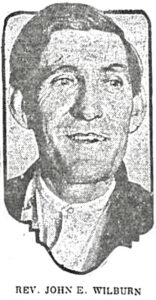
CHARLES TOWN, W. Va., April 27.-Counsel for the hunreds of West Virginia miners on trial here for alleged treason and murder in connection with their armed March to Logan county last August are only waiting a chance to put the Rev. John E. Wilburn, for five years pastor of the Baptist church at Blair, Logan county, on the stand as their star witness.
Rev. Wilburn himself has been held without bail, he was brought in handcuffs to Charles Town from Logan. He is now in jail here.
In court he is the center of all eyes.
Reign of Terror
On the witness stand the Reverend Mr. Wilburn will tell a story of the reign of terror in the Logan and Mingo county coal fields of the “‘battle of Blair Mountain” where men died on both sides, of the alleged mistreatment of miners and their families by the deputies said to have been hired by the coal operators, and of his own mistreatment in the Logan county jail following his arrest.
A round-shouldered, tired little man, with kindly blue eyes, a soft voice and an almost saintly manner-that’s Mr. Wilburn.
Not a word of complaint against anybody has passed his lips.
His Experiences
Mr. Wilburn told me his story here in the Charles Town jail.
[He said:]
I am 45 years old and was born in the mountains of Tennessee. I received a common school education and at 16 I was converted to Christ and joined the Baptist Church.
The ambition of my life was to become a minister, but we were very poor, so I went to work in the coal mines to earn a living while I studied.
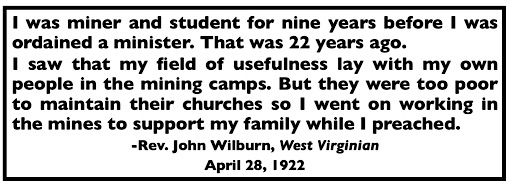
I was miner and student for nine years before I was ordained a minister. That was 22 years ago.
I saw that my field of usefulness lay with my own people in the mining camps. But they were too poor to maintain their churches so I went on working in the mines to support my family while I preached.
Family Prayer Daily
I am the father of five sons and three daughters and never has there passed a day at our home that we haven’t had our family prayers.
Five years ago I became pastor of the Baptist Church at Blair, Logan county. At the same time got a job as track-layer in a union mine. My three sons also worked in this mine.
I was put in solitary confinement [because of?] all the trouble there.
In September I went back to my old home in Tennessee to conduct a series of revival services and it was not until January that I learned that the Logan County grand jury had indicted me for alleged participation in the “battle of Blair Mountain.”
I immediately wrote Sheriff Don Chafin that I would come back if he wanted me, but, not hearing from him, I continued my revival meetings. When I returned to Logan County in March I was dumbfounded to learn that I was under indictment for murder and treason.
I was jailed at Logan. My two sons, John 18, and Frank 16, had been in jail without bond since December 31. A third son, Isaac, had been in jail but was admitted to bond.
The authorities offered me many inducements to turn state’s evidence and testify against the miners but I spurned their offers.
I was put in solitary confinement in the Logan jail on March 14 and remained in solitary confinement until Saturday, April 22, when I was handcuffed to another miner and brought to Charles Town.
Hellraisers Journal – Sunday April 28, 1912 Socialist Party Organizing in West Virginia by Harold Houston
From the International Socialist Review of April 1912:
The Socialist Outlook in West Virginia
[-by Harold W. Houston, State Secretary]
It is impossible to write of the political situation in this state without enthusiasm. The apathy of recent years has given place to a marvelous awakening among all classes of voters. The seed sown by the early agitators has taken deep root in our soil and is bearing abundant fruit. The dues paying membership of the Socialist party is about one thousand.We have ninety-three locals in good standing. Our party press is a development of the last two years, and we now have the following papers:The Labor Argus, Charleston, edited by C. H. Boswell; the Clarksburg Socialist, Clarksburg, edited by E. H. Kintzer; the Wheeling Majority and the West Virginia Socialist, both of Wheeling and edited by Walter B. Hilton; the Plain-Dealer, Cameron, edited by William E. Lang. A movement is now on to start several other papers during the coming campaign.
Several towns in the state have elected Socialist mayors and other officials. Star City, Hendricks, Adamston, Miama and other towns have been swept into the Socialist ranks. All indications point to our carrying at least five counties in the coming election. Our state government is located at Charleston, Kanawha county, and the political piracy that always characterizes the doings of the politicians that infest the seat of government has polluted that community beyond description. The voters there are in revolt. The generals of the old parties find themselves without an army. The Socialists have set themselves the task of electing the entire ticket in that county, especially the legislative ticket. Our enemies freely admit that we have a splendid fighting chance. At Clarksburg, Harrison county, the situation is intensely interesting. It has attracted the attention of all of the lyceum lecturers. The industrial workers of that section are intelligent and progressive, and during the last two years they have been coming into the Socialist movement in battalions. This is another county that is almost certain to land a full Socialist ticket.
At Wheeling there is the same widespread response to the call of Socialism. The voters are organizing the entire county, and there is little doubt but that we will secure at least a portion of the ticket in that county. One of the most gratifying things about the West Virginia movement is the utter absence of factional strifes and disruptive tactics. Some slight differences do indeed exist as to minor matters, but there is no bitter or serious breaches in the organization. On the whole complete harmony reigns. The personnel of the movement is exceptionally high, and the movement is revolutionary to the core.
This is a war-born state, and it has a population that illy wears the collar of industrial servitude. When it seceded from Old Virginia it placed upon its coat of arms the motto: “Montani Semper Liberi” (Mountaineers are always free), and the sweep of the Socialist movement over the mountains and valleys indicates that we are going to translate those words into a reality. We send greetings to our comrades of other states, and we say to them that the coming election will show that we have been in the thick of the battle.
Hellraisers Journal – Thursday April 27, 1922 Welch, West Virginia – Gunthugs Acquitted of Murder in Killing of Sid Hatfield
From the Baltimore Sun of April 25, 1922:
Three Are Acquitted Of Hatfield Killing ———-
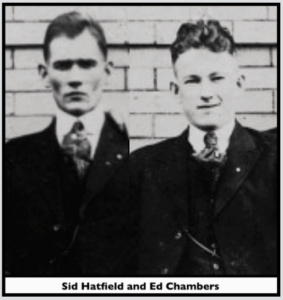
Welch, W. Va., April 24.-The final chapter in one of Mingo’s numerous industrial tragedies was written here today when a jury in Circuit Court returned a verdict of not guilty against C. E. Lively, Buster Pence and William Salters, indicted in connection with the killing of Sid Hatfield.
A similar verdict was returned when the same defendants were tried on charges of having killed Ed Chambers.
On August 1 last,Hatfield and Chambers came to Welch to answer for the part they were alleged to have played in the shooting up of the little mining town of Mohawk. As they were walking up the Courthouse steps, near where the three defendants were standing, a shot was heard, and when the smoke of general shooting cleared away the bodies of Hatfield and Chambers lay at the bottom of the steps.
They were accompanied by their wives when the shooting occurred.
Lively was the chief witness against Hatfield and the other men who were tried in connection with the killing of seven private detectives at Matewan. In that fight 10 men met death, including Mayor C. C. Testerman.
Shortly after this affray, Hatfield married Testerman’s widow, and soon after Sid went down at Welch his widow married a State trooper.
Hellraisers Journal – Wednesday April 26, 1922
Charles Town, West Virginia – Miners Resent Treason Charge
From the Baltimore Sun of April 25, 1922:
(From a Staff Correspondent.)
Charles Town, W. Va., April 24.-Attacking directly the indictment charging treason, attorneys for the defense in the big industrial trials which opened here this morning began their fight to clear more than 100 men, mostly members of the United Mine Workers of America, of charges growing out of the armed march from Marmet, Kanawha county, to Logan county last August and September.
Entering a demurrer to the treason indictment, which covers 23 defendants, had been expected, and from the legal point of view is regarded as purely a routine move. From the moral point of view, however, and particularly , considering the effect it may have on public pinion, the outcome of the maneuver is regarded by the defense as of paramount importance.
Treason Charge Resented.
Indictments for murder and conspiracy were more or less expected in the circumstances by the United Mine Workers, but the indictment for treason always rankled. It is their contention that they are as patriotic citizens as anybody, and that they never for an instant contemplated war on the constituted authorities of the United States or West Virginia.
The arguments today, therefore, were followed with more interest than was usual at such a stage an ordinary trial, and many of those accused betrayed not a little tenseness as the attorneys held forth.
The arguments on which the demurrer was based were largely technical, fault being found in one instance with the language of the indictment, and in another with the alleged general character of the offenses charged. The tediousness of the arguments, however, never for an instant acted to break attention with which the case was followed by the crowd in the courtroom.
Judge J. M. Woods, of Martinsburg, who is presiding, reserved his decision on the demurrer until the morning, and court adjourned about 3.30 this afternoon.
Crowd Has Holiday Air.
The crowd in front of the Courthouse this morning, far from presenting the grim aspect you might expect from men about to go on trial for their lives, were rather a holiday air. The defendants had been provided with ribbons reading “U. M. W. A. – Defendant,” which made them look more like a lot of delegates to a fraternal order convention than men accused of the most serious crimes on the statute books.
Hellraisers Journal – Tuesday April 25, 1922
Charles Town, West Virginia – Stage Set for Trial of Miners
From the Baltimore Sun of April 24, 1922:
(From a Staff Correspondent.)
Charles Town, W. Va., April 23.-Excited, nervous, confident here, depressed there, a small army of defendants, witnesses, attorneys and newspaper men has taken possession of Charles Town on the eve of the trials of more than 200 men on charges including treason, murder and conspiracy, growing out of the “armed march” from Marmet on Logan county last summer.
It is estimated that fully 1,000 persons are in the little county seat of Jefferson county in connection with the trials.
Trials Are Sole Topic.
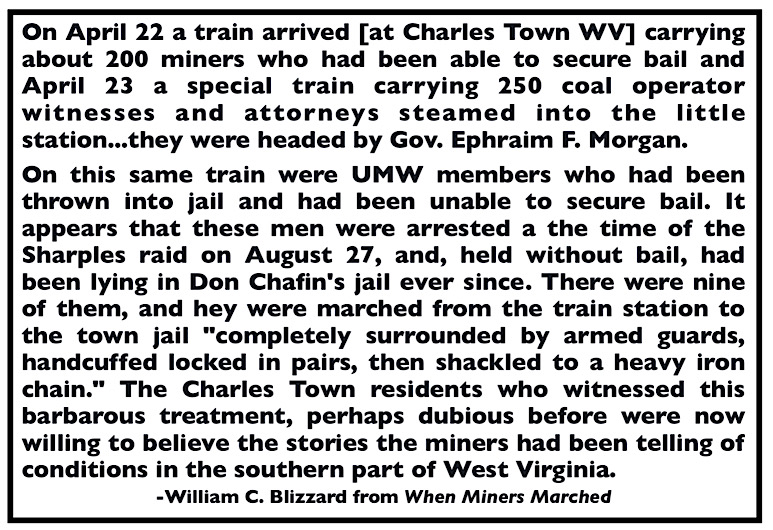
All over town, in the lobbies of the hotels, on street corners, gathered in knots here and there, they are discussing one thing-the trials. They have been arriving since Friday. A grim incident this morning was the arrival of nine men in handcuffs from Logan county. They were those who are unable to get bail after being indicted in Logan last year. They were escorted to the Charles Town jail.
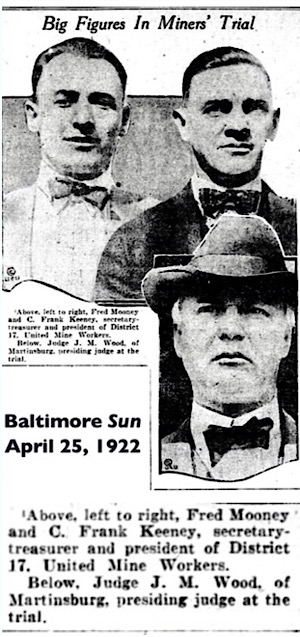
Central figures in the whole West Virginia industrial controversy already are in town and others are expected tomorrow and on succeeding days. There is C. Frank Keeney, president of District No. 17, United Mine Workers, and the man, who, it is believed, will be the target for the heaviest artillery of the prosecution. He faces a charge of treason and is alleged to have instigated and aided the alleged insurrection. With him are Mrs. Keeney and their son. He is at one of the hotels, smiling and high-spirited as usual.
There is Fred Mooney, secretary of District No. 17, also charged with treason. He is a bit more self-contained than Keeney, yet you would scarcely know he was to be tried on a charge that might bring his neck into a noose.
Scores Of Notables Present.
There is H. W. Houston, chief counsel for the defense, often called the “brains of the United Mine Workers in West Virginia.” There is William Blizzard, accused of being the “generalissimo of the insurrection.” There are a half-dozen special lawyers engaged by the prosecution, famous in the annals of West Virginia criminal procedure. There are scores of others of lesser prominence, though all are well enough known in their localities.
Before the week is out, Gov. E. F. Morgan will be here, having been subpoenaed by both sides. William M. Wiley, of Sharples, picturesque figure among the operators, around whose mines the fighting raged last summer, will be called. John L. Lewis, international president of the United Mine Workers, will be here Tuesday.
One big, outstanding figure, however, from all that can be learned, will not be here. He is not here tonight and it is reported he will not come. That is Don Chafin, Sheriff of Logan county. Chafin has been for years the bete noir of the United Mine Workers. He has worked against them, resisted two armed marches, and in general earned for himself the undying hatred of many connected with the big mine union…..
—————
[Emphasis added.]
From the Baltimore Sun of April 23, 1922:
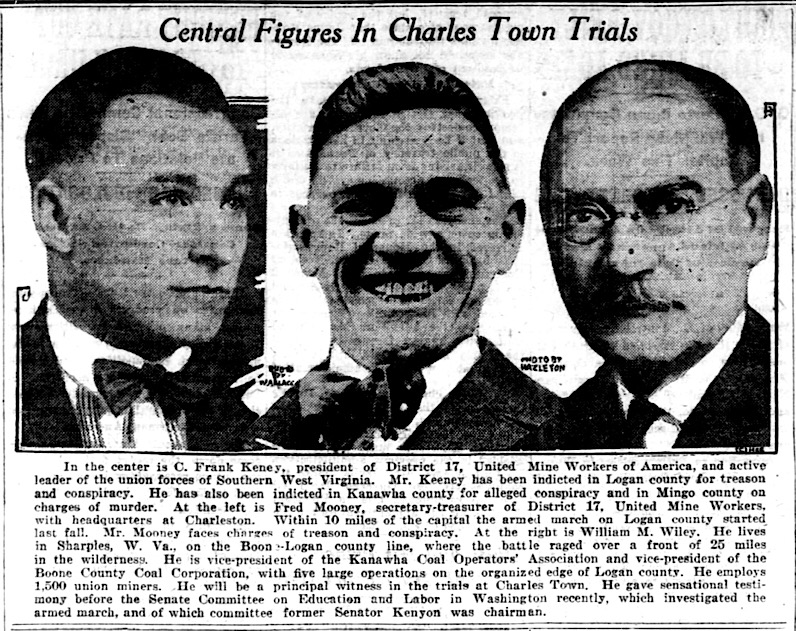
In the center is C. Frank Keeney, president of District 17, United Mine Workers of America, and active leader of the union forces of Southern West Virginia. Mr. Keeney has been indicted in Logan county for treason and conspiracy. He has also been indicted in Kanawha county for alleged conspiracy and in Mingo county on charges of murder. At the left is Fred Mooney, secretary-treasurer of District 17, United Mine Workers, with headquarters at Charleston. Within 10 miles of the capital the armed march on Logan county started last fall. Mr. Mooney faces charges of treason and conspiracy. At the right is William M. Wiley. He lives in Sharples, W. Va., on the Boon-Logan county line, where the battle raged over a front of 25 miles in the wilderness. He is vice-president of the Kanawha Coal Operators’ Association and vice-president of the Boone County Coal Corporation, with five large operations on the organized edge of Logan county. He employs 1,500 union miners. He will be a principal witness in the trials at Charles Town. He gave sensational testimony before the Senate Committee on Education and Labor in Washington recently, which investigated the armed march, and of which committee former Senator Kenyon was chairman.
Hellraisers Journal – Wednesday April 24, 1912 London, England – Statistics Prove Class-Discrimination on Titanic
From The Daily Herald of April 22, 1912:
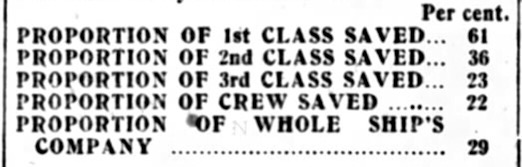
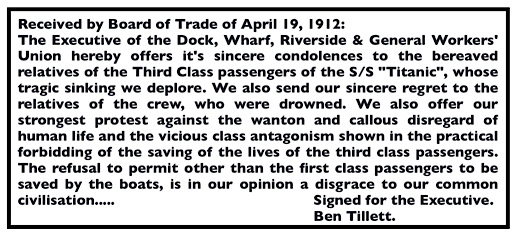
The various representatives of the capitalist Press have taken Mr. Ben Tillett sharply to task for declaring, in a printed statement, that obvious discrimination was apparent in favour of the cabin passengers when the “Titanic’s” lifeboats were being manned. Mr. Tillett probably overstated himself when he spoke of “the vicious class antagonism shown in the practical forbidding of the saving of the lives of the third-class passengers.”
That the facts in the long run justify Mr. Tillett, however, is shown in the proportions of those rescued in each class to their several totals, which the DAILY HERALD here prints for the first time. They are as follows : Per cent:-
Hellraisers Journal – Tuesday April 23, 1912
Cambridge, England – Letter to Editor Condemns Ben Tillett
From the Cambridge Daily News of April 20, 1912:
MR. BEN TILLETT AND THE TITANIC,
TO THE EDITOR.
Received by Board of Trade April 19, 1912
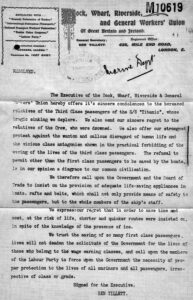
Sir,-According to the “Labour Gazette,” Mr. Ben Tillett is reported to be circulating a resolution passed by the Executive of the Dock, Wharf, Riverside and General Workers’ Union, protesting “against the wanton and callous disregard of human life and the vicious class antagonism shown in the practical forbidding of the saving of the lives of the third-class passengers on the ill-fated Titanic.”
Does Mr. Tillett know that as far as is known at present an equal number of each class has been rescued, and that several millionaires have perished, giving their lives heroically for the sake of the women and children? Mr. Tillett ought to be thoroughly ashamed of himself, and the sooner he publicly apologises for his insults to those brave men the better will be his position in the eyes of the workers. He is called a champion of the workers, but if this is a sample of the sympathy he extends then my opinion is that he ought to change places with one of those bravo first-class passengers who so heroically sacrificed their lives irrespective of class. The sooner the workmen select different men for their leaders the sooner will their needs be granted. Such men as these are not worthy to be called Englishmen.- Yours, etc.,
C. C. P. BARRETT.
79, Hills-road.
[Resolution to Board of Trade and emphasis added.]
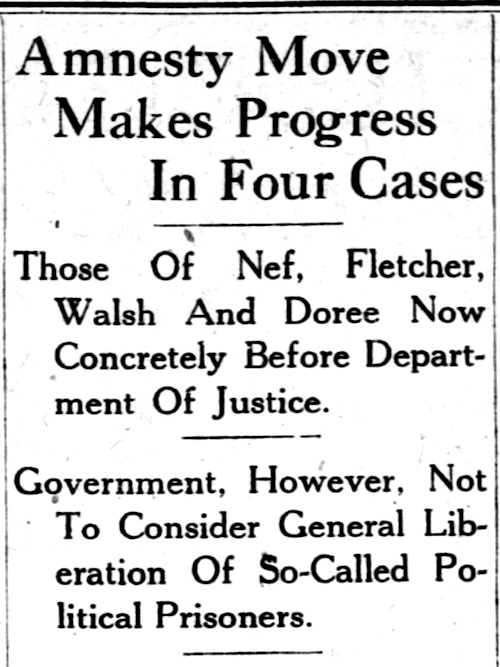
Hellraisers Journal – Saturday April 22, 1922 Washington, D. C. – Amnesty Possible for Fletcher, Nef, Walsh and Doree
From the Baltimore Sun of April 20, 1922:
(From The Sun Bureau.)
Washington, April 19.-In the face of a renewed effort, led by the American Civil Liberties’ Union, to secure the pardon or commutation of sentences of 113 so-called political prisoners who still are in Federal prisons, it was learned today that the Department of Justice has no thought of recommending amnesty for the group. It is willing, however, to take up individual cases in the usual way, it is said. Apparently only Presidential intervention can accomplish general amnesty, and of that there is no sign.
Four cases are now concretely before the department-those of Walter T. Nef, Ben Fletcher, John J. Walsh and Edward F. Doree. They were members of the Marine Transport Workers’ Union, of Philadelphia, which is affiliated with the I. W. W. They were sentenced to prison by Judge Landis, in Chicago, because of their activity in the I. W. W., although, it is asserted by their friends, they had been wholly loyal to the Government in their work at Philadelphia.
No Evidence Yet Of Disloyalty.
Investigation made thus far by the Department of Justice has failed to disprove contentions of champions of Nef, Fletcher, Walsh and Doree that the Transport Workers’ Union in Philadelphia, which Nef, dominated and which embraced practically all of the dock workers in Philadelphia, performed its work with complete loyalty to the Government.
Dr. Frederick Edgerton, of the University of Pennsylvania, a champion of the men, has said that the Philadelphia dock workers did better than those anywhere else.
Dr. Frederick Edgerton has said that enormous quantities of munitions were shipped from Philadelphia during the war without a single accident at the dock or on any ship loaded at the dock; that many accidents occurred at other ports, and ships loaded elsewhere were taken to Philadelphia and reloaded. He also asserted that there was no strike in 1917 among the Philadelphia longshoremen, although strikes occurred elsewhere; that Nef used his influence against a strike, and also intervened against strikes in Boston and Baltimore; that many of the members of the Philadelphia union entered the service and that the members of the union bought $115,000 of Liberty bonds.
Thinks Record Should Count.
All of this, according to Dr. Edgerton and others, should outweight any significance that may attach to the activity of the four men in the central organization of the I. W. W., which led to their indictment and conviction with a large number of others, under the Espionage act, on charges of conspiracy.And it seems that Government officials, so far as they have gone into these cases, have no evidence that the men were not helpful to the Government at Philadelphia or that they were guilty of any overt acts elsewhere.

 —————
—————
 —————
————— —————
————— —————
————— —————
————— —————
————— —————
————— —————
————— —————
—————