 —————
—————
Hellraisers Journal – Tuesday January 28, 1913
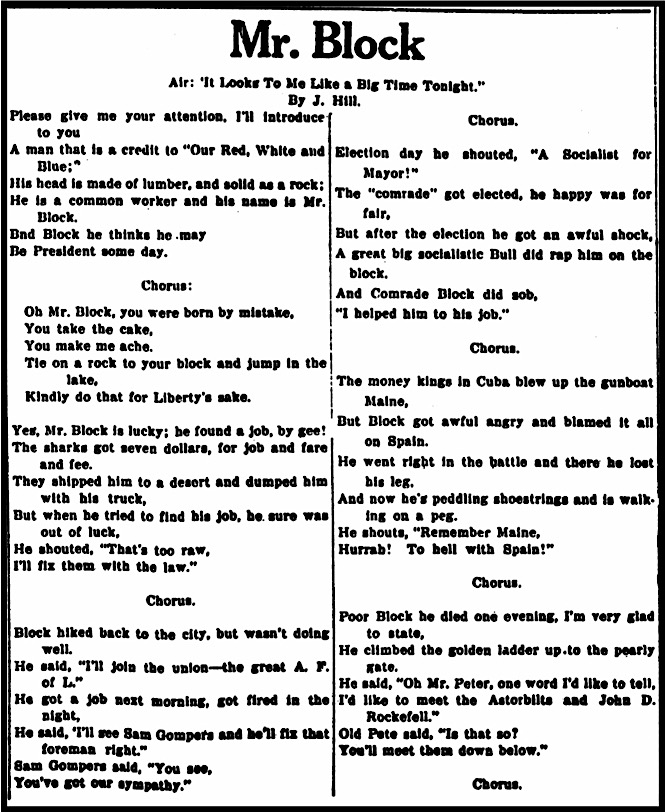
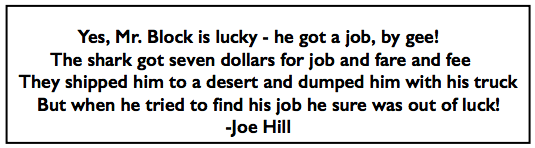
Fellow Worker Joe Hill Introduces Mr. Block, a Common Worker
From the Spokane Industrial Worker of January 23, 1913:
—————
Hellraisers Journal – Tuesday January 28, 1913
Fellow Worker Joe Hill Introduces Mr. Block, a Common Worker
From the Spokane Industrial Worker of January 23, 1913:
 —————
—————
Hellraisers Journal – Monday January 27, 1913
New York, New York – Theresa Malkiel on Suffering of Garment Workers
From The Coming Nation of January 25, 1913:
Striking for the Right to Live
-by Theresa Malkiel
[Part II of III]
The clothing workers have suffered and starved, and, it must be admitted, tried to improve their condition by frequent strikes and attempts at organization. But their organizations, even as their strikes bore local character. One part of the trade, or one branch, or subdivision would go out on the warpath, but its struggle was doomed from the start, for the rest of the industry continued its work as if nothing had happened.
The German hated the Jew, the Jew the Italian, who is trying to wrench the trade from him, the Italian despised the Russian, the Russian the American, the cutter looked down upon the operator, the operator exploited the finisher, the finisher the helper, and while this was going on the employers exploited them all to their heart’s content.
The United Garment Workers of America, though considered the mother body of the clothing trade occupied themselves chiefly with one branch the overall-making, which is mostly in the hands of American women, and paid but little attention to the woes and sorrows of the tailors, perhaps, because the latter was considered beyond redemption.
Thus have men, women and children slaved for over seventy-five years. Thus have thousands upon thousands gone to their early graves, victims of consumption, heart disease, malnutrition, insanity. The man in charge of the claim department of the Workingman’s Circle, most of whose members are garment workers, told the writer that nine-tenths of their members died before they reached the age of forty.
And with the tailors the general public suffered. Unsanitary work-rooms, sweat-shop labor means infection of the garments, and eventually of the public who wear them. Our coats and suits were and still are made in places where smallpox, scarlet fever, diphtheria, measles, consumption and numerous other contagious diseases make great inroads. Our garments are made by workers themselves afflicted with disease, as a matter of fact, the workers in the sweat-shops and tenements not only work on the garments we wear, but often use them to sleep on or to cover themselves with.
Thus have ninety-two million people all over the country been subject to disease and contagion carried to them in their garments from Baltimore, Philadelphia, Chicago, Rochester and New York. For these cities produce 70 per cent of the entire output of man’s and children’s clothing, while New York alone produces one-third of the entire output.
New York was always the largest center in the clothing industry. The city has the natural advantages for production of all grades of clothing. Here, too, a large body of tailors land from Europe, and for the most part remain. The tailors form the nucleus for the better grades of work, while the hundreds of thousands of immigrants landing here yearly enable the employers to obtain cheap labor for the lower grade of garments.
The 125,000 striking garment workers think and say that their strike should be the concern of the entire nation. That their demand for the abolition of the sweat-shop and the subcontracting system should meet the endorsement of every thinking man and woman.
As a matter of fact, even the capitalist press, always ready to slur labor and denounce strikes has exhibited a more human attitude in this strike. It has gone even so far as to express its approval of the abolition of the sweatshop, this perhaps, not because it loves the garment workers so much, but that it wants to protect the general public more.
Then again the sudden display of solidarity has almost taken our newspaper men off their feet. And how wonderful this display is at present can be fully appreciated by an eye witness only. From the highest to the lowest, the few Americans as well as the great body of foreigners, the bulk of Jewish men even as the Italian women stand out for the recognition of their union, for the joint settlement with all branches
“When did the tailor learn this class solidarity? How did he come by it?” ask our upholders of the present regime. They know not, or don’t care to know that the world moved a bit of late, that the progress of evolution, the age of industrialism has advanced the cause of the working class. That the workers are not only firmly-planted on the economic field, but that they have a great political party, the Socialist party, that they have a great press in almost all languages represented in the tailoring industry, the Socialist press.
—————
Hellraisers Journal – Sunday January 26, 1913
New York, New York – Theresa Malkiel Observes Ten Thousand Pickets
From The Coming Nation of January 25, 1913:
Striking for the Right to Live
-by Theresa Malkiel
[Part II of III]
Ten Thousand Pickets
A tumult, a commotion, a shout and I found myself eagerly peering out of the window; many heads pressed close about and in back of me. They were coming from the field work, the pickets I mean. Not two, not ten, not a hundred, but 10,000 strong, an army of labor, a city in itself.
My God! how powerful they looked. Every stone in the street pavements, every brick of the dark grim tenements seemed to have spoken to me of it. I was moved to tears of joy. I felt like a long-lost traveler who had at last found the right road. Now I knew it. There is where the true power, the road to freedom, was to be found in the combination and solidarity of labor.
These ten thousand tailor pickets were a power that even New York could not combat. It would take the entire police force to fight them man to man, or rather man to woman, for the women are really the greater fighters, the most determined pickets of the two.
Out of the picket line came an Italian woman, a mother of six children. She was beaten up by the police while watching her shop with a few others. The brutal thugs in police uniform knocked her about, bruised her face, disheveled her hair, tore her clothes off her back and Lord knows what else they might have done to her had she not been rescued by the army of 10,000.
Thus is the working class mother treated by our capitalist government, for no other crime than the earnest desire to earn an honest living for her children.
She took it calmly, stoically, as they all take it, the true Roman matrons that they are. “It’s all for my childs,” she said. “I fight them again. I no care.”
And still the picket line marched onward like a threatening cloud from above. They feared nothing, not even the elements. Occasionally one would fall out of their midst for the same reasons as the Italian woman came out of the picket line, but the men, like the women, took the medicine dealt out to them by the police and thugs like good fellows.
—————
Hellraisers Journal – Saturday January 25, 1913
New York, New York – Theresa Malkiel on the Scene with Striking Garment Workers
From The Coming Nation of January 25, 1913:
Striking for the Right to Live
-by Theresa Malkiel
[Part I of III]
GRANDMOTHER! what are you doing here?” I asked of an old, old Italian woman who came up panting to the fourth floor of Clinton Hall. She turned around, looked me over with her black, penetrating eyes, which in spite of her age had not lost their luster and said:
“Me striker. Who you are?” I showed her my speaker’s card issued by the joint committee of the Socialist party and the United Hebrew Trades and she nodded her head in approval. I told her I was anxious to hear the story of the strike from the lips of the workers themselves.
“Me no speak much English,” she replied, “but me tella you just what me feel.”
She pulled up her gray, worn shawl which had slid down from her bent shoulders, smoothed her snow-white hair and slowly in broken English told me her tale of woe and suffering.
As she talked on I observed her closely and wondered what had kept up the fire and activity in that aged body, perhaps her very sorrow and unbelievable struggle for existence, for the revelations made by these aged lips sent a chill through me, filled my heart with horror. I knew that her case was not singular, that her condition was characteristic of the condition of all of her sisters in the trade and they constitute 60 per cent of the entire number of 15,000 women workers in men’s and children’s clothing industry.
She told me of twenty long years spent in the clothing workshops where the air is constantly surcharged with the foulest odors and laden with disease germs, she complained of the lack of sunlight of which she had so much in her own land. Here she had to spend her days working by artificial light. She complained of the long hours when work was plentiful, of the dread of slack time, of the small wages at best.
A bread winner for her own children in her younger days, when she first came to this country, she was now supporting two grand-children whose mother fell a victim to the ravages of consumption. Consumption invaded the old Italian woman’s family, as it had invaded the families of most of the clothing workers, carrying them off in the prime of life. The old woman was exceptionally strong, and she and the two small children she was supporting were the only survivors of the whole family.
These children, who are the apple of her eye, she keeps in a two-room flat of a rear eight-story tenement house located on East Houston street, the district where most of the clothing workers lived in order to be near their workshops, and where the population is recorded to be 1,108 to every acre. She pays $8 a month for rent and keeps two boarders to help pay it.
Strike for Love of Grandchildren
This woman who lacks only five years to the allotted three score and ten must finish 20 pair of pants, that is, sew on the lining, serge the seams, finish up the legs, sew on buttons and tack the buttonholes in order to make a dollar a day; $6 a week is the highest she ever makes in season. The season in the clothing industry lasts from March to June and from September to December. The old woman is no exception, to the rule, $6 per week, in fact, is above the average, many make less and very few more. They have no regular hours, but work as long as there is work, sometimes twelve, and fourteen hours a day.
It was not herself that the old Italian woman considered so much, as her poor orphan grand-children who had to take up the trade where she would leave it off.
“Why me strike you ask?” all the venom of the years of sorrow and wretchedness, all the bitter memory of her sacrificed children, cried out in her voice of defiance.
 —————
—————
Hellraisers Journal – Saturday January 24, 1903
Mother Jones News Round-Up for December 1902, Part II
Found Organizing in West Virginia for the United Mine Workers
From the Clarksburg Daily Telegram (West Virginia) of December 27, 1902:
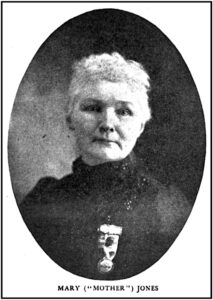
“MOTHER” JONES VISITS CLARKSBURG
———-
Upon Her Return From the New River District
-On Her Way to Tunnelton
to Make an Address to Miners.
———-Talked Freely of Strike Conditions
in Other Sections of the State
-Compliments Jackson but Has no Flattery for Goff.
“Mother” Jones, the noted strike and labor agitator, arrived in the city Friday evening on No. 12 from the New River district. She reports conditions in that field unsettled and the strike unended. Many miners are residing in camps and there is considerable suffering. She paid her compliments to both Judge John J. Jackson and Judge Nathan Goff. She thinks Judge Jackson has a tender spot in his heart but entertains a different opinion of Judge Goff. Her remarks about the latter were not at all flattering. She left Saturday morning for Tunnelton to address a mass meeting of miners there Saturday night.
She believes the Roosevelt commission’s work will be of much benefit to the miners’cause, especially in the way of moulding public opinion. She also thinks that some beneficial legislation will result from the investigation of the commission. She expressed herself as gratified with what she termed a more liberal spirit on the part of the press toward the miners.
She reviewed briefly prevalent conditions in some sections of the southern part of this state. She says the miners are allowed the regulation weight and the short ton and they have the privilege of buying at the pluck-me store as she terms it or elsewhere. There is nothing compulsory about it. She thought under those circumstances that the strike had been beneficial to the miners.
Inquiry was made by her as to what was doing around here. She made no comment when informed that all was quiet and we were running along in the even tenor of our ways.
“Mother” Jones was in her usual splendid health and was quite talkative and courteous.
While in the city she was the guest of Mr. and Mrs. D. W. McGeorge in Glen Elk.
[Photograph added.]
 —————
—————
Hellraisers Journal – Friday January 23, 1903
Mother Jones News Round-Up for December 1902, Part I
W. V: Saved from Suspicious Hotel Fire; Ill: Attends Celebration for Mitchell
From The Richmond Dispatch (Virginia) of December 3, 1902:
TO BURN “MOTHER” JONES.
———-
This Seemed the Object of Incendiaries
at Montgomery, W. Va.Mother Jones,
PARKERSBURG, VA., December 3.-(Special.)—”Mother” Jones, the friend of the miners, narrowly escaped with her life from a burning hotel at Montgomery, early this morning.
Mrs. A. R. Wagoner, the wife of the proprietor of the Montgomery Hotel, was aroused from her slumbers and gave the alarm. The room occupied by “Mother” Jones was full of smoke when she wakened, and in a short time she would have been suffocated.
The fire was of incendiary origin, starting in a room that had not been occupied for three days. The hotel has been on fire three times within the past few weeks, and it is supposed that it was because “Mother” Jones was stopping there.
John C. Todd, one of the guests, had a hip fractured by jumping from the third story window. All the guests lost most of their valuables and clothing.
[Photograph added.]
From Hinton Daily News (West Virginia) of December 6, 1902
Mother Jones was at Beckley yesterday and made a speech at the labor meeting.
From the Duluth Labor World of December 13, 1902:
Mother Jones was nearly suffocated in a hotel fire at Montgomery, W. Va., this week. The fire was of incendiary origin. The coal operators would not be sorry to learn that Mother Jones lost her life, and it is not improbable that some of their thugs had something to do with firing the hotel.
From the Chicago Inter Ocean of December 15, 1902:
MITCHELL IS HERE; RECEIVES OVATION
———-
Mine Workers’ Chief Greeted by Chicago Labor Men.
———-HAS LITTLE TO SAY
———-
Refuses to Discuss Matters Before the Commission.
———-
Goes to Spring Valley Today for Reception
and Will Hasten Back to Scranton.
———-John Mitchell, president of the United Mine Workers of America and the most prominent figure in the labor movement today, arrived in Chicago at 10:30 o’clock last night. He will leave at 9:15 o’clock this morning for his home in Spring Valley, where a public demonstration is planned in his honor by the residents of that city.
The train on which Mr. Mitchell arrived was delayed seven hours on account of a snowstorm, but the friends who had gathered to greet him waited patiently for his arrival. The Cabdrivers’ union sent a carriage to the depot, and he was driven to McCoy’s hotel, where he was given an ovation by the crowd in waiting in the rotunda.
[…..]
“Mother” Jones Here.
At the same hotel is “Mother” Jones, the socialist agitator and organizer of the miners of the country. She will be one of the speakers at the reception at Spring Valley today. Mrs. Jones is almost as popular among the miners as Mr. Mitchell, and while she shakes her head over the probable outcome of the investigation of the commission, she is rejoicing that the actual condition existing in the mines are being held up to the public.
[She said:]
I have been preaching about those conditions for years, but the world refused to listen. It is listening now, and whatever the final outcome may be it cannot fail to be an advantage to the suffering miners.
 —————
—————
Hellraisers Journal – Wednesday January 22, 1913
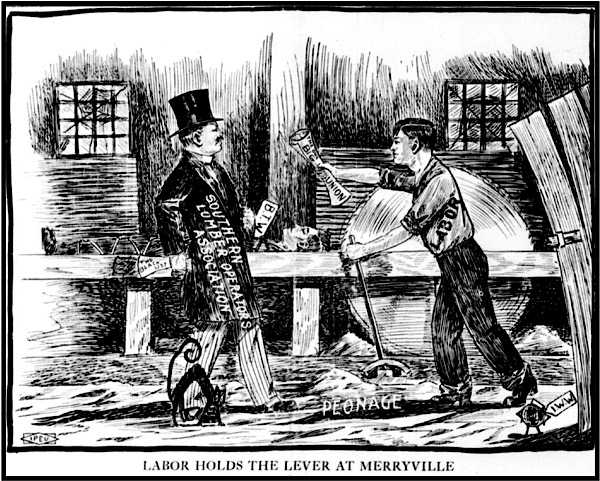
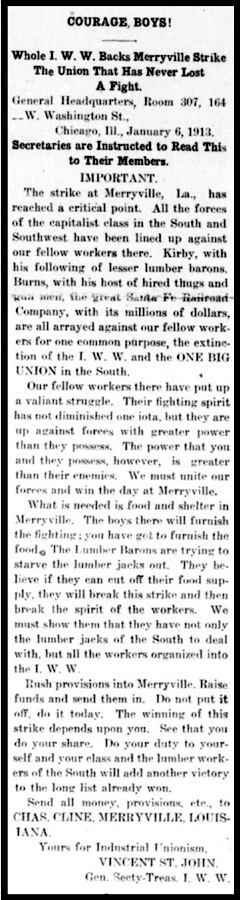
Merryville, Louisiana – B. T. W. (I. W. W.) Battles Peonage
From the Alexandria Lumberjack (Louisiana) of January 16, 1913:
—–
 ~~~~~~~~~~~~~~~~~~~~~~~~~
Hellraisers Journal – Tuesday January 21, 1913
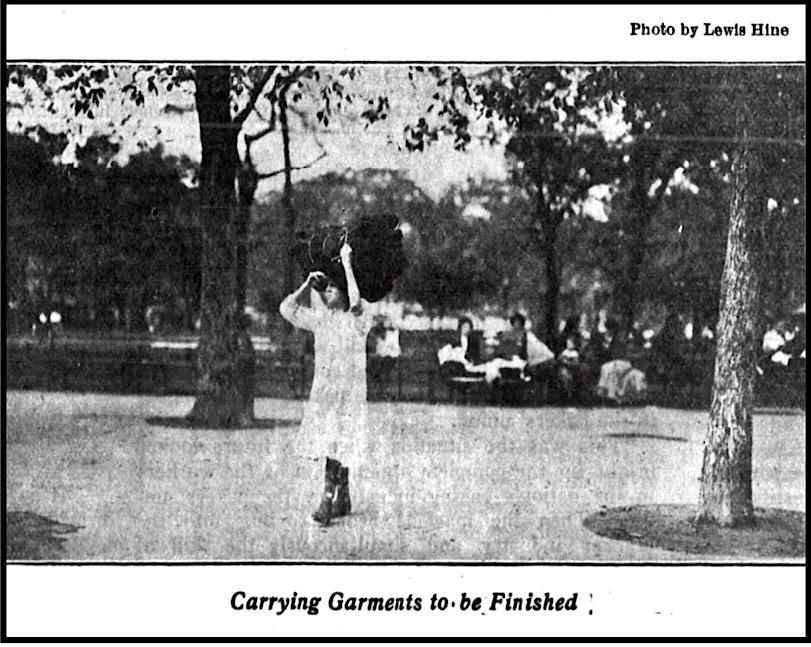
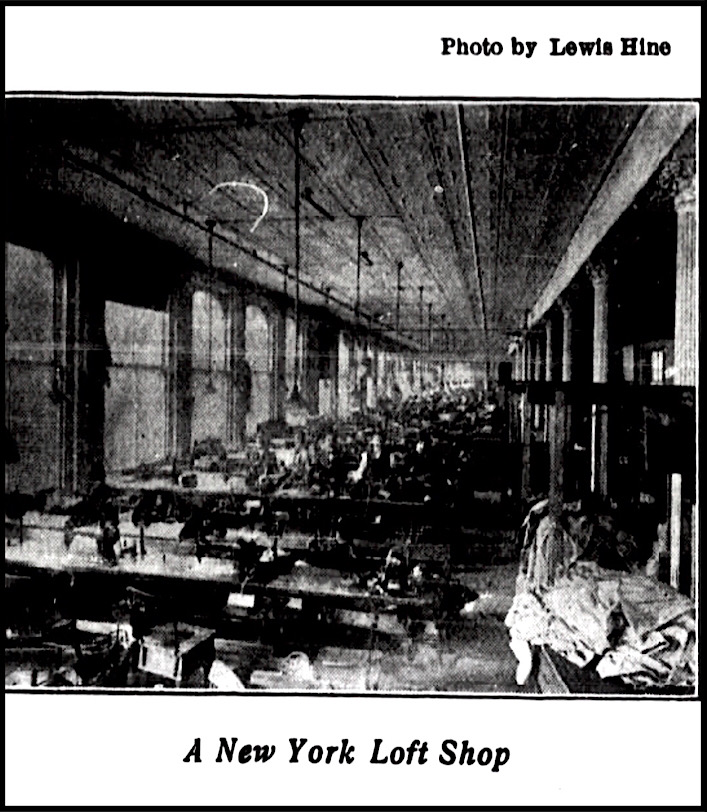
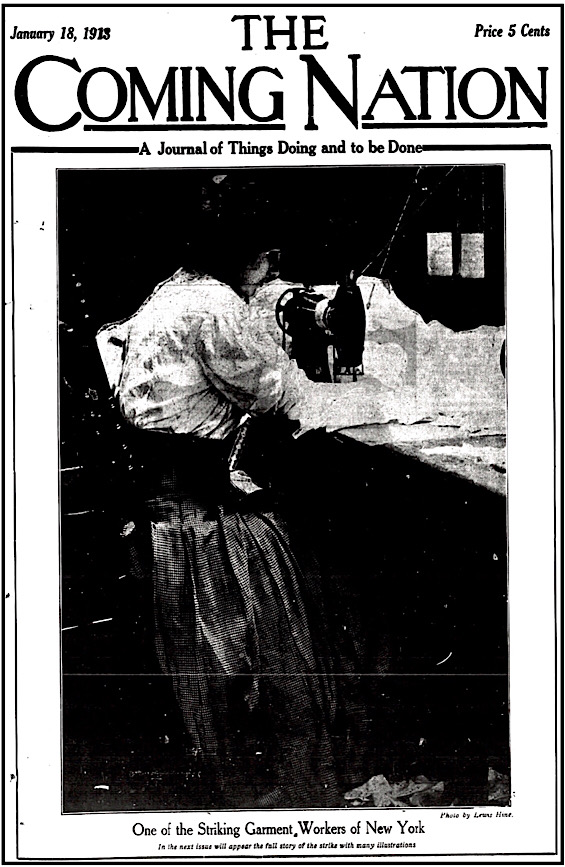
New York, New York – Photograph of Striking Garment Worker by Lewis Hine
From The Coming Nation of January 18, 1913:
Hellraisers Journal – Monday January 20, 1913
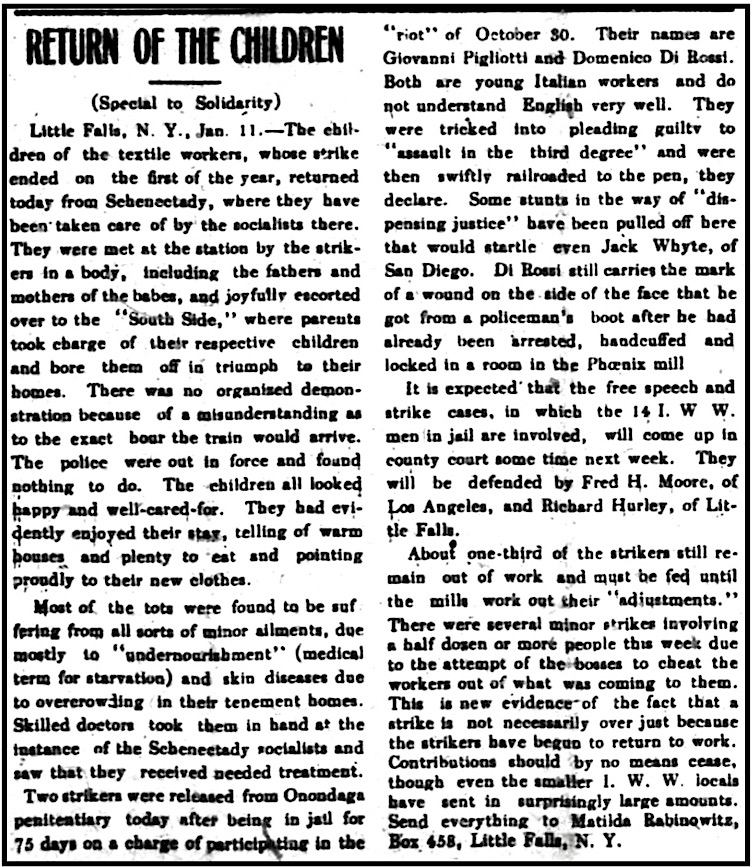
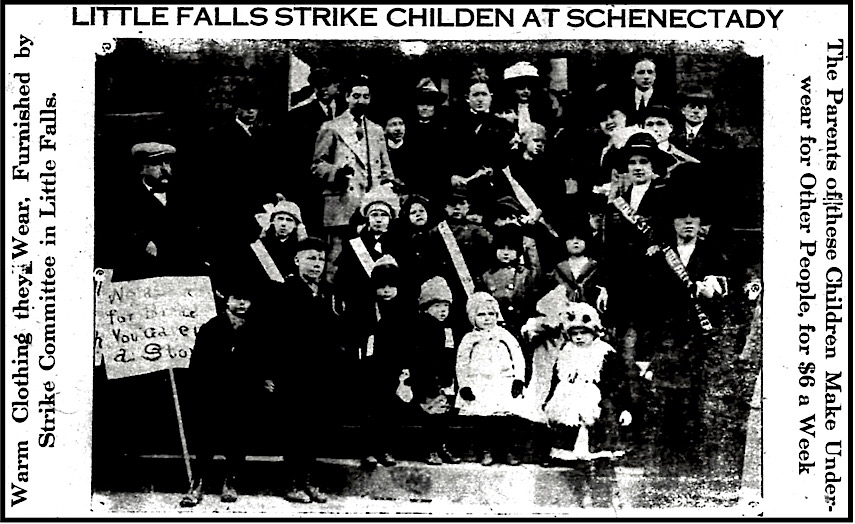
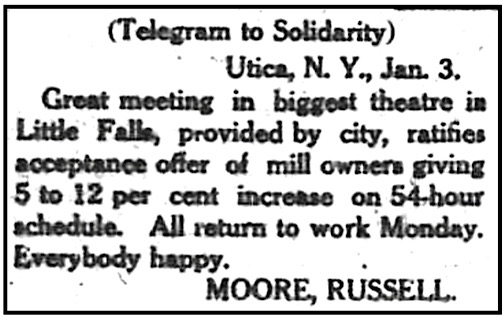
Little Falls, New York – Strikers’ Children Return from Schenectady
From Solidarity of January 18, 1913:
From Solidarity of January 4, 1913:
 —————
—————
Hellraisers Journal – Sunday January 19, 1913
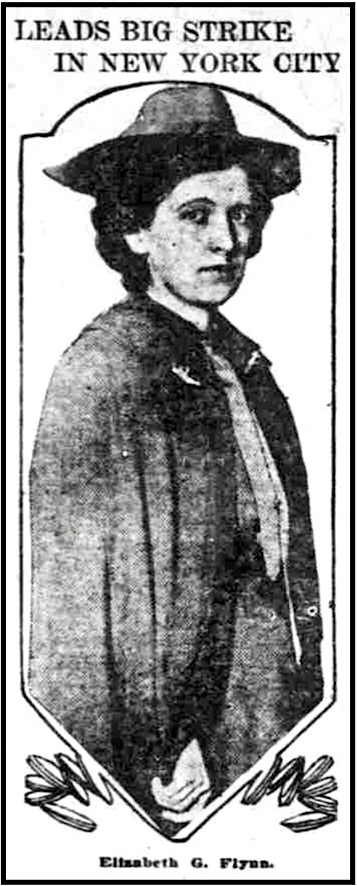
New York, New York – Elizabeth Gurley Flynn Leads Waiters’ Strike
From The Rock Island Argus of January 18, 1913:
New York.-Elizabeth Gurley Flynn is just a woman, but she has demonstrated her ability to lead a big strike in New York City. When the hotel and restaurant waiters decided that they wanted more pay, they asked Miss Flynn to help them. She played a prominent and successful part in the Lawrence, Mass., textile strike a year ago.
She came to New York City about the time the strike started and has been on the job ever since. She’s a good organizer and a fiery speaker. She says the best way to hit the hotel-keepers is to prove that the food they serve is unclean. Addressing a big crowd of strikers the other night she said:
I want you all to come and tell about the adulteration of food. I want you to tell how dishes which are refused by one guest because of their inferiority are sent back again to another guest; and how sauces are poured upon bad food to make it taste like good food. I want you to make affidavit to it, so we may give our information to the board of health and to the newspapers.
If the guest knew half much as you do about the food they eat and the places it comes from, they wouldn’t dare go into some of our best known hotels and restaurants.
Miss Flynn declared that of course the board of health wouldn’t do anything in the matter. All public officials, naturally, had their palms crossed with filthy capitalistic lucre when they went on “inspection.”
[She resumed:]
We want Mr. Capitalist, when he sits down to his dainty dinner, to know that its daintiness rose out of a vile spot like a lily out of a mud pool. We want to let the evil smell of your waiters’ quarters spread throughout New York.
He doesn’t care where you work, of course. But if you can impress him with the fact that you work in a vile place, and that his food comes from a vile place, you may be helped. For you will hit him square in the stomach, and that’s where all the senses of the American capitalist are located.
Miss Flynn has been trying to induce the waiters to adopt an anti-tipping resolution. In this she has been unsuccessful.
[Emphasis added.]