Hellraisers Journal – Monday March 28, 1910
Spokane, Washington – FW S. O. Chinn Gives His Life for Freedom of Speech
From the Industrial Worker of March 26, 1910:
DEAD AS RESULT OF BRUTAL TREATMENT
—–
Thirty-five Days on Bread and Water Brings On
an Attack of Diabetes and Causes
Death of S. O. Chinn, Spokane Free Speech Fighter.
—–
Spokane Press of March 17, 1910
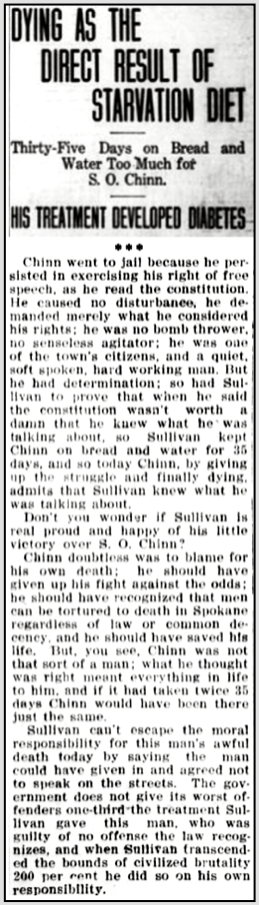
Because of Chief Sullivan’s brutal system, S. O. Chinn, who contracted diabetes after being fed on bread and water for a period of 35 days, died at Deaconess Hospital of Spokane on Friday evening, March 18th. This brutal treatment was accorded him because of his participation in the Spokane free speech fight.
Chinn was a member of the Industrial Workers of the World. He had resided at Spokane for a period of two years, and for a time was secretary of the Central Executive Committee of the I. W. W. locals of that city. Those who knew him best knew him to be scrupulously, even fanatically, honest. He never drank, his personal life was clean and he was zealously devoted to what he thought was right.
Chinn went to jail because he believed that the constitution meant what it said; that free speech and free assemblage were inalienable rights; that as a man it was his duty to see that they were not trampled under foot. He caused no disturbance; he demanded merely what he considered were his rights. He believed that constitution meant what it said. But Chief Sullivan and the powers that be in Spokane had decreed otherwise.
Nowhere but in Spokane have men been put on bread and water for 35 days; from three to five days is the army regulation. For the average man a diet of bread and water for ten days, as it was allowed to the imprisoned free speech fighters, means chronic disease, but for 35 days S. O. Chinn was given a bread and water diet, and from the barbarity of the treatment he emerged a wreck and died a lingering death.
The Spokane Press has the following to say on Fellow Worker Chinn’s death:
He was one of the town’s citizens and a quiet, soft-spoken, hard-working man. But he had determination; so had Sullivan to prove that when he said the constitution wasn’t worth a damn, that he knew what he was talking about, so Sullivan kept Chinn on bread and water for 35 days, and so today Chinn, by giving up the struggle and finally dying, admits that Sullivan knew what he was talking about.
Don’t you wonder if Sullivan is real proud and happy of his little victory over S. O. Chinn?
Hellraisers Journal – Sunday March 27, 1910
Cincinnati, Ohio-Speech of Mother Jones at Miners’ Special Convention
From The Topeka State Journal of March 24, 1910:
SOUNDS CALL TO ARMS.
—–
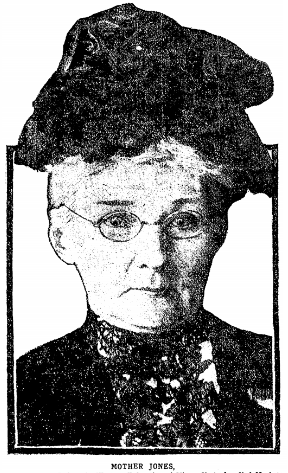
“Mother Jones” Arouses Coal Miners
to Great Enthusiasm.
—–
Cincinnati. O., March 24.-Bituminous coal operators and miners of Ohio, Indiana and Pennsylvania, entered their subscale meeting this afternoon with almost certainty that a disagreement would be reported to the joint committee, that the joint conference would reach a like disagreement before tomorrow noon and that the International Convention of United Mine Workers would then be asked to say whether it should be industrial peace or war after April 1.
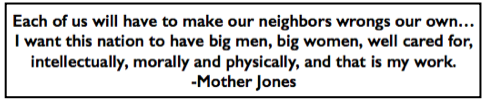
Operators of the three states immediately concerned, held a secret conference all morning and at the conclusion announced that the vote had been unanimous to resist all of the miners’ demand. The attitude of the miners in the international convention was shown during an address by “Mother” Jones when she declared:
If the operators force a fight we are all in trim to give them the hottest fight they ever had in their lives.
The convention was almost stampeded and the cheering did not cease for several minutes.
Hellraisers Journal – Monday March 26, 1900
Indianapolis, Indiana – Eugene Debs Accepts Nomination for President
From the Social Democratic Herald of March 24, 1900:
DEBS’ SPEECH OF ACCEPTANCE
[Social Democratic Party Convention
Indianapolis, March 9th]
—–
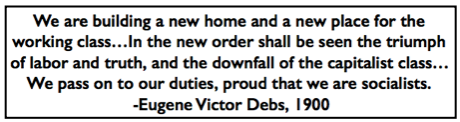
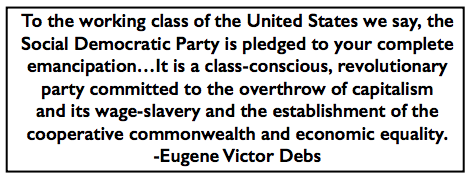
Mr. Chairman and Comrades:— A few moments ago your committee advised me of the great honor conferred upon me by this convention in making me one of the standard-bearers of the party in the great campaign upon which we are now entering. Never in all of my life was I so profoundly impressed with the conviction that there is a divinity that shapes our ends, rough hew them how we will. Yesterday [March 8th, Third Day of Convention] I left this hall under the solemn belief that I could not, under any possible circumstances, accept the nomination tendered me with such enthusiastic unanimity. But with your united voices ringing in my ears, and your impassioned appeals burning and glowing in my breast, and your eyes searching the very depths of my soul, I was soon brought to realize that in your voice in behalf of socialism there was the supreme command of Duty—that I could not disregard it and decline the nomination without proving myself wholly unworthy of the confidence which inspired it.
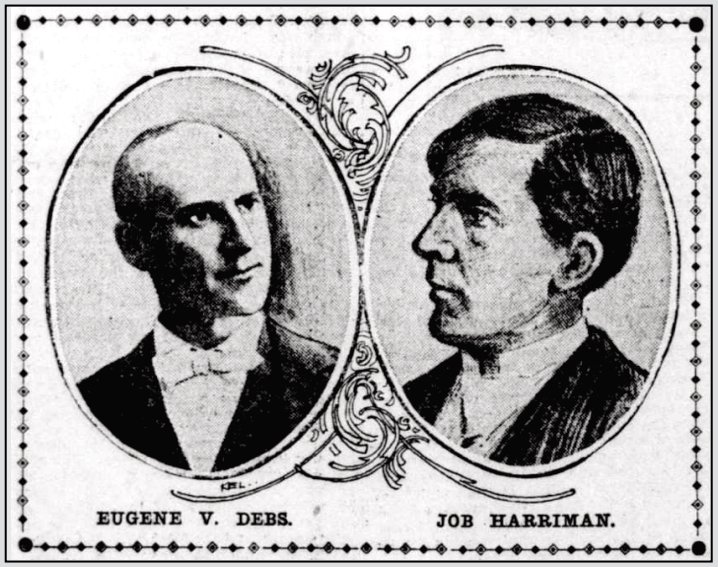
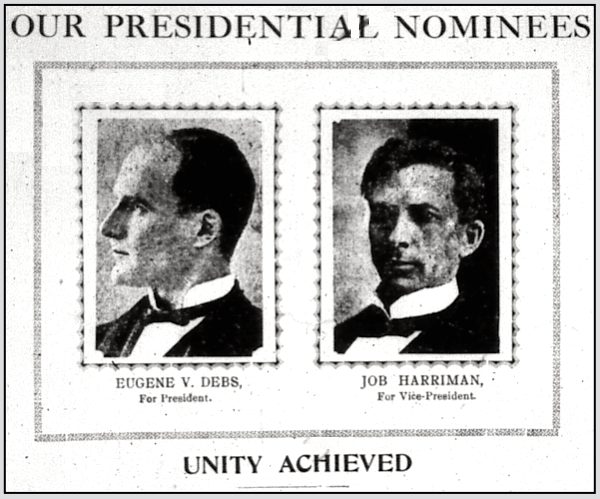
I felt that I could not decline the nomination, tendered me under such circumstances, without being guilty of treason to the cause we all love so well; and so I come to you this afternoon, obedient to the call voice by your committee, to say that I accept your nomination, and with it all of the responsibilities that the great trust imposes; and with my heart trembling upon my lips, I thank the comrades, one and all, for the great honor your have conferred upon me. I also thank you for having nominated as my associate and colleague so true a socialist, so manly a man as Comrade Job Harriman, and let me assure you that we will stand together, side by side, in the true spirit of socialism, and joining hands, will bear aloft the conquering banner of the Social Democratic Party of America.
Hellraisers Journal – Wednesday March 24, 1920
Pittsburgh, Pennsylvania – Steel Workers Offer Resolution of Heartfelt Thanks
From The Butte Daily Bulletin of March 20, 1920:
STEEL WORKERS THANK CLOTH UNION FOR HELP
—–
(By the Federated Press.)
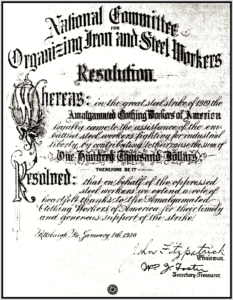
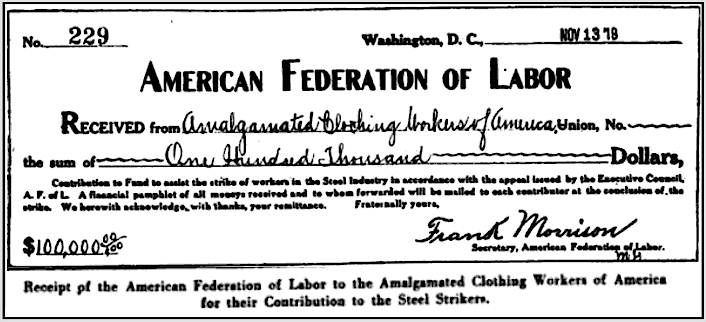
New York, March 20.-As a mark of gratitude for the magnificent aid given by the Amalgamated Clothing Workers of America to the steel workers during the great strike of 1919, they have been sent a handsomely drafted resolution of thanks. The document, which is signed by John Fitzpatrick and William Z. Foster, respectively chairman and secretary-treasurer of the committee for organizing the iron and steel workers, thanks the amalgamated for their gift of $100,000 to the strikers’ defense fund.
The amalgamated’s solidarity with the steel workers has created a sensation all over the world. Their gift is the largest sum ever raised by any organization to aid workers in another industry.
Hellraisers Journal – Monday March 21, 1910
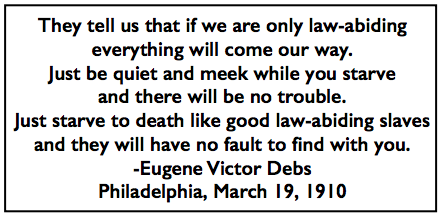
Philadelphia, Pennsylvania – Eugene Debs Speaks at Mass Meeting
From The Philadelphia Inquirer of March 20, 1910:
PRATT AND DEBS AT LABOR MEETING
—–
Sympathetic strikers crowded Labor Lyceum Hall, at Sixth and Brown streets, when their big mass meeting was called to order at 3 o’clock yesterday afternoon [Saturday March 19th], and the streets about the building were blockaded with hundreds who were unable to enter the hall.
Many policemen, under command of Lieutenants Nippes and Ehrsman, were stationed about the entrance to the hall and along Sixth and Brown streets to prevent possible rioting, and riot wagons from City Hall were placed in near-by streets.
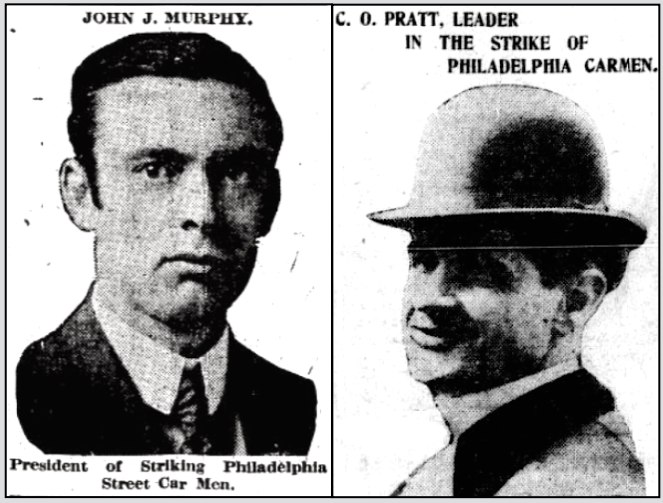
C. O. Pratt, the executive chairman of the carmen’s organization, arrived at the Labor Lyceum soon after 3 o’clock in an automobile, and was cheered by the crowd as he made his way to the entrance. The doors had been ordered closed by the police, but the lieutenant in charge made way for Pratt and the speakers with him. As soon as Pratt was inside the hall the crowd picked him up and passed him along to the platform.
Pratt in his speech exhorted the labor men to stand firm in their demands. In concluding he asked all who would remain out on strike to say “aye.” The answering chorus of “ayes” was heard in the streets.
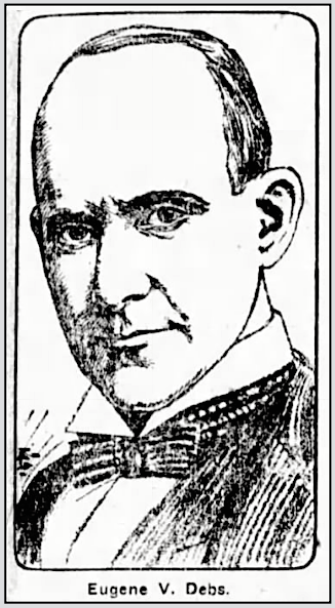
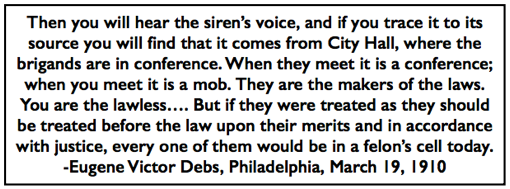
Eugene [V]. Debs, a former Presidential candidate on the Socialist ticket, also addressed the meeting.
[He said:]
You are waging a class fight. I am not here to philosophize, but to tell you to fight and fight to the end, and you will win. There is nothing to concede, nothing to arbitrate. If you concede anything you will lose all. Fight the Philadelphia Rapid Transit Company. J. Pierpont Morgan could end the strike in a minute if he wanted to.
Hellraisers Journal – Sunday March 20, 1910
Philadelphia, Pennsylvania – General Strike Committee Sends for Debs
From The Philadelphia Inquirer of March 17, 1910:
[Statement of Philadelphia’s General Strike Committee.]
———-
Announcement of the plans of the labor leaders for today was embodied in the following statement issued by the General Strike Committee, from its headquarters at Twelfth and Filbert streets:
In our statement issued last night we announced several mass meetings would be held in different parts of the city, to which organized and unorganized working men and women and the general public are invited. These meetings will be held at Kensington Labor Lyceum. Second and Cambria streets; Mercantile Hall, 849 Franklin street; Academy Hall, 524 South Fourth street, and Labor Lyceum, Sixth and Brown streets, on Thursday, March 17, at 8 P. M.
These meetings will be addressed by C. O. Pratt, Jeff Pierce, organizer of the American Federation of Labor; John J. Murphy and other prominent speakers…
The committee has also made arrangements for holding a monster mass meeting at Labor Lyceum, Sixth and Brown streets, at 3 P. M., Saturday, March 19, which meeting will be addressed by Eugene V. Debs and other prominent speakers…
Hellraisers Journal – Monday March 19, 1900
Indianapolis, Indiana – S. D. P. “Unity” Convention Nominates Debs
From San Francisco’s Class Struggle of March 17, 1900:
[Part II of II.]
FOURTH DAY [March 9th].
J.C. Chase, who served as chairman on the third day, was again elected to preside.
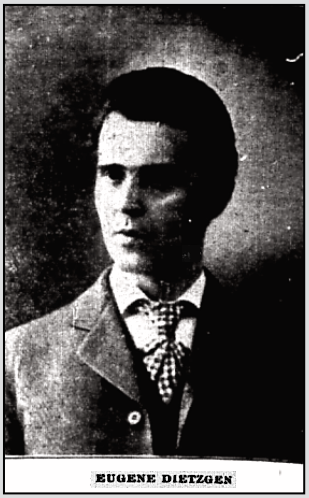
A motion to elect two delegates to the International Congress at Paris in 1900 was carried.Eugene Dietzgen was elected as one delegate, and on motion the election of the second delegate was referred to the joint committee of 18, the delegate to be elected by referendum.
MacCartney took the floor and stated that Debs had reconsidered his declination. Great applause. Debs was declared the nominee.
G.B. Benham was called upon for a speech, and congratulated the convention upon the nomination of Debs.
A man recognized from the Atlantic to the Pacific as one of the bravest advocates of the rights of the workers that the world has ever seen. His example has inspired the best efforts of the exponents of socialism, and his candidacy cements the union of socialist forces and assures us a grand result for the coming Presidential campaign.
Victor Berger nominated Job Harriman for Vice President. The nomination was received with applause as hearty as that which greeted the nomination of Debs. His nomination was declared unanimous, and all rose and gave three cheers for the candidates. Great enthusiasm. Handshaking was in order.
Hellraisers Journal – Sunday March 18, 1900
San Francisco’s Class Struggle of March 17th Claims “Unity Achieved”
The first national convention of the Social Democratic Party of America was called to order Tuesday morning, March 6, 1900 by Chairman Jesse Cox, at Reichwein’s hall, Indianapolis, Ind. The Class Struggle of March 17th, official organ of the Socialist Labor Party of California, described the convention in detail in an article written by Editor G. B. Benham.
[Part I of II.]
At 10 o’clock am Tuesday, March 6th, the convention was called to order and William Mailly, editor of the Haverhill Social Democrat, was elected chairman. Strickland was made secretary and Johnson of Chicago and Val Putnam of St. Louis assistant secretaries.
The usual committees were appointed, and an order of business was adopted. The credentials committee had an amount of work that does not usually fall to such committees, for the arrangement and basis of representation is not of the character generally used in representative bodies. Any number of members may sign the credentials of a delegate and his vote in the convention is the vote of the number who signed the credentials. Any local organization can thus send as many delegates as they desire. In fact a member can send himself, sign his own credentials, and his voice is recorded as one vote on the floor of the convention, but the vote depends entirely upon the number of signers of the credentials. Thus Margaret Haile has 196 votes, and Martin of Ohio has 1 vote.
The total number of delegates present was 67, representing 17 states, showing total membership represented 2,043.

 ———-
———-
 ———-
———-
 ———-
———- —–
—– ———-
———-
 ———-
———- —–
—– —–
—–
 ———-
———-
 ———-
———- ———-
———-
 ———-
———-