Hellraisers Journal: From the New York Liberator: “The Wars of West Virginia” by Robert Minor, Part III of IV

Share

———-

Hellraisers Journal – Wednesday August 4, 1920
Robert Minor Arrives in Matewan, Meets Smilin’ Sid Hatfield

From the New York Liberator of August 1920:

WV Mingo Logan Coal Wars by Robert Minor, Lbtr p7, Aug 1920

III of IV

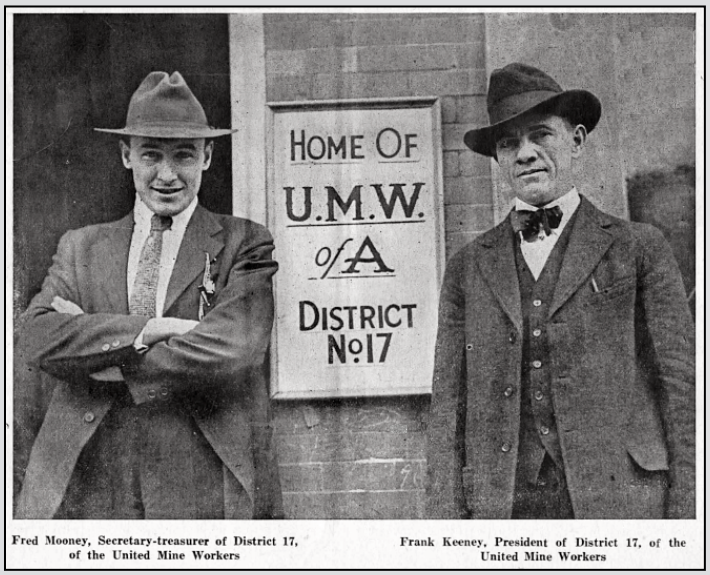
From the five o’clock morning train I alighted at the little. double row of stores and houses that are called Matewan, and before the town was astir I took a walk to the middle of the bridge over Tug River. There boy asked me, “Is it true they got two more thugs up the road last night?” I turned back to talk with the boy, and then I saw a man on a bench before a building on which was scrawled in red letters, “U. M. W. of A.” This man’s face limbered up when I told him I was a friend of Fred Mooney, Secretary of the Mine Workers at Charleston, and he said, “I sized you up as a friend of the Union and I’m glad you didn’t go further across the bridge, because you might have got shot. That is Pike County, over there.

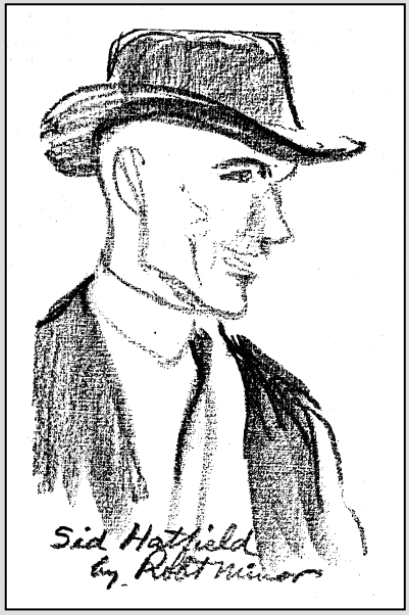
Sid Hatfield by Robert Minor, Lbtr p11, Aug 1920

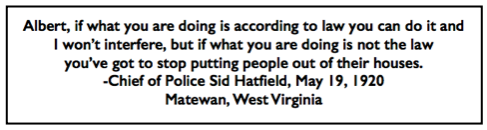
Toward nine o’clock I saw, standing near the railroad track, a middle-sized man of age about twenty-two. Although this man was alone, he was continually smiling. When he moved, his vest was displaced and exposed two Smith & Wesson revolvers, one stuck into each side of his trousers; A coal digger introduced him as Chief of Police Sid Hatfield.

Continue reading “Hellraisers Journal: From the New York Liberator: “The Wars of West Virginia” by Robert Minor, Part III of IV”

Hellraisers Journal: From the New York Liberator: “The Wars of West Virginia” by Robert Minor, Part II of IV

Share

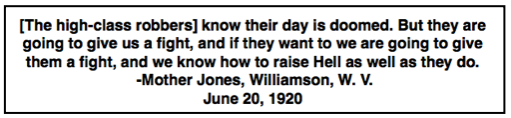
Quote Mother Jones, Doomed, Wmsn WV, June 20, 1920, Speeches Steel, p213———-

Hellraisers Journal – Tuesday August 3, 1920
Robert Minor Reports on Efforts to Organize Mingo County

From the New York Liberator of August 1920:

WV Mingo Logan Coal Wars by Robert Minor, Lbtr p7, Aug 1920

II of IV

UMW D17, Mooney Keeney, Lbtr p9, Aug 1920

When the United States entered the World War and the getting-out of coal became important, the United Mine Workers of District 17, comprising the southern half of West Virginia, grew in membership from five thousand to forty-two thousand. Young and energetic leaders developed out of the coal pits, advances were made in pay, and the workday was reduced from nine to eight hours.

In 1919, Unionism knocked hard on Old Man Baldwin’s door, and even slipped her foot over his sill. Unionism entered Logan County. Logan County is the “fortified town” of Don Chafin. Old Man Baldwin ruled Mercer, McDowell, Wyoming and Mingo Counties from his headquarters at Bluefield, but the County of Logan is held by his ally, Don Chafin, officially known as County Clerk.

Continue reading “Hellraisers Journal: From the New York Liberator: “The Wars of West Virginia” by Robert Minor, Part II of IV”

Hellraisers Journal: From the New York Liberator: “The Wars of West Virginia” by Robert Minor, Part I of IV

Share

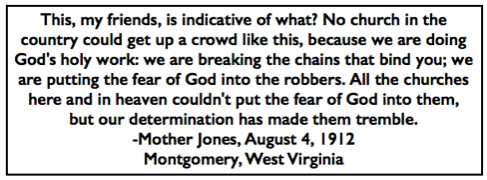
Quote Mother Jones Robbers Tremble, Montgomery WV, Aug 4, 1912———-

Hellraisers Journal – Monday August 2, 1920
Robert Minor Travels to West Virginia to Report on Coalfield Wars

From the New York Liberator of August 1920:

WV Mingo Logan Coal Wars by Robert Minor, Lbtr p7, Aug 1920

I of IV

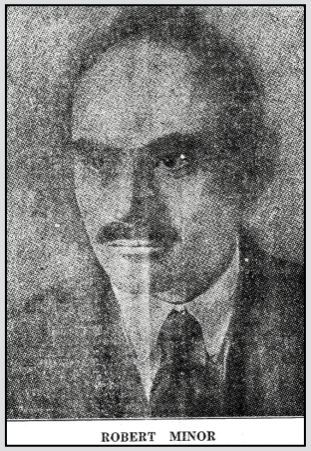
Robert Minor, ed, KC Wkrs Wld p1, Sept 19, 1919

As the train from Charlottesville ran through the Blue Ridge Mountains, a Negro looked out of the window, arose and walked from the stuffy compartment “for colored people” into a more comfortable car marked “for whites.” From that I knew the train had passed into West Virginia. The Negro sat down facing a weatherbeaten man with a white mustache and a broad-brimmed hat. The white man’s face did not change expression at the Negro’s entrance, and from that I knew that the white man was a mountaineer of the West and not an inhabitant of Old Virginia.

From Chesapeake Bay, across the Blue Ridge Mountains and away up around the southwest corner o£ Pennsylvania, used to extend the domain of Old Virginia. But the rich planters of the eastern valleys went to war against the Union, and the “po’ white” men hoeing their corn alone on the mountains and not owning any n——, refused to follow. The new State of West Virginia was made of these soft green mountains and lonely cabins and corn patches.

For another generation the people of the mountains hoed their corn. Then somebody discovered that the green-covered mountains were made of coal. The railroads began to scratch their way through the green, and to nose out the great black insides that were worth more than the cabins and corn patches. Men from Northern cities took part in West Virginia affairs and soon could prove with legal papers that they owned the black contents of the mountains and the green surface, too.

Many mountain families quit hoeing corn. They settled near the coal pits where regular wages and store clothes seemed to offer more of a living. The population passed from the outside of the mountains to the inside of them, and the grip of the men with the title deeds dosed down hard upon all.

Continue reading “Hellraisers Journal: From the New York Liberator: “The Wars of West Virginia” by Robert Minor, Part I of IV”

Hellraisers Journal: From Industrial Worker: Frank Little, Horse and Wagon Agitator, to Organize Ranches Near Fresno

Share

Quote Frank Little, re Fresno FS May, IW p2, June 11, 1910———-

Hellraisers Journal – Monday August 1, 1910
Frank Little Calls for Good Agitators to Come to Fresno

From the Industrial Worker of July 30, 1910:

A HORSE AND WAGON AGITATOR.

[-by FW Frank Little]

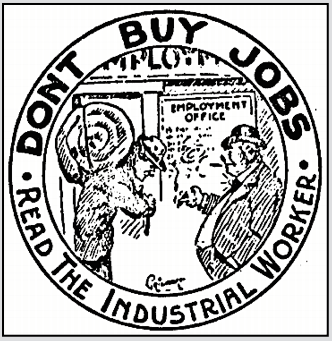
IWW Dont Buy Jobs, IW p4, June 11, 1910

FRESNO, Cal., July 23.-To the Editor of I. W.-Am back in Fresno, and will take up the work of organizing the ranch employes and packing house employees. Will start out with horse and wagon and travel from ranch to ranch, holding meetings in all of the small towns. But we are up against a hard fight. The masters will do all in their power to keep us from organizing the slaves. The A. F. of L. is going to try to organize, and, of course, the masters will aid them to defeat the I. W. W., and they have the money to put their labor fakirs in the field, while the few of us who are trying to build up the I. W. W. have to depend on working for a master to make a jungle stake.

I have been sick for some time, but will get out and hustle now. I will try and hustle some subs for the Worker on my trip.

Now is the time for work in this valley. I. W. W. men can get work and we need some good job agitators to get out in the fruit country and get control of the boss and make the masters raise the wages; and also build up the organization. It can be done if all of us will get in and hustle.

So, fellow workers, let us keep the work going. Yours for action,

F. H. LITTLE.

———-

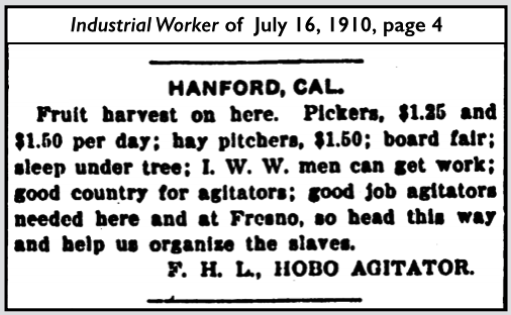
IWW Frank Little re Fresno n Hanford, IW p4, July 16, 1910

[Photograph, newsclip and emphasis added.]

Continue reading “Hellraisers Journal: From Industrial Worker: Frank Little, Horse and Wagon Agitator, to Organize Ranches Near Fresno”

Hellraisers Journal: From The Liberator: “The Mexican Revolution” by Carleton Beals and Robert Haberman, Part III

Share

Quote Zapata Die Fighting, Wikiquote———-

Hellraisers Journal – Saturday July 31, 1920
“The Mexican Revolution” by Carleton Beals and Robert Haberman, Part III

From The Liberator of July 1920:

The Mexican Revolution

By Carleton Beals and Robert Haberman

[Part III of III.]

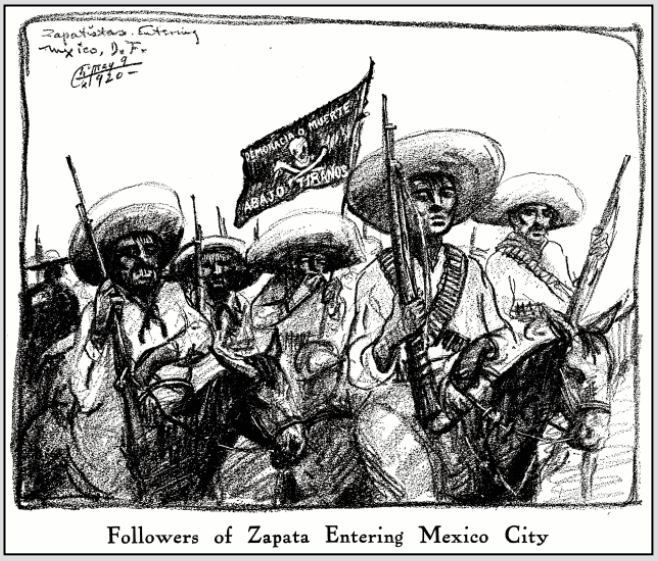
Mex Rev, Zapatistas Mexico City, Liberator p5, July 1920

There are other interesting personalities behind the new revolution-Calles
[Plutarco Elías Calles]
(pronounced Kah-yayz), for example, ex-military governor of Sonora, Secretary of Commerce and Labor and leader of the Sonora secession. He is without doubt the most forceful, the most radical, the most intelligent and widely informed among the present leaders of Mexico.

As governor of Sonora he proved himself a champion of labor, and he gave the Indians lands, and each a gun and five hundred rounds of ammunition with which to protect and hold them. Carranza immediately telegraphed him, when these acts became known, to take back the lands. Calles replied: “Send a stronger man than I am, for I can’t do it.” Calles has tried to enforce Article I23 of the Constitution, which is the most enlightened labor code of any capitalist country. As a result the Phelps-Dodge Company, which operates the great copper mines at Cananea, closed their works. Calles instructed the workers to take charge of them and run them. He told me how surprised he was to see how well they did it. The representatives of the Phelps-Dodge Company hurried back upon the scene with a great bill for damages. Calles admitted their claims, but then he turned to the Mexican constitution.

“I read here,” he said, “that any company that ceases operations without giving two weeks’ notice must pay three months’ salary to its employees. Go bring your payrolls, and we will strike a balance to see how much YOU owe the workers, whom I represent.” The mine representatives decided to return to Cananea and put in safety appliances, build club rooms, reading rooms, and, to crown all, a huge concrete swimming pool for the workers.

“Do you know of any other mine in the world that has a swimming pool for its workers?” Calles asked me as he told this story, and then he laughed. At the same time the same company, just over the international line in Bisbee, was driving its workers, across the heat-eaten sands of the desert. so Calles, not being able to enforce Article I23 in the civilized United States, did what he could by sending food to the unfortunate victims.

Continue reading “Hellraisers Journal: From The Liberator: “The Mexican Revolution” by Carleton Beals and Robert Haberman, Part III”

Hellraisers Journal: From The Liberator: “The Mexican Revolution” by Carleton Beals and Robert Haberman, Part II

Share

Quote Zapata Die Fighting, Wikiquote———-

Hellraisers Journal – Friday July 30, 1920
“The Mexican Revolution” by Carleton Beals and Robert Haberman, Part II

From The Liberator of July 1920:

The Mexican Revolution

By Carleton Beals and Robert Haberman

[Part II of III.]

Mex Rev, Obregon Mexico City, Liberator p4, July 1920

There have been a great many myths regarding the benefits of the Carranza régime, such as the opening of schools, giving lands to the Indians, nationalizing the sub-soil, etc., etc. One by one the pitifully few schools of the Diaz administration have been closed until Tacubaya and Mixcoac, two of the largest residence suburbs of Mexico City cannot boast a single public school. Land, given to the Indians, has in many cases, as in Yucatan, Tabasco and Morelos, been wrested away by military might, while a single grant to a General has often amounted to more in area than all the lands given away to the people during the whole of the Carranza rule. Under the cloak of the slogan of Mexico for the Mexicans, which has so attracted the imaginations of American radicals, he has stabbed every liberty in the back, and has built up a grasping, grafting, unprincipled military clique, the members of which have ridden across the land looting, murdering and stirring up revolt, until the federal soldier is more feared and hated than the bandit.

Directly the revolution resulted from two things: the attempt on the part of the government to railroad Bonillas, former ambassador at Washington, into the presidency; and the attempt to repeat the story of Yucatan and its murders in Sonora, the home state of Obregon.

To guarantee the election of Bonillas, government candidates were imposed by force in half a dozen states, Obregon meetings were broken up by the sabers of the man on horseback, Obregon himself was arrested on fake charges of inciting a rebellion. The knowing shook their heads, and predicted his murder within a week or two.

In the meantime Carranza was pouring soldiers into Sonora, against the repeated remonstrances of Governor de la Huerta, to crush the railroad strike and several mining strikes that were on, and probably in addition to break up the state government and impose his own officials as he had done in Yucatan, in Tabasco, in half a dozen other states.

Continue reading “Hellraisers Journal: From The Liberator: “The Mexican Revolution” by Carleton Beals and Robert Haberman, Part II”

Hellraisers Journal: From The Liberator: “The Mexican Revolution” by Carleton Beals and Robert Haberman, Part I

Share

Quote Zapata Die Fighting, Wikiquote———-

Hellraisers Journal – Thursday July 29, 1920
“The Mexican Revolution” by Carleton Beals and Robert Haberman, Part I

From The Liberator of July 1920:

The Mexican Revolution

By Carleton Beals and Robert Haberman

[Part I of III.]

Mex Rev, Zapatistas Mexico City, Liberator p5, July 1920

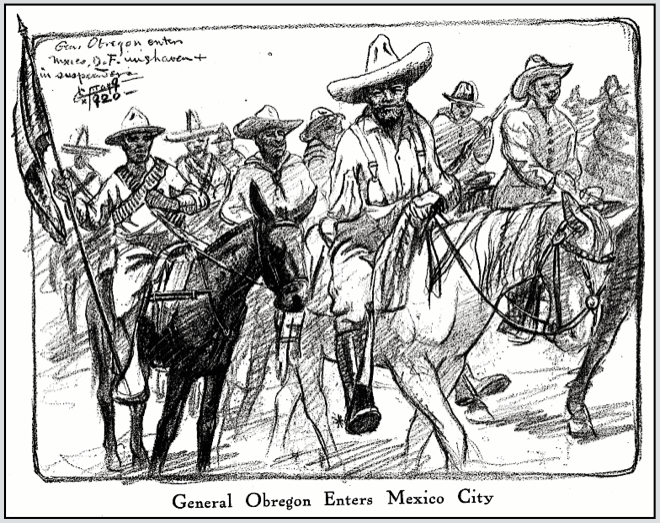
AFTER ten years of practice any people should understand quite thoroughly the technique of conducting a respectable, eat-out-of-your-hand revolution. The Mexican revolution which brought a new régime into power some few days ago was orderly, efficient, easily successful. Less than a month from the day the sovereign state of Sonora raised the banner of revolt, the revolutionary army-el ejercito liberal revolucionario-galloped into the capital without the firing of a single shot.

They looked strange-those men from the hills, on their lean, tired ponies, as they pounded down Avenida Francisco Madero, Mexico’s fashionable Fifth Avenue, dusty and ragged-colorful with great red and blue bandana handkerchiefs and vivid shirts, with flowers hung on their carbines, but eyes grim with purpose. Yet Mexico paid little attention to them. The stores were open; the honking automobiles crowded the flanks of their ponies; fashionable women went unconcernedly about their shopping. Only occasionally did they stop with a rustle of their silk gowns to gaze at the queer outlaw crew of sandalled Indians and Mestizos sweeping by beneath their great, bobbing sombreros.

During those first days I roamed the streets disconsolately-box seats at a Mexican revolutionary melodrama and no thrills. I tried to imagine the turnover as being a cross-your-heart-to-die proletarian revolution, but merely spoiled the afternoon wishing I were in Russia.

Nevertheless, I made the most of it; hired an automobile and dashed around town taking snapshots of generals-who were easier to find than soldiers-scoured the countryside looking for the victoriously approaching Obregon who was expected in the capital within forty-eight hours with an immense force, of which the bands of cavalry we had seen were the paltry forerunners. Early in the afternoon we burnt up the road to Guadelupe Hidalgo-that venerated religious mecca of Mexico five miles outside of the capital, whishing past red-cross machines speeding back from the wreck of one of the Carranza military trains that had evacuated the capital some twenty minutes before the rebels arrived.

Continue reading “Hellraisers Journal: From The Liberator: “The Mexican Revolution” by Carleton Beals and Robert Haberman, Part I”

Hellraisers Journal: From the Appeal to Reason: “A Personal Letter to the Appeal Army” by Eugene V. Debs

Share

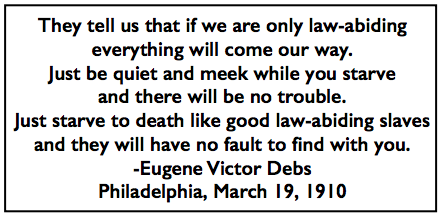
Quote EVD, Starve Quietly, Phl GS Speech IA, Mar 19, 1910———-

Hellraisers Journal – Thursday July 28, 1910
Eugene V. Debs to the Appeal Army, “It All Depends on You”

From the Appeal to Reason of July 23, 1910:

A Personal Letter to the Appeal Army
—–

BY EUGENE V. DEBS.
—–

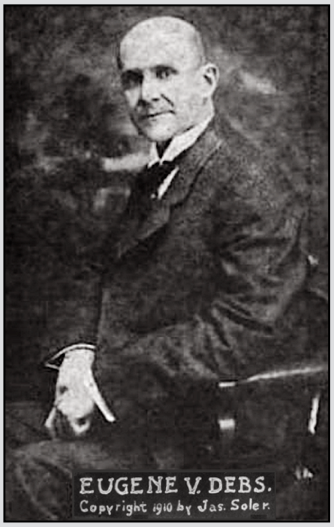
EVD Life Size Photo by Jas Soler ed small, ISR p1044, May 1910

Comrades-During the past year or more my work in the field has brought me into personal touch with most of you and I want to express to you this word of appreciation of your personal kindness and your service to the cause. You have made the Appeal the most widely circulated labor and Socialist paper in the world and given it a power which is making capitalist culprits in high places tremble with fear and misgiving. But for this power Warren would long since be in jail and along with him Wayland, myself and the rest of the Appeal staff. The order to this effect was duly issued and the papers prepared but when the time came to move the puppets were paralyzed with fear. They were palsied by the silent power of the Appeal and did not dare to defy its lightning.

This power of the Appeal created by you is the power of the rising people and the degree it registers on the indicator is the degree of their progress toward emancipation.

This power is subject to the laws of growth and decay. Daily hourly, it must advance or it must decline. It cannot remain at a standstill. The very law of its being forbids.

IT ALL DEPENDS ON YOU.

You not only created that power, YOU ARE THAT POWER!

The moral power of the Appeal, in the revolutionary movement of the people is the concrete expression of the moral power of the Appeal Army.

To the extent that you add to the moral stature and strength of the Appeal to Reason you hasten the day of deliverance from the tyranny of plutocracy.

Continue reading “Hellraisers Journal: From the Appeal to Reason: “A Personal Letter to the Appeal Army” by Eugene V. Debs”

Hellraisers Journal: Reward Offered for Slayer of Fannie Sellins, UMW Organizer Who Lost Her Life in Freedom’s Cause

Share

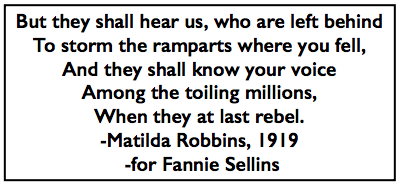
Quote M. Robbins, for Fannie Sellins, Wkrs Wld p4, Nov 28, 1919———-

Hellraisers Journal – Monday July 26, 1920
Reward of $5,000 Offered for Apprehension of Slayer of Fannie Sellins

From The Pittsburgh Post of July 23, 1920:

Slayer of Woman In Riot Sought
—–

Reward Offered For Apprehension
of Guilty Person.
—–

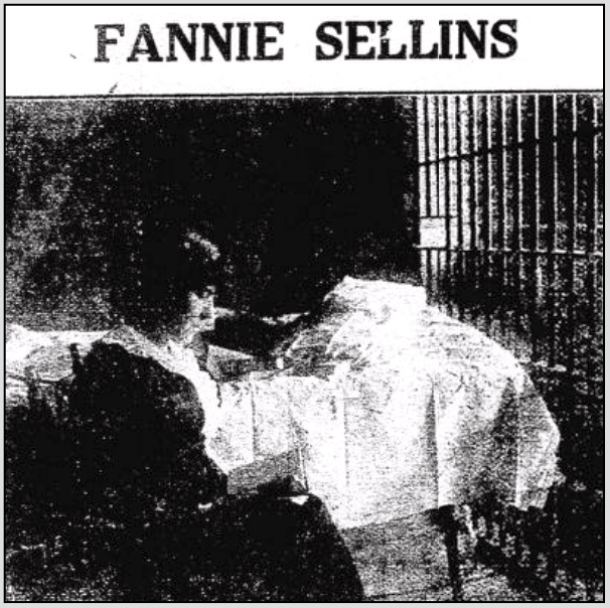
Fannie Sellins in Jail, Hgtn WV Lbr Str p1, May 22, 1914
Fannie Sellins in Marion County Jail at Fairmont, W. V.
-from the Huntington Labor Star of May 29, 1914
———-

A reward of $5,000, thought to be offered either by the United Mine Workers of America, or by Fred Broad of New Kensington, a son-in-law of the slain woman, will be paid for information leading to the arrest and conviction of the slayers of Fannie Sellins, labor organizer, who was killed in a mine strike riot near Brackenridge almost a year ago. The reward has been advertised in the local papers.

The circumstances surrounding the death of the woman leader was a subject for discussion at recent labor meetings in Montreal, and it is said that the campaign for a solution will be continued this summer.

Mrs. Sellins was shot down the night of August 26, 1919, during a riot between guards and strikers near the pit mouth of the Allegheny Coal and Coke Company at Brackenridge. The guards were arrested after the riot but they were released because of insufficient evidence. Since then there have been no new developments or arrests in the case.

[Note: there was no riot. Company gunthugs attacked picketers who were peacefully assembled, as was their right.]

———-

[Photograph and emphasis added.]

Continue reading “Hellraisers Journal: Reward Offered for Slayer of Fannie Sellins, UMW Organizer Who Lost Her Life in Freedom’s Cause”