Hellraisers Journal – Sunday May 30, 1920
Logan County, West Virginia – Coal Operators Own Public Officials, Part I
From The Nation of May 29, 1920:
Private Ownership Of Public Officials
By ARTHUR GLEASON
[Part I of II.]
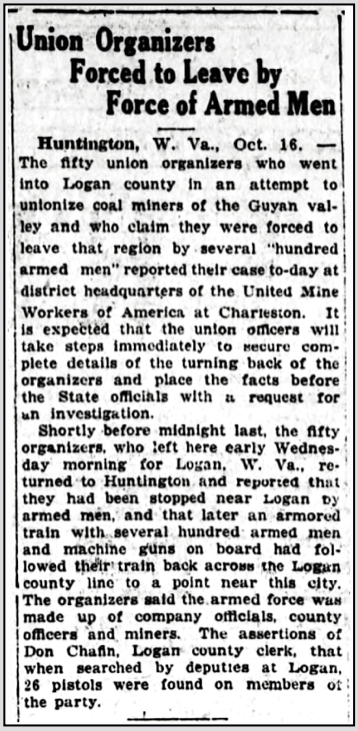
Harrisburg Telegraph October 16, 1919
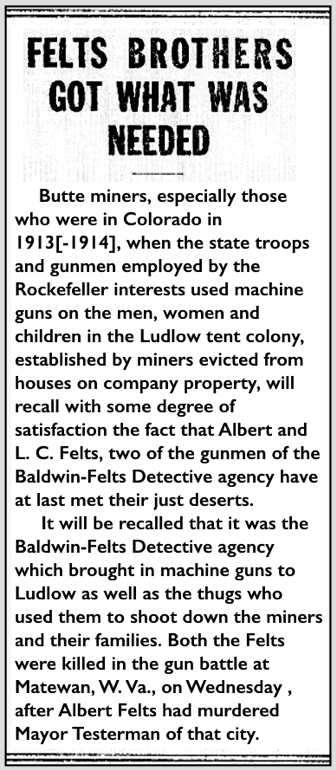
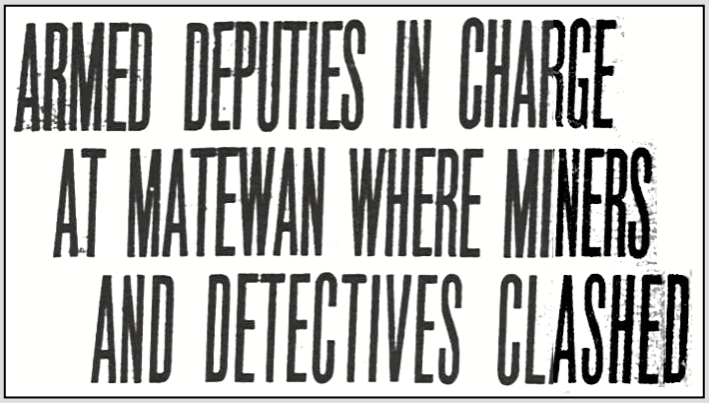
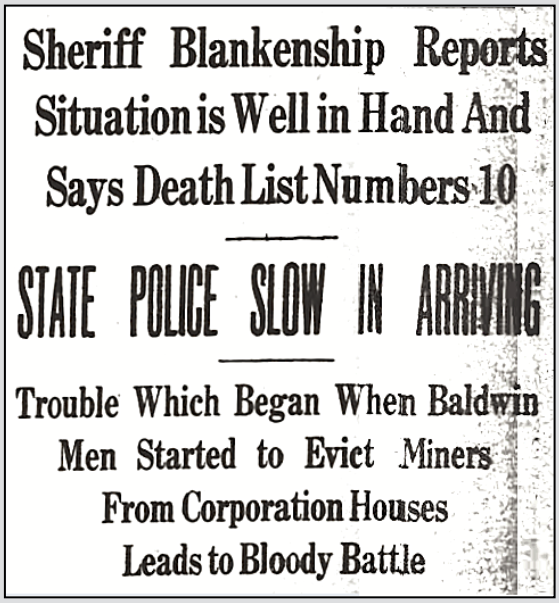
WEST VIRGINIA has started in again on the organized killing which every few years breaks loose in the mining districts. On May 19, eleven men were shot to death in the town of Matewan, Mingo County. Seven of them were detectives, three were miners and one was an official. This skirmish is the first in the 1920 war between the coal operators of the State and the United Mine Workers of America. Mingo is one of the counties in the southwest of the State which have been held against organized labor by detectives, armed guards, and deputy sheriffs.
With the beginning of May, the miners formed local unions, and brought in 2,000 members. As fast as the miners join the union, the coal companies are evicting them from the company-owned houses. I saw the typewritten notice of the Stone Mountain Coal Company on the window of the company-owned grocery store. It stated that the houses of the miners were owned by the company, and that the miners must leave the premises at once if they join the union. Ezra Frye, the local organizer, acting for the United Mine Workers, had leased land, and was erecting tents for the evicted families. He had ordered 300 tents on the first allotment. Matewan lies on the Tug Fork of the Big Sandy River. It is run politically by the Hatfield clan, who for generations have had a feud with the McCoy clan. The economic struggle is making a new alignment across the old feudist divisions. No stranger is safe just now in these unorganized counties. We had a spy who trailed us from Charleston to Matewan. In the town, we were kept under constant guard.
Hellraisers Journal – Saturday May 28, 1910
Princeton, Illinois – Jury Reaches Verdict in Great Cherry Mine Disaster
From the Duluth Labor World of May 28, 1910:
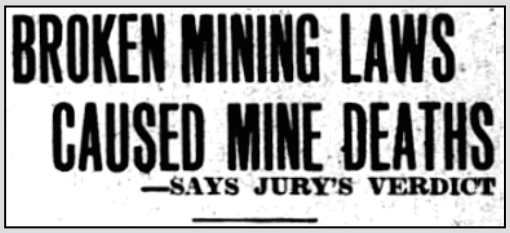
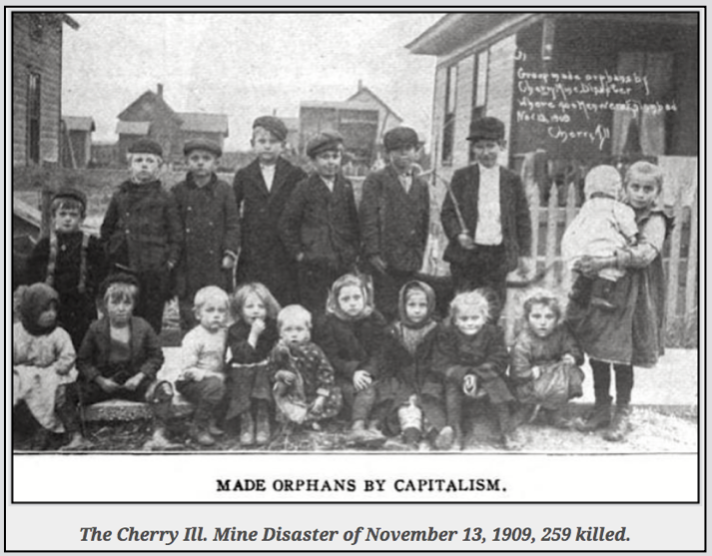
PRINCETON, Ill, May 27.-The coroner’s jury, which began last November to investigate the cause of the Cherry mine disaster, which resulted in the death of 265 miners in the St. Paul Coal company’s mine, has reached an agreement, and 250 separate verdicts have been returned.
The jury says the mining laws were broken with the knowledge and consent of the mine inspector.
The verdicts were in three sets, one set fixing the cause of the death of the twelve men in the rescue party who perished on the cage in the mine shaft, another set for the 187 men who were suffocated in the second vein and the third for the 51 men who were trapped in the third vein and died of exposure and suffocation.
The verdict of the coroner’s jury is a vindication of John Cowley, the engineer who was in charge of the cage on which the twelve rescuers lost their lives. The verdict says the twelve rescuers lost their lives “indirectly by a confusion of signals regulating the movements of the cage.”
Hellraisers Journal – Wednesday May 26, 1920
Matewan, West Virginia – Chief of Police Sid Hatfield Arrested
From The Wheeling Intelligencer of May 25, 1920:
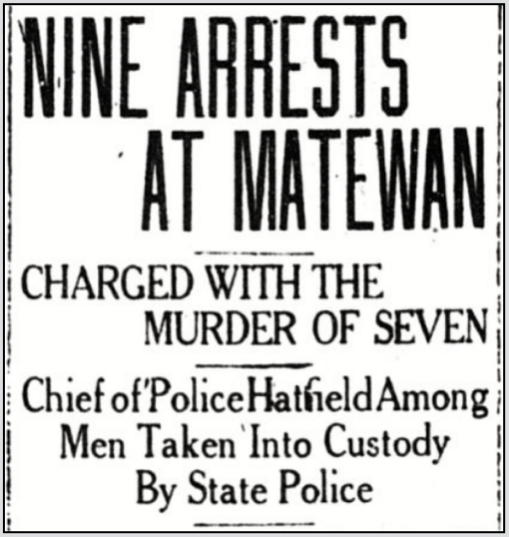
MATEWAN, W. Va., May 24.-Sid Hatfield, chief of police of Matewan, Mingo county, and nine others were arrested today and taken to Williamson, where they were arraigned before Judge James Damron of the circuit court, charged with the murder of L. C. Felts and other Baldwin-Felts detectives in the recent Matewan riots.
They waived examination and were released on bond in the sum of $3,000 each.
Among the men arrested with Hatfield were: Reese Chambers, Clare Overstreet, Charle Kiser, Douglas Mounts, [Ed] Chambers, Ezra Fry, Billy Bowmen and two others.
The men were taken to Williamson by Jackson Arnold, chief of the state department of public safety, and other members of the state constabulary.
Other arrests are expected, as fifteen warrants have been issued for miners. Warrants have also been issued for the four surviving detectives who are alleged to have participated in the battle.
Hellraisers Journal – Tuesday May 25, 1920
Matewan, West Virginia – Correspondent Russ Simonton on “Yaller Dog”
From the Harrisburg Evening News of May 24, 1920:
—–
MATEFAN [Matewan], W. Va., May 24.-State police patrol this coal town because Americans refused to sign away their rights as citizens.
Here is the history of the events which led a few days ago to the killing of Mayor Testerman, it is said, in cold blood, by mine private detectives [Baldwin-Felts gunthugs], and a battle between citizens and detectives that cost a total of twelve lives.
Fighting Union
Matewan miners want to affiliate with the United Mine Workers of America. Mine operators of the Tug Creek District are opposed to any labor organizations.
Organizers were sent here last April. They held street meetings. A few miners joined them, then right and left those who joined lost their jobs. These men became organizers themselves. Obviously that sort of thing could not continue long. There are 6000 miners in this district and two-thirds or more live in company houses and buy food from company stores.
“Yaller Dog” Appears
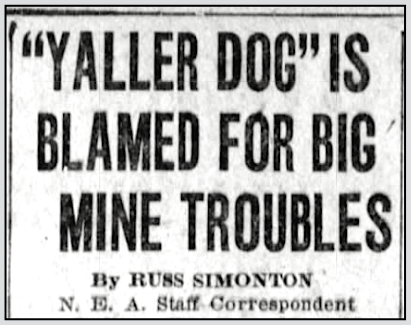
The “Yaller Dog” soon made its appearance. It is a marvelous document. In part It reads:
In consideration of my employment I agree that I will not affiliate with or give assistance to any union or labor organization without first giving you notice. Should I fall to comply with this agreement, our relations shall be terminated. I will leave your premises and will surrender without notice any house occupied by me, it being understood that such house is incident to my employ.
The “Yaller Dog” made no favorable impression with these drawling, slow-moving hill miners.
Not half a dozen signed the agreement.
Wholesale firing began and man after man was discharged and several mines boarded up their drifts and loaded the miners out.
Then Hughie Coombs, Methodist minister and one of the first men discharged for joining the union, arranged, he said, that if dispossession proceedings should be started, the sheriff [George Blankenship] of Mingoco [Mingo Co.] should serve the papers.
Hellraisers Journal – Sunday May 22, 1910
Washington, D. C. – Congressman Wilson on Plan to Establish Bureau of Mines
From the Duluth Labor World of May 21, 1910:
———-
State to Establish Bureau of Mines Regarded
as Means of Checking Fearful Death Toll
of Those Who Work Beneath the Ground.
Signature of President Only Lacking.
—–
WASHINGTON, D. C., May. 20.—A death toll of over twenty thousand of human lives, lives of miners sacrificed in the United States in the last ten years, has at last forced congress to take the first tardy and hesitating step towards checking the senseless slaughter by establishing a national bureau of mines. The bill now only lacks the president’s signature to become law.
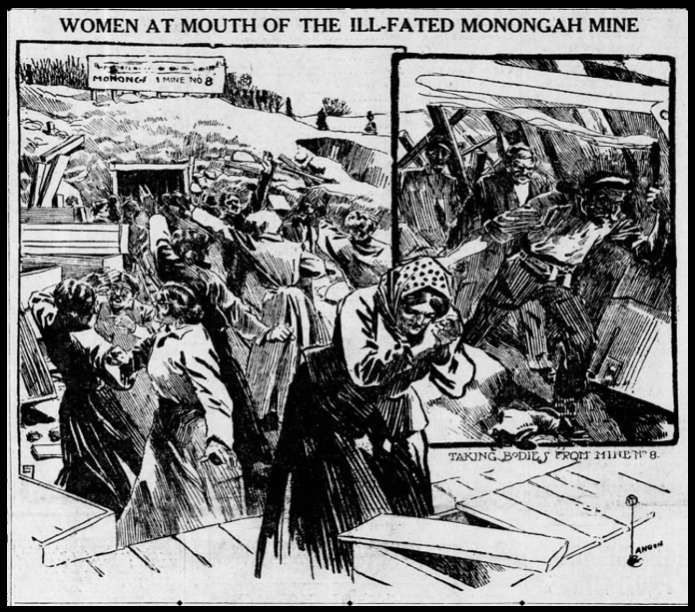
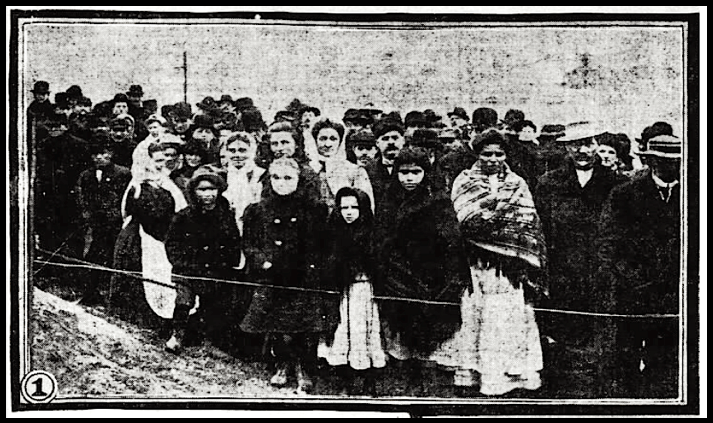
The Monongah W. V. Mine Disaster of December 6, 1907, 362 killed. —–The Darr (Pa.) Mine Disaster of December 19, 1907, 239 killed. —–
Asked as to the immediate effect which a bureau of mines would have upon the everyday life of the miner, Representative [Wiliam B.] Wilson, former secretary-treasurer of the United Mine Workers of America, himself a practical coal miner, first drew attention to the terrible loss of life in the American mines as compared with abroad. He said:
Hellraisers Journal – Friday May 20, 1910
Mother Jones News Round-Up for April 1910, Part II:
-Found in Washington D. C. Berating Author of Dick Military Law
From the Duluth Labor World of April 30, 1910:
MOTHER JONES RAKES OHIO’S
WATCH CHARM SENATOR
OVER COALS
——–
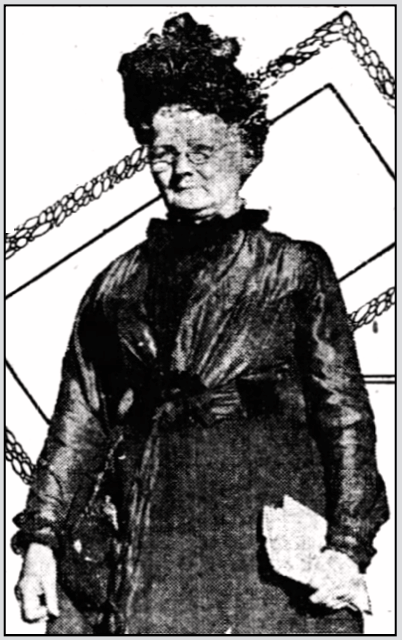
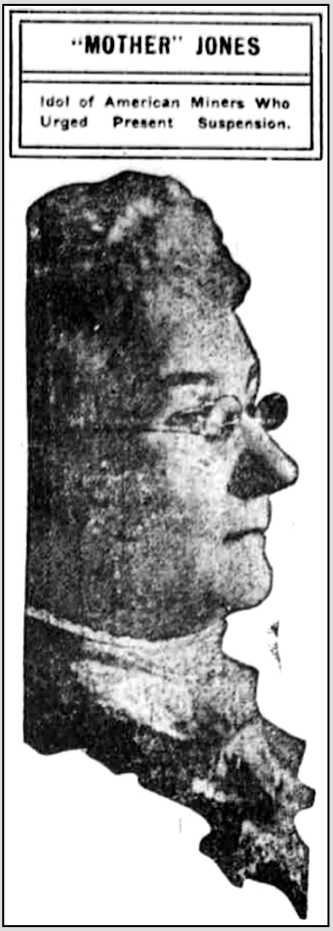
WASHINGTON, D. C., April 29.— Mother Jones, whose “boys” are working in every coal mine in Pennsylvania and every mineral camp of Colorado, met Senator Dick, of the notorious Dick military law, as that urbane member of the upper house was standing in the senate lobby of the [Capitol].
All smiles and gladness the senator acknowledged the introduction to the white-haired woman and offered his hand, but “Mother” dropped hers significantly to her side:
I’m fighting you, Senator Dick. It was your work that sent two thousand guns out to Colorado in the last big strike, and shot us up.
“You don’t look as if you had been injured, Madam,” flushed the senator.
“No thanks to your law and the guns that killed others while they missed me,” answered the woman whose appearance and participation in almost every miners’ strike during the last thirty years has earned for her the name of “stormy petrel.”
“But, madam,” argued Senator Dick, “don’t we need soldiers in time of revolution?”
[Flashed Mother Jones:]
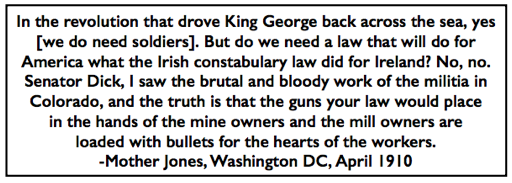
In the revolution that drove King George back across the sea, yes. But do we need a law that will do for America what the Irish constabulary law did for Ireland? No, no. Senator Dick, I saw the brutal and bloody work of the militia in Colorado, and the truth is that the guns your law would place in the hands of the mine owners and the mill owners are loaded with bullets for the hearts of the workers.
Hellraisers Journal – Thursday May 19, 1910
Mother Jones News Round-Up for April 1910, Part I:
-Found in the Thick of the Fight on Behalf of Working Class Men and Women
From the Mt. Vernon, Ohio, Democratic Banner of April 5, 1910:
DROP THEIR PICKS AT STROKE OF TWELVE.
———-
Coal Miners’ Strike Is a Reality.
—–
200,000 MEN ARE IDLE
—–
D. H. Sullivan Falls Heir
to Ohio Situation.
—–
THINKS SETTLEMENT IN SIGHT
—–
General Belief Is That Suspension
Will Be of Short Duration and That
Country Will Experience No
Serious Result From Shutdown
-Pittsburg Operators Anxious to Sign.
—–
Columbus, O., April 1- Dennis H. Sullivan of Coshocton today assumed his duties as president of the Ohio miners’ union, and made the announcement that nearly every union miner in the state is now idle, work at all mines having been suspended in response to the general order to quit work until new agreements are signed between the operators and officials of the union, in accordance with the 5-cent increase demanded as an ultimatum by the miners present at the Cincinnati conference.
Mr. Sullivan said:
The miners of Ohio stopped work at midnight, but this is in accord with an understanding with the operators. Every miner in the state went out, with the exception of cases in which there has been special permission granted for them to run.
Some mines are run to furnish coal for some specific purpose. For instance, there will be a mine whose entire output is taken by certain locomotives or by a furnace. Here is a contract [picking one from his desk] signed by an eastern Ohio operating company. A furnace is absolutely dependent on these mines, and if they were closed the business would so to some other mine, outside the state, or the furnace would close. We’re not driving business from the state; we’re for Ohio. So in all these cases privilege is given to continue work, pending adjustment of local differences at some later time.
Hellraisers Journal – Friday May 14, 1920
Harlan County, Kentucky – Company Gunthugs Shoot Down Miners
From the United Mine Workers Journal of May 1, 1920:
Reports which have reached the Journal indicate a terrible condition of affairs in the Harlan coal field of Kentucky. Gunmen and thugs in the employ of the coal companies run wild in that section, without fear or hindrance. They are shooting down innocent and helpless miners and members of miners’ families. Three members of the United Mine Workers were shot down in cold blood by these ruffians and murderers on March 20 at the Banner Fork Coal Corporation Mine No. 2. The following are the names of the victims:
K. S. TAYLOR, instantly killed. Leaves a widow and seven children without any means of support.
JAMES BURK [John Burkes], deputy sheriff, fatally wounded. Died the next day in a hospital at Harlan, leaving a widow and family without support.
GENERAL GIBSON, fatally wounded. Died on an operating table in a hospital at Harlan, leaving a family without support.
One of the gunmen, Jim Hall, was severely wounded and was sent to a hospital at Harlan [has since died]. Banner Fork Local Union No. 3319 has adopted resolutions of condolence to the families of the deceased brothers, all of whom were good men and highly respected. They gave their lives to uphold the principles of the United Mine Workers of America.
Since the shooting the membership of Banner Fork local union has reached 100 per cent, and the coal company has locked out its employes.
According to reports from Harlan county, Jim Hall, the thug, beat up and disfigured a young son of K. S. Taylor, afterward locking him up in a boarding house. When attempting to give bond for the release of his son the father was shot down. The thugs suddenly appeared from the office of the coal company and ordered the miners to throw up their hands. There was a hailstorm of bullets for ten minutes. Hall is said to boast that he kills a miner a month. He and five other thugs are said to receive $10 a day for their bloody work. Hall wore a steel breast plate as a protection against bullets, but it did not save him.
Following the shooting, the sheriff searched the company boarding house and another house and found three machine guns and two cases of high-power rifles with an ample supply of ammunition ready for instant use.
[One of the reports said:]
This is what they use on American citizens whose only offense is their effort to protect themselves and their families. Everything is peaceful at present, but the miners are greatly stirred up over the outrage.

 ———-
———-
 ———-
———-
 —–
—– ———-
———- ———-
———- ———-
———-
 ———-
———-
 ———-
———-
 ———-
———-
 ———-
———-