Hellraisers Journal: Charles Ashleigh: How Forest & Lumber Workers’ IU Stood Forth Against the Lumber Trust Dragon

Share

We meet today in freedom’s cause
And raise our voices high;
We’ll join our hands in union strong
To battle or to die.

~~~~~~~~~~~~~~~~~~~~~~~~~~~~~~~~~~~~~~~~~~~~~

Hellraisers Journal, Thursday March 1, 1917
Everett, Washington – Solidarity can free our brave class comrades!

In an article in this month’s edition of the International Socialist Review, Charles Ashleigh gives some background on the organizing efforts in Everett, Washington, which landed 74 I. W. W. men in the Snohomish County jail facing murder charges. He calls for workers to stand in Solidarity with these heroic class-war prisoners, and states that working-class loyalty can win their freedom.

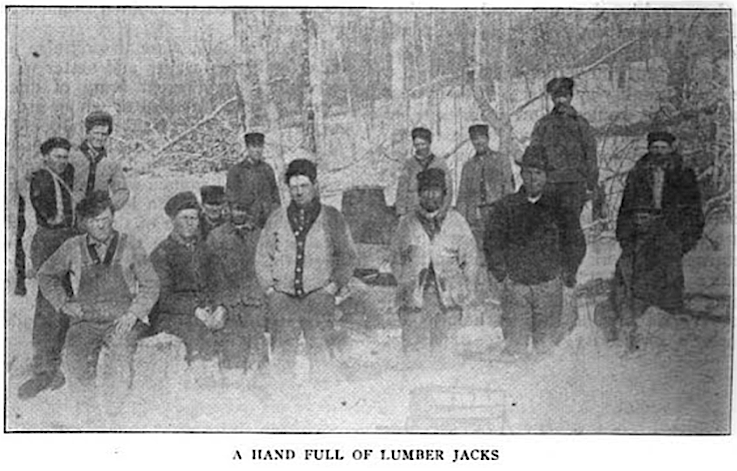
Northwest Lumber Jacks, ISR, March 1917

The Lumber Trust and Its Victims

By CHARLES ASHLEIGH

THE great Northwest! Land of snow-topped hills and fertile valleys; of the gray Puget Sound and timber-covered acres! This is the much vaunted land of plenty, country of enterprise—the State of Washington.

Years ago, the first stalwart pioneers laid the foundation of a civilization which is now ripening to a maturity,—and, it would seem, a decay! The pioneers are gone and, in their place, are the mighty potentates who have come into power over the land: the emperors of lumber. Hundreds of thousands of acres of timber land have become the stage for the slow, grinding industrial drama of the exploitation of the army of slaves of the lumber companies. From myriad logging camps and a multitude of saw-mills flows an ever-increasing volume of fat profit into the gaping maw of the few who own the lumber industry. Along the shores of Puget Sound are a number of busy ports, the purpose of whose existence is the shipping of the lumber to all parts of the world.

And, in the “lower end” or “working-stiff quarter” of every town upon the Sound you can see the producers of this tremendous wealth. Congregated on street corners, in pool halls, in the sitting-rooms of cheap “flop-houses” and in the “employment sharks'” offices are crowds of sturdy men, clad in the high, spiked shoes of the logger, heavy short flannel shirts and mackinaws; these are the human material which the lumber barons use for their enrichment.
Continue reading “Hellraisers Journal: Charles Ashleigh: How Forest & Lumber Workers’ IU Stood Forth Against the Lumber Trust Dragon”

Hellraisers Journal: The Resolution on War and Class Solidarity from IWW Convention of 1916

Share

IWWC on War and Class Solidarity, Dec 1, 1916

~~~~~~~~~~~~~~~~~~~~~~~~~~~~~~~~~~~~~~~~~~~~~

Hellraisers Journal, Friday February 9, 1917
Chicago, Illinois – I.W. W. Opposes War, Advocates Class Solidarity

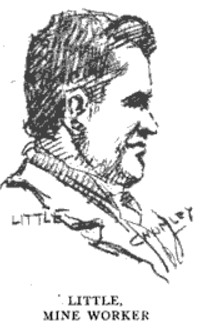
IWWC 1916, Delg Little, ISR Jan 1917

In the dark shadow of War, now looming over the nation’s working class men and women, we have concluded that now is a good time to consider the Resolution on War and Class Solidarity passed at Tenth Convention of the Industrial Workers of the World. The delegates gathered together in Chicago for ten days last fall, from November 20th to December 1st of 1916. Resolution #112 was passed during the afternoon session on the last day of the convention:

No. 112—A DECLARATION:

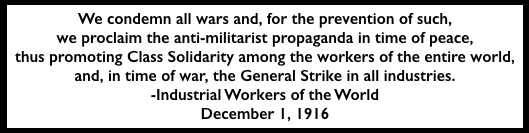
We, the Industrial Workers of the World, in convention assembled, hereby reaffirm our adherence to the principle of Industrial Unionism, and rededicate ourselves to the unflinching, unfaltering prosecution of the struggle for the abolition of wage slavery and the realization of our ideals in Industrial Democracy. With the European war for conquest and exploitation raging and destroying the lives, class consciousness and unity of the workers, and the ever growing agitation for military preparedness clouding the main issues and delaying the realization of our ultimate aim with patriotic and, therefore, capitalistic aspirations, we openly declare ourselves the determined opponents of all nationalistic sectionalism, or patriotism, and the militarism preached and supported by our one enemy, the capitalist class. We condemn all wars and, for the prevention of such, we proclaim the anti-militarist propaganda in time of peace, thus promoting Class Solidarity among the workers of the entire world, and, in time of war, the General Strike in all industries. We extend assurances of both moral and material support to all the workers who suffer at the hands of the capitalist class for their adhesion to these principles and call on all workers to unite themselves with us, that the reign of the exploiters may cease and this earth be made fair through the establishment of the Industrial Democracy.

F. H. LITTLE,
W. E. MATTINGLY,
FRANCIS MILLER,
WM. D. HAYWOOD.

National Organizer McGuckin suggested that every effort should be made to get this published in the capitalist press, and that it should also be printed in leaflet form and widely distributed. Motion made and seconded that this be adopted unanimously, and published in the presses throughout the United States of America and the world. Unanimously carried.

Continue reading “Hellraisers Journal: The Resolution on War and Class Solidarity from IWW Convention of 1916”

Hellraisers Journal: “Everett, November Fifth,” a Poem by Charles Ashleigh

Share

Fierce and long the battle rages,
But we will not fear.
Help will come whene’er it’s needed,
Cheer, my comrades, cheer!

~~~~~~~~~~~~~~~~~~~~~~~~~~~~~~~~~~~~~~~~~~~~~

Hellraisers Journal: Sunday February 4, 1917
From the International Socialist Review: Remember Everett!

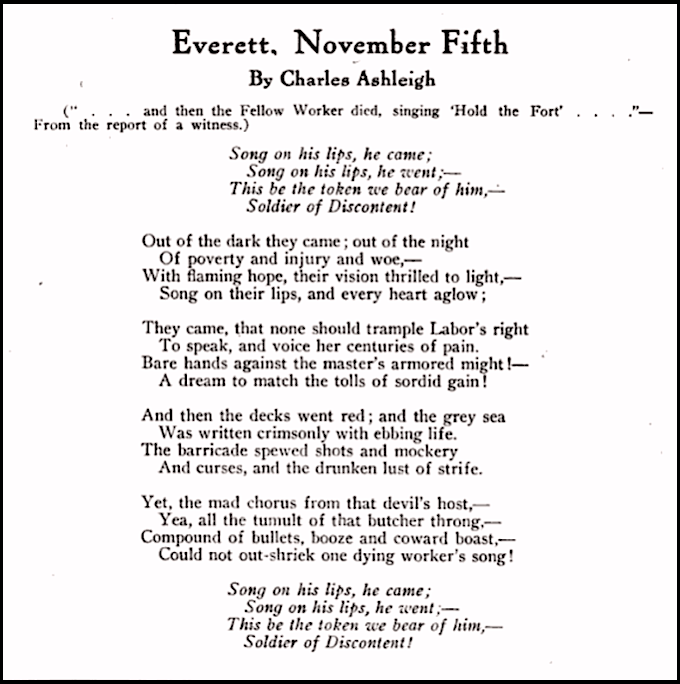
Everett Massacre, Nov Fifth, Charles Ashleigh, ISR Feb

Walker C. Smith on the young martyr, Hugo Gerlot:

As the Verona cleaved the placid, sunlit waters of the Bay and swung up to the City Dock at Everett, shortly before two o’clock, the men were merrily singing the English Transport Workers’ strike song, “Hold the Fort.”

From a hillside overlooking the scene thousands upon thousands of Everett citizens sent forth cheer after cheer as a hearty welcome to the “invading army.” High up on the flag-pole of the Verona clambered Hugo Gerlot, a youthful free speech enthusiast, to wave a greeting to the throng that lined the shore…

Continue reading “Hellraisers Journal: “Everett, November Fifth,” a Poem by Charles Ashleigh”

Hellraisers Journal: Rebellion in Lumber Camps of Northern Minnesota: Harrison George Reports

Share

The camps are deserted, the strikers firm,
the bosses wild and the cat sits on
every log that straggles thru
to the mills of Minnesota.
-Harrison George

~~~~~~~~~~~~~~~~~~~~~~~~~~~~~~~~~~~~~~~~~~~~~

Hellraisers Journal, Thursday February 1, 1917
Northern Minnesota – Lumber Workers Fight for Dignity

IWW Metal Mine Workers IU No. 490, Hibbing MN, June 19, 1916, Crpd

The Duluth News Tribune could not contain its glee when the Mesabi Iron Miners’ Strike was defeated last December and the I. W. W. organizers bid the workers of the Range good-bye. So imagine then the surprise when less than two weeks later the Industrial Workers of the World again appeared on the Range, this time to organize under the leadership of “Timber Beast” Jack Beaton and Fellow Worker Charles Jacobson, Secretary of the Virginia L. U. A meeting was held in the Finnish Socialist Hall of Virginia, demands issued, and soon a strike was on at the two sawmills and in the lumber camps of the Virginia & Rainy Lumber Company.

From the International Socialist Review of February 1917:

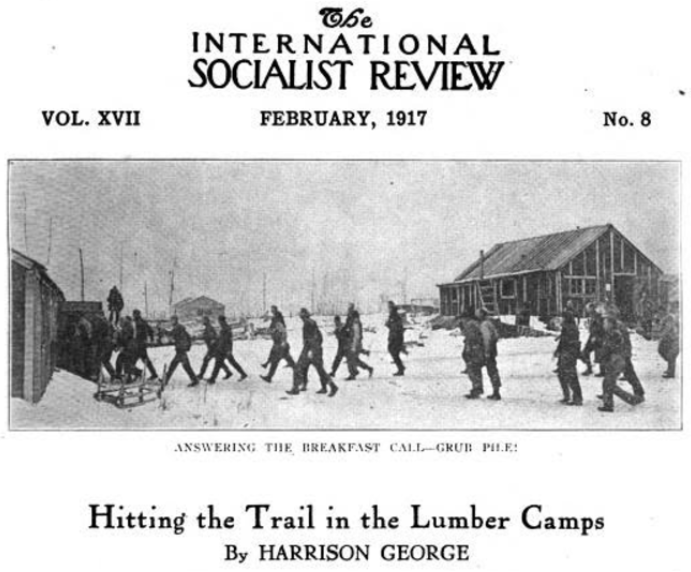
Lumber Workers, Camp Grub Pile, ISR, Feb 1917

WHILE the Lumber Workers’ Union, the bull-pen of the Industrial Workers of the World, was in convention at Portland, Ore., during the last week of December, the rumblings of revolt began half way across the continent among workers of that industry in Minnesota.

North and westward of the Mesaba Iron Range lies millions of acres of swamp lands. In the primeval state, these swamps were covered with magnificent forests where roamed the Indian and the fur-bearing fox, bear and beaver. In this section John Jacob Astor’s fur business in the early times laid the base of the present Astor-crat fortune. A very simple process—the Indians skinned the animals and Astor skinned the Indians.

Later huge land grants the railroads secured by bribery and worse practices, opened the forests to the pillage of the Lumber Trust. Where the government yet retained title to timber lands, the lumber trust in open defiance simply entered and stole the finest of timber and used the political axe on all annoying officials.

Continue reading “Hellraisers Journal: Rebellion in Lumber Camps of Northern Minnesota: Harrison George Reports”

Hellraisers Journal: “The Dream of Debs” by Jack London, Fictional Account of a General Strike

Share

You ought to be out raising hell.
This is the fighting age.
Put on your fighting clothes.
-Mother Jones

~~~~~~~~~~~~~~~~~~~~~~~~~~~~~~~~~~~~~~~~~~~~~

Hellraisers Journal Wednesday January 24, 1917
From the International Socialist Review: A Story by Jack London

The pen of Jack London, perhaps our greatest Socialist writer, was silenced by death last November. And, therefore, we were pleased to find London’s fictional account of The General Strike republished in this month’s edition of the Review.

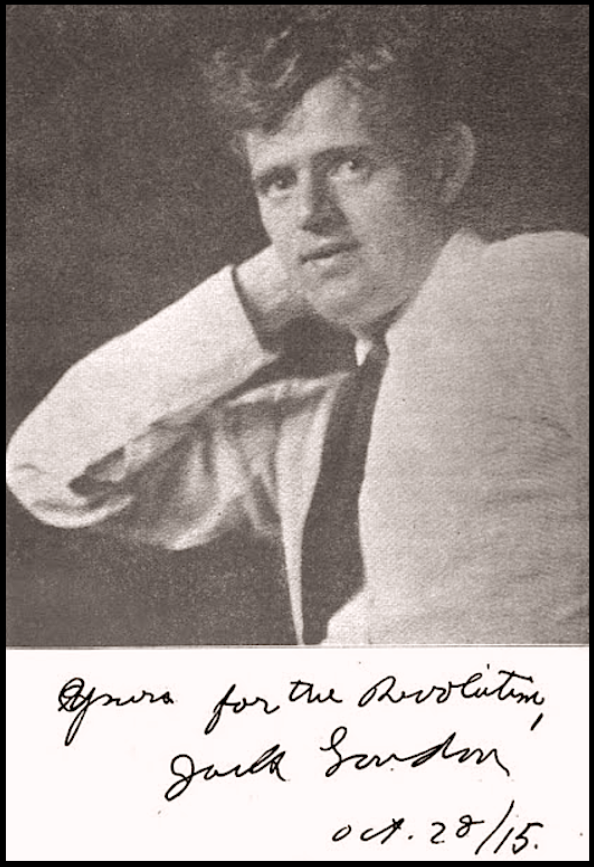
Jack London with sig 10-28-1915, ISR January 1917

ISR Dream of Debs by J London, January 1917

I awoke fully an hour before my customary time. This in itself was remarkable, and I lay very wide awake, pondering over it. Something was the matter, something was wrong-I knew not what. I was oppressed by a premonition of something terrible that had happened or was about to happen. But what was it? I strove to orient myself. I remembered that at the time of the Great Earthquake of 1906 many claimed they awakened some moments before the first shock and that during these moments they experienced strange feelings of dread. Was San Francisco again to be visited by earthquake?

I lay for a full minute, numbly expectant, but there occurred no reeling of walls nor shock and grind of falling masonry. All was quiet. That was it! The silence! No wonder I had been perturbed. The hum of the great live city was strangely absent. The surface cars passed along my street, at that time of day, on an average of one every three minutes; but in the ten succeeding minutes not a car passed. Perhaps it was a street-railway strike, was my thought; or perhaps there had been an accident and the power was shut off. But no, the silence was too profound. I heard no jar and rattle of wagon wheels, nor stamp of iron-shod hoofs straining up the steep cobble-stones.

Pressing the push-button beside my bed, I strove to hear the sound of the bell, though I well knew it was impossible for the sound to rise three stories to me even if the bell did ring. It rang all right, for a few minutes later Brown entered with the tray and morning paper. Though his features were impassive as ever, I noted a startled, apprehensive light in his eyes. I noted, also, that there was no cream on the tray.

“The Creamery did not deliver this morning,” he explained; “nor did the bakery.”

I glanced again at the tray. There were no fresh French rolls-only slices of stale graham bread from yesterday, the most detestable of bread so far as I was concerned.

“Nothing was delivered this morning, sir,” Brown started to explain apologetically; but I interrupted him.

“The paper?”

“Yes, sir, it was delivered, but it was the only thing, and it is the last time, too. There won’t be any paper to-morrow. The paper says so. Can I send out and get you some condensed milk?”

I shook my head, accepted the coffee black, and spread open the paper. The headlines explained everything-explained too much, in fact, for the lengths of pessimism to which the journal went were ridiculous. A general strike, it said, had been called all over the United States; and most foreboding anxieties were expressed concerning the provisioning of the great cities.

Continue reading “Hellraisers Journal: “The Dream of Debs” by Jack London, Fictional Account of a General Strike”

Hellraisers Journal: “Remember the Fifth of November,” by Walker C. Smith, for the International Socialist Review

Share

Today we pay tribute to the dead.
Tomorrow we turn, with spirit unquellable,
to give battle to the foe!
-Charles Ashleigh

~~~~~~~~~~~~~~~~~~~~~~~~~~~~~~~~~~~~~~~~~~~~~

Hellraisers Journal, Tuesday January 16, 1917
From Seattle, Washington: The Everett Martyrs Remembered

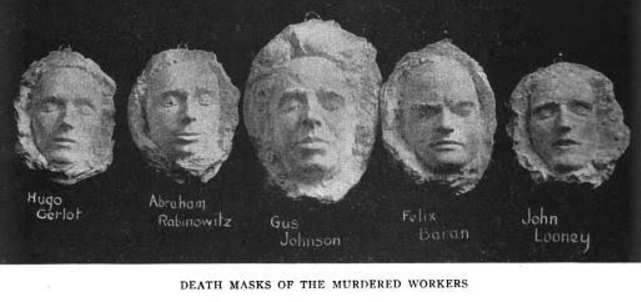
In this month’s edition of the International Socialist Review, Walker C. Smith gives a moving account of the great mass funeral given by the Industrial Workers of the World to honor our fallen fellow workers, Hugo Gerlot, Felix Baran, and John Looney. Gus Johnson and Abraham Rabinowitz are also honored as martyrs. They were buried separately by their families.

Everett Martyrs, Death Masks, ISR, Jan 1917

Remember the Fifth of November

By WALKER C. SMITH

“Do you remember the fifth of November,
With its gunpowder, treason and plot?
I see no reason why gunpowder treason
Should ever be forgot!”

THIS ancient English verse in commemoration of the exploits of Guy Fawkes applies so undeniably well to the operations of the murderous master-class mob on Bloody Sunday at Everett, Wash., that it should be accorded a place among the songs of the social revolution.

Why should we forget that five members of our class were shot down in cold blood by the scab-loving lackeys of the lumber trust on November 5, 1916? Why should we forget that many of our brothers were punctured by the poisonous copper bullets and soft lead slugs from the guns of the open-shop camoristas [camorristas] acting for the commercial clubs on the Pacific coast? Why should we forget that seventy-four stalwarts of labor, absurdly charged with first degree murder, are at the mercy of the half-crazed sheriff of Snohomish county and thirty-four more are imprisoned in the King county bastile on the charge of unlawful assembly? I see no reason why any of these things “should ever be forgot” by the working class.

Felix Baran, Hugo Gerlot, Gus Johnson, John Looney, Abe Rabinowitz-French, German, Swedish, Irish, Jewish—these are the true internationalists who died in the fight for free speech in this “land of liberty.” In the words of Courtenay Lemon, “That the defense of traditional rights to which this government is supposed to be dedicated should devolve upon an organization so often denounced as ‘unpatriotic’ and ‘un-American’ is but the usual, the unfailing irony of history.” The names of those who are martyrs to the cause of free speech will be a source of inspiration to the workers when their cowardly murderers have long been forgotten.

Continue reading “Hellraisers Journal: “Remember the Fifth of November,” by Walker C. Smith, for the International Socialist Review”

Hellraisers Journal: Robert Minor, of International Workers’ Defense League, on the Mooney Frame-Up

Share

There are no limits to which
powers of privilege will not go
to keep the workers in slavery.
-Mother Jones
~~~~~~~~~~~~~~~~~~~~~~~~~~~~~~~~~~~~~~~~~~~~~

Hellraisers Journal, January 12, 1917
San Francisco, California – Frame-Up of Tom Mooney Examined

Writing in this month’s edition of the International Socialist Review, Robert Minor, Treasurer of the International Workers’ Defense League, exposes a few interesting details in the ongoing frame-up of the San Francisco labor leader, Tom Mooney:

The Suitcase Ghost

By ROBERT MINOR

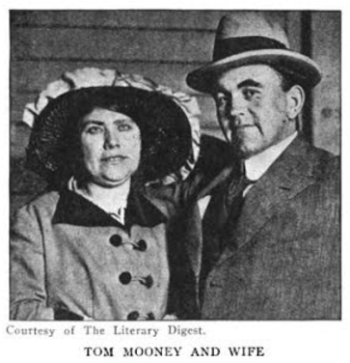
Tom and Rena Mooney, ISR, Dec 1916

LIKE the giant trees that astonish the eye of the traveler, like the wonderful climate and other marvels of the state, California produces the most amazing manifestations of the Labor Struggle.

Since the McNamara plea of guilty, there has been a ghost in nearly every labor dispute. That ghost is “the Suitcase.” There is a suitcase in every strike. Sometimes made of yellow leather, some times of black morocco, the suitcase is more often built of nightmares—pure imagination. But the suitcase, in one form or another, is a California institution.

When made of more than imagination, the suitcase has usually been (since the McNamara case) in the hand of an agent of the corporations, and loaded with dynamite.

In Stockton, three years ago, Anton Johannsen, labor organizer, “got the drop on” a gunman who came to his hotel room to kill him for the Merchants,’ Manufacturers’ and Employers’ Ass’n. The trapped gunman confessed that it was his intention, after killing Johannsen, to place a suitcase of dynamite in his room, another suitcase of the same explosive in the Santa Fe station checking room, with the check slipped into the pocket of the Secretary of the Building Trades Council. One of the other plotters, J. J. Emerson, was caught by a bungling policeman with a suitcase of dynamite, confessed to the plot to “plant” it so as to blame the strikers, but was, of course, acquitted in spite of the confession. (What are courts for?) Ed Nolan and Tom Mooney were instrumental in the expose.

In the same strike, Warren K. Billings, then 19 years of age, out of a job, was accosted by strangers who offered him $50 to carry a suitcase to Sacramento, to be delivered to two men whom he was to meet in a saloon. The boy accepted the offer. The men waiting for him in the saloon in Sacramento proved to be detectives, the suitcase contained dynamite, and Billings was given a two-year sentence.

When an explosion occurred in the San Francisco preparedness parade and killed ten persons, the blame was laid upon labor organizers with a suitcase. This in spite of the fact that the most reliable witness, a prominent physician, and several others whose names the police promptly lost, stated that they had seen a large, cylindrical bomb thrown.

Continue reading “Hellraisers Journal: Robert Minor, of International Workers’ Defense League, on the Mooney Frame-Up”

Hellraisers Journal: From the International Socialist Review: Harrison George Claims Victory on the Mesabi

Share

You ought to be out raising hell.
This is the fighting age.
Put on your fighting clothes.
-Mother Jones
~~~~~~~~~~~~~~~~~~~~~~~~~~~~~~~~~~~~~~~~~~~~~

Hellraisers Journal, Saturday January 6, 1917
From the Mesabi Range, Minnesota, Comes News of Plea Agreement

The International Socialist Review of January 1917:

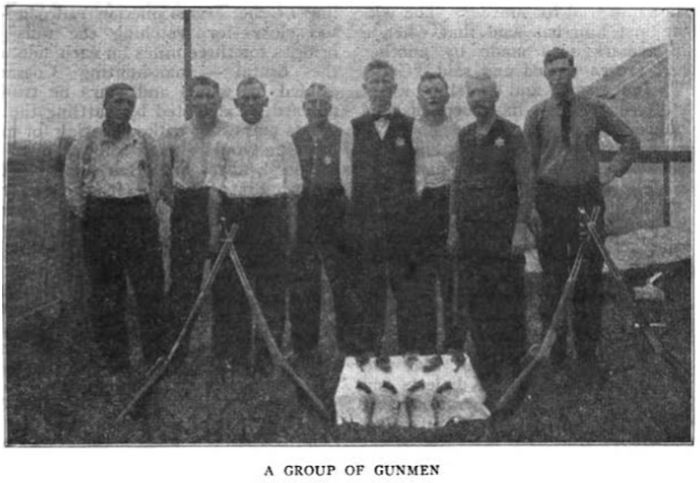
MN16 Gunthugs on the Mesabi, ISR Jan 1917

Victory on the Mesaba Range

By HARRISON GEORGE
We were all ready to go to press when the following telegram came in. We feel sure all REVIEW readers will be interested in the brief sketches that follow:
Virginia, Minn., Dec. 15, 1916.
Tresca, Scarlett, Schmidt, Mrs. Masonovitch, Orlandich, [F]reed, Phil Masonovitch, Nikich, Cernogorovich year sentence each. All cases against Gilday, Greeni, others dismissed. Full statement will follow. Funds needed here meet honor bound obligations. All committees rush balance funds on hand here. All together for freedom Everett and all class war prisoners.
Ettor, Gilday, Flynn.

CARLO TRESCA, who was born in Sulmona, Italy, in 1879. Entering the labor movement at an early age, he became editor of a Socialist paper in his native town when he was only twenty years old. By 1904 he had shown his worth by being many times sent to prison on political charges. In 1903 he was elected secretary of the largest labor organization of Italy, the Syndicate of Firemen and Railroad Engineers. In 1904, however, he was given choice of eighteen months penal servitude or ten years exile for political offenses, and, choosing exile, he landed in America in August, 1904. As organizer and editor he continued his fight for labor, now being editor of an Italian paper in New York, LL’Avenire [L’Avvenire]. Jailed for months on different occasions, he was attacked by an assassin, who is said to have been an emissary of the Italian consul in Pittsburgh and his throat badly slashed. In the last six years Tresca has taken part in all big strikes of the I. W. W., which involved Italian workers. Lawrence, Little Falls and Paterson are only a few of the many strikes where thousands cheered when Tresca stood before them. Now he is on trial for murder. The witness against him has said that when a certain remark was made by another speaker, Tresca smiled and said, “Good, good!” For a smile and one short word, twice uttered, Tresca has been charged with murder!

Continue reading “Hellraisers Journal: From the International Socialist Review: Harrison George Claims Victory on the Mesabi”

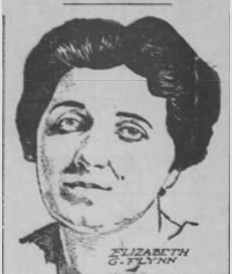
Hellraisers Journal: Elizabeth Gurley Flynn for The Masses: “The Minnesota Trials”

Share

It is a privilege and a duty even by sacrifice
to advance our priceless cause.
-John R Lawson

~~~~~~~~~~~~~~~~~~~~~~~~~~~~~~~~~~~~~~~~~~~~~

Hellraisers Journal, Friday January 5, 1917
From The Masses: FW Flynn on Behalf of Minnesota Defendants

EGF, MN Iron Miners Strike, Ev IN, Aug 17, 1916

The following article was obviously written for The Masses by Fellow Worker Flynn, I. W. W. organizer, before the plea agreement was reached in the cases of the strikers and organizers charged with first degree murder in connection with the strike of iron miners up on the Mesabi Range of northern Minnesota. The article is nevertheless valuable for the information given regarding the defenses campaign along with a short history regarding “criminal conspiracy” as related to labor struggles, past and present. Tomorrow’s Hellraisers will present an article from this month’s edition of the International Socialist Review, written by Harrison George, which claims the plea agreement as a victory for the strikers and for the cause of labor in general.

From The Masses of January 1917:

The Minnesota Trials

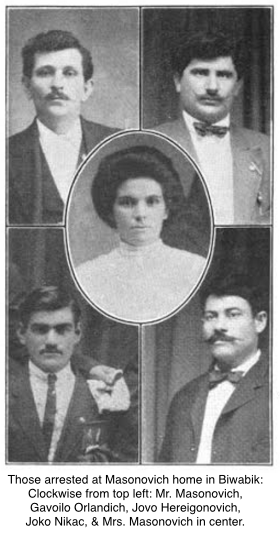
Masonovich-P. & M. & Boarders, ISR, Sept 1916

Many of our friends fail to appreciate the magnitude of the Minnesota strike, involving 15,000 miners and the United States Steel Corporation, and are beguiling themselves into belief that the murder cases pending are not serious.

Mrs. Masonovitch [Masonovich], the woman prisoner, wife of one of the strikers, is a particularly pathetic and appealing figure, a young and beautiful Montenegrin woman, mother of five children, one a nursing baby. She speaks little English, does not understand the proceedings, looks frightened and bewildered and clings frantically to her children. If the parents should be convicted these little ones would be practically orphans. The older ones, twelve and eight, bright, nice boys, tell very clearly what happened on July 3, the night of the tragedy, how the deputies came to arrest their father, how one struck their mother and threw her to the floor, how the fight then started in which Mr. Myron was killed, and how Nick Dillon, the notorious gunman, shot and killed Thos. Ladvalla [Tomi Ladvalla-WE NEVER FORGET], a bystander. If the episode was not connected with a strike, it would be comparatively easy to clear these poor people.

Continue reading “Hellraisers Journal: Elizabeth Gurley Flynn for The Masses: “The Minnesota Trials””

Hellraisers Journal: From the International Socialist Review: Theodora Pollok on the Mooney Frame-Up

Share

There are no limits to which
powers of privilege will not go
to keep the workers in slavery.
-Mother Jones

~~~~~~~~~~~~~~~~~~~~~~~~~~~~~~~~~~~~~~~~~~~~~

Hellraisers Journal, Monday December 18, 1916
San Francisco, California – The Closed Shop Fight and Frame-Up

From the December edition of the International Socialist Review:

Will Labor Stand for Another
Haymarket?

By THEODORA POLLOK

Tom and Rena Mooney, ISR, Dec 1916

SAN FRANCISCO in 1916; Chicago in 1886. The closed shop fight now; the 8-hour fight then. In both cases, a crime of violence occurs and is tied around the necks of innocent labor men in the hope of helping to crush the spirit of labor.

In Chicago in 1886 a slavish press and an inflamed public mind, and the labor and radical groups, too weak to save the chosen victims. Today in San Francisco a slavish press, but a public mind open to conviction. Yet young Billings, first of the San Francisco Preparedness Day explosion defendants to be tried, has been convicted and sentenced to life imprisonment, and only the fighting working class of the country can save him—by saving his four co-defendants.

Tom Mooney’s trial, the second trial, is set for the 27th of November. It is Tom Mooney’s life that is desired above all others by this gang of ruffians, the “gentlemen” of the Chamber of Commerce, the United Railroads, and the Pacific Gas & Electric, and their tools in the District Attorney’s office. For Mooney, helped by his little music teacher wife, Rena, who is one of his co-defendants—Mooney recently dared actually try to organize the carmen of the United Railroads, who have been beaten down, spied upon and “weeded out” since the great car strike before the earthquake.

The tactics of the prosecution are such as might rather be expected in some backwoods lumber baron’s camp than in a great urban center. Indeed, with the “Law and Order” Committee from the Chamber of Commerce censoring all the press, the truth is even harder to get to the people than in a small town where it flies from mouth to mouth.

Continue reading “Hellraisers Journal: From the International Socialist Review: Theodora Pollok on the Mooney Frame-Up”