Hellraisers Journal: Chicago IWW Trial: “Free speech is necessary to social change and to maintain freedom.” -J. A. McDonald

Share


“Yaas,” said the farmer reflectively,
“all the I.W.W. fellers I’ve met
seemed to be pretty decent lads,
but them ‘alleged I.W.W.’s’ must be holy frights.”
-Little Red Songbook, 1919
~~~~~~~~~~~~~~~~~~~~~~~~~~~~~~~~~~~~~~~~~~~~

Hellraisers Journal, Sunday August 11, 1918
Chicago, Illinois – J. A. McDonald on Free Speech and Freedom

Report on the Chicago I. W. W. Trial from Harrison George:

John A. McDonald, IWW, ISR Jan 1918

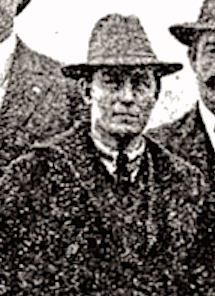
John A. McDonald, editor of the “Industrial Worker,” occupied the chair for some length of time. He told of the origin of his ideas and how his experiences in the southern timber strike had made an I. W. W. of him.

[He said:]

The experience of all thinkers in the past is that free speech is necessary to social change and to maintain freedom.

[Photograph added.]
Trial Notes: Tuesday July 30, 1918:

On the morning of July 30, Chas. Thompson and Corporal Reynolds were recalled by Vanderveer. They told the jury that when leaving the court room the day before they had been arrested and detained by Department of Justice men in the office of Hinton G. Clabaugh. Over Nebeker’s strenuous objection they told of this attempt to intimidate defense witnesses and said that other soldier witnesses might be fearful of coming to testify. It was rumored about the court that Judge Landis had told Nebeker privately that if another soldier witness would be treated that way he would dismiss the case by a directed verdict. Following this, three Finnish witnesses were called in support of Laukki’s story that the registration trouble in Minnesota was a Finnish issue solely.

Fred Jaakkola, also an editor of “Industrialisti,” and a defendant, contradicted a government witness by proving by a church certificate that he was not a “slacker,” having been born in 1885. Nebeker in a nasty-mannered examination of the big, stolid Finn, thought to get an acknowledgement that Finlanders called a “slacker” a martyr or a hero. “Slacker” had been mentioned and Nebeker said, “You know what I mean by a slacker, don’t you?” “Yes,” said Jaakkola. “By the way,” said Nebeker, “what do you Finns call a slacker?’” “We call it ‘Vitkastelija,’” replied Jaakkola, and everybody laughed. And that was all the answer Nebeker got.

Continue reading “Hellraisers Journal: Chicago IWW Trial: “Free speech is necessary to social change and to maintain freedom.” -J. A. McDonald”

Hellraisers Journal: Migratory Workers Riding the Rods, Riding the Bumpers, and on the Blind Baggage

Share

Then we’ll sing one song of the poor and ragged tramp,
He carries his home on his back;
Too old to work, he’s not wanted ’round the camp,
So he wanders without aim along the track.
-Joe Hill

~~~~~~~~~~~~~~~~~~~~~~~~~~~~~~~~~~~~~~~~~~~~

Hellraisers Journal, Monday August 10, 1908
Chicago, Illinois – “How Hoboes Ride on Trains Free.”

From The Inter Ocean of August 9, 1908:

How Hoboes Ride, Intr Ocn -p29, Aug 9, 1908

CHICAGO being the greatest railroad center of the United States it is naturally the center of population for most of the hobos of the country at one season of the year or another. The train crews of all the great railroads and the guards in the big railroad yards of this city could tell some exciting stories of conflicts with the men who ride for nothing on the railroads, as hundreds are brought in here and go out every day.

Every body knows that there is a class of people called hobos. Everybody has heard of almost unbelievable rips, completed in almost unbelievable time, considering that not a cent of railroad fare is ever paid.

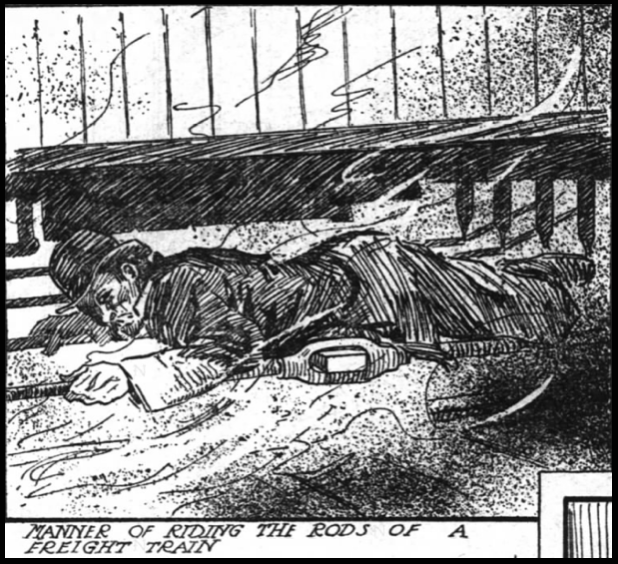
Many have spent time wondering how it is done, but when, upon inquiry, it is learned that it is a simple matter of “riding the bumpers” or “straddling the rods,” the recipient of the information is still in the dark as to the ways and means employed….

The following drawings are included in the article:

Riding the Rods

Riding the Rods, How Hoboes Ride, Intr Ocn -p29, Aug 9, 1908

Continue reading “Hellraisers Journal: Migratory Workers Riding the Rods, Riding the Bumpers, and on the Blind Baggage”

Hellraisers Journal: From The Socialist Woman: City of Los Angeles Locks-Up Socialist Women for Speaking on Streets

Share

You ought to be out raising hell.
This is the fighting age.
Put on your fighting clothes.
-Mother Jones
~~~~~~~~~~~~~~~~~~~~~~~~~~~~~~~~~~~~~~~~~~~~~

Hellraisers Journal, Sunday August 9, 1908
Los Angeles – Socialist Women Raise Hell for Free Speech

From The Socialist Woman of August 1908:

SOCIALIST WOMEN IN JAIL.

LA FSF, SF Call -p9, July 10, 1908

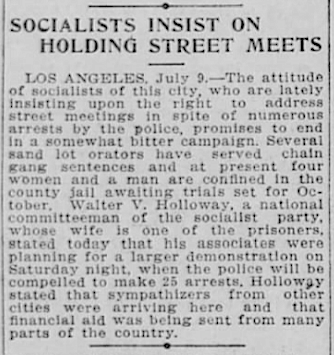
Four Socialist women—Mrs. Bertha M. Dailey, Mrs. Alice Vail Holloway, Mrs. Helen A. Collins, Mrs. Cloudsley Johns—all of Los Angeles, have been spending the warm days of July in the jail of that city. This, for speaking on the streets of Los Angeles—the City of Angels.

The Los Angeles Herald asks, editorially, “Why arrest scholarly, refined, delicately nurtured, women, mothers of families, and irreproachable members of society, and allow men to exercise with impunity the right of free speech?…Salvation Army speakers, evangelists, and other reformers are not interfered with…The worst feature of all this wretched display of prejudice and lack of good judgment is in the fact that all the leading newspapers of the land—ALL—have published accounts of the arrest of the little women and the immunity of the big men, and are commenting on it unreservedly. Los Angeles may well afford to do without this kind of advertising, and we think the chamber of commerce should call a special meeting to review this whole subject, and set our city right before the United States of America.”

In the meantime, the “little women” are doing a good stroke of agitation work for the Socialist movement. They are advertising the Los Angeles movement as it was never advertised before, and are creating sympathy where it never before existed. A daintily gotten-up “At Home” card sent out by them, reads as follows:

Continue reading “Hellraisers Journal: From The Socialist Woman: City of Los Angeles Locks-Up Socialist Women for Speaking on Streets”

Hellraisers Journal: Chicago IWW Trial: Fellow Worker Francis Miller on Early Death in the Textile Mills of New England

Share

You ought to be out raising hell.
This is the fighting age.
Put on your fighting clothes.
-Mother Jones
~~~~~~~~~~~~~~~~~~~~~~~~~~~~~~~~~~~~~~~~~~~~

Hellraisers Journal, Tuesday August 6, 1918
Chicago, Illinois – Francis Miller on Textile Mills and Early Death

Report on the Chicago I. W. W. Trial from Harrison George:

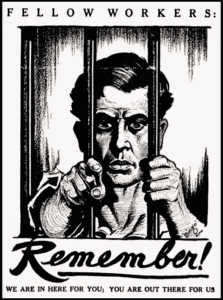
WWIR, In Here For You, Ralph Chaplin, Sol Aug 4, Sept 1, 1917

The first witness to take the stand on Monday, August 5, was Francis P. Miller, defendant and member of the General Executive Board. Miller was born in France in the region known as the Department of the Seine, where the great textile mills were before the war. He came to America in 1892, and has worked continuously in the textile mills of the east, and at the time of his arrest was employed by the American Woolen Company as inspector on government goods.

Testifying upon conditions in the textile mills of New England, Miller said:

The development in the textile industry has been both a development of machinery and the process of ‘speeding up.” In the cotton industry the looms and other machinery have been improved so that the worker produces 300 or 400 per cent more than he did a generation ago. In the woolen mills the machinery has not been improved to any great extent, but the workers usually have to run two machines where they ran one twenty years ago. The pay has increased a little, but not in keeping with the cost of living at all. Factory owners and trade papers say that production has increased one thousandfold, that is, over hand production. It has certainly increased 300 or 400 per cent in the last twenty-five years.

Continue reading “Hellraisers Journal: Chicago IWW Trial: Fellow Worker Francis Miller on Early Death in the Textile Mills of New England”

Hellraisers Journal: Western Federation of Miners Drops Industrial Workers of the World; Constitution Amended

Share

Quote Mother Jones, UMWC, Indianapolis, July 19, 1902
~~~~~~~~~~~~~~~~~~~~~~~~~~~~~~~~~~~~~~~~~~~~

Hellraisers Journal, Tuesday August 4, 1908
Denver, Colorado – W. F. of M. Makes Break Official

The reporting by Luella Twining from the recent convention of the Western Federation of Miners, as published by the Appeal to Reason of August 1st, failed to mention that the convention, on July 22nd, officially severed all ties between the Federation and the Industrial Workers of the World. Other newspaper accounts did not ignore the rupture.

From the Illinois Moline Daily Dispatch of July 22, 1908:

WESTERN FEDERATION DROPS INDUSTRIALS
—–
Adopts Amendment to Constitution
Which Strikes Out All Reference to
Industrial Workers of the World.
—–

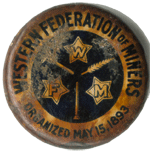
WFM button

Denver, July 22.-The Western Federation of Miners today officially repudiated the Industrial Workers of the World by adopting an amendment to its constitution striking out the words “mining department of Industrial Workers of the World” where they appear and inserting in lieu thereof Western Federation of Miners.”

[Photograph added.]

Continue reading “Hellraisers Journal: Western Federation of Miners Drops Industrial Workers of the World; Constitution Amended”

Hellraisers Journal: From the Industrial Union Bulletin: James Wilson on the Power of Music to Rouse the Toilers

Share

Then raise the scarlet standard high,
Beneath its folds we’ll live and die,
Tho’ cowards flinch and traitors sneer,
We’ll keep the Red Flag flying here!
-Jim Connell
~~~~~~~~~~~~~~~~~~~~~~~~~~~~~~~~~~~~~~~~~~~~

Hellraisers Journal, Friday July 31, 1908
Fellow Worker James Wilson on the Songs of Social Revolution

From The Industrial Union Bulletin of July 25, 1908:

MUSIC
—–
One of the Most Powerful
of the Natural Forces.

[by James Wilson]

IWW Emblem, IUB -p1, July 25, 1908

Among the physical forces, made useful to men, sound has played one of the most important parts. We use the word light, in a literal as well as figurative sense. But sound has more often a real, plain meaning.

Is not the ear the most perfect of the organs of sense? We can remember a tune, long after the words have been forgotten.

The association of sounds, and in a higher degree, music, is one of the most lasting and forcible of impressions.

What old cavalry veteran does not know that even the war horse remembers the different bugle calls, and will neigh and paw the ground with excitement when he hears the stirring blast of the trumpet?

We know that music stirs the emotions in every way. The majestic funeral march of Beethoven appeals to the mind with its solemn and awful grandeur; the latest rag-time dance tune fills us with the feeling of gaiety and enlivens our care-worn existence.

What more powerful to excite ridicule than a comic song? How very useful to bring out the hollowness of the sham religionists, with their sounding drum and doleful chants while they pick our pockets and tell us that “he that giveth to the poor, lendeth to the Lord!” The debt to be repaid in the next world-probably Mars-for that its the world nearest to the earth!

The sky-pilots have long told us of reviving grace-whatever that may be. They also tell us to “taste of the Lord and see that He is good.”

How comforting to a hungry man!

Continue reading “Hellraisers Journal: From the Industrial Union Bulletin: James Wilson on the Power of Music to Rouse the Toilers”

Hellraisers Journal: From The Industrial Union Bulletin: “Shall we Die Starving or Shall We Die Fighting?” -J. H. Walsh

Share

Am I to die, starving in the midst of plenty?
Or shall I die fighting?
For my part, a thousand times over,
I’ll die fighting before I’ll die starving.
-J. H. Walsh
~~~~~~~~~~~~~~~~~~~~~~~~~~~~~~~~~~~~~~~~~~~~

Hellraisers Journal, Thursday July 30, 1908
National I. W. W. Organizer Reports from the Pacific Northwest

From The Industrial Union Bulletin of July 25, 1908:

SHALL WE DIE STARVING, OR SHALL WE DIE FIGHTING?
[by J. H. Walsh]

IWW Emblem, IUB -p1, July 25, 1908

We are confronting a new condition in the labor movement in the northwest, and judging from all the labor reports it is the same throughout the United States, as well as many of the foreign countries.

Every train in this country is loaded with dozens of “hoboes” (working men looking for jobs), and in some instances there are hundreds in place of dozens. Last night there arrived on one train in this city [Spokane?] 313 men who were beating their way. The previous night 73 arrived in one box car, and in another car 53. The men coming to the headquarters report the same news day after day, and that is that the unemployed army is growing larger and larger.

There are ten men in the harvest fields in this country for every job. They are working for as low as 75 cents per day. There are women and children in this country actually starving. This is not the worst. The worst is yet to come. After the harvest is over the hundreds who secured work, although at small wages, will return to the army of unemployed. Its ranks will be swelled again. And swelled just on the verge of winter, when hardships will be added to the workers’ struggles for an existence.

Those who are getting their “feet under dad’s table,” coupled with those who have a job sufficiently remunerative to eke out an existence, will stand united with the philosophers in passing resolutions condemning the conditions-Bryan, “God Knows” Taft, etc., etc. But resolutions, no matter how philosophically drawn, will not fill empty stomachs.

I am with the “down-and-outs”-I am broke. I am in a land of plenty. Am I to die, starving in the midst of plenty? Or shall I die fighting? For my part, a thousand times over, I’ll die fighting before I’ll die starving.

Continue reading “Hellraisers Journal: From The Industrial Union Bulletin: “Shall we Die Starving or Shall We Die Fighting?” -J. H. Walsh”

Hellraisers Journal: Chicago IWW Trial: Ralph Chaplin on the War and the Draft, Advice and Statement Was His Alone

Share

Ah, slaves, you fight your masters’ battles well-
The reek of rotting carnage fills the air!
Your swollen bodies yield their noisome smell,
Sweet incense to the ghouls who sent your there…
-Ralph Chaplin
~~~~~~~~~~~~~~~~~~~~~~~~~~~~~~~~~~~~~~~~~~~~

Hellraisers Journal, Monday July 29, 1918
Chicago, Illinois – Ralph Chaplin on the War and the Draft

From The Bisbee Daily Review of July 20, 1918:

CHAPIN ADMITS HE PERSONALLY OPPOSED WAR
—–
I. W. W. Defendant Assumes Full Responsibility
for Editorial Advice to Wobblies of Nation
—–

(By Review Leased Wire)

CHICAGO, July 19.-Ralph R [H]. Chaplin editor of Solidarity, one of the chief organs of the I. W. W. a defendant, was on the stand today in the trial of the 101 I. W. W.

Chaplin, in his direct testimony, had dwelt on the evil of the exploitation of labor and told of the vast amount of money wrested from the toilers by such means.

The attention of Chaplin was called to an editorial printed in Solidarity defining the attitude of the I. W. W. toward the war and the draft. It advised any member drafted to claim exemption as an I. W. W., and to write on his card: “The I. W. W. is opposed to war.”

Chaplin assumed full responsibility for this article.

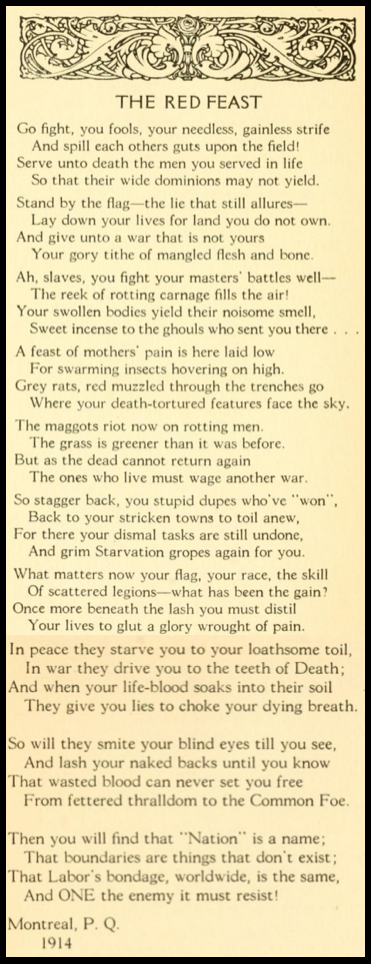
“The Red Feast” by Ralph Chaplin:

Ralph Chaplin, The Red Feast, Long, When Leaves, 1917

Continue reading “Hellraisers Journal: Chicago IWW Trial: Ralph Chaplin on the War and the Draft, Advice and Statement Was His Alone”

Hellraisers Journal: Chicago IWW Trial: Ralph Chaplin on West Virginia and His Undying Hate for Industrial Tyranny

Share

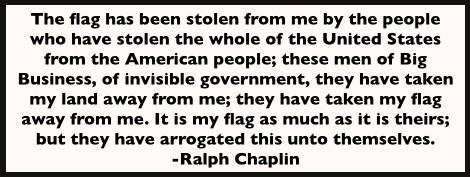
Quote Ralph Chaplin, US Flag Arrogated, Chg IWW Trial, July 19, 1918
~~~~~~~~~~~~~~~~~~~~~~~~~~~~~~~~~~~~~~~~~~~~

Hellraisers Journal, Sunday July 28, 1918
Chicago, Illinois – Testimony of Ralph Chaplin

Report from Defendant Harrison George:

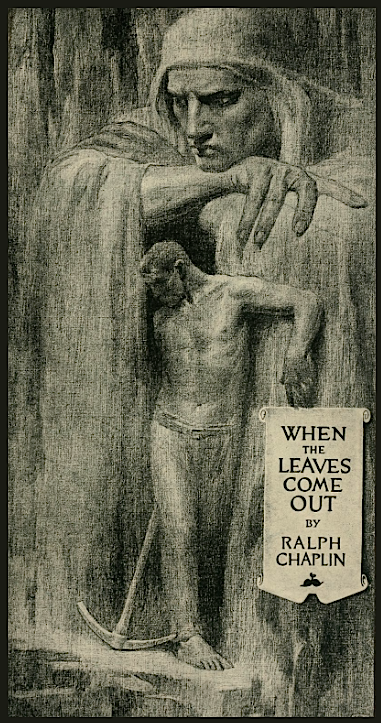
Ralph Chaplin, Leaves, 1917

Ralph Chaplin, defendant, artist-poet, and editor of “Solidarity” during 1917, took the stand on the morning of July 19th, 1918, and gave an account of how his life’s events had influenced his conclusions upon industrial and political questions. Born in Kansas thirty years ago, he had studied art at night-school while working during the day-time in the darkroom, “Spot-knocking” photographs. Later, another boss, knowing he was a “scissor-bill,” had him pledge $10 a week out of a $16 wage to invest $500 in the boss’ business. When that was paid in, the boss told him to go to hell and got another victim. This $500 was recovered because Chaplin was a minor when the contract was made; so he took this and started into business for himself with the ambition to be “independent.” But—he found a trust controlled all supplies and he was unable to buy anywhere and had to quit. So he went back to the easel, working for wages.

He then went to Mexico for one year and noted the extreme poverty of the peon class under the Diaz regime. Coming back, he had worked for the Chicago Portrait Company until the artists struck against conditions there. When that strike was lost he went to West Virginia, where he did artist work in the coal mining region. For several years previous he had been an enthusiastic member of the Socialist Party, “soap-boxing” and writing articles.

In West Virginia he did much work on the “Socialist and Labor Star” at Charleston [Huntington], which paper became the spokesman for the U. M. W. of A. coal miners’ strike at Paint Creek and Cabin Creek. During this strike Chaplin acquired his hatred of the labor-crushing militia. He described to the jury the “Bull Moose Special,” an armored train, built by union machinists in the C. & O. shops, loop-holed for machine guns and rifles; a train that was manned by Baldwin-Felts detectives and commanded by Quinn Morton, a company superintendent, and in the darkness run through the strikers’ colony at Holly Grove, belching death to men, women and children.

Chaplin came out of that strike zone with undying hate for industrial tyranny. He had written many poems about that strike and Vanderveer read them to the jury: “What Happened in the Hollow,” “The Mine Guard,” “When the Leaves Come Out,” and “Too Rotten Rank for Hell.” The latter Vanderveer asked about. “Does it express your contempt for the prostitute newspaper men?” “Well,” said Chaplin, “a part of it.”

Continue reading “Hellraisers Journal: Chicago IWW Trial: Ralph Chaplin on West Virginia and His Undying Hate for Industrial Tyranny”

Hellraisers Journal: “Butte Is a City of Widows” per Heartbreaking Testimony at Chicago Trial of IWW Leaders

Share

Now is the time, Boys…
We can make it if you muster
all the strength you have left.
-Manus Duggan

~~~~~~~~~~~~~~~~~~~~~~~~~~~~~~~~~~~~~~~~~~~~

Hellraisers Journal, Sunday July 21, 1918
Chicago, Illinois – Butte Miners Describe Horrors of Mine Fire

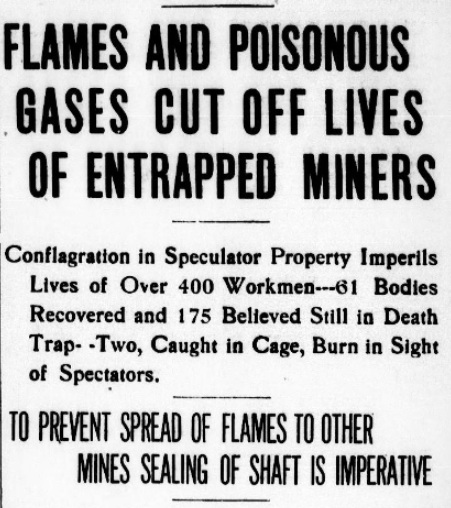
On June 15th, there came forward two miners from the city of Butte to testify for the defense in the federal conspiracy trial against leaders of the Industrial Workers of the World. The miners quietly and calmly described the horrors they had witnessed during and immediately following the mine fire that claimed the lives of 164 of their fellow miners.

From the Billings Morning Gazette of July 16, 1918:

BUTTE CITY OF WIDOWS SAYS WOBBLY
—–

Speculator MnDs, HDLN 2, Dly Missoulian, June 10, 1917
The Daily Missoulian
June 10, 1917

CHICAGO, July 15.-“Butte is a city of widows,” said Murta Shay [Murty Shea], a witness at the I. W. W. conspiracy trial today. John Muzilech [Musevich], a miner, told of the fire in the Speculator mine in June, 1917, declaring that the workers were trapped behind cement bulkheads which contained no doors. “We found the bodies piled in heaps against these bulkheads,” he said.

Joseph Kennedy, recording secretary of the Metal Mine Workers of Butte, testified he had joined the I. W. W. in 1917. Since 1909, he said, he had worked about six years under ground in Butte and had never seen a mine inspector in the workings.

George Taylor of Fernwood, Idaho, testified he had worked in lumber camps on St. Mary’s river for many years, but was made, a deputy sheriff last summer during the lumber strike there. He said there was no disorder but that many I. W. W. members who went into the woods to fight forest fires were arrested and locked in a stockade on their return.

—–

[Newspaper clipping added.]

Report from Defendant Harrison George:

[Testimony of Murty Shea]

Next upon the stand [June 15th] came a stalwart, broad-shouldered man, a pleasant-mannered Irish miner from Butte, who told in that nonchalant way usual to those whose every hour of labor is an hour of peril how he and a few other miners had fought their way through that hell of flame and smoke which swept the Speculator Mine in June, 1917, and left its sacrifice to greed in the form of 174 burned and mangled men. The story of this man, who walked out of the jaws of death into the Chicago courtroom is worth perusal.

Continue reading “Hellraisers Journal: “Butte Is a City of Widows” per Heartbreaking Testimony at Chicago Trial of IWW Leaders”