Hellraisers Journal – Wednesday June 9, 1920
Butte, Montana – W. F. Dunne on the Anaconda Road Massacre
From The Liberator of June 1920:
Why Copper Is Red
By W. F. Dunne
ANOTHER crimson chapter has been added to the bloody history of Butte, Montana. It was written on April 21 when Winchester repeaters in the hands of gunmen of the Anaconda Mining Co;, poured their deadly loads of buskshot into a peaceful assemblage of striking miners.
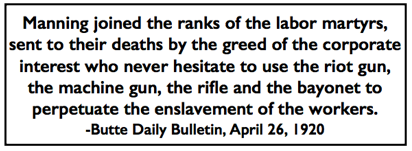
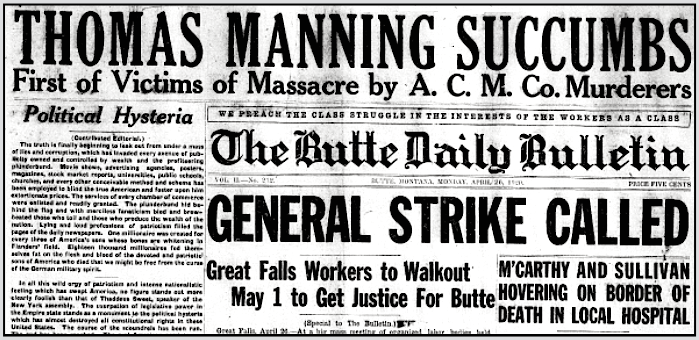
Thomas Manning is dead, two more lie at the point of death, twelve more were wounded. Everyone of the victims was shot in the back.
The Butte Daily Bulletin of April 26, 1920
The miners struck on Monday, April 19. Their demands were as follows:
Release of all industrial and political prisoners. Six-hour day from collar to collar. Minimum wage scale of $7 a day for all workers in the mining industry. Abolition of the rustling-card. Abolition of contract and bonus and so-called efficiency system. Two men work together on all machines, and two men to work together in all workings.
The picket lines were sent out and by Tuesday evening, as they say in Butte, “the hill was clean.” The hoisting of ore ceased. The strike was called on Sunday, April 18, by Local 800 Metal Mine Workers Industrial Union of the Industrial Workers of the World, at two meetings attended by over 2,500 miners. For several weeks miners had been leaving Butte by the dozens, dissatisfied with the contract and bonus system instituted by the mining companies. Men were forced to take contracts and if they made more than a day’s pay received but a fraction of their increased earnings in their envelopes; if they failed to break enough rock, at the price per cubic foot paid, to equal a day’s pay, they were fired. At the Sunday meetings some speakers urged postponement of action until June but were greeted with silence. The miners wanted to strike and strike at once. The demands were drawn up, the strike declared and a committee appointed to close all of the boot-legging joints to eliminate trouble as far as possible. Between forty and sixty illegal places were closed on Monday evening by the miners committee but they were immediately told to open up the following morning by the authorities, and did so.
Hellraisers Journal – Sunday June 5, 1910
New Castle, Pennsylvania – Big Bill Haywood Visits Solidarity Staff in Jail
From the International Socialist Review of June 1910:
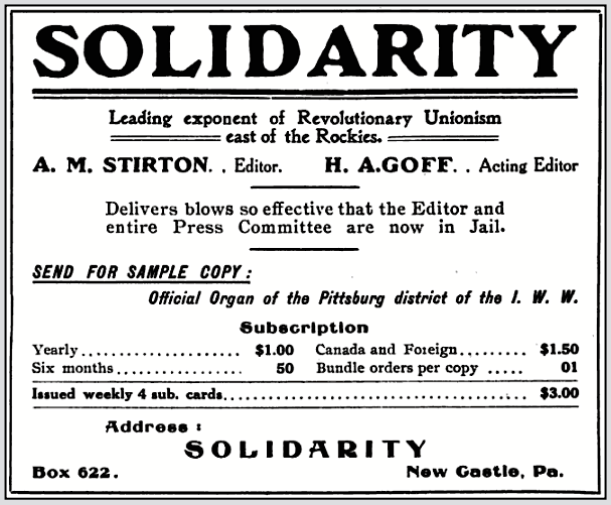
“Leading exponent of Revolutionary Unionism east of the Rockies.”
—–
“Solidarity in Prison” by William D. Haywood
—–
[Part II of II.]
The [New Castle] Free Press and Solidarity were issued every week. The employers were furious. Members of the Business Men’s Exchange grew hydrophobic. Detectives were hired and set on the trail of the papers and finally the editorial staffs of both The Free Press and Solidarity were arrested, charged with an alleged violation of the Pennsylvania publishing law (enacted in 1907 and never called into use except on one occasion, as a matter of spite).
This law is being violated daily and weekly by many publications in Pennsylvania at the present time.
The editors of Solidarityand the Free Press were hailed into court and with them the editor of the New Castle Herald, a capitalist sheet. All three were convicted, but the leniency of the court, resulted in the capitalist editor being released on payment of costs while the others were fined $100 and costs.
The Free Press appealed their case while the members of Solidarity refused to pay the fines and were sentenced to jail, declining to accept Judge Porter’s profferred offer of ten days in which to look for money to pay them. Knowing that the workers alone would be the ones to contribute, they preferred to go to jail.
Hellraisers Journal – Saturday June 4, 1910
New Castle, Pennsylvania – Big Bill Haywood on the Jailing of Solidarity
From the International Socialist Review of June 1910:
“Leading exponent of Revolutionary Unionism east of the Rockies.”
—–
“Solidarity in Prison” by William D. Haywood
[Part I of II.]
CTIVITY in the socialist movement presents some complex situations, some unusual rewards.
There are socialists in jail in New Castle. There are socialists in office at Milwaukee.
If the opportunity of the individuals concerned could be reversed, it is certain that Comrade Emil Seidel, mayor of Milwaukee, and his colleagues, would bear with fortitude the gloomy ignominy of the cells in Lawrence County Jail. It is likewise true that comrades McCarty, Stirton, Williams, Jacobs, Fix and Moore, the manager and editorial staff of Solidarity, could administer the affairs of a municipality with honor to the party, and credit to themselves. But those who know the boys in jail, know that neither would voluntarily change places. All are filling their present positions, in upholstered, revolving office chairs or hard rough benches for the same great cause.
The imprisonment of our fellow-workers in New Castle is an incident in the strike against the American Sheet and Tin Plate Co., which has been on since last July.
Hellraisers Journal – Thursday June 3, 1920
Minneapolis, Minnesota – May Day-I. W. W. and A. F. L March Together
From The One Big Union Monthly of June 1920:
[Part II of II.]
Some of those in charge attempted to turn the speaking into a “campaign rally” to boost some local aspirants for different political offices and relegate all other speakers to the rear and have the crowd tired out before any genuine working class speakers could get the platform, and they succeeded to a certain extent; but when W. F. Dunne, editor of the Butte Daily Bulletin, managed to get the floor he lost no time in explaining how the Workers’ International Labor Day had been desecrated by those who had no other desire except to get into office, no matter how, and that those who would stoop to misuse Labor’s holiday would need watching.
Hellraisers Journal – Wednesday June 2, 1920
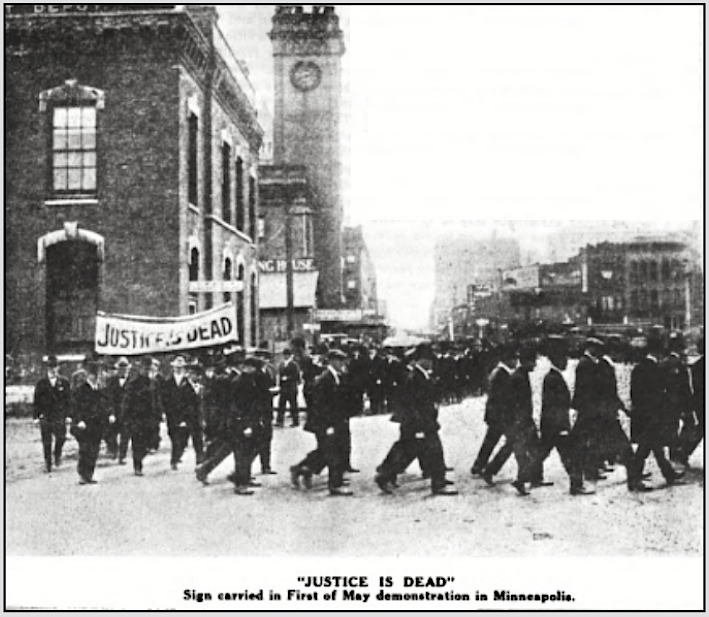
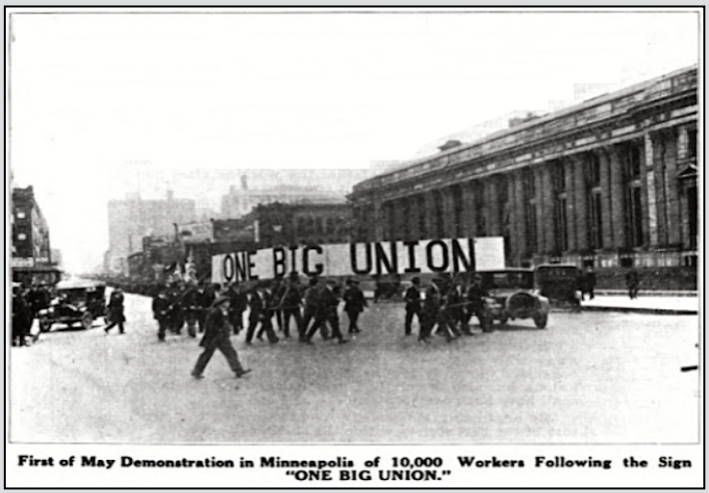
Minneapolis, Minnesota – May Day Celebrated by 10,000 Workers
From The One Big Union Monthly of June 1920:
[Part I of II.]
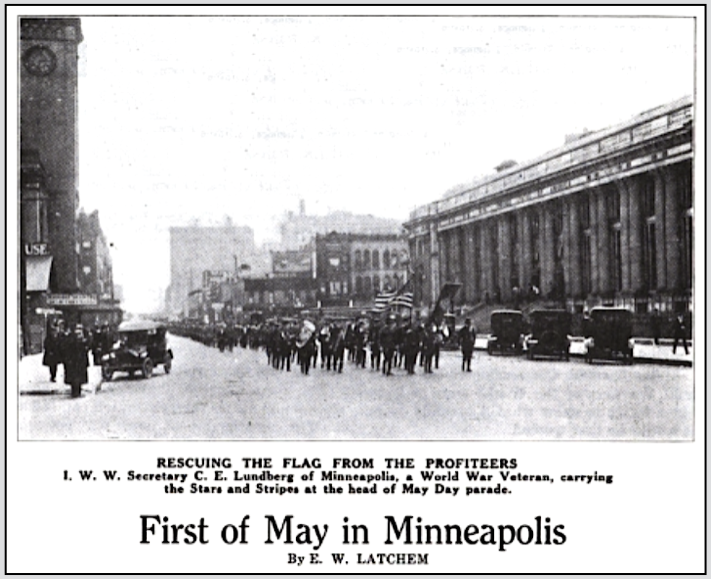
On May 1st, 1919, when the workers of Minneapolis attempted to celebrate International Labor Day, their parade was broken up several times by the police and other willing tools of the money interests, but they always succeeded in reforming and managed to continue their parade until their destination had been reached. All speaking was stopped by the police, but that did not seem to dampen the spirit of the workers, as will be seen from what happened on May 1st, 1920.
Only about two thousand participated in 1919, but as a result of police opposition all unions in Minneapolis took part in one gigantic parade on May 1st, 1920, with the result that close to 10,000 workers were participants in the largest and most enthusiastic May Day celebration that Minneapolis ever had. Not a word was said in regard to this by most of the local news perverters. Only one paper had the decency to mention the affair, in spite of the fact that it was one of the most important events of the day.
Hellraisers Journal – Sunday May 29, 1910
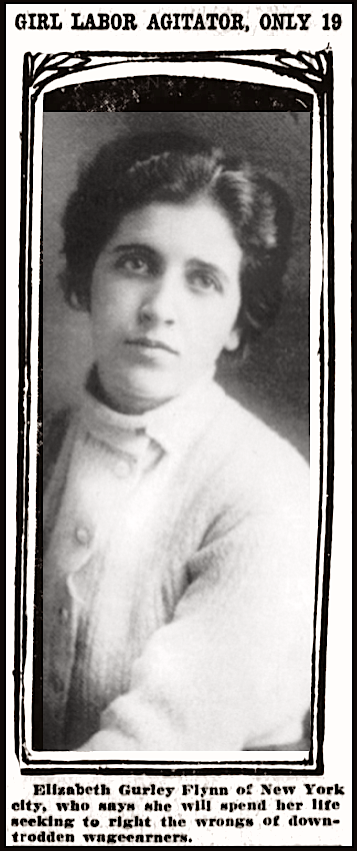
Spokane Fellow Workers Learn of Birth of Baby Boy to Elizabeth Gurley Flynn
From the Spokane Spokesman Review of May 28, 1910:
GURLEY FLYNN IS MOTHER
———-
I. W. W.’S EX-LEADER ENDS WARFARE TO CARE FOR SON.
—–
Youngster Will Be Named Frederic Vincent Jones,
According to Letter.
—–
The birth of a son to Mrs. Elizabeth Gurley Flynn Jones, leader of the recent street speaking fight in this city, is announced in a letter received by Mrs. Fred Heslewood, of E703 Providence avenue. Mrs. Jones is with her mother in New York, engaged in the preparation of a book called “Women in the Industrial World.”The boy has been named Frederic Vincent Jones, it is said. It was born May 19.
Mr. Jones, better known by her maiden name, Elizabeth Gurley Flynn, was the leader of the street speakers in their fight against the authorities last winter. She was arrested on a charge of criminal conspiracy, found guilty by a jury in a justice court, and acquitted on appeal to the superior court. She spent one night in the county jail and made charges of misconduct against the jailers that were taken up later by members of the Woman’s club. She left for New York before the final adjustment of the street speaking difficulties. Her husband’s home is in Missoula, Mont.
———-
[Photograph added is from Spokesman Review of July 9, 1909.]
[Emphasis added.]

 ———-
———-
 ———-
———- —–
—– —–
—– CTIVITY in the socialist movement presents some complex situations, some unusual rewards.
 ———-
———-
 ———-
———-
 ———-
———-
 ———-
———-
 ———-
———-