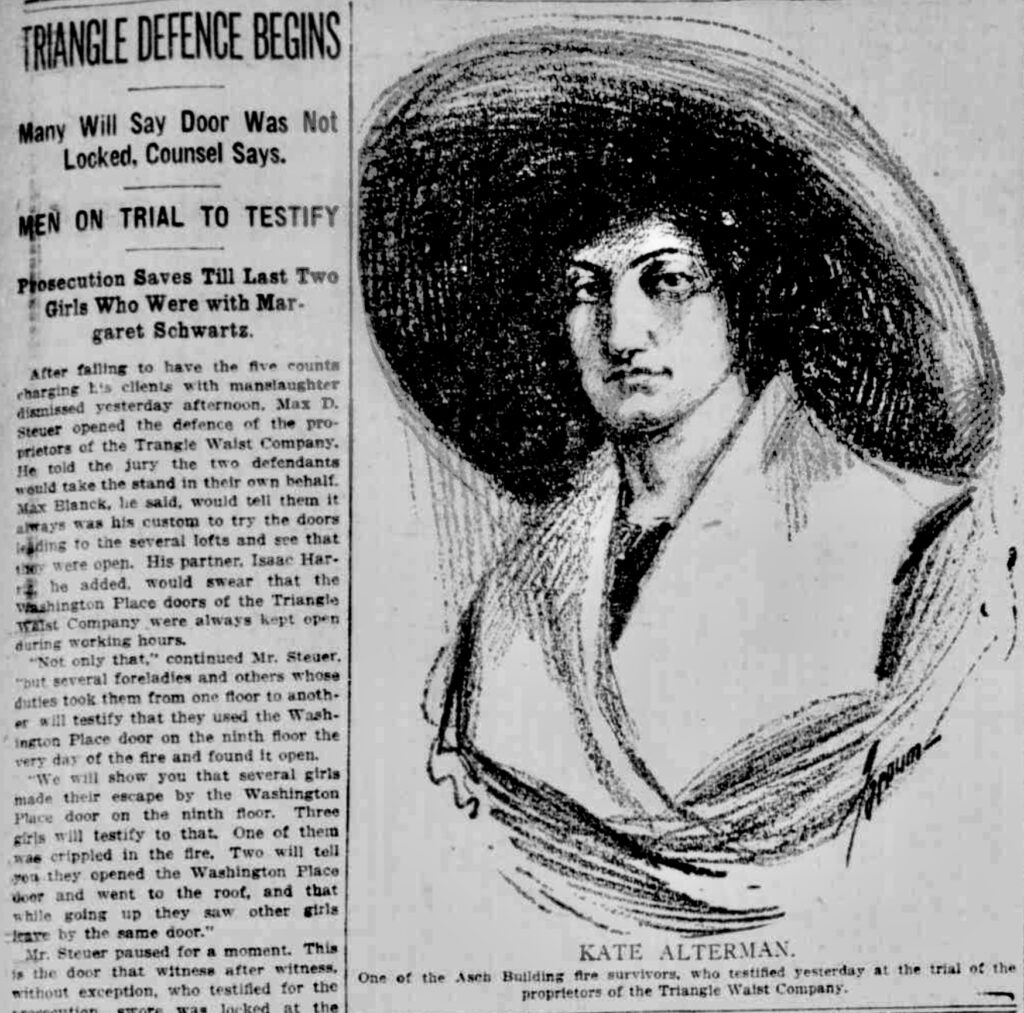
Hellraisers Journal – Thursday December 28, 1911 Blanck and Harris Found “Not Guilty” in Connection with Triangle Fire Deaths
-Verdict was delivered at 4:46 p. m., December 27th.
From the New York Tribune of December 28, 1911:
——-
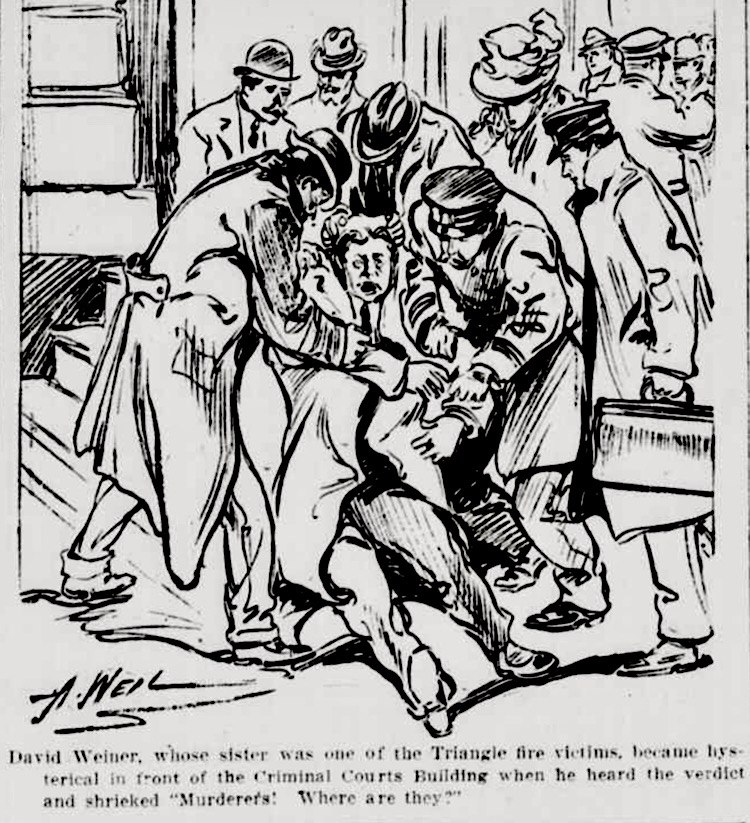
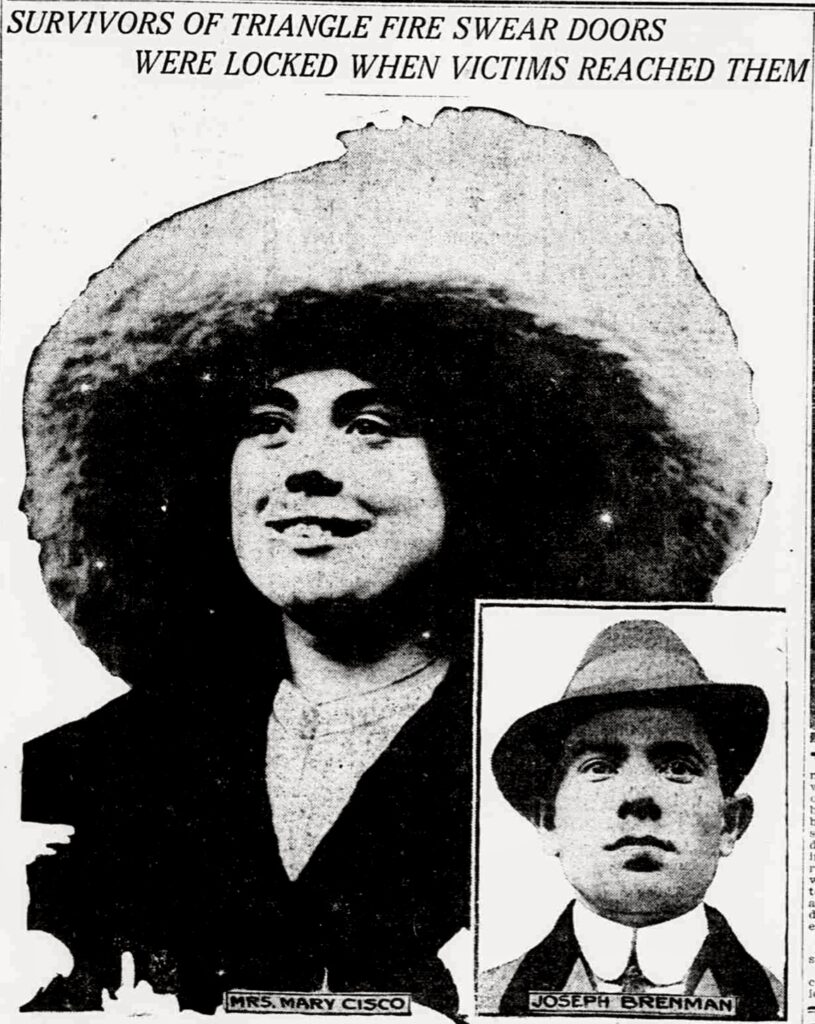
David Weiner, whose sister, Rosie, perished in the fire, collapses after confronting Blanck and Harris.
——-
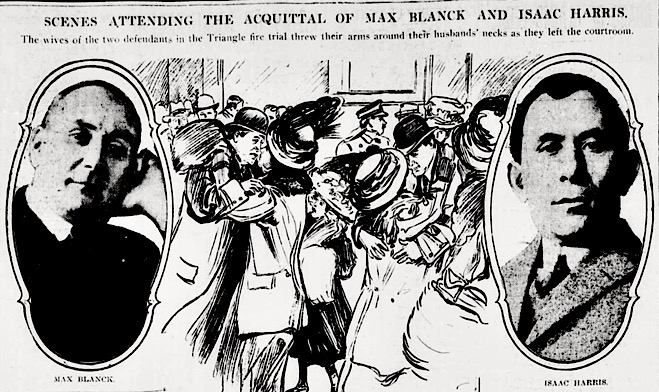
The wives of the two defendants in the Triangle fire trial threw their arms around their husbands’ necks as they left the courtroom.
Hellraisers Journal – Tuesday December 27, 1921 Atlanta Penitentiary – Debs Weeps as 2,300 Convicts Cheer His Release
From The Indianapolis Star of December 26, 1921:
—————
(Special to The Indianapolis Star.)
ATLANTA, Ga. Dec. 26.-Eugene V, Debs left prison today. His going was the occasion of the most unique demonstration in American prison history.
Twenty-three hundred men, convicted of crimes unnumbered, their faces pressed against the bars of the windows on three floors of the big Federal penitentiary, shouted and cheered him and before them all, in the great foreground, he broke down and cried like a child.
Recovering himself, he stepped into an automobile and was driven off, the voices of the 2,300 following him for half a mile.As this is written, on a train bound for Washington, with Debs as a passenger in a day coach, the mystery surrounding the celebrated convict deepens. Why is he going to the capital? He refuses to say, but he has admitted he has a mission there. Whether or not the trip is a condition of his release he declines to say, but the fact that he was driven to the station in the automobile of the warden, four of whose deputies are aboard this train, would indicate that while Debt is out of prison he is not yet free.
“Citizen of the World.”
So far as he himself is concerned, however, he construes himself a liberated “citizen of the world,” the phrase having to do with President Harding’s refusal to grant a pardon which would have restored the prisoner’s civil rights.
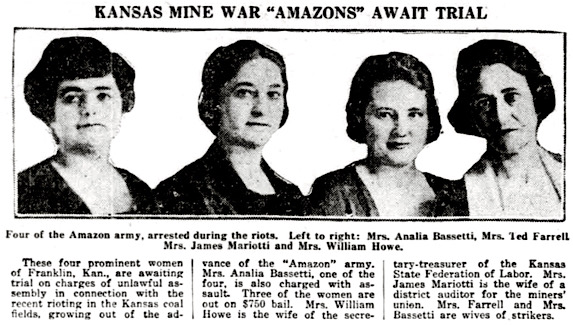
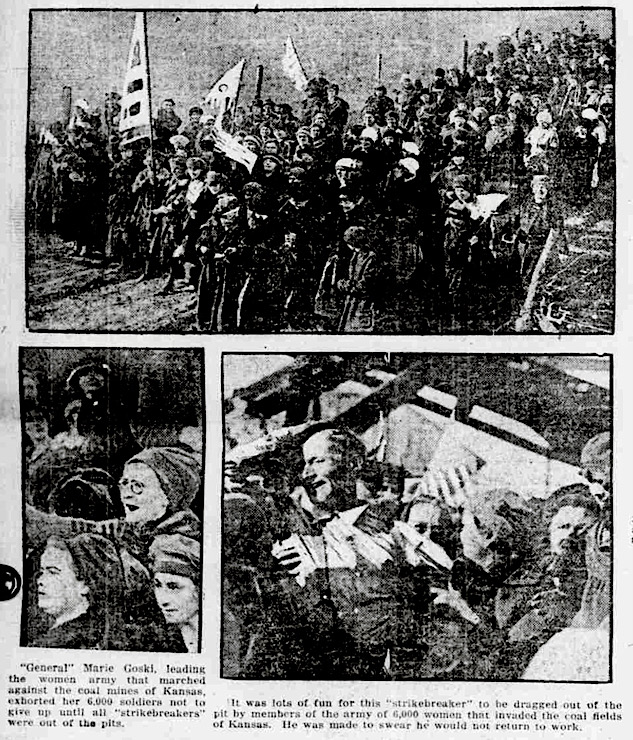
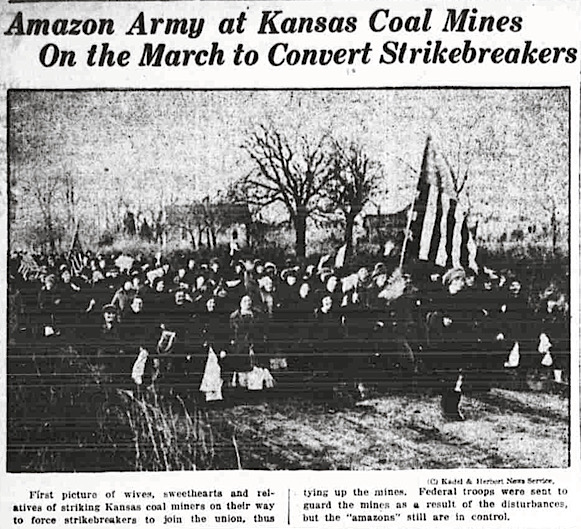
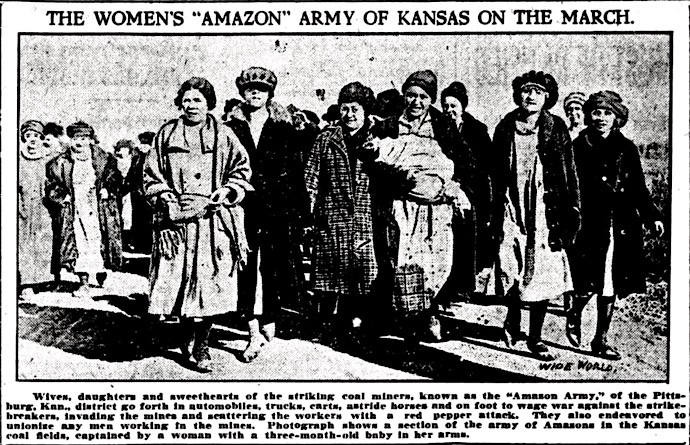
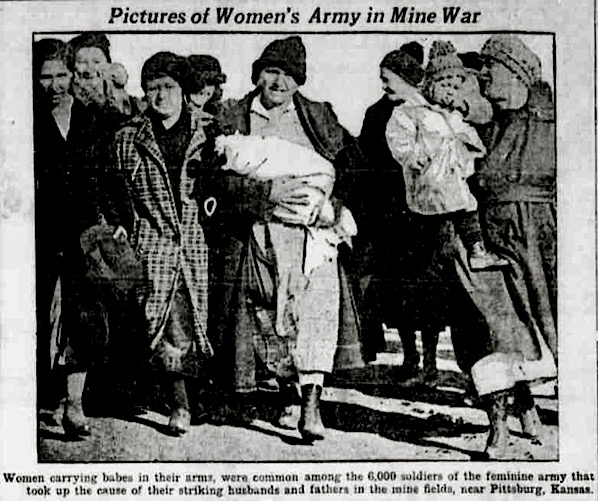
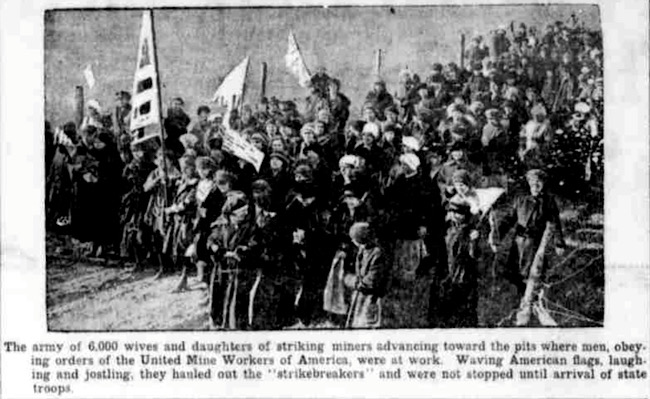
Hellraisers Journal – Friday December 23, 1921 Coal Mining Region of Southeastern Kansas- “Amazon Army” Raises Hell
From the New York Evening World of December 20, 1921:
SIX MORE WOMEN RIOTERS ARRESTED Police of State and Nation Extend Drive in Kansas Coal Field Against Bootlegging.
PITTSBURG, Kan., Dec. 20. Six more women, charged with unlawful assemblyin connection with the coal mine riots were under arrest today as State and county officials broadened their offensive against illegal rum venders, radicals and other undesirables of the mine fields….
From Washington Evening Star of December 21, 1921:
From the Albuquerque Evening Herald of December 22, 1921:
Hellraisers Journal – Thursday December 22, 1921
Mother Jones News Round-Up for July 1921
Found in Washington, D. C., at Senate Hearings on Conditions in W. V. Coal Fields
From The Cincinnati Enquirer of July 15, 1921:
Unionization Back of Strife,
Senate Mingo Inquiry Shows
—————
SPECIAL DISPATCH TO THE ENQUIRER.
Washington, July 14.-In the opening hour of its investigation to-day the select Senate committee investigating conditions in the West Virginia coal fields, elicited from spokesmen for operators and for the miners the admission that the virtual warfare there centers about unionization of the fields.
At the prompting of Senator William S. Kenyon, of Iowa, the committee Chairman, both agreed that unionization is “the issue.”
[…..]
A distinctly West Virginia atmosphere permeated the committee room.
Attorneys for both factions were powerful man, husky voiced and tanned. Others present were: Sid Hatfield, former Chief of Police of Matewan, who participated in the gun battle there; Frank Keeney, President of the district organization; Samuel B. Montgomery, state labor leader; Sheriff Jim Kirkpatrick and Mother Jones, silvery haired matriarch of labor welfare.
Secretary Mooney described general conditions in the mining region and paralleled them with the situation there in 1913 when a Senate Committee investigated.
[…..]
—————
[Photograph added.]
From The Scranton Times of July 16, 1921:
Sid Hatfield Describes Pistol Battle In Mingo —————
Takes Stand In Senate Committee’s Probe of Strike Trouble
-Denies He Took Credit For Killing Detectives.
Washington, July 16.-“Sid” Hatfield, ex-chief of police of Matewan, W. Va., today took the stand in the senate labor committee’s investigation of the Mingo mine war.
Word that the member of the famous West Virginia family was testifying spread through the capitol and the room soon was soon crowded.
“Mother” Jones pitched her chair closer to the witness table to catch what the man who is under indictment on charge of shooting Baldwin Felts detectives would say.
Without the slightest sign of nervousness the lanky, blonde mountain youth described the pistol battle in which he was the central figure. His suit was neatly pressed and a Masonic charm dangle from his watch chain. His quick gray eyes watched the members of the committee intently and he frequently gave a sneering laugh at questions from counsel for the operators…..
Hellraisers Journal – Wednesday December 21, 1921
Mother Jones News Round-Up for May and June 1921
Found in Mexico City, Standing for Organization of Mexican Workers
From the Tucson Citizen of May 11, 1921:
MOTHER JONES WILL RESIDE IN MEXICO.
In January Mother Jones, the noted socialistic agitator who has been in the public eye throughout the United States through many years, went to the City of Mexico to attend an international congress of workingmen and women.
It is announced now that Mrs. Jones has decided to make her permanent residence in Mexico. She is quoted as saying that after many years of story experience in the United States including six penitentiary sentences served she finds Mexico “the only country where she can live la tranquility.”
[Photograph added.]
—————
Note: Mother has been taken into custody many times during her long life of standing with working people, but has never served a sentence in any penitentiary sentence that we know of.
From the Cleveland Toiler of June 4, 1921 -excerpt from article by Geo. N. Falconer:
MOTHER JONES.
Seemed as if she had been imported specially to boost the Workers’ Mexican Government. “Workers,” she shouted during her several addresses during the Pan-American Congress, “stand by your government and it will stand by you.”
“The pulse of the world is throbbing today,” declared ‘Mother’ Jones. “Humanity is watching the new Mexico. I want to tell you that there will be no intervention by the capitalist robbers of the United States in the affairs of Mexico. We won’t stand for it. We are going back to the United States and appeal to the workers there to stand by the workers here.”
When she shouted, “You are going to bring the new day in this country and center the eyes of the world on Mexico as well as Russia,” the applause was tremendous.
Didn’t Mother Jones boost for Woodrow Wilson in 1916? And Mother Jones paid many compliments to that “grand old man of labor,” King Gompers. Why? Is she so ignorant of Samuels’ labor history?
—————
From Proceedings of the Convention of American Federation of Labor at Denver, Colorado, June 13-25, 1921:
…..Ernest Greenwood representing the International Labor Office at Geneva, Frank Bohn, publicist, together with Mother Jones as the invited guest of General Villarreal, minister of agriculture of Mexico, accompanied the party [of representatives of the American Federation of Labor] from St. Louis to Mexico City. Mother Jones attended the meetings of the convention and spoke on two occasions.
On arrival at Nuevo Laredo we learned that that the government of Mexico had sent a reception committee representing the government and labor to the boundary line to meet and greet us…..
Hellraisers Journal – Wednesday December 20, 1911 Report on Child Labor in Mississippi by E. N. Clopper, Part II
From The Hattiesburg News (Mississippi) of December 18, 1911:
CHILD LABOR IN MISSISSIPPI ———————- By E. N. CLOPPER, Mississippi Valley Secretary National Child Labor Committee.
III.Why Mississippi Should Adopt the Uniform Child Labor Law.
[Part II of II]
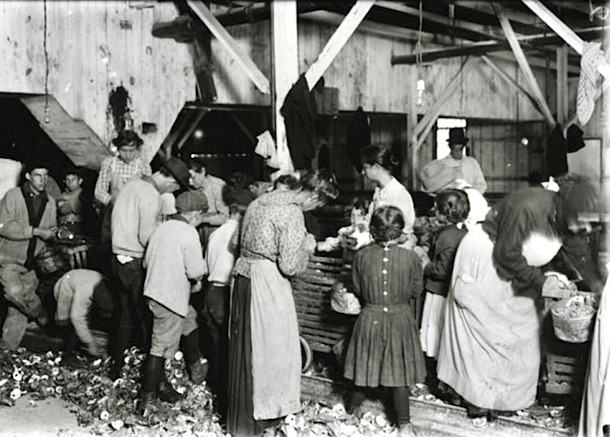
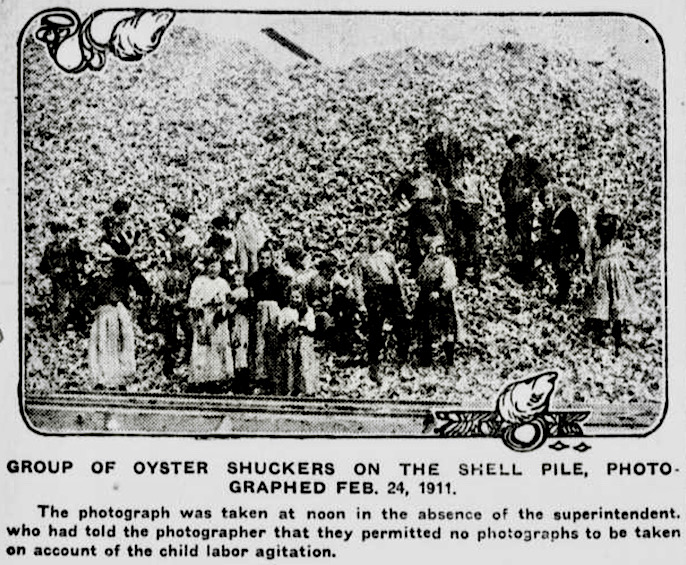
Oyster Shuckers, Beloxi, Mississippi, by Lewis Hine Children as young as ages 3 and 5 years old.
A uniform child labor law was adopted by the United Stales commissioners on uniform laws at their twenty-first annual meeting in Boston, Aug. 25 and 26, 1911, upon the report of their special committee, a distinguished member of which was the Hon. A. T. Stovall of Mississippi. It embodies the best provisions of the child labor laws already in existence in several states.
The uniform child labor law may be summarized thus:
The law prescribes a general age limit of fourteen for practically all employment, except agriculture and domestic service, and for all occupations during the hours when the public schools in the district in which the child resides are in session; an age limit of twelve for newsboys; an age limit of sixteen for certain specified occupations dangerous to life or limb or injuries to the health or morals of the child, the specified occupations to be increased upon order of the state board of health; an age limit of eighteen for children in specified extra hazardous occupations; an age limit of twenty-one for employment of boys in saloons, the employment of girls in mines or quarries, in oiling or cleaning machinery in motion or in any occupation where this employment compels them to remain standing constantly; an eight hour day for boys under sixteen and girls under eighteen, with a fifty-four hour week for boys under eighteen and girls under twenty-one; an age limit of twenty-one for boys in the night messenger service.
Certificates of employment are to be issued by the superintendent schools or by a person authorized by him in writing.
The adoption of this uniform child labor law in its entirety by the state of Mississippi would not only cure the evils of child labor from which the state is now suffering, but would prevent greater evils in the future development and progress of the state, so that industry would be built upon a secure foundation and the children, the future citizens of the state, be fully protected.
Why should not a southern state, why should not Mississippi, with its traditions of high statesmanship, be the first to put this model child labor law into effect?
Hellraisers Journal – Tuesday December 19, 1911 Report on Child Labor in Mississippi by E. N. Clopper -with Photograph of Little Oyster Shuckers by Lewis Hine
From The Hattiesburg News (Mississippi) of December 18, 1911:
CHILD LABOR IN MISSISSIPPI
———————-
By E. N. CLOPPER, Mississippi Valley Secretary
National Child Labor Committee.
III.Why Mississippi Should Adopt the Uniform Child Labor Law.
[Part I of II.]
THE investigations covered in article 2 were made before the Mississippi child labor law went into effect. A more recent study of the conditions in April and May, 1911, was made by L. W. Hine, an agent of the national child labor committee. Fortunately, Mr. Hine was able to secure the aid of the camera in communicating his impressions to others. No anonymous or even signed denials can contradict the proof given with photographic fidelity by the camera that the law is being violated.
There has in recent years grown up another child employing industry in Mississippi which in some of its aspects is as bad as the cotton mill. It is the business of shucking and canning oysters and packing shrimps along the gulf coast. These children, in contrast to the children of the cotton mills, who are almost altogether of Mississippi stock, are mostly foreign children imported from Maryland and Delaware, where they are employed in the great truck gardens and berry fields and the vegetable canneries during the summer months, on account of the effective laws of those states, and then are brought to the gulf coast during the shrimp and oyster season. Thus they get no chance at all at an education. Mr. Hine’s report is as follows:
Feb. 24, 1911, I asked the manager of a certain packing house for permission to take some photos, and he said very emphatically that they permitted no one to take photos around the place while workers were there because of the fact they might be used by child labor people. On my own responsibility, then, I visited the plant at 5 a. m., Feb. 25, 1911, before the manager arrived and spent some time there. They all began work that morning at 4 a. m., but it is usually 3 a. m. on busy days. The little ones were there, too, and some babies—one, off in the corner, with a mass of quilts piled over it. From 4 a. m. the entire force worked until 4 p. m., with only enough time snatched from work during the day in which to take a few hurried bites. The breakfast, got in a hurry and in the dark, was not likely very nourishing. Sound asleep on the floor, rolled up against the steam chest, for it was a cold morning, was little Frank, eight years old, a boy who works some. His sister, Mamie, nine years old and an eager, nimble worker, said: “He’s lazy. I used to go to school, but mother won’t let me now because I shuck so fast.” I found considerable complaint about sore fingers caused by handling the shrimps. The fingers of many of the children are actually bleeding before the end of the day. They say it is the acid in the head of the shrimp that causes it. One manager told me that six hours was all that most pickers could stand the work. Then the fingers are so sore they have to stop. Some soak the fingers in an alum solution to harden them. Another drawback to the shrimp packing is the fact that the shrimps have to be kept ice cold all the time to preserve them. It would seem that six hours or less of handling icy shrimps would be bad for the children especially.
The mother of three-year-old Mary said she really does help considerably. So does a five-year-old sister, but they said the youngest was the best worker.

 ———————-
 —————
————————
 —————
———————
 ———————-
 —————
————— ————–
————– —————
—————