Hellraisers Journal – Wednesday November 22, 1922 Leavenworth Federal Penitentiary, Kansas – Ricardo Flores Magón Dead at Age 48
From The Leavenworth Post of November 21, 1922
DEATH COMES TO POLITICAL PRISONER
AT FEDERAL PRISON
———- Ricardo [Flores] Magon, Noted Revolutionist
Victim of Heart Disease Early Today. ———-
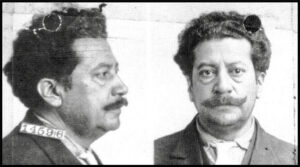
Ricardo [Flores] Magon, noted Mexican revolutionist and generally regarded as an anarchist, died in the Federal prison early this morning. The body was removed to the Davis Undertaking establishment awaiting word from relatives. Marie B. Magon, his wife, resides at 2132 Fargo street, Los Angeles.
Magon called an attendant at 4:30 o’clock this morning and said he was not feeling well. He had retired in bis usual health. A physician was called and it was discovered Magon was suffering with an acute attack of heart disease. While the physician was preparing a dose of medicine, Mason died.
Magon lad served terms in three penitentiaries. In 1912 he was arrested in Arizona on a charge of violating the neutrality laws. The trial resulted in conviction and he was sentenced to serve a year and a day in the Yuma state penitentiary. He was next arrested in June, 1916, on charges of obstructing the military service, violating the trading with the enemy act, mailing unmailable matter and conspiracy against the government.
The trial resulted in a conviction on all charges and he was given a total sentence of 21 years in the Federal prison at McNeil Island. On November 3, 1919, Magon was transferred to the Federal penitentiary here.
Since Magon has been in the Federal prison there have been several efforts to obtain his freedom by so-called radical organizations.
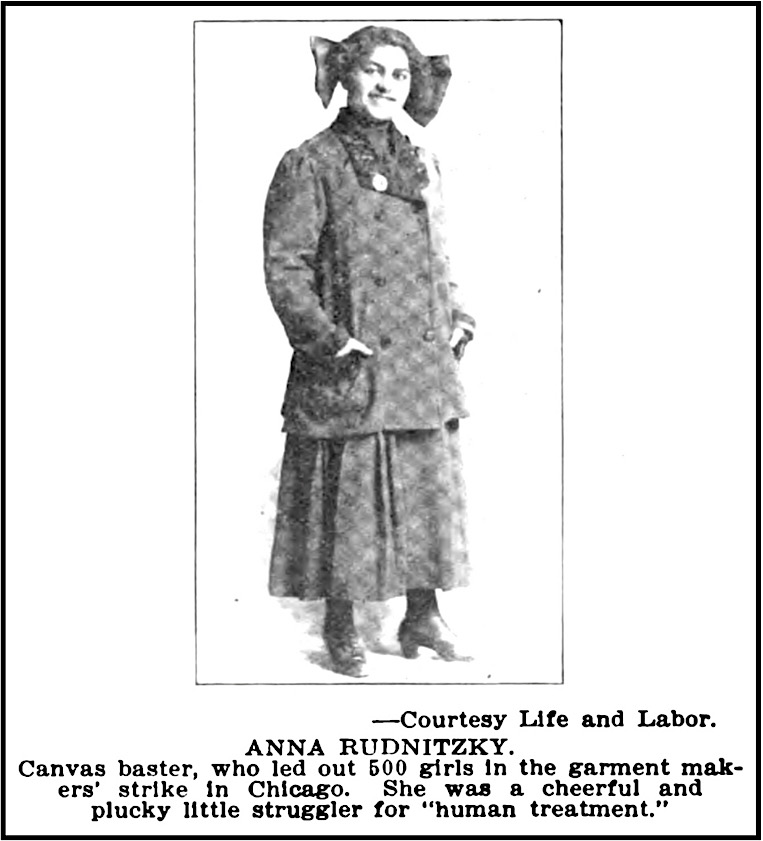
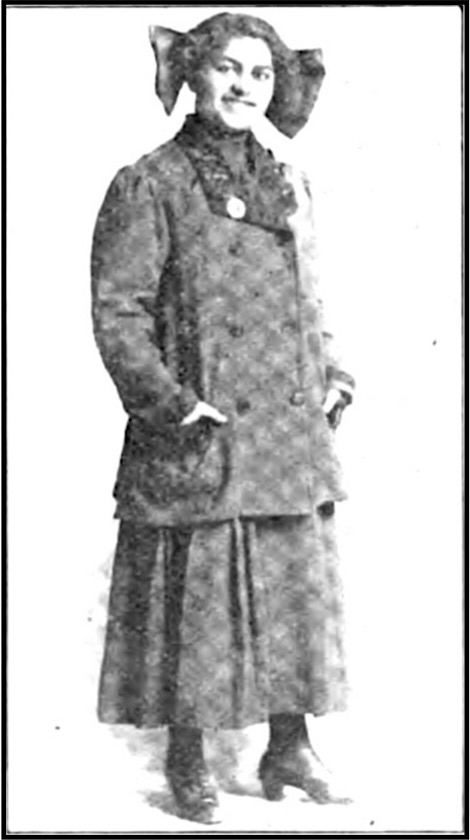
Hellraisers Journal – Thursday November 21, 1912 Photograph of Anna Rudnitzky of the 1910 Chicago Garment Makers’ Strike
From The Progressive Woman of November 1912:
From Life and Labor of April 1912:
Time Is Passing
[by Anna Rudnitzky]
Anna Rudnitzky
I HAVE so much I want to say. What bothers me most is time is passing. Time is passing and everything is missed. I am not living, I am just working.
But life means so much, it holds so much, and I have no time for any of it; I just work. Am I not right?
In the busy time I work so hard; try to make the machine run faster and faster because then I can earn some money and I need it, and then night comes, and I am tired out and I go home and I am too weary for anything but supper and bed. Sometimes union meetings, yes, because I must go. But I have no mind and nothing left in me. The busy time means to earn enough money not only for today but to cover the slack time, and then when the slack time comes I am not so tired, I have more time, but I have no money, and time is passing and everything is missed.
Romance needs time. We can think about it, yes, but to live it needs time. Music I love, to hear it makes me happy, but it is passing. The operas and the theatres and the dramas, they are here but for me they are just passing. To study, to go to high school, to the university, I have no time and I have no money.
Then the world is so beautiful. I see the pictures of the trees and the great rivers and the mountains,and away back in Russia I was told about Niagara Falls. Now why if I work all day and do good work, why is there never a chance for me to see all these wonders?
I have been thinking. First we must get a living wage and then we must get a shorter work-day, and many, many more girls must do some thinking. It isn’t that they do not want to think, but they are too tired to think and that is the best thing in the Union, it makes us think. I know the difference it makes to girls and that is the reason I believe in the Union. It makes us stronger and it makes us happier and it makes us more interested in life and to be more interested is oh, a thousand times better than to be so dead that one never sees anything but work all day and not enough money to live on. That is terrible, that is like death.
And so now the Women’s Trade Union League has helped me so much, and the Union has helped me so much, and I want to help others, and so we must have “Life and Labor” written in Yiddish too so that all the Jewish girls can understand. And then I think we ought to have it in Polish and Bohemian and Lithunian and Italian. Can you do this? How can I help you to do it?
Hellraisers Journal – Wednesday November 19, 1902 Mother Jones News Round-Up for October 1902, Part V Found Speaking in Holyoke and Celebrating John Mitchell Day in Wilkes-Barre
From the Holyoke Daily Transcript of October 27, 1902:
MOTHER JONES SPEAKS. ———-
LARGE AUDIENCE LISTENS ———- The Most Successful Socialist Rally Held Here For Many Years. ———-
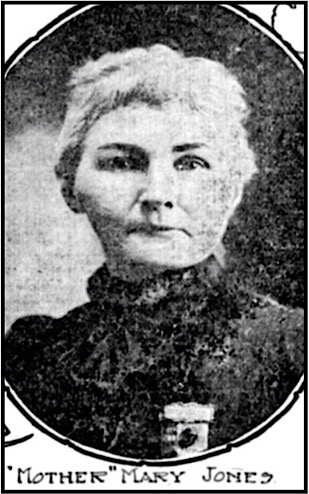
“Mother Jones, the miners’ friend” who has become well known all over the country for her fierce defence of the miners in the coal strike, and who has been arrested in the mining regions several times for her utterances, lectured in this city at the city hail last evening. That she was one of the persons who gained in popularity for her course was shown by the enthusiastic reception she received here. She was welcomed by the largest audience of any campaign speaker this fall, and the largest which attended a socialist rally for years, in Holyoke. It was attributed to her cause in which she appears to be in sympathy body and soul, and to the active part she has taken in it. “Mother” Jones is a pleasant-faced woman who speaks clearly and convincingly, and at times with the most bitting sarcasm. She made a big hit with the large audience. She has force and eloquence. She has been speaking a week in New England.
E. A. Buckland, the congressional candidate of the Socialist party, in this district, presided and introduced L. F. Fuller of Springfield, as the first speaker.
It was 8.30 o’clock before the speaking began.
Mr. Fuller said that a great case was on trial, a case of dollars against men. “The statement is sometimes made that money always did rule and always will rule. This is not true; as in the case of primeval man, money did not rule, and it is my firm belief that it will not long rule. In this country we do not recognize a governmental despotism, but an industrial despotism has already taken place. Abraham Lincoln placed labor above capital. Even in this country the hardest work is done by those who have the least. Labor is the creator of all values. We notice that the home-owners are disappearing. In the last few years the percentage of home-owners has dropped from 69 to 34 per cent. Socialism demands justice for humanity. The socialist objects to dividing up. If the laboring man was not continually dividing up the profits of his labor, there would be no millionaires in this country.
“Mother” Jones, at her introduction, was received with hearty applause.
One of the most important statements made by Mrs. Jones was that the strike is not at an end. She said the commission appointed by the president was organized because an election was approaching. Mrs. Jones wanted to know why the president took the insults of the coal barons so mildly sometime ago and then consulted with Morgan last Sunday on a yacht. She said the miners went back because of public opinion and public opinion did not care for them until the matter was brought home to the people by empty coal bins.
In speaking for organized labor co-operating with the socialists she said that during her 30 years’ acquaintance with the coal regions not a single clergyman protested against the oppression of the miners until the United Mine Workers entered the district. She said that if there is any Christian religion today it is in organized labor.
In speaking of the operators of Pennsylvania and the manner in which they treat the miners she said the operators can violate the law any time they please and 10 times a day if they desire. They seem to own the world, and all the people thrown in. She pictured the manner in which the coal barons live in contrast with the bare existence of the miners, who are compelled to bring their young children into the mines to help get a living. She made much of the journey of Morgan and some others across the continent when wine costing $35 a bottle was opened.
[…..]
She said the strike will not be settled in the coal regions until the miners get what belongs to them. They did not want charity, they wanted justice. Solidarity of labor, she said, was still in its incipiency. Mention was made of the probability of a strike of engineers and firemen that would overshadow the one now in existence. She said much was being urged against the militia and other weapons of the capitalists, but the greatest danger to the miners is the injunction.
In conclusion she urged the working people to emancipate themselves [by] the power of organized labor and by voting the socialist ticket at the polls.
Hellraisers Journal – Tuesday November 18, 1902 Mother Jones News Round-Up for October 1902, Part IV Boston, Massachusetts – Found Speaking on Behalf of Striking Coal Miners
From The Boston Globe of October 20, 1902:
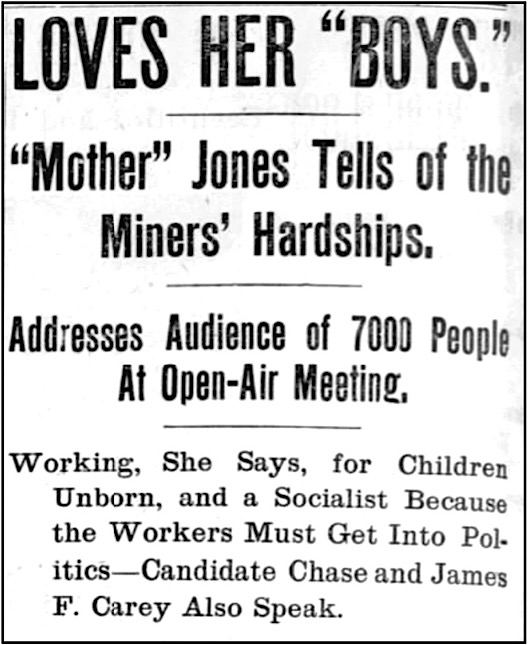
“Mother” Jones, who has become famous all over the country as a result of her work in behalf of the coal miners, addressed a gathering of more than 7000 yesterday afternoon at the open-air meeting at Apollo garden, Roxbury. The meeting was in behalf of the striking miners, and was under the auspices of the general committee of the socialist party.
It is said that more than 8000 tickets were sold and a good sum was realized, which will be forwarded for the assistance of the strikers. The meeting was also addressed by Representative James F. Carey and Ex-Mayor Chase of Haverhill, the latter socialist candidate for governor.
The meeting was an enthusiastic one and every telling point scored by the speakers brought forth ready approval. In the gathering was a fair sprinkling of women. The speakers stood on the balcony of the old house, which had been decorated free of charge, and the grove was given free of charge also.
The principal interest centered about the appearance of “Mother” Jones. She sat on the balcony while the other speakers were talking. She was dressed in a plain gown of black cloth and wore no hat. She looks to be more than 50 years old, and her hair is almost snow white. Her keen, small eyes look out from under rather heavy brows, and she has a voice of remarkable power, her address easily being heard at the other side of the grove.
She is a fighter for her “boys,” as she terms the men who work in the mines, and it was easy for those in the audience to see how she has come by the loving term of “mother.”
She told in a quiet, easy manner of her work among the miners, of their toil in the bowels of the earth, their attempts to keep their little families from starving, and of their grinding down by the coal barons. “Mother” Jones evidently knows whereof she speaks, for she told of her visits to the mines underground, and her control over the miners was illustrated by a story she told of a recent occurrence in the present strike, when she led a gathering of 7000 strikers and many women over the mountains in the coal region and their meeting with the armed militia.
———-
Respects the Law.
The keynote of her address was that the people had made the government, and must obey the law and abide by its decisions. When she was being introduced by the presiding officer, Patrick Mahoney, a man on the balcony interpolated the remark that “She also defied Judge Jackson.” She was hardly on her feet before she made a denial of the statement, saying that Judge Jackson represented the law, and she never defied the law.
Representative James F. Carey of Haverhill was the first speaker. He said the coal strike would have been a failure but for the fact that it has taught the miners a lesson. It has opened the eyes of the people. The class in economic power, he continued, always controls the government, and socialists, knowing that, have tried to bring to the attention of the voters the absurdity of voting for the representatives of capital…..
John C. Chase, socialist candidate for governor, was received with cheers. He said that if the strikers had to go back without gaining a single thing it would show one thing, and that is that the working class must stand together in industrial matters and politics…..
“Mother” Jones was the next speaker, and there was a wave of applause as she came forward. She spoke clearly and distinctly and rather slowly. At no time till she grow heated, but the pathos of her voice showed clearly that the interests of the striking miners were her interests.
She said she largely was responsible for the miners’ organization.
[She said:] For ages men had been struggling to right the wrongs of the world. In this country we first had the civil struggle, and we settled that. Now at the beginning of the 20th century we have the industrial struggle.
Hellraisers Journal – Monday November 17, 1902 Mother Jones News Round-Up for October 1902, Part III New York, New York – Mother Jones Speaks to Socialists at Cooper Union
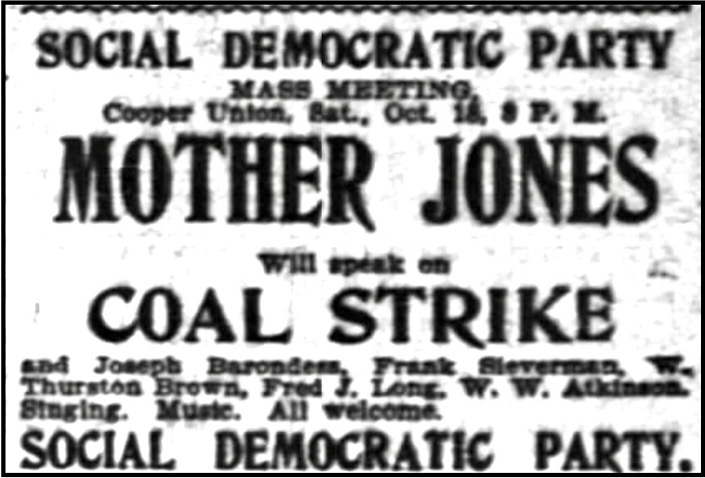
From The New York Times of October 18, 1902:
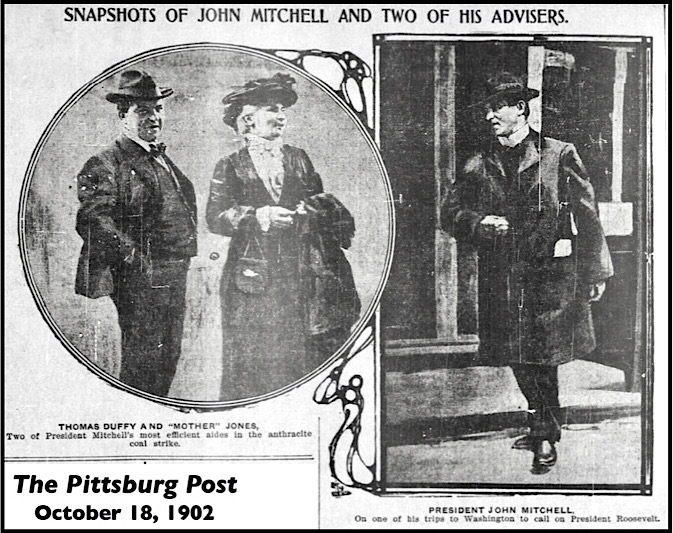
From The Pittsburg Post of October 18, 1902:
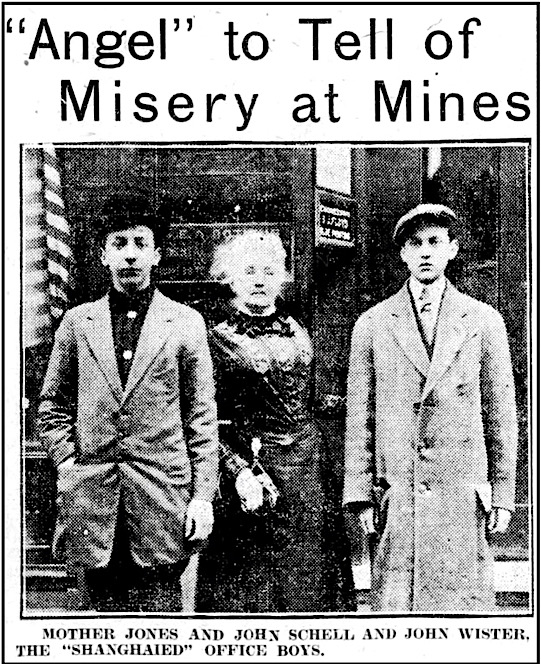
Thomas Duffy, Mother Jones and President John Mitchell
Hellraisers Journal – Sunday November 16, 1902 Mother Jones News Round-Up for October 1902, Part II Found Describing Miner’s Sorrow; Assist Efforts to Settle Anthracite Strike
From the Duluth Labor World of October 11, 1902:
[Mother Jones stated:]
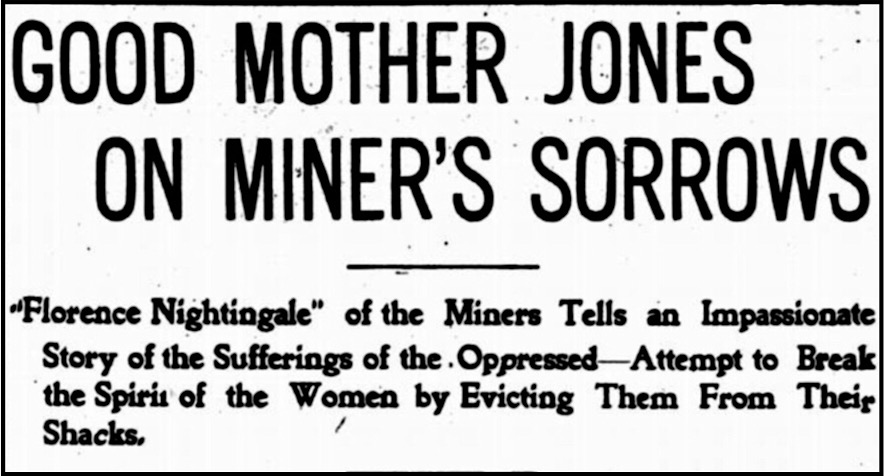
If Christ came to America, took advantage of the best university education the country affords, then went into the anthracite and West Virginia mining regions he never would be able to write a book which could properly convey to the minds of its readers the horrors that surround the lives of miners. The human tongue cannot tell of the miseries that blast the lives of those who earn a living in the bowels of the earth, nor of the sufferings of their unfortunate wives and children. My hair is white and I am burdened with the weight of many years, but while I have strength enough left to use my voice it will be lifted in behalf of those miners whose lives have been ruined and who have been made slaves through the avarice of those who not only believe but declare boldly they have a divine right to the earth and the fullness thereof.
A woman of small stature, credited with having spent three-score years and ten on earth, spoke as above. Her hair is white, but her form is erect. Fire flashed from her eyes and her voice trembled with emotion as she told of her experiences with the miners. “
[She further said:]
I have spent years with them. I have lived in their homes, have partaken of their scant, coarse fare, have wept with them by the deathbeds of their loved ones, have shared their sorrows, but alas, I cannot say that I ever rejoiced with them. Joy is unknown in the mining regions of West Virginia, as far as the miners and their unfortunate families are concerned.
The speaker was “Mother” Jones, the idol of the miners, who have spent the greater part of her life in an effort to organize them and improve their conditions. She is lecturing in several towns on the conditions of the miners in the anthracite regions of Pennsylvania and in West Virginia.
Any reference to West Virginia roused the champion of the miners.
When asked “How do the miners get along in West Virginia? She answered:
How do they live? they don’t live-they exist. Harriet Beecher Stowe never drew a picture of slavery that compares with the conditions of the miners in West Virginia. The wage slavery of that state is the blackest page in American history. I tell you, you people in the north can’t realize the amount of human misery that exists among the unfortunates with whom I have made my home for years.
“How are the miners housed?” she was asked. “
[She cried:]
Housed? Housed, did you say? Why, cattle may have decent roofs over them, but the shacks they call homes among the mines of West Virginia would not be tolerated in the worst sections of your city. They are are not houses—they consist of six boards, a bundle of shingles and half a pound of nails. Such are the homes the West Virginia miners when they are working, but many of them at present have only heaven for a roof and the ground for a pillow.
The coal operators do not propose to let the strikers indulge in the luxury of a board roof, and men, woman and children have been driven out to die on the mountain sides. At Piney Ridge three weeks ago I saw a mother with her babe, 6 months old thrown out of the shack called home by the officers of the law. An old, gray headed grandmother was thrown out with them.
The feeble old grandmother took the babe on her lap and with tears streaming down her cheeks said: “My poor babe, how soon they have begun to persecute you!”
Three hours later the babe died under God’s sunlight. I could recite hundreds of cases just as bad as this. They thought they would break their spirits when they threw them out of the shacks, but the woman and children in many cases have been given shelter in barns and the men can live on the mountain sides until the fight is won.
[She continued:]
The children are the worst sufferers, and their sufferings prompt some of the strikers to seek employment elsewhere. Just as I started for Iowa one of the strikers came to me and said: “Mother, I would like to stay and fight, but I’ve got twins 4 months old and I’m afraid I’ll have to go and get work some other place so can buy malted milk for them or they’ll die.” I said: “You stay here, Jack, and fight and when I get to Iowa I’ll sell books and get the money which I will send to you and you can buy malted milk for the babes.” Tears ran down the cheeks of the poor fellow as he grasped my hand and said: “If you’ll do that mother, I’ll stay and fight to the end. T’hey can’t lick us.”
The miners will win. They have come to the conclusion that they might as well starve striking as working and they will stick to the last.
Hellraisers Journal – Saturday November 15, 1902 Mother Jones News Round-Up for October 1902, Part I Found in Colfax, Iowa, and at New York Anthracite Strike Conference
From the Des Moines Registrar and Leader of October 1, 1902:
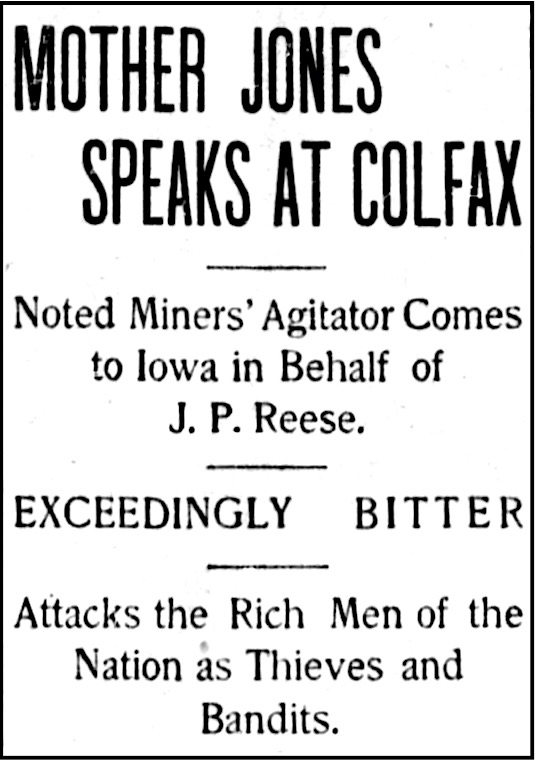
Colfax, Ia., Sept. 30.-(Special.)-Mother Jones, the famous organizer of the miners in the anthracite region, gave an address, tonight at the Methodist church, and urged the miners of the Sixth district to work for John P. Reese of Albia for congress.Mother Jones denounced the capitalists of the country in severe terms, and was bitter against the use of the injunction by the courts.Her address was listened to by a large audience, composed for the most part of miners. Immediately after her speech, Mother Jones started across the country to Prairie City and caught a night train for Albia, where she will speak. She will also deliver an address at Ottumwa and then return east.
Mother Jones is now over sixty years of age, her hair being white as snow. Yet she is vigorous and energetic, and speaks with wonderful feeling and eloquence when describing the sufferings of the miners in the anthracite regions. She urged the miners and workingmen to wake up and work for their rights.
[She said:]
You don’t need a gun. Let us bury the bullet and resurrect the ballot.
Wants Iowa to Act.
I want Iowa to be the first state to carry the banner of organized labor into congress and elect a workingman to that body. I want a worker to make laws for me and not a henchman. If ever an awakening comes in this country it must come now. The injunction must be stopped. I plead with you young men; shall you all be slaves or shall you be men? You have got to take hold of this government and run it for all the people. It is your duty to see that the next congressman from this district is a miner so that the next congress shall have a miner in it.When the last injunction bill was up before congress there was no one there to press it, because no one there had felt the sting of the injunction injustice.
I say down with the government that upholds injunctions. I repeat I want to see the next congress have a miner in it. When the corporations see the workingmen waking up and electing workingmen to office they will tremble. You have got to break up this corporate power. The only way to break it up is by legislation. If you men feel that you are too big cowards to do it, stand aside and let us women do it and we’ll show you how. Woman is the greater sufferer from the power of corporate wealth.
Mother Jones, at the outset of her address, spoke of the progress of the human race and the various inventions that have been made.
[She said:]
Yet the workers have not the benefit of these inventions. A few men who have never done anything in their lives have taken advantage of them all and the human race stands aghast and asks “What shall we do?” If these inventions have been produced by society, why should one band of thieves and robbers, and assassins, and plunderers possess them to the detriment of all the rest? That is the great question before the human race. There is no other question before you. You have the labor question to settle, and it will be settled in this century. The men who produce the wealth will have the wealth.
Who has built your magnificent homes and public buildings? Who have gone down into the depths of the earth and toiled sixteen hours a day? The workers. Who live in your palaces? The parasite. Why? Because he has plundered other men of what they produce. When he boasts of prosperity, what is it to 30,000 breaker boys in the anthracite region? That you can make money by scheming doesn’t make a nation prosperous. You can’t have a prosperous nation until the workers prosper. If you give to your nation an illiterate broken down body of workers, ruin will overtake your country.
Mother Jones paid her respects to Morgan for saying he had nothing to arbitrate, and to Baer, who says he owns the earth and is the “steward of the Almighty.”
[She said:]
I wish he would take care of these men and women down in West Virginia, if he is the Almighty’s steward, as he claims.
[And again:]
Every page of every book of every Carnegie library in the country is written with the blood of Homestead.

 —————
—————
 —————
————— —————
————— —————
————— —————
————— —————
—————