Hellraisers Journal: News from the Great Paterson Silk Strike: Philips Russel on the Arrest of Bill Haywood and Adolf Lessig

Share

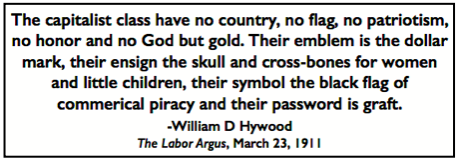
Quote BBH re Capitalist Class, Lbr Arg p4, Mar 23, 1911—————

Hellraisers Journal – Sunday May 4, 1913
Paterson, New Jersey – The Arrest of Bill Haywood and Adolf Lessig

From the International Socialist Review of May 1913:

The Arrest of Haywood and Lessig
By Phillips Russell

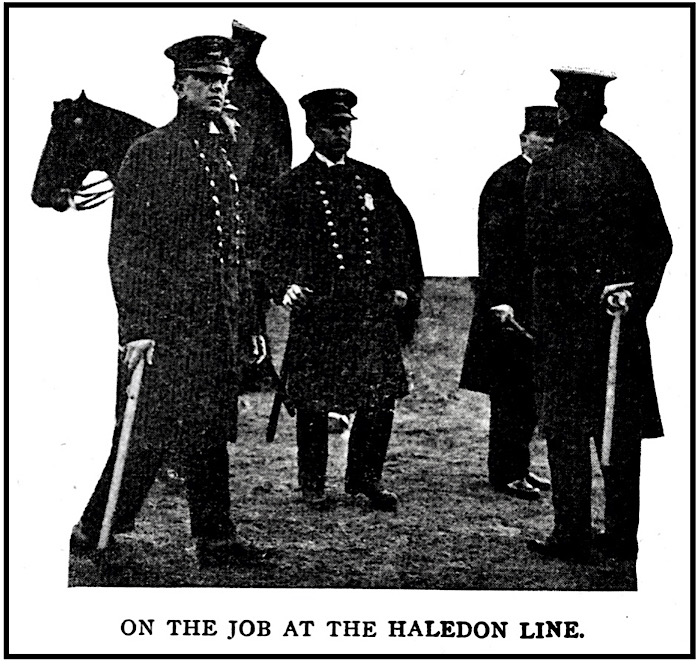
Paterson Police at Haledon Line, ISR p789, May 1913

DETERMINED that the 25,000 silk strikers of Paterson, N. J., should not listen to William D. Haywood on Sunday, March 30, the guardians of Paterson’s law and order, seized Haywood and Adolph Lessig on their way to Haledon and, in the interests of the mill owners, secured Haywood’s conviction and sentence to six months at hard labor, and Lessig to six months.

No single act or process in the proceeding had the least semblance of legality, and no attempt to make even a show of legality was made. The mill owners are represented on Paterson’s Police Commission by one of themselves. They appointed as Recorder one James F. Carroll, notorious in the city as a bar room politician. They wanted Haywood and Lessig out of the way; they had them seized by their police; they put them behind the prison bars, and intended them to stay there.

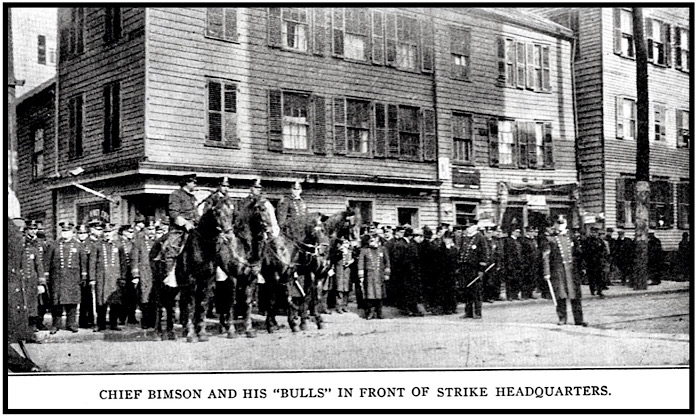
A mass meeting had been called for Sunday, March 30, in Lafayette Oval, which had been secured for the purpose by the strikers. On the preceding Saturday Police Chief Bimson issued an order prohibiting the meeting, but partly because of the lateness of the order’s appearance, but more largely because they believed they had the rights of free assemblage and free speech, the strikers ignored the order, and at the appointed hour began to pour in thousands down the roads leading to the meeting place.

In the meantime, a squad of special police detailed for special duty, namely, to prevent the meeting and disperse the crowd, held up Haywood and Lessig a block before they reached the Oval. The police informed Haywood that no meeting would be allowed, and that if he attempted to speak he would be arrested, whereupon the strikers within hearing distance shouted “On to Haledon!”

The cry was taken up by the thousands assembled, Haywood assenting: “All right we’ll go to Haledon,” and he began to walk the two miles beyond which lies the little Socialist municipality, followed by the strikers who had just learned that in Paterson they had no rights.

Paterson Chief Bimson n Bulls, ISR p790, May 1913

The crowd was perfectly orderly, although without any formation, but when it had got within half a block of the city’s limits the patrol wagon thundered through the mass of men, women and children to where Haywood and Lessig were walking in front. Motorcycle police had noted the general direction of the crowd and had rushed for the wagon, which was hooted and jeered by the strikers as it dashed directly for Haywood and Lessig.

Police Sergeant Ryan jumped out of the wagon, pointed at Haywood, saying, “You’re under arrest!” and grabbed Lessig, at the same time shouting, “Get Tresca!” Carlo Tresca, however, had dropped behind. As the wagon dashed by on its way to Haywood, some friends seized Tresca and hurried him into the house of a friend from whence he smiled pleasantly at the police who came to seize him.

After Haywood and Lessig were under arrest, the police, in a frantic effort to drive back the crowd, met with one who refused to be hurried. This was Messari, who was arrested and later arraigned on the same charges as the two principal defendants, some of the police conveniently swearing he was with them, as the amended charge required three defendants to make it legal.

“Have you a warrant?” asked Haywood of the policemen who rode with him in the wagon.

“I have,” answered one of them.
Continue reading “Hellraisers Journal: News from the Great Paterson Silk Strike: Philips Russel on the Arrest of Bill Haywood and Adolf Lessig” →

Hellraisers Journal: From the International Socialist Review: “The Rip in the Silk Industry” by Bill Haywood, Part II

Share

Quote BBH re Capitalist Class, Lbr Arg p4, Mar 23, 1911—————

Hellraisers Journal – Saturday May 3, 1913
Paterson, New Jersey – Bill Haywood on the General Strike of Silk Workers, Part II

From the International Socialist Review of May 1913:

The Rip in the Silk Industry

By William D. Haywood
———-

[Part II of II]

The Red Badge of Toil

Paterson Strike, EGF, ISR p786, May 1913

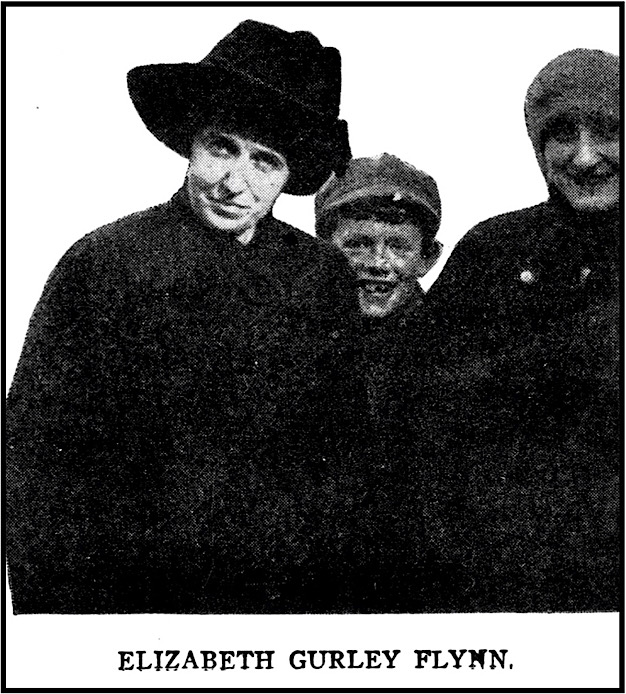
In this connection it is worth while to relate an incident-one of the most dramatic of the strike. The Paterson bosses lost no time in injecting the “patriotic” issue after the fashion of Lawrence, Little Falls and Akron. The red flag, they howled, stood for blood, murder and anarchy-the Star Spangled Banner must be upheld, etc., etc. Elizabeth Gurley Flynn was on the platform at a big strike meeting one day explaining the significance of the red flag when a striking dyer sprang up from the middle of the audience crying:

“I know ! Here is the red flag!”

And aloft he held his right hand-stained a permanent bloody crimson, gnarled from years of toil, and corroded by the scarlet dye which it was his business to put into the fabrics worn by the dainty lady of the capitalist class as well as by the fawning prostitute.

For an instant there was silence and then the hall was rent by cries from the husky throats as all realized this humble dyer indeed knew the meaning of the red badge of his class.

Ribbon weaving is largely done by men and women. In this department the bosses have developed a speeding up system with reductions in pay, overlooking no opportunity to introduce improved machinery. Thus they increase production, at the same time they lowered the pay, until the workers are now demanding a scale which 19 years ago was imposed upon them! That is, the weavers now ask a wage that prevailed two decades ago. 

The significance of this demand makes it plain that in the evolution of industry and the introduction of new machinery the workers have obtained no benefit, while the bosses have reaped ever increasing profits. 

Many children are employes in the silk industry, most of them being between the ages of 14 and 16. However there are few violations of the child labor law, not because. the manufacturers care anything about either the law or the children, but because the making of high grade silk requires the careful and efficient work that only adults can give. However the Paterson capitalists have begun to set up plants in the southern states as well as in the mining regions of Pennsylvania, installing there new style looms which can be operated by girls and children.

Meeting For Children

Paterson Child Strikers, ISR p787, May 1913

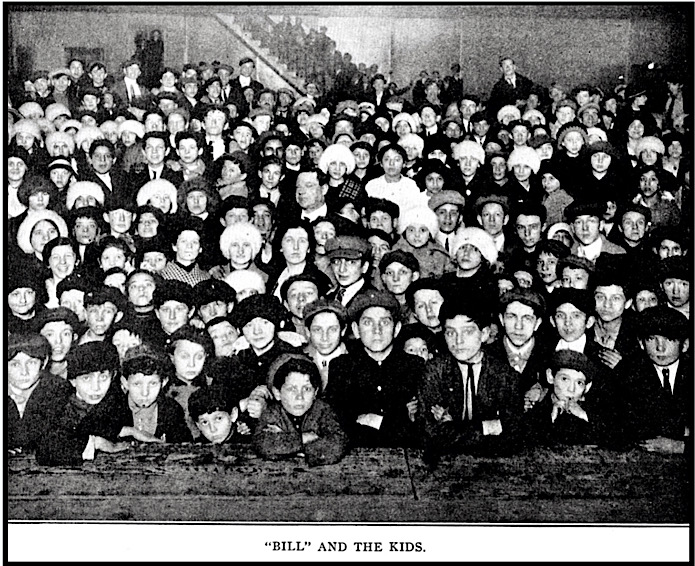
One of the best and most enthusiastic meetings held during the strike was that for the benefit of the children of the mills. They packed Turner Hall and listened eagerly and with appreciation as speakers outlined to them the development in the manufacture of silk from the cocoon to the completed fabric lying on the shelves of the rich department store.

Continue reading “Hellraisers Journal: From the International Socialist Review: “The Rip in the Silk Industry” by Bill Haywood, Part II” →

Hellraisers Journal: From the International Socialist Review: “The Rip in the Silk Industry” by Bill Haywood, Part I

Share

Quote BBH Corporation Soul, Oakland Tb p11, Mar 30, 1909—————

Hellraisers Journal – Friday May 2, 1913
Paterson, New Jersey – Bill Haywood on the General Strike of Silk Workers, Part I

From the International Socialist Review of May 1913:

The Rip in the Silk Industry

By William D. Haywood
———-

[Part I of II]

Paterson Doherty Mill Workers, ISR p783, May 1913

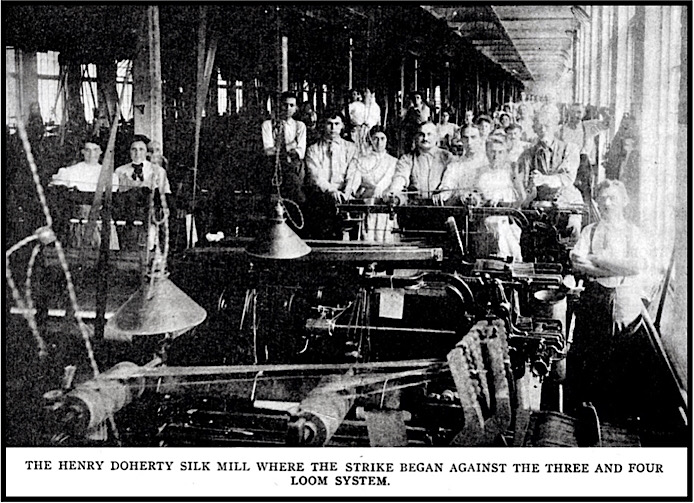
WHEN the broad silk weavers in Henry Doherty’s mill in Paterson, N. ]., left their machines last February they inaugurated what has proved to be the closest approach to a general strike that has yet taken place in an American industry.

They revolted against the 3 and 4 loom system which until recently has been confined to the state of Pennsylvania. This system is restricted to the lower grades of silk, messaline and taffeta.

There are almost 300 silk mills in Paterson. Doherty was the first manufacturer to introduce this system there and later it was carried into 26 other mills. The silk workers soon realized that unless this scheme for exploiting them still further was checked, it would in time pervade the entire industry in the Jersey city.

The silk workers of Paterson are the most skilled in the United States and the employers thought that if there was anywhere in the country where this system could be successfully adopted it was in Paterson. They thought that their workers would stand for it. The workers themselves were not consulted, as the manufacturers afterward realized to their sorrow, when a general strike was called embracing the industry in all its branches and extending to all states where silk is manufactured.

At present no less than 50,000 silk workers are on strike in New Jersey, Pennsylvania, New York and Connecticut, including those in the preparatory processes, the “throwster” mills, dye houses, broad silk making in all grades, as well as in nearly all the ribbon mills.

In many respects this strike is hardly less significant than that at Lawrence. It involves nearly as many workers and the conditions are just as bad. But the Paterson revolt has attracted less public attention than did the woolen fight. This is due to several reasons.

Paterson Socialist Editor Scott, ISR p784, May 1913

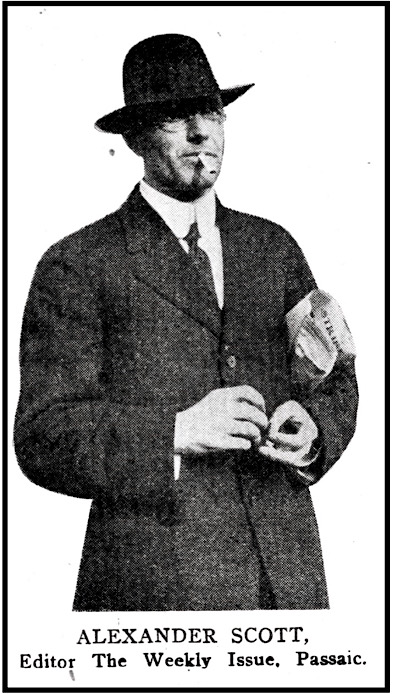
In the first place, the manufacturers, through their control of outside newspapers, were able to bring about a general conspiracy of silence. The New York papers, for example, after the first few days in which they gave prominence to the strike, were warned through subtle sources that unless there was less publicity they would be made to suffer through loss of support and advertising. Then the Paterson strikers were fortunate in having among them several trained veterans in the labor movement, such as Adolph Lessig, Ewald Koettgen, and Louis Magnet, who had been members of the I. W. W. since 1906, and knew what to do towards putting the strike on an organized basis. For a time they were able to take care of themselves without relying much on outside help. Besides, the authorities kept their hands off for a time, after their first fright in which they threw Elizabeth Gurley Flynn, Carlo Tresca and later Patrick Quinlan and Alex Scott, the Socialist editor, into jail. These organizers got on the job instantly and have done excellent work.

Continue reading “Hellraisers Journal: From the International Socialist Review: “The Rip in the Silk Industry” by Bill Haywood, Part I” →

Hellraisers Journal – Fred Merrick Arrested at Charleston, West Virginia; Printing Plant of Labor Argus Raided and Confiscated

Share

Quote Fred Merrick, Hatfield Mad, Wlg Maj p1, May 1, 1913—————

Hellraisers Journal – Thursday May 1, 1913
Charleston, West Virginia – Fred Merrick of the Socialist Labor Argus Arrested

From The Cincinnati Enquirer of April 30, 1913:

SOCIALIST EDITOR
———-
And Labor Leader Arrested in West Virginia
-Plant Confiscated.

SPECIAL DISPATCH TO THE ENQUIRER.

Labor Argus Seized, Merrick Arrested, Hinton WV Dly Ns p1, Apr 30, 1913
The Hinton Daily News
April 30, 1913

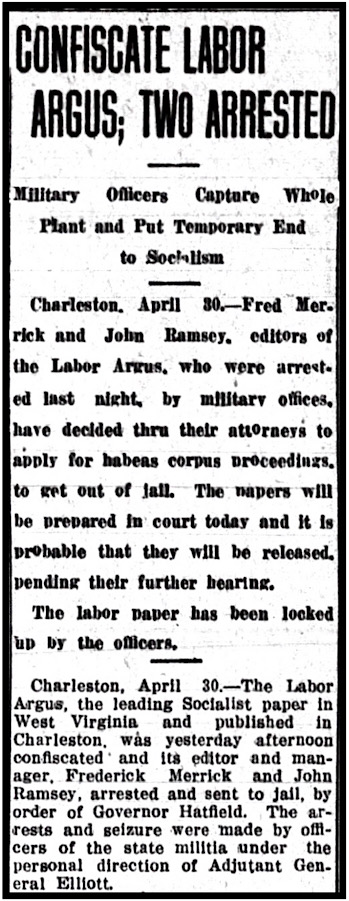
Charleston, W. Va., April 20.-Fritz Merrick, of Pittsburg, Socialist editor, and John L. Ramsey, a member of the United Mine Workers, were arrested this afternoon by the military authorities, and the printing plant of the Labor Argus, a local Socialist publication, was confiscated.

Merrick and Ramsey were seized by Adjutant General Charles D. Elliott, Major John H. Charnock and Captain Charles Wood and were taken to the Kanawha County Jail and placed in custody of Sheriff Bonner Hill on a commitment from the Governor, who acted under the provisions of the code giving him authority to seize persons who are engaged in an effort to incite insurrection.

The mailing list of the publication, which circulates largely through the coal fields, where a strike has recently been in progress, was seized by the officers, together with a number of copies of the newspaper.

Merrick, who served a sentence in Pittsburg for contempt of Court, anticipated his arrest and wired the Pittsburg Socialist last Sunday that “I expect to be arrested within 24 hours, but I shall have completed arrangements by that time to have the Labor Argus published In Pittsburg.”

—————

[Newsclip and emphasis added.]

Continue reading “Hellraisers Journal – Fred Merrick Arrested at Charleston, West Virginia; Printing Plant of Labor Argus Raided and Confiscated” →

Hellraisers Journal: John Reed Arrested at Paterson for Refusing “Move On” Order, Gets Twenty Days in Passaic County Jail

Share

Quote John Reed, Rebellious People, Ten Days, 1919—————

Hellraisers Journal – Wednesday April 30, 1913
Paterson, New Jersey – John Reed Sentenced to 20 Days in Passaic County Jail

From The New York Times of April 29, 1913:

WRITER SENT TO JAIL.
———-
John Reed of the American Magazine
Among Strike Victims.
———-

John Reed to Jail at Paterson, Eve Ns p9, Apr 28, 1913
The Paterson Evening News
April 28, 1913

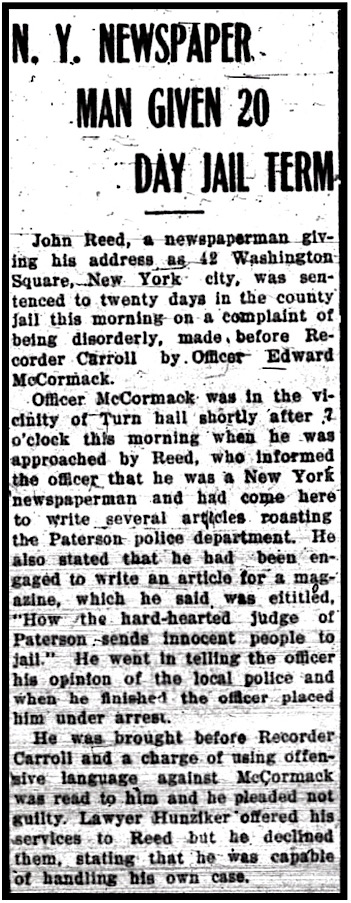
John Reed, a writer and a member of the staff of the American Magazine, was arrested in Paterson yesterday on a charge of disorderly conduct in the silk workers’ strike. He was arraigned before Recorder James F. Carroll, who, after hearing the evidence, sentenced Reed to twenty days’ imprisonment in the Passaic County Jail. Reed gave his address as 42 Washington Square, and according to some of his friends was in Paterson getting “local color” for a magazine story dealing with the silk workers’ strike.

Reed was at the corner of Cross and Ellison Street yesterday in the centre of the strike zone, talking to three men strikers. Policeman McCormick came along and ordered the men to disperse. The strikers said they lived in the house in front of which they were standing. 

“Well, get inside then,” said McCormick.

“But I don’t live in there,” said Reed.

“Well, move on, then,” said McCormick to the magazine writer.

Reed started to obey and then changed his mind and went back to where McCormick was and demanded his number.

An argument between the policeman and Reed followed which ended in the arrest of Reed on a charge of disorderly conduct. He was immediately taken to court and arraigned before Recorder Carroll.

“What’s your business?” asked the Recorder.

“Poet,” answered Reed.

“What’s your business here?” the Recorder asked again.

“None; I am a bystander,” Reed replied.

McCormick then testified that Reed had refused to move on when ordered to do so, and had insisted on questioning his authority.

The Recorder took McCormick’s view of the case and sentenced Reed to jail. 

John S. Phillips, editor of The American Magazine, was asked last night if the management of that publication would interest itself in the affairs of Mr. Reed and attempt to have him released from jail on appeal or by suing out a writ of habeas corpus. Mr. Phillips replied that he did not know of any contemplated action by the magazine management and that he did not care to discuss the matter.

[Newsclip and emphasis added.]

Continue reading “Hellraisers Journal: John Reed Arrested at Paterson for Refusing “Move On” Order, Gets Twenty Days in Passaic County Jail” →

We Never Forget: April 24, 2013, Rana Plaza Factory Collapse at Dhaka; Kalpona Akter, “I Have Broken Heart Today.”-1,134 Killed

Share

We Never Forget: April 24, 2013
Rana Plaza Factory Collapse

-Savar Upazila, Dhaka District, Bangladesh
-1,134 killed, 2,500 injured
-Suspect: Sohel Rana, Charge: Murder
-“The search for the dead ended on 13 May 2013 with a death toll of 1,134.”

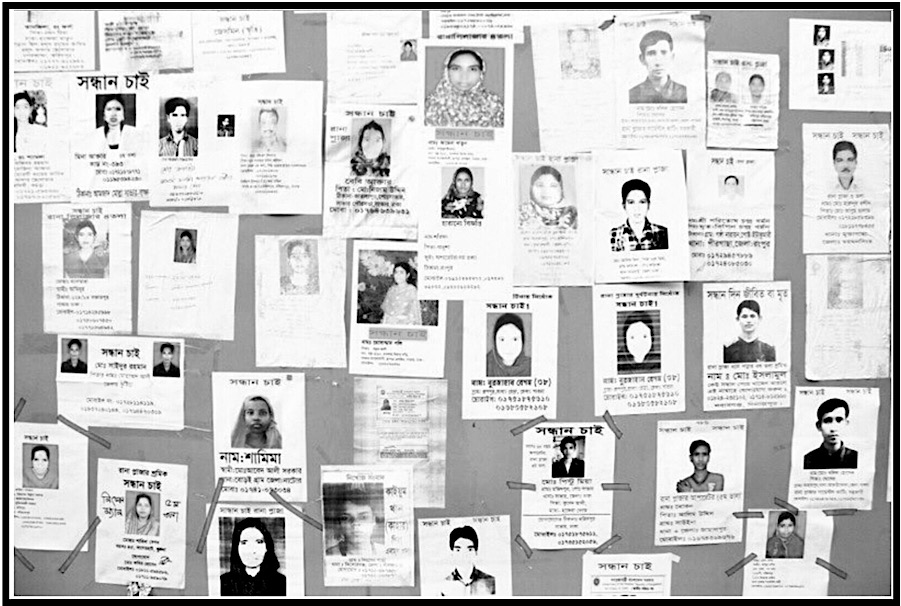
Rana Plaza Factory Collapse, Photos of Missing, Dhaka Apr 27, 2013
Photograph by Sharat Chowdhury [edited]
Rana Plaza Factory Collapse of April 24, 2013, at Dhaka, Bangladesh 
-Board of the Missing, taken April 27, 2013

https://en.wikipedia.org/wiki/Rana_Plaza_collapse
https://commons.wikimedia.org/wiki/File:2013_savar_building_collapse_-_missing_photos_01.jpg

—————

From Warehouse Workers United
– Statement from Kalpona Akter on
Rana Plaza Factory Collapse of April 24, 2013

Our deepest sympathies go out to the families of workers lost in this tragic event.It must be said, these tragedies can be prevented by multinational corporations like Walmart and the Gap that operate in Bangladesh. Because of these companies’ negligence and willful ignorance, garment workers are in danger every day because of the unsafe working conditions.

As we learn more details, we will better understand the brands that were manufactured in these factories, but we already know that the largest retailers in the world hold tremendous power to transform conditions for garment workers – mostly young women – in Bangladesh.

Today’s news is yet another reminder that Walmart and the Gap must immediately adopt the Bangladesh Fire and Building Safety Agreement, a transparent and legally binding agreement that includes worker representation, independent building inspections, worker rights training, public disclosure and a long-overdue review of safety standards. The safety agreement is the first step toward ensuring no more lives are lost.

More from Warehouse Workers United:

Kalpona is the Executive Director of the Bangladesh Center for Worker Solidarity. She is a former garment worker and is currently in the United States calling on retailers like Walmart, the Gap and Disney to lead on improving working conditions and adopting fires safety standards in Bangladesh.Today, international worker rights groups are calling for immediate action from international corporations and brands following the horrific news of a deadly collapse of the Rana Plaza building in Savar, in Dhaka Bangladesh. The collapse of the eight story building that housed five factories and a mall, has reportedly killed at least 80 people and injured over 800[*]. For the last month Kalpona has been touring the United States with Sumi Abedin, a young garment worker who jumped out of a third story window to save her life as the Tazreen factory burned killing on 112.

Warehouse Workers United
http://www.warehouseworkersunited.org/

Corporate Action Network
http://corporateactionnetwork.org/

*As of April 28th: death toll-372, injured-more than 1000, missing-up to 900. The owner of the building had been arrested.
http://beta.dawn.com/…

—————

Continue reading “We Never Forget: April 24, 2013, Rana Plaza Factory Collapse at Dhaka; Kalpona Akter, “I Have Broken Heart Today.”-1,134 Killed” →

Hellraisers Journal: From The Wheeling Majority: John W. Brown Writes from the Harrison County Jail at Clarksburg

Share

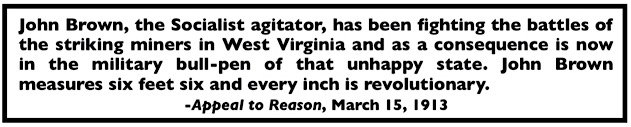
Quote re John W Brown Revolutionary, AtR p2 Mar 15, 1913—————

Hellraisers Journal – Saturday April 26, 1913
Clarksburg, West Virginia – Comrade John W. Brown Writes from Jail

From The Wheeling Majority of April 24, 1913:

John Brown Writes From Harrison Jail
———-

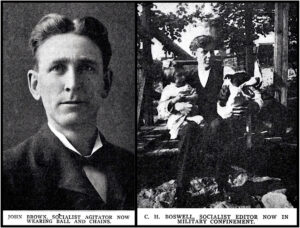
John Brown and Charles Boswell, ISR p733, Apr 1913

John W. Brown, who, with Charles Boswell, editor of the Charleston Labor Argus, and George F. Parsons, United Mine Workers’ organizer, have been imprisoned under the martial law anarchy system in West Virginia since last February, has written a letter to W. A. Peters, of this city, from the present abode of the three men, the Clarksburg jail.

These men, with Mother Jones and many others, were arrested by the militia and have been in jail ever since, having been tried at a farcial trial at which they were not even represented, and tried by men who had previously sworn that they believed them guilty. Their crime is defending the poor mine workers of this state from the greed of the coal barons. For this they will likely be sentenced to the penitentiary, and sent under a violation of the constitution of the state of West Virginia and the United States, for they have been denied a trial in the civil courts, before a jury.

—————————————–

The Letter.

Following is the letter:

Harrison County Jail.
Clarksburg W. Va., April 10, ’13.

Dear Comrade Peters:

Your kind favor of March 25 just reached me. Was mighty glad to hear from you. Nothing doing in the Haywood line for this bunch; I know of but two Haywoods in this country, and I am not one of them. As to trials and tribulations…I will tell you all about it some other time. Let it suffice to say: We are here—because we’re here.—Because we can’t get away.

We arrived here April 2 from Pt. Pleasant, where we were flooded out. And, strange as it may seem, we are treated here as human beings. We have been under arrest since Feb. 10, and up to the time we were brought here we were held “incommunicado.” Yet notwithstanding this, did not prevent us from touching an underground wire, and stinging them once in a while. Do you get the “Argus”? Did you see “Old Liberty” from the Bull Pen at Pratt or “Don’t give up the Fight” from Mason county jail?

It is impossible to say at this time what they are going to do with us. But you can take it from me that if they can get Boswell, Parsons and myself, we will sure go. I am looking for about five years. They couldn’t get us for a day in the civil-courts.

As to matters personal, there is nothing the comrades can do for us other than to demand a trial in the civil courts. It’s a great opportunity for the [Socialist] party, but unfortunately, the party is not taking advantage of it.

They made a mistake in bringing us here. Evidently the jailer told them he was running this jail, as we are getting our mail, and outgoing mail is not censored, besides we can see “everybody”, and there is someone here about all the time. The boys hold a meeting every night in front of the court house and every day they bring us in a good dinner.

We have been corraled in box cars, passenger cars, churches, freight depots, old stores and three jails in three different counties. I am afraid the comrades here are going to spoil our “playhouse,” and in that case they may take us to Wheeling.

Give my kindest regards to all the comrades, and…

Sincerely yours,
J. W. BROWN

[Photographs and emphasis added.]

Continue reading “Hellraisers Journal: From The Wheeling Majority: John W. Brown Writes from the Harrison County Jail at Clarksburg” →

Hellraisers Journal: Mrs. Fremont Older Travels from San Francisco to West Virginia, Enters Martial Law/Strike Zone, Speaks with Prisoners and Mother Jones

Share

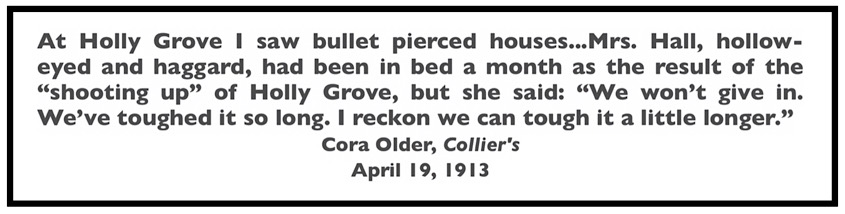
Quote Annie Hall per Cora Older, WV Strikers Wont give in, Colliers p28, Apr 1913—————

Hellraisers Journal – Friday April 25, 1913
Martial Law/Strike Zone, West Virginia – Cora Older Speaks with Mother Jones

From Collier’s National Weekly of April 19, 1913:

Answering a Question

By MRS. FREMONT OLDER

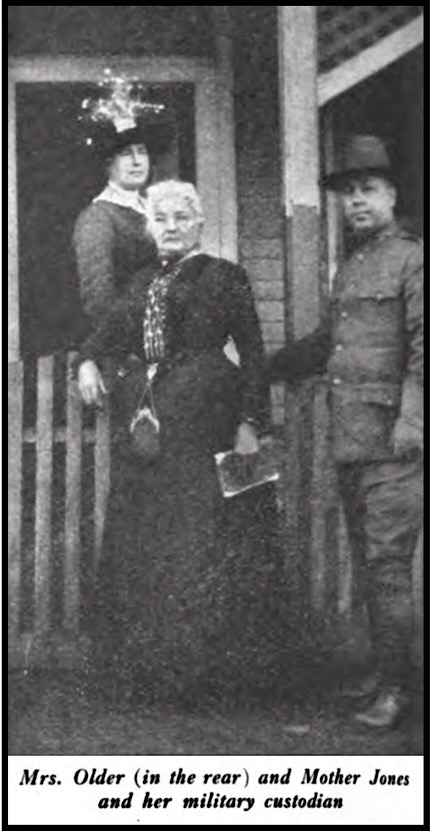
Mother Jones, Cora Older, at Military Bastile WV, Colliers p26, Apr 1913

Mrs. Older is the wife of Fremont Older, editor of the San Francisco “Bulletin,’’ who was one of the citizen leaders responsible for the overthrow of the Schmitz boodle gang and for the conviction of Abe Ruef. But Mr. Older is a newspaper man before he is a reformer. Hence his question-which herewith Mrs. Older answers.

———-

MOTHER JONES and forty-eight men were on trial before a military court in Paint Creek Junction, W. Va., charged with conspiracy to murder. Mother Jones and five leaders refused to plead; they would not admit that the military court had jurisdiction over civilians. It was an interesting situation, but little news came to the outside world.

“Why don’t we get news from West Virginia?” my husband asked me one morning. So I started from San Francisco to find out.

On the last day of the trial I arrived in Paint Creek Junction [Pratt], the military capital of the strike zone. A few small houses tilted toward the muddy New River. Barren brown mountains imprisoned the town. 

A flag fluttered freely over the dingy village. A soldier greeted me as I got down from the train. Soldiers swarmed about the little railway station converted into a “bull pen” for strikers on trial. Through the streets at the point of guns soldiers were driving civilians. “Prisoners,” some said; “Martial law.” Former Governor Glasscock’s proclamation posted on the little green lunch counter at the station spelled it “Marital law.”

Pickles are served at breakfast in Paint Creek Junction. “Lena Rivers” is the “best seller,” but the place is filled with class hatred and suspicion. One whispers; soldiers may hear. Americans of old colonial stock sneer at the militia. “Yellow legs!” “Spies!” “Strike breakers!”

EVERY man is his own Marconi in Paint Creek Junction. In half an hour it was known that a strange woman had arrived to visit Mother Jones. A messenger tiptoed into my boarding house to say that Mother Jones and the prisoners were allowed to meet no one, especially reporters; but if I wanted to find out about conditions I’d better talk with Mother Jones’s landlady. “Go to the side door, and into the kitchen.”

By this time I felt like a conspirator. I almost tiptoed through the soldiers. Mother Jones occupied the parlor of a small white cottage. I was welcomed by the landlady. We were chatting in the kitchen when, without rapping, an officer entered and said to me: “The Provost Marshal wants you at headquarters.”

“Why?” I asked, bewildered. I did not know I was under arrest.

Martial law was in the soldier’s glance. He repeated his command. “And they call us anarchists,” commented the fiery-eyed, white-faced landlady.

Through the main street, past armed sentinels, up a flight of stairs to a large room filled with empty benches and stacked guns, we went to the Provost Marshal. Stern, unsmiling as justice, he asked me to explain my presence and my existence. I told him the truth. The Provost Marshal frowned. I wondered about the “bull pen.” I made the discovery that I am no Christian martyr. I am a sybarite hopelessly prejudiced against bull pens. I fumbled in my bag and brought forth an engraved card. I was released on good behavior.

But I was able now to answer the question which had brought me across a continent. The PROVOST MARSHAL was the ASSOCIATED PRESS CORRESPONDENT.

Continue reading “Hellraisers Journal: Mrs. Fremont Older Travels from San Francisco to West Virginia, Enters Martial Law/Strike Zone, Speaks with Prisoners and Mother Jones” →