Hellraisers Journal – Friday September 11, 1903 Cripple Creek District, Colorado – Governor Sends the Militia into Strike Zone
Report of Emma F. Langdon of Victor, Colorado:
[Cripple Citizens’ Alliance]
Emma F. Langdon
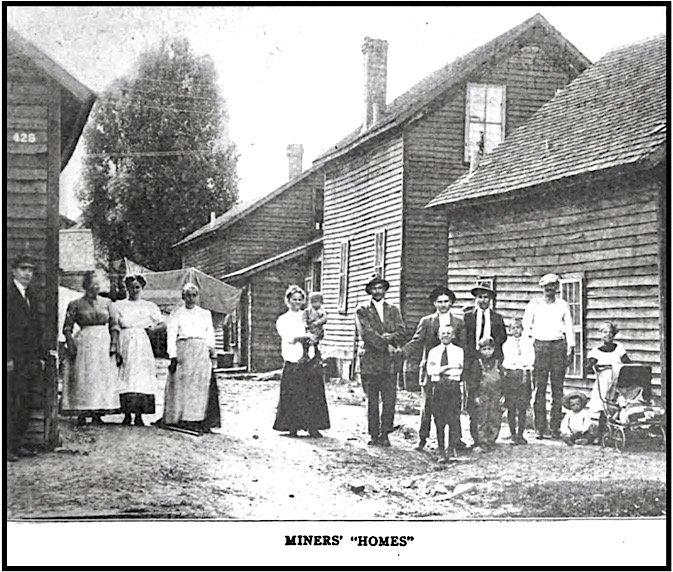
About Sept. 1 there were many rumors of an alliance being formed in Victor. Upon investigation it was found there was an organization known as the “Citizens’ Alliance” in Cripple Creek. If there was at the above date, such an organization in Victor, there could not be one member located. Just what this organization hoped to accomplish in the Cripple Creek district was hard to understand, but it was not hard to understand from whence the spirit of the movement came. It required but little investigation into the membership to convince one that it was inspired by the mine owners; at least, the most prominent members are their lieutenants in the district. These men, it appears, first interviewed the Victor merchants but received a decided “turndown,” for which all friends of organized labor were grateful. The situation is different here from what it is in Denver. The great mass of people here are union people and just how a “Citizens’ Alliance’” could hope to accomplish any good for itself or anybody else is hard to understand. Just think of it; the idea of the business men, or anyone else of this district, organizing to fight organized labor. What has made the Cripple Creek district from a business standpoint? Has it been the generosity of the mine owners, or the work of organized labor in establishing a wage scale here that would put enough money in circulation to make business here in place of going to Colorado Springs.
In the city of Victor the news of the organization caused much amusement at that time, be it said to the credit of Victor’s business men.
[Home of Mr. Dennison, Union Miner, Burned]
[From] when the first non-union men began the work of building a fence at the El Paso, until the completion of the tunnel, there was enacted at the mine many disgraceful scenes of lawlessness. Guards at the mine had fights among themselves; insulted passers-by; stopped respectable people that had business to pass that way, at the point of rifles. They were, it was said, caught stealing. They made indecent exposures before innocent children; for which some of the men employed were arrested. The home of Mr. Dennison, a union miner, was destroyed by incendiaries on the night of Sept. 2, and while it was not proved positively that it was the work of the El Paso crew, evidence was strong against them. If they did not actually light the fire that destroyed the property, they, at least, made plain the fact that they were glad to see Mr. Dennison and family made homeless. While the house was in flames and the work of saving some of the household goods was in progress, the guards stood by and laughed and jeered. They did not offer to assist the unfortunate people. For that reason, I say if they were not instrumental in the burning of the building, at any rate, they made no secret of their joy at the sight of Dennison’s home being in flames.
[Large rewards were offered by the county officials and citizens for evidence leading to the arrest of those guilty of the assault upon businessmen Stewart an Hawkins, however] no reward offered for the villains that burned the home of Mr. Dennison, a union miner, and there was very little said of the matter by the enemies of organized labor.
[Governor Sends Investigating Committee]
When it was announced that an investigating committee was to visit the district a general expression of satisfaction was heard on every side. But, alas, that investigating committee—what a farce.
The members of the committee arrived [in Victor] over the Short Line Sept. 3, at 9:30 p. m. They were hastened through a back alley by F. M. Reardon to a rear entrance into the Bank of Victor, where they were met by Mayor French and a few other prominent citizens and held a short consultation, when they left for the residence of Nelson Franklin. The committee remained at the residence of Nelson Franklin about a half hour and then took the low line electric for Cripple Creek, where they went into session and held a long interview with Sheriff Robertson. They refused to talk. After the meeting with the mine owners they returned to Victor on a special car.
A telegram received at the Victor Daily Record office from Denver shortly after midnight said that the commission was in session at the National hotel in Cripple Creek and would not be ready with the recommendation for several hours. The commission consisted of Attorney General N. C. Miller, Brigadier General John Chase of the National guard, and Lieutenant T. E. H. McClelland, an obscure lawyer of Denver. No intimation was given out as to the possible conclusions.
The commission returned to Denver early the following morning, being in the district less than eight hours and only interviewed one side of the question.
[Troops Arrive]
September 4, about noon, the news reached the district that troops had been ordered to the gold camp and would arrive that night. The people were seized with consternation at this news. A wail of indignation went up from at least two-thirds of the entire population. The people at once understood the mission of the “investigating committee” and why they did not consult. all parties concerned. The first of the state troops arrived in the district Sept. 4 before midnight, and from then on for twenty-four hours they came until there was located, in one of the quietest, most conservative, law-abiding districts in the world, over 1,000 men with munitions of war sufficient to fight a small nation.
The all absorbing subject on the streets of Victor and in the entire district was the question of the arrival of the troops. The farce committee sent here by Governor Peabody to secure an excuse to bring the troops, returned to Denver Sept. 4, early in the morning, and immediately advised the governor to send the troops. Adjutant General Bell had his men in readiness. In fact, they were wearing their uniforms around Denver early in the morning and were simply waiting for the farce committee to report what had been agreed upon the day before.
Hellraisers Journal – Saturday September 6, 1913
Kearsarge, Michigan – Young Margaret Fazekas Shot Down by Deputies
From The Calumet News of September 2, 1913:
[…..]
Saturday September 6, 1913
Keweenaw Peninsula, Michigan – Girl, fourteen, shot in head, not expected to live.
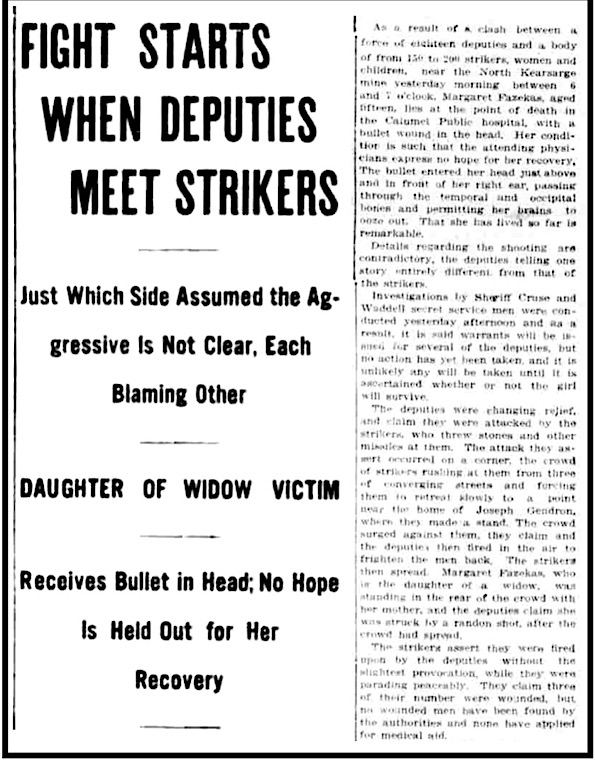
Disturbing stories of violence against the women and children in the Michigan Copper Country Strike Zone are making there way out of the area. A young fourteen-year-old girl was shot in the head when deputies opened fire on a strikers’ parade. The girl is Margaret Fazekas. She was shot near the Kearsarge shaft during the Labor Day parade by Sheriff Cruse’s armed deputies.She was rushed to the hospital and was not expected to live.
On September 4th, a guardsmen was so enraged by a woman waving a broom and cursing at him that he threatened her:
I’ll fix you so that you won’t handle a broom anymore!
The guard attempted to tie her to his horse for the purpose of dragging her along the ground. However, his plan was thwarted when more women came running to her aid, pelting the guardsmen with rocks and sticks.
Militiamen routinely ride their horses into the strikers who gather for any reason, and, by this practice, a small child has been injured in Laurium.
But it is for the children that the strike must go on, for as one woman said pointing to her children:
These are the ones we are striking for. You don’t want to see them bent and crippled before their time, do you?
Another woman joins the picket lines even though her husband is dead, killed in the mines leaving her with four young children. She said:
Men killed, company pay nothing. Many families get poor by strike, but maybe men win. I hope so.
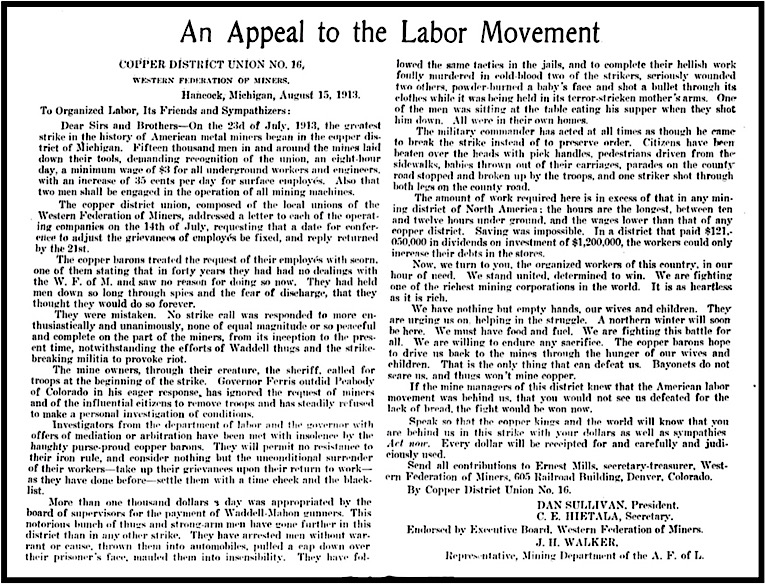
Hellraisers Journal – Friday September 5, 1913 Hancock, Michigan – W. F. of M. District Union No. 16 Appeals to Labor Movement
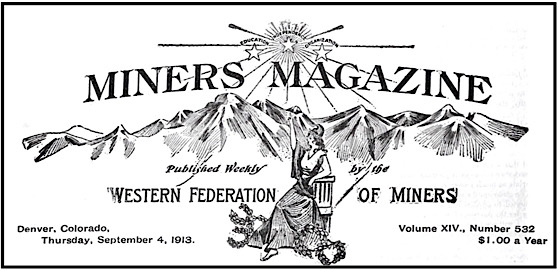
From the Miners Magazine of September 4, 1913 -Dan Sullivan, C. E. Hietala, and John H. Walker Sign Appeal to Labor Movement:
…..Now, we turn to you, the organized workers of this country, in our hour of need. We stand united, determined to win. We are fighting one of the richest mining corporations in the world. It is as heartless as it is rich.
We have nothing but empty hands, our wives and children. They are urging us on, helping in the struggle. A northern winter will soon be here. We must have food and fuel. We are fighting this battle for all. We are willing to endure any sacrifice. The copper barons hope to drive us back to the mines through the hunger of our wives and children That is the only thing that can defeat us. Bayonets do not scare us, and thugs won’t mine copper.
If the mine managers of this district knew that the American labor movement was behingd us, that you would not see us defeated for the lack of bread, the fight would be won now.
Speak so that the copper kings and the world will know that you are behind us in this strike with your dollars as well as sympathies…..
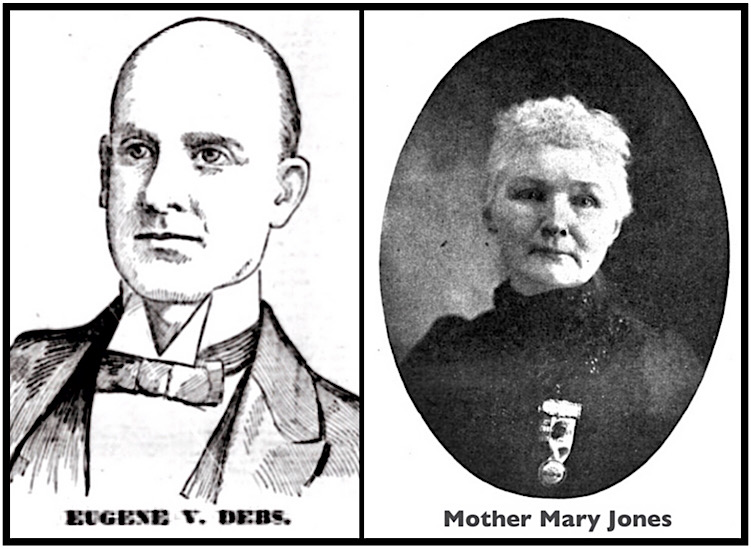
Hellraisers Journal – Thursday September 3, 1903 Terre Haute, Indiana – Mother Jones Spends Day as Guest of Eugene Debs
From The Cincinnati Enquirer of September 1, 1903:
ECHO OF THE PAST ———- Is Populism, Says Eugene Debs, the Labor Leader.
SPECIAL DISPATCH TO THE ENQUIRER
Terre Haute, August 31.-Eugene Debs, who has closed his Chautauqua engagement, spent yesterday at home, with Mother Jones as his guest. In regard to the conference at Denver to revive the Populist party, Mr. Debs says:
The committee on the exhumation of issues and galvanization of corpses reported both in a state of satisfactory preservation. There is no inspiration in a cadaver. Populism is an echo of the past, with gray whiskers on it. The Denver funeral procession and its Populist pallbearers present a sorry picture in contrast with the advancing, enthusiastic, confident, cheering, revolutionary hosts of International Socialism.
Hellraisers Journal – Tuesday September 2, 1913 “Copper Country” of Michigan – Striking Copper Miners Standing Firm
From the International Socialist Review of September 1913:
The Copper Miners’ Strike By Edward J. McGurty
[Part II of II]
So far [the mine operators] have been unable to intimidate the miners. The men are standing firmly.Parades are held every day along the 28 miles which comprise the range. Meetings of from three to six thousand are held every day in Calumet, Hancock, South Range and Mass City. There is no sign of weakening on the part of the men. They are determined upon a victory. They will refuse to submit to the slavery of the Copper Kings any longer. Thirty years of it has been enough.
The principal bone of contention at present is the recognition of the union. The men have made up their minds on this point. The mine-ownes have also apparently done so. The struggle is on in earnest. The miners are up against tremendous odds. They have absolute solidarity in their ranks, however, and that means a great deal. They are going to win! The copper barons are already desperate!
August 5th. The enclosed affidavit was sent to Ferris on the 29th of July and Ferris has absolutely refused to take the troops from this county. They are still in Keweenaw county at this writing.
Hon. W. N. Ferris, Governor, Lansing, Michigan.
I, John H. Hefting, sheriff of Keweenaw county, Michigan, hereby certify, that I was requested and urged by certain mining officials to call troops, and I refused as I did not see any necessity, inasmuch as there had been perfect peace and order and not a single infraction of the law committed since the strike commenced. The said mining officials urged me to get your permission to call upon General Abbey for troops, in case I needed them and not otherwise. My intention was not to call troops into this county. On July 29, 1913, several troops appeared at the boundary line, and I protested against troops being brought into this county as conditions did not require it. Whereupon one of the officers of the army stated to me that if I did not permit the troops to enter Keweenaw county at that time, that no matter how bad conditions became even though the location would burn down, they would not give any assistance thereafter. The telegram was made out by the attorney for the company and my attention was called to sign it. I requested them to give me time to consider the case at least one day, but their answer was that I must decide at once. Therefore I request you to withdraw all troops from this county.
Respectfully yours, JOHN HEFTING, Keweenaw County Sheriff.
Subscribed and sworn to before me this day, the 29th of July, 1913. My commission expires March 4, 1917.
]. A. HAMILTON, Notary Public.
The newspapers here carried on a three-day campaign to form a “back-to-work” movement and yesterday got one of the company tools to act as chairman, surrounded on the platform by shift and trammer bosses, at a meeting called by the Calumet & Hecla Co., to appoint a committee from the workers to meet with the bosses, and as the chairman put it, find out on what terms the C. & H. would allow its employes to go back to work. The miners saw through the game immediately and refused to “fall” for the game. They started the cry of “scab” and left the hall for union headquarters.
Mother Jones arrived today [morning of August 5th] and was met at the depot by the strikers. They stood bare-headed in two lines two miles long, while she went through to the union hall. She refused to ride in an automobile which had been brought for her. Ten thousand strikers will pack the Palestra and neighboring halls tomorrow to hear her. She will then go over the range, addressing meetings in the various “locations.”

 —————
—————
 —————
————— —–
—– —–
—–
 —————
—————
 […..]
[…..]
 —————
—————