Hellraisers Journal: Arnot Miners’ Strike Ends in Victory; Mother Jones Given Rousing Farewell at Blossburg

Share

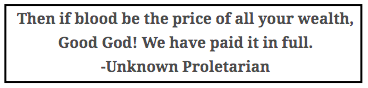
Quote re Mother Jones at Arnot, Wellsboro PA Agitator p1, Jan 17, 1900———-

Hellraisers Journal – Saturday February 24, 1900
Blossburg, Pennsylvania – Arnot Miners and Families Bid Mother Jones Farewell

From the Wilkes-Barre Daily News of February 17, 1900:

Mother Jones ed, St L Rpb p2, Feb 5, 1898

STRIKE DECLARED OFF.

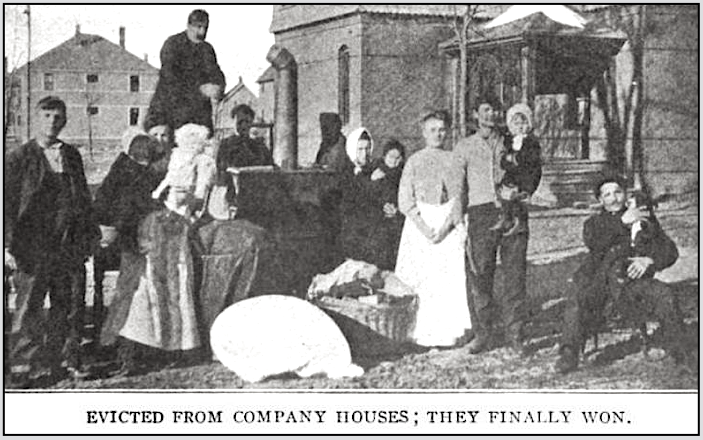
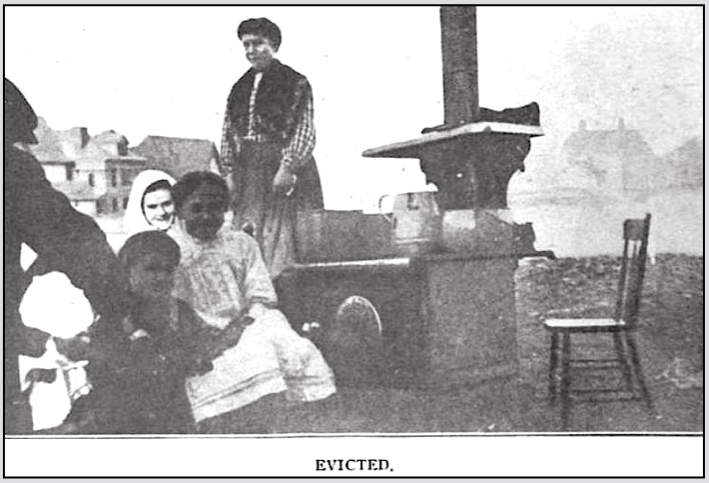
BLOSSBURG, Pa., Feb. 16.-The strike at the Arnot and the Landrus mines of the Blossburg Coal Company, which began eight months ago, was officially declared of to-day, when all the demands of the miners were conceded by the company. The men will be put to work as fast as places can be made for them. One thousand men are affected. During the strike forty families were evicted from company houses at Arnot. There were daily demonstrations and parades and many were arrested charged with riot, true bills being found against 35 persons, including several women.

———-

[Photograph and emphasis added.]

From the Mansfield Advertiser of February 21, 1900:

-Mrs. Jones, of Pittsburg, otherwise “Mother Jones,” was given a rousing farewell at Blossburg Opera House last Saturday by the miners, late on strike, among whom she has labored so unceasingly the past few months.

[Emphasis added.]

Continue reading “Hellraisers Journal: Arnot Miners’ Strike Ends in Victory; Mother Jones Given Rousing Farewell at Blossburg”

Hellraisers Journal: From Butte Daily Bulletin: Review of “Debs, His Authorized Life and Letters” by David Karsner, Part II

Share

Quote EVD, Be True Labor Will Come Into Its Own, OH Sc p1, Nov 5, 1919———-

Hellraisers Journal – Monday February 23, 1920
David Karsner, of New York Call, “Paints Debs with Loving Hands” -Part II

From The Butte Daily Bulletin of February 13, 1920:

EVD re Karsner Bio, BDB p3, Feb 13, 1920

[Part II of II.]

EVD, David Karsner, Debs Life n Letters, Brk Dly Egl p4, Jan 17, 1920

Debs was born in Terre Haute, Ind., Nov. 5, 1855. The sixty-five years between that date and the present day which sees him in United States penitentiary at Atlanta, Ga., are of startling significance in the social and economic history of this country.

“He was one of 10 children of Jean Daniel Debs and Marguerite Bettrich Debs, both natives of Alsace.”

“Jean Daniel Debs possessed a well-equipped library of French history as well as the works of some of the most noted French writers including Victor Hugo who was one of their favorites. Very early in his life, Eugene became acquainted with the works of Hugo and the master’s characterization of Jean Valjean in “Les Miserables,” made an indelible impression upon his mind.”

Debs in his early youth saw the Civil war, and Karsner wonders “to what extent these scenes and sounds of conflict influenced Eugene Debs to take his stand against war, but it is notable that not once during his long and varied career as a labor leader has he safe-counseled violence as means to the settlement of any dispute.”

Eugene’s school years were cut short by the necessity for earning money. At the age of 14, Debs began work in the shops and later as locomotive fireman for the Terre Haute and Indiana Railroad company. At first he received one dollar a day, but later, as fireman, was paid on a mileage basis. “Eugene’s pay envelope, which he turned over to his mother unopened, was decidedly slim.”

Debs’ first step in the organized labor movement was taken when the local lodge of the brotherhood of locomotive fireman was organized at Terre Haute on the evening of Feb. 27, 1874. He served in various official capacities as organizer. In 1892 he resigned from a position in which he was receiving $4,000 a year so that he might receive from the American Railway union a $75-a-month position.

Continue reading “Hellraisers Journal: From Butte Daily Bulletin: Review of “Debs, His Authorized Life and Letters” by David Karsner, Part II”

Hellraisers Journal: From Butte Daily Bulletin: Review of “Debs, His Authorized Life and Letters” by David Karsner, Part I

Share

Quote EVD, Be True Labor Will Come Into Its Own, OH Sc p1, Nov 5, 1919———-

Hellraisers Journal – Sunday February 22, 1920
David Karsner, of New York Call, “Paints Debs with Loving Hands” -Part I

From The Butte Daily Bulletin of February 13, 1920:

EVD re Karsner Bio, BDB p3, Feb 13, 1920

[Part I of II.]

EVD, David Karsner, Debs Life n Letters, Brk Dly Egl p4, Jan 17, 1920

“Debs, His Authorized Life and Letters,” has just gone into its second edition, (Boni and Liveright, New York). Written for socialists, by a socialist, it might well be termed a book for Americans, since socialism is the great issue of the present day. “Debs” is propagandist. And as such it should be a handbook of ready reference for those who agree with its doctrines, and for those whore aim it is to refute those doctrines. But the book primarily presents the emotional color of Debs’ socialism.

David Karsner, the author, paints Debs with loving hands. He is an ardent disciple. He depicts a man who is not a fiery leader, but rather one who is filled with good-will and a desire for peace on earth. Debs was not born a socialist. He was pushed, says the author by the logic of facts as he saw them, into the opinions that have finally caused his incarceration in prison. According to Karsner, his magnetism does not issue from flame, for he is not a “Red.” He is, says Karsner, a mild and greatly loved leader. He is said to have no desire for honors. Yet he was four times a candidate for the presidency of the United States.

Continue reading “Hellraisers Journal: From Butte Daily Bulletin: Review of “Debs, His Authorized Life and Letters” by David Karsner, Part I”

Hellraisers Journal: From the Cleveland Toiler: Eugene V. Debs on the Power of the Capitalist Press, Fed Fat by Ruling Class

Share

Quote AtR p1 Nominates EVD for President, May 24, 1919———-

Hellraisers Journal – Saturday February 21, 1920
Power of Press Underestimated by American Socialist Movement

From the Cleveland Toiler of February 20, 1920:

The Power of the Press
—–

– by Eugene V. Debs –

EVD f President by OK SP, Mpl Str Tb p2, Feb 2, 1920

The power of the press is sadly underestimated in the socialist movement. The ruling class make no such mistakes. They are keenly alive to the power of the press in molding public sentiment and in shaping affairs in accordance with their interests. The capitalist papers do not suffer for the want of support and never die of starvation. They are fed fat and ungrudgingly by the class in power and in return serve that class with all their power.

Not so with the press of the working class. With scarcely an exception the papers and periodicals published in the interest of labor eke out a precarious existence. Ninety-five percent of them line the highway of the past with their skeletons. They lingered for a brief while and then gave up the ghost, falling victims to the chronic labor-paper malady, starvation.

Of course not all papers claiming to be labor papers are fit to exist. Many of them are fakes and run by political grafters. These often thrive in their blackmail and graft while an honest paper is allowed to die for the want of support.

Working men and women ought to have intelligence enough by this time to discriminate between an honest labor paper and a grafting sheet and they ought to be loyal enough to the working class to give their support to the paper that uses its influence to mold sentiment in favor of their cause and fights their industrial and political battles.

It is when the strike comes that the working class suffer most keenly the lack of a powerful press that reaches the people. They are always at a fearful disadvantage on this account. The capitalists get in a thousand licks to their one, not only because they can get their case before the people in its most favorable light and keep it there, but because they can put the case of the workers in the most unfavorable light and keep it there.

Continue reading “Hellraisers Journal: From the Cleveland Toiler: Eugene V. Debs on the Power of the Capitalist Press, Fed Fat by Ruling Class”

Hellraisers Journal: “White Landlords, Robbing Negro Tenants, Let Loose Arkansas Reign of Terror” -Part II

Share

Quote Claude McKay, Fighting Back, Messenger p4, Sept 1919———-

Hellraisers Journal – Friday February 20, 1920
Phillips County, Arkansas – White Landlords Terrorize Negro Tenants, Part II

From the Appeal to Reason of February 14, 1920:

White Landlords, Robbing Negro Tenants,
Let Loose Arkansas Reign of Terror

[Part II of II.]

Arkansas Elaine Massacre, 12 Union Men Condemned to Die, IB Wells Barnett p2, 1920

Early in 1919, some of the young negroes who had returned from the army began an organization of the negro share croppers, under the name of “Farmers’ and Householders’ Progressive Union of America,” for the purpose of getting relief from the abuses their people were made to suffer. The charter and constitution of the organization was drawn up by two prominent white lawyers at Winchester, Ark. The organization was looked upon with much disfavor from the start by the land owners. So the plans of the organization had to be carried on in secret, but it met with instantaneous approval of the negro laborers. The organization arranged that friendly and trustworthy counsel was furnished the negroes who would bring suit and force the land owners to make a settlement with the negroes and in many instances they were forced to pay back to them hundreds, and some instances, thousands of dollars that they were stealing from their tenants.

These negroes had grown a bumper crop this season, some families making as much as fifty bales of cotton, twenty-five of which was theirs. Cotton this season in this locality was selling at from fifty to seventy-five cents per pound, or $250 to $300 per five hundred pound bale, or over $5,000 for the tenant’s share of the crop, while everything they purchased at the land owner’s store was sold at 50 to 100 per cent higher than at cash stores in nearby towns. These negro tenants were due to have several thousand dollars as their share of the crop for their work. This the land owners could not allow for various reasons. If the negroes got out of debt, they might leave the farm, then they would not trade at their stores if they had the cash to buy from mail order houses or the cash stores in the towns.

The land owners began to make arrangements to again ship the negro’s cotton without asking his consent or rendering him a statement of his store account. The negroes went to their organization for aid and counsel. A representative of their organization went to a prominent white attorney for counsel [Ulysses S. Bratton], who they knew was a friend to all labor organizations. This attorney was not in his office at the time the delegation called, but his son [O. S. Bratton], who was in charge of the office in his father’s absence, advised the delegation to get their members together and he would come out and meet them, and investigate their claims. The representatives of the negroes returned and called a meeting in one of their churches, to advise their members.

Continue reading “Hellraisers Journal: “White Landlords, Robbing Negro Tenants, Let Loose Arkansas Reign of Terror” -Part II”

Hellraisers Journal: “White Landlords, Robbing Negro Tenants, Let Loose Arkansas Reign of Terror” -Part I

Share

Quote Claude McKay, Fighting Back, Messenger p4, Sept 1919———-

Hellraisers Journal – Thursday February 19, 1920
Phillips County, Arkansas – White Landlords Terrorize Negro Tenants, Part I

From the Appeal to Reason of February 14, 1920:

White Landlords, Robbing Negro Tenants,
Let Loose Arkansas Reign of Terror

[Part I of II.]

WNF Elaine Massacre, HdLn AR Gz p1, Oct 3, 1919, wiki
Headline from Arkansas Gazette of October 3, 1919

Repeated and strenuous strenuous efforts have been made to extradite Robert L Hill, a negro from the state of Kansas to Arkansas, where he is indicted for murder. He has not been delivered up to the Arkansas authorities, and his extradition would be a deep and shameful stain upon the state of Kansas. For Hill’s is no common murder case. The question of his fate is linked with the larger question of economic justice to an exploited race. It isn’t for murder, really, that Hill would be tried if he were sent back to Arkansas; the real charge against him is that he was active in helping to organize the negro tenant farmers of southern Arkansas that they might remove some of the burdens of landlordism and virtual slavery from which they have cruelly suffered.

Hill is the president and organizer of the Farmers’ and Householders’ Progressive Union of America—a union negro tenant farmers. The story this union and of the present effort to extradite Hill into Arkansas cannot be understood without explaining the general situation existing in Arkansas.

First let us recall the lurid excitement that prevailed in Phillips county, Arkansas, of which Helena is the county seat, in October, 1919. It will be recalled that the Associated Press sent out to the rest of the country stories of a formidable negro plot to terrify and exterminate the white race in Arkansas, with the news that negroes in Phillips county had uprisen and wantonly killed 21 white men. For several days Arkansas was crimsonly featured in riot stories, and the patriotic fashion in which the white men of Phillips county suppressed the uprising and upheld law and order was dramatically chronicled.

Continue reading “Hellraisers Journal: “White Landlords, Robbing Negro Tenants, Let Loose Arkansas Reign of Terror” -Part I”

Hellraisers Journal: Fellow Worker Ben Fletcher, Imprisoned Since September 1918, Released on Bond from Leavenworth

Share

Quote Frank Little re Guts, Wobbly by RC p208, Chg July 1917———-

Hellraisers Journal – Wednesday February 18, 1920
Leavenworth Penitentiary, Kansas – Ben Fletcher Released on Bond

From The Leavenworth Times of February 8, 1920:

FOUR PRISONERS WERE RELEASED AT FEDERAL PEN
—–
All but One, Ben Fletcher, Colored I. W. W.
Were Taken Immediately into Custody.
—–

[…..]

IWW, Ben Fletcher, 13126 Leavenworth, Sept 7 or 8, 1918
Fellow Worker Ben Fletcher

Ben Fletcher, the only colored I. W. W. of “Big Bill” Haywood’s tribe, received, September 8, 1918, at the Federal penitentiary was released yesterday from that institution on an appeal bond to the amount of $10,000. The bond was furnished in Chicago and Ben, immediately upon his release, set out for that metropolis.

The colored “wobbly” was one of four inmates, who were released yesterday, but Fletcher is the only one to enjoy his freedom. The others were taken into custody at the prison gates…..

[Photograph added.]

Continue reading “Hellraisers Journal: Fellow Worker Ben Fletcher, Imprisoned Since September 1918, Released on Bond from Leavenworth”

Hellraisers Journal: Whereabouts & Doings of Mother Jones for January 1920: Found Speaking in Johnstown and Altoona, Pennsylvania

Share

Quote Mother Jones, Revolution in Our Veins, Altoona Tb p6, Jan 12, 1920 ———-

Hellraisers Journal – Tuesday February 17, 1920
-Mother Jones News for January 1920
Found Speaking in Johnstown and Altoona, Pennsylvania

From The Pittsburg Press of January 6, 1920:

‘MOTHER’ JONES TALKS AT JOHNSTOWN TEMPLE
—–

GSS, Mother Jones, WZF, Survey p64, Nov 8, 1919

Special to THE PRESS.

Johnstown, Pa., Jan. 6.-Under police surveillance, “Mother” Jones, aged 90, who admits she labor agitator and who often has been arrested for her utterances and her part in labor troubles, spoke to 300 men, mostly foreigners, at Labor Temple, Sunday. Her audience was largely made up of the remnants of the steel strike organization and she harangued the men as if the steel strike had never been ended. Police were present at the meeting and her statements were considered milder than when she appeared here several months ago.

[Photograph of Mother Jones with William Z. Foster added.]

Note: The Great Steel Strike was officially called off by the National Committee for Organizing Iron and Steel Workers on January 8th.

From the Altoona Times Tribune of January 7, 1920:

Mother Jones Talks To Flood City Men
—–

Mother Mary Jones, beloved by the miners of the country and the union workers of Colorado, comes to the Mishler theater Sunday afternoon to address the members of the craft unions of the city. She was the guest of the workers of Johnstown on Sunday afternoon and delivered an address in the Labor temple.

Mother Jones is most democratic and her aim in life is to make the workers comfortable. After being introduced to some 600 workers of the Flood City she won their hearts right off the reel by saying “If smoking gives you boys any comfort, keep right on smoking.” She then invited a squad of policemen to the stage but not one of them accepted but when she had finished several of them shook hands and congratulated her.

Continue reading “Hellraisers Journal: Whereabouts & Doings of Mother Jones for January 1920: Found Speaking in Johnstown and Altoona, Pennsylvania”

Hellraisers Journal: The One Big Union Monthly: Message to the Men, Women and Children of Labor from Big Bill Haywood

Share

Quote BBH, Poem A Message Part 3 ed, OBU p56, Feb 1920———-

Hellraisers Journal – Monday February 16, 1920
“O Men and Women and Children of Labor” by William D. Haywood

From The One Big Union Monthly of February 1920:

BBH, Poem A Message Part I, OBU p56, Feb 1920BBH, Poem A Message Part 2, OBU p56, Feb 1920BBH, Poem A Message Part 3, OBU p56, Feb 1920

Continue reading “Hellraisers Journal: The One Big Union Monthly: Message to the Men, Women and Children of Labor from Big Bill Haywood”

Hellraisers Journal: “47 Days in Spokane City Jail” by William Z. Foster, Part II -from the Seattle Workingman’s Paper

Share

Quote EGF, Compliment IWW, IW p1, Nov 17, 1909———-

Hellraisers Journal – Tuesday February 15, 1910
Spokane, Washington – Foster Describes I. W. W. Organizing within City Jail

From the Seattle Socialist Workingman’s Paper of February 12, 1910:

Spk FSF, 47 Days WZF, Workingmans p1, Feb 12, 1910Spk FSF, 47 Days by WZF, Workingmans p1, Feb 12, 1910

[Part II of II.]

[Fellow Workers Organize Behind the Bars of City Jail]

Our propaganda meetings were a howling success, and we made at least forty I. W. W. converts in the city jail. These were all workingmen who were arrested for the crime of being broke, and when they listened to our talks and saw how we handled ourselves they promised to read up on industrial unionism and to join the I. W. W. as soon as possible.

In the jail the cells are in a double row, opening from a corridor about six feet wide and it was in this corridor that we held our meetings.

Another good feature of our meetings was the spirit of democracy prevailing. We practically forced men to get up and speak who had never but once before attempted to speak before a crowd (said “Fellow-Workers” on Spokane streets), and a couple of these give promise of becoming excellent “soap-boxers.”

We were getting along swimmingly when someone decided that our meetings were too successful and that we must have some “leaders” amongst us. As a result of this, on Jan. 3rd, Fellow-Worker Jones of Los Angeles (commonly called “Voiende Sulpher Smoke”) who was speaker of the evening, and myself, who had acted as chairman of the meeting the night previous, were “grabbed” and put into the “strong box” (a steel cage reserved for the more serious criminals). Our seizure simply stimulated the remainder to greater efforts, and from that time on the jail organization became a pronounced success. Once more the grabbing of men suspected of being “leaders” acted as a boomerang.

* * *

The effects of the organization upon the work done on the rock pile was remarkable, and the possibilities of the passive resistance strike, even as evidenced by us chained prisoners, of working. We accomplished almost nothing. For instance, two men chained together pounded for four days upon one rock, when it was accidentally broken. To break that small rock (about as large as a wash bucket) cost the city of Spokane $4.00 for food alone, at the rate of 50 cents per day per man, besides the other expenses for guards, etc. This is only a sample of how we worked, and by no means an exceptional one.

Continue reading “Hellraisers Journal: “47 Days in Spokane City Jail” by William Z. Foster, Part II -from the Seattle Workingman’s Paper”