Hellraisers Journal – Friday February 10, 1922 Mother Jones News Round-Up for September 1921, Part III Found Speaking to Delegates at Convention of United Mine Workers
Indianapolis, Convention of the United Mine Workers of America Sixth Day, Afternoon Session, Monday September 26, 1921
“I can fight…”
Indiana Daily Times September 27, 1921
Vice-President Murray: I understand that Mother Jones has just arrived in the convention and I am going to request Brother David Fowler to escort her to the platform. It isn’t necessary that I should introduce Mother Jones to you at this time; it isn’t necessary that I should eulogize the work she has performed for the coal diggers of America, and I will simply present to the convention at this time our good friend, Mother Jones.
ADDRESS OF MOTHER JONES
Mr. Chairman and Delegates: I have been watching you from a distance, and you have been wasting a whole lot of time and money. I want you to stop it.
All along the ages, away back in the dusty past, the miners started their revolt. It didn’t come in this century, it came along in the cradle of the race when they were ground by superstition and wrong. Out of that they have moved onward and upward all the ages against all the courts, against all the guns, in every nation they have moved onward and upward to where they are today, and their effort has always been to get better homes for their children and for those who were to follow them.
I have just come up from West Virginia. I left Williamson last Friday and came into Charleston. I was doing a little business around there looking after things. We have never gotten down to the core of the trouble that exists there today. Newspapers have flashed it, magazines have contained articles, but they were by people who did not understand the background of the great struggle…..
I walked nine miles one night with John H. Walker in the New River field after we had organized an army of slaves who were afraid to call their souls their own. We didn’t dare sleep in a miner’s house; if we did the family would be thrown out in the morning and would have no place to go. We walked nine miles before we got shelter. When we began to organize we had to pay the men’s dues, they had no money.
At one time some of the organizers came down from Charleston, went up to New Hope and held a meeting. They had about fourteen people at the meeting. The next morning the conductor on the train told me the organizers went up on a train to Charleston. I told Walker to bill a meeting at New Hope for the next night and I would come up myself. He said we could not bill meetings unless the national told us to. I said: “I am the national now and I tell you to bill that meeting.” He did.
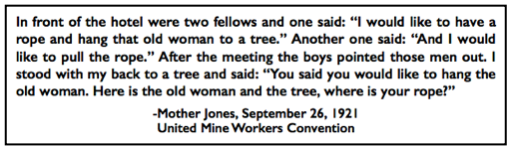
When we got to the meeting there was a handful of miners there and the general manager, clerks and all the pencil pushers they could get. I don’t know but there were a few organizers for Jesus there, too. We talked but said nothing about organizing. Later that night a knock came on the door where I was staying and a bunch of the boys were outside. They asked if I would organize them. I said I would. They told me they hadn’t any money. Walker said the national was not in favor of organizing, they wanted us only to agitate. I said: “John, I am running the business here, not the national; they are up in Indianapolis and I am in New Hope. I am going to organize those fellows and if the national finds any fault with you, put it on me—I can fight the national as well as I can the company if they are not doing right.”
[…..]
When we began organizing in 1903 the battle royal began. The companies began to enlist gunmen. I went up the Stanaford Mountain and held a meeting with the men. There wasn’t a more law-abiding body of men in America than those men were. While they were on strike the court issued an injunction forbidding them to go near the mines. They didn’t. I held a meeting that night, went away and next morning a deputy sheriff went up to arrest those men. He had a warrant for them. The boys said: “We have broken no law; we have violated no rules; you can not arrest us.” They notified him to get out of town and he went away. They sent for me and I went up. I asked why they didn’t let him arrest the men. They said they hadn’t done anything and I told them that was the reason they should have surrendered to the law.
That very night in 1903, the 25th day of February, those boys went to bed in their peaceful mining town. They had built their own school house and were sending their children to school. They were law-abiding citizens. While they slept in their peaceful homes bullets went through the walls and several of them were murdered in their beds. I went up next morning on an early train. The agent said they had trouble on Standifer [Stanaford] Mountain, that he heard going over the wires news that some people were hurt. I turned in my ticket, went out and called a couple of the boys. We went up the mountain on the next train and found those men dead in their homes, lying on mattresses wet with their blood and the bullet holes through the walls.
I want to clear this thing up, for it has never been cleared up. I saw there a picture that will forever be a disgrace to American institutions. There were men who had been working fourteen hours a day, who had broken no law, murdered in their peaceful homes. Nobody was punished for those murders.
Hellraisers Journal – Thursday February 9, 1922 Mother Jones News Round-Up for September 1921, Part II Found Denouncing Government by Gunthug in the State of West Virginia
From The New Castle Herald of September 6, 1921:
MOTHER JONES HAS SOLUTION
DECLARES FORCE OF RIGHT MUST SUPPLANT RIGHT OF FORCE IN WEST VIRGINIA ———-
By HARRY HUNT
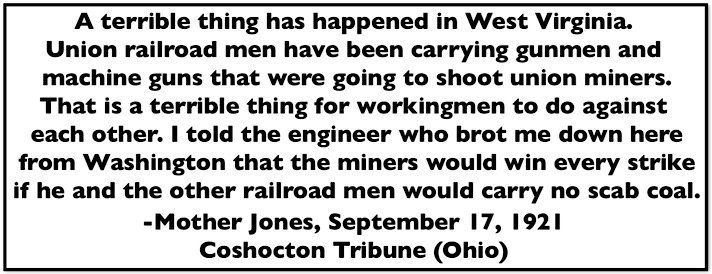
WASHINGTON Sept. 6.-“The secretary of war doesn’t understand. The president doesn’t understand.”
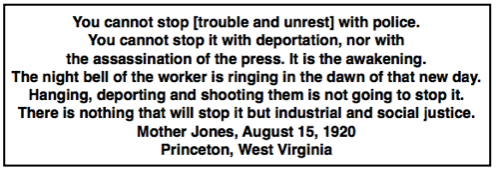
There is a great wrong being perpetrated in West Virginia. This wrong will not be corrected by jailing miners or shooting them. It will be settled only by social and industrial justice.
It was ”Mother” Jones speaking. She had just left the office of Secretary of War Weeks, where she had gone to protest against the sending of federal troops into the zone of the West Virginia mine war.
“Just what is the situation?” she was asked. “You were there last week. What is the trouble?”
[Mother Jones replied:]
The miners under arms in West Virginia are not fighting the government, either state or nation. But they are determined to defend themselves from the oppression and domination of the hired gunmen of the mine operators who constitute a private army of the interests in West Virginia.
Companies Obdurate
The government rendered a decision on the wage question in this district in 1919. But the mine companies have not recognized the authority of the government in that decision and have not followed it.
The men, being Americans, revolted. They sent out word asking to be organized.
Then they were thrown out of the miserable company shacks in which they lived.
The mine workers in this district are robbed to pay an army of professional murderers, maintained to keep the workers in subjection.
The money that ought to go to the miner who slaves underground is diverted to maintain gunmen to enforce the demands of greedy overlords of industry.
The fathers want that money, which they earn, to help educate their children, to improve their homes, to get churches and schools and the rights of American citizens.
Force of Right
The trouble in West Virginia must be settled by the force of right, not by the right of force.
You can shoot down these men in West Virginia, but they will rise again against the outrage of being robbed to pay a private army to enforce the brutal demands of coal operators.
If the employers can form their army, the workers naturally think they can do the same. That’s logical, isn’t it?
And that situation is the ulcer from which flows all the poison. Until it is removed, there will be no peace.
Fought Same Battle
We fought this fight out in the Kanawah and New River fields 23 years ago. We had a few battles. A good many of us were put in jail. I was carried 84 miles to jail myself, to get me out of the zone where it was thought I would be troublesome.
But we got the whole of these fields organized. The gunmen had to leave. The men began to get their pay in Uncle Sam’s currency, not in company money that could only be spent at company stores.
They are living in peace today in the Kanawha and New River fields and in the Fairmont district. Their homes are happier, their work better, the relations of the men and their employers more just.
But along the Norfolk & Western in the Mingo fields, a private army rules.
Hellraisers Journal – Wednesday February 8, 1922 Mother Jones News Round-Up for September 1921, Part I Found Celebrating Labor Day in Indiana, Pennsylvania
From Pennsylvania’s Indiana Evening Gazette of September 3, 1921:
Labor Day.
The local committee announced this morning that the arrangements for the Labor Day celebration had been practically completed and that all that was lacking for a proper observance of the occasion was the promise of fair weather. “We expect all organized labor to join in the parade on Monday,” said the chairman of the committee this morning.
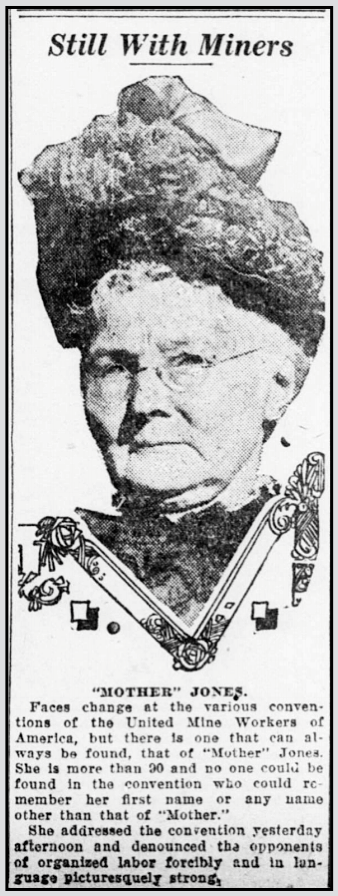
There will be hundreds of visitors for the occasion, music by four bands and a drum corps and talks from three well-known speakers-President John Brophy of Clearfield, President of District No. 2, United Mine Workers of America; Mother Jones, and John Ghizzoni, international board member. It was stated that Mother Jones would probably arrive here on Sunday afternoon, direct from the scene of the conflict in West Virginia.
—————
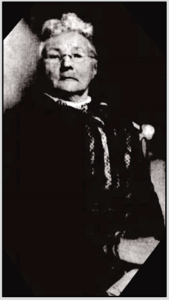
[Photograph added.]
From the Fort Wayne News-Sentinel of September 4, 1921:
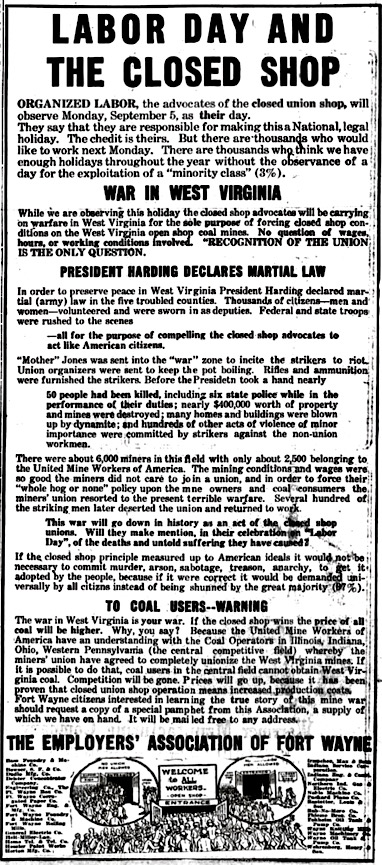
“Labor Day and the Closed Shop” -Ad from The Employers Association of Fort Wayne:
From the Pennsylvania’s Indiana Evening Gazette of September 6, 1921:
Labor’s Holiday.
With the presence of three notables of the international association of the United Mine Workers of America in attendance-John Brophy, president of District No. 2: John Ghizzoni, international board member & “Mother” Jones-organized labor held its annual celebration under the most favorable auspices at the Fair Grounds yesterday. Members of organized labor and their families, to the number of several thousand, came into Indiana for the celebration, the events of which were carried out with a minimum of confusion and no trouble worth mentioning…..
Hellraisers Journal – Tuesday February 6, 1912 The Triangle Shirtwaist Factory Fire: “God Did It” by Phillips Russell
From the International Socialist Review of February 1912:
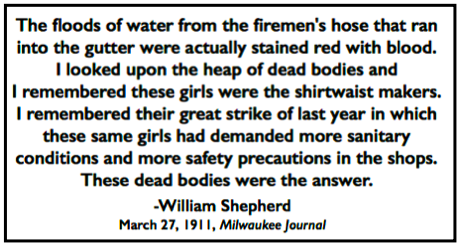
A NEW YORK jury composed of capitalistic cockroaches has absolved Harris & Blanck of the murder of 147 young workers in the Triangle shirtwaist factory fire of March 25, 1911.
Harris & Blanck, the two bosses, were tried only for the death of one girl worker, according to the crooked ways of capitalist courts, and since “it couldn’t be proved” that they were responsible for this one girl’s death, they were freed.
A member of the jury afterward expressed himself as follows:
“I can’t see that anyone was responsible for the loss of life, and it seems to me that it must have been AN ACT OF GOD.”
Poor God! The capitalists have got him just where they have the working class-cornered! They tell us He can do all things. But there is one thing God can’t do, it seems-He can’t answer back. Else the moment this pitiful squirt uttered these words He would have rent the sky open, would have hurled His scepter aside, thrown off His robe, stepped down from His awful throne, taken this petty capitalist croaker by the throat, and rammed his statement back down him again.
Hasn’t God any manhood at all? How long will He continue to allow Himself to be made the goat for capitalist crimes? Or is His eternal silence a confession of guilt? If so, then it is time we were knowing. Is it God who has been up to the deviltry of all these years? Is it God who traps the worker in blazing factory or buries him in tomblike mine, without providing him with even one means of escape? Is it God who sends the sailor abroad in a rotten hulk of a ship and drowns him before he can leap from his foul bunk? Is it God who hurls the iron worker from his lofty perch a thousand feet to the stones below and mangles the brakeman and the machine hand into an unrecognizable mass, telling the weeping wives and children that He is very sorry but the dead men were guilty of contributory negligence? Is it God who takes into His tender care all that the worker produces and hands him back just enough to live on?
The capitalists say so. Their priests and preachers, their professors and editors, their teachers and other kept men, say so.
But we have begun to suspect. We have begun to see that the capitalists have created God in their own image. And He is running up a terrible account which some day He will have to settle with the working class of the world.
Hellraisers Journal – Sunday February 5, 1922 First Hand Account of the Release of Eugene Debs from Atlanta Penitentiary
From The Liberator of February 1922:
The Uncaging of Debs
IT was Christmas morning. By the President’s order a man was to be released from prison in Atlanta some time that day and proceed to Washington-no one seemed to know just when.But at six o’clock we newspaper men were tipped off to go to the warden’s house, where Debs was said to be having his breakfast.We waited. An hour passed and then Debs, in his blue denim prison raiment, was ushered out a side door of the Warden’s house into a car and shot back to prison. We then were certain the President had not succeeded in getting his prisoner past our lines during the night. That was something, for few men have left prison supposedly free under circumstances as mysterious as these which attended the release of Eugene V. Debs. And, perhaps, no handful of reporters ever faced so strange a task as that of watching a prison so the President of the United States couldn’t sneak a prisoner up to Washington without anybody knowing it.
Playing this curious game against Presidential secrecy, we had to chase every car that came from the prison, overtake it, look in, satisfy ourselves Debs was not there, and then return to our station in the road two hundred yards from the prison. And this all morning, until eleven o’clock, when we boarded the train that took Debs to Washington.And this, we learned, waswhat happened at the prison.
One by one they came to say good-bye to Debs. One man, a hospital patient, fainted in his arms. Sam Moore, the life-term Negro murderer made over by Debs, wept, and Debs kissed him and promised him he would constantly advocate his freedom. Moore has been in prison thirty years, since he was twenty. A lawyer, also a lifer, imprisoned for killing his wife in a fit of drunken jealousy, embraced the man he said was the best friend he ever knew. The way over from the hospital to the great prison building was choked with men in blue denim, all with outstretched hands. There were tears, and there were smiles, according to temperament. Up the corridors they blocked his way, crowded about him, followed him as he advanced. The warden had suspended all rules. All, all, could come to the front. On every tier they rushed forward to the great barred windows of the building that is as broad as a city block. From the outside, out beyond the prison foreground and beyond the gates, those windows now were pictures of bars and faces, faces, faces.Debs reached the end of the corridor by the warden’s office and the big front door. It opened. Then the shout went up, and as Debs was going down the granite steps it resounded through the vast place and carried out over the free air to the ears of those away out in the road.
But it was no longer a shout. For it would not die. It steadily increased in volume. It was twenty-three hundred caged men crying to see the one who was loose. He walked away out over the grass foreground where he could see them all and they could see him. Cheers mingled with fanatical screams, and yells of his name. For a half a minute he stood with his hat high in air. Then his hand fell, then his head and he wept. He walked back to the warden’s automobile, and away he went with the great noise in his ears.
We all got in the train with Debs and rode with him to Washington, and not yet do any of us know why it was that the President of the United States took so great an interest in this man, whom he does not think worthy of the rights of citizenship.
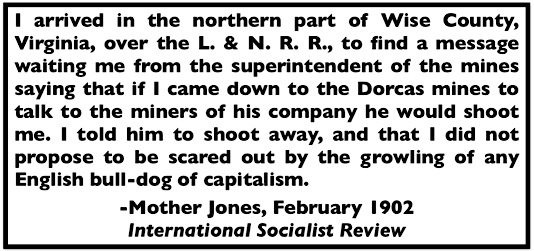
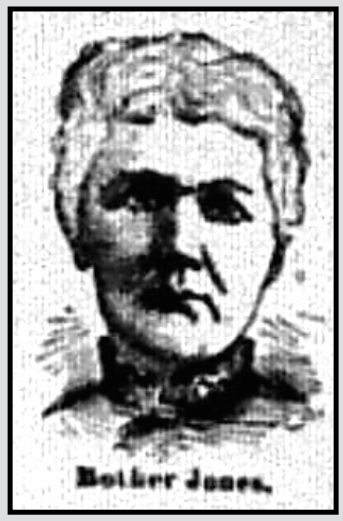
Hellraisers Journal – Monday February 3, 1902 Mother Jones Describes Conditions for Coal Miners in Old Virginia
From The International Socialist Review of February 1902:
Coal Miners of The Old Dominion. ———-
[-by Mother Jones]
A FEW Sundays ago I attended church in a place called McDonald, on Loop Creek, in West Virginia. In the course of his sermon the preacher gave the following as a conversation that had recently taken place between him and a miner.
“I met a man last week,” said the preacher, “who used to be a very good church member. When I asked him what he was doing at the present time he said that he was organizing his fellow craftsmen of the mines.”
Then according to the preacher the following discussion took place:
“What is the object of such a union?” asked the preacher.
“To better our condition,” replied the miner.
“But the miners are in a prosperous condition now.”
“There is where we differ.”
“Do you think you will succeed?”
“I am going to try.”
Commenting on this conversation to his congregation the preacher said: “Now I question if such a man can meet with any success. If he were only a college graduate he might be able to teach these miners something and in this way give them light, but as the miners of this creek are in a prosperous condition at the present time I do not see what such a man can do for them.”
Yet this man was professing to preach the doctrines of the Carpenter of Nazareth.
Let us compare his condition with that of the “prosperous” miners and perhaps we can see why he talked as he did.
At this same service he read his report for the previous six months. For his share of the wealth these miners had produced during that time he had received $847.67, of which $45 had been given for missionary purposes.
Besides receiving this money he had been frequently wined and dined by the mine operators and probably had a free pass on the railroad.
What had he done for the miners during this time. He had spoken to them twenty-six times, for which he received $32.41 a talk, and if they were all like the one I heard he was at no expense either in time, brains or money to prepare them.
During all this time the “prosperous” miners were working ten hours a day beneath the ground amid poisonous gases and crumbling rocks. If they were fortunate enough to be allowed to toil every working day throughout the year they would have received in return for 3,080 hours of most exhausting toil less than $400.
Jesus, whose doctrines this man claimed to be preaching, took twelve men from among the laborers of his time (no college graduates among them) and with them founded an organization that revolutionized the society amid which it rose. Just so in our day the organization of the workers must be the first step to the overthrow of capitalism.
* * * * * * *
Then my mind turns to the thousands of “trap boys,” with no sunshine ever coming into their lives. These children of the miners put in 14 hours a day beneath the ground for sixty cents, keeping their lone watch in the tombs of the earth with never a human soul to speak to them. The only sign of life around them is when the mules come down with coal. Then as they open the trap doors to let the mules out a gush of cold air rushes in chilling their little bodies to the bone. Standing in the wet mud up to their knees there are times when they are almost frozen and when at last late at night they are permitted to come out into God’s fresh air they are sometimes so exhausted that they have to be carried to the corporation shack they call a home.
The parents of these boys have known no other life than that of endless toil. Now those who have robbed and plundered the parents are beginning the same story with the present generation. These boys are sometimes not more than 9 or 10 years of age. Yet in the interests of distant bond and stockholders these babes must be imprisoned through the long, beautiful daylight in the dark and dismal caverns of the earth.
Savage cannibals at least put their victim out of his misery before beginning their terrible meal, but the cannibals of to-day feast their poodle dogs at the seashore upon the life blood of these helpless children of the mines.A portion of this bloodstained plunder goes to the support of educational incubators called universities, that hatch out just such ministerial fowls as the one referred to.
The very miner with whom this minister had been talking had been blacklisted up and down the creek for daring to ask for a chance to let his boy go to school instead of into the mines. This miner could have told the minister more about the great industrial tragedy in the midst of which he was living, in five minutes than all his college training had taught him.
Hellraisers Journal – Thursday February 1, 1912 Lawrence, Massachusetts – Syrian Boy, John Ramey, Second Martyr of Textile Strike
From The New York Call of January 31, 1912:
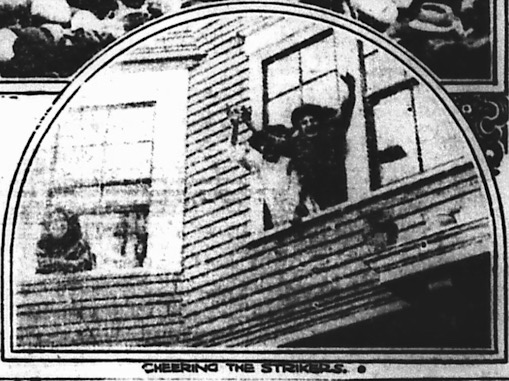
—–—– CHEERING THE STRIKERS
———-
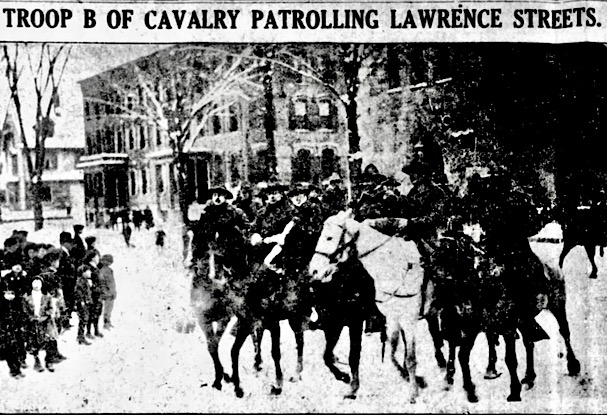
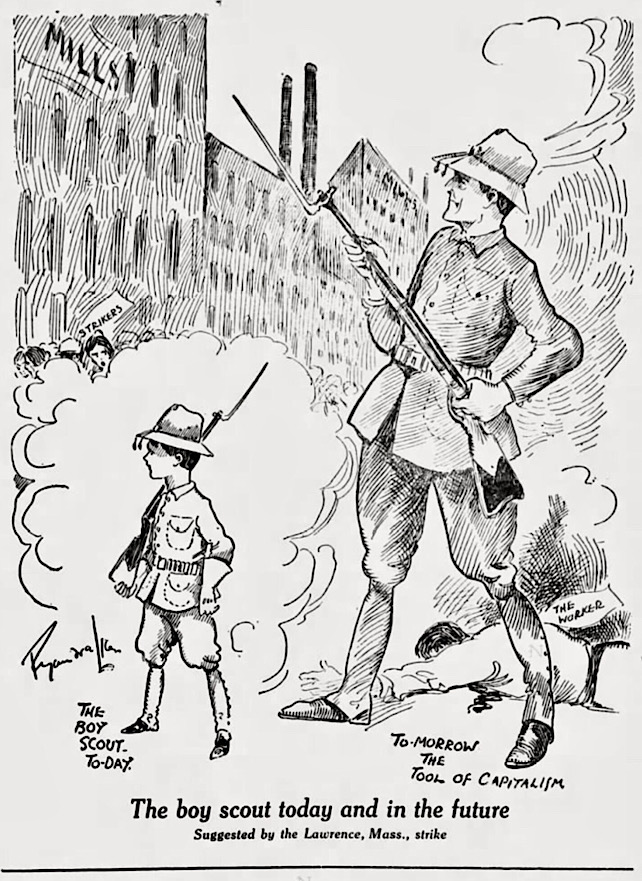
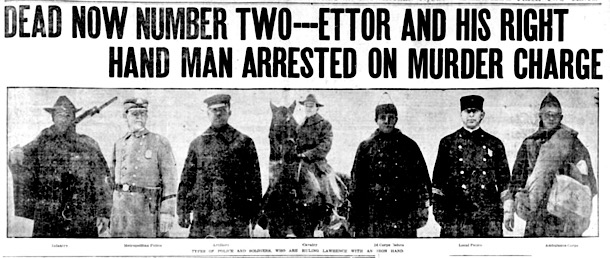
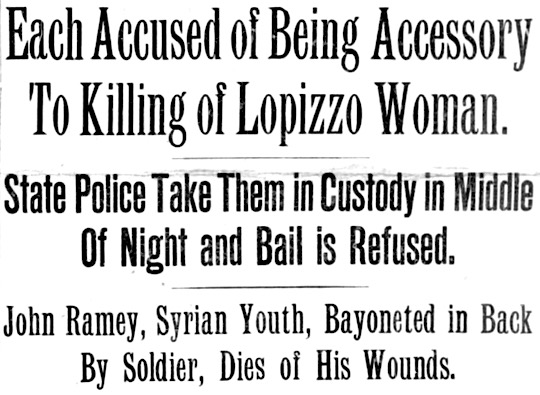
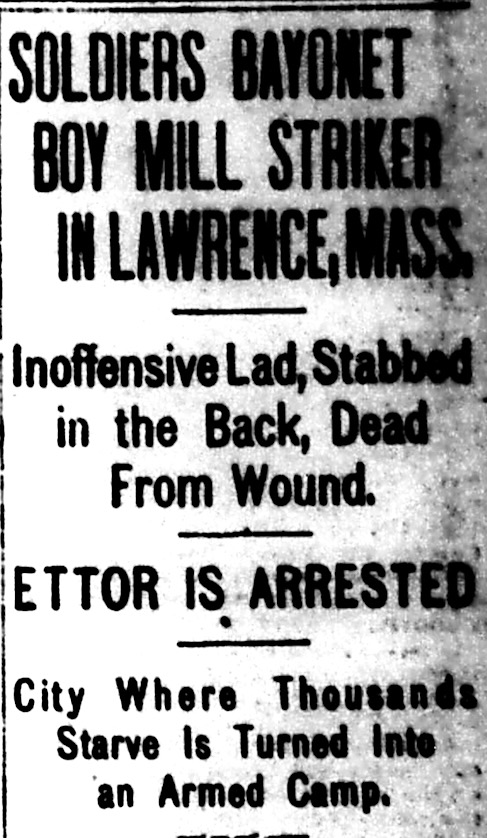
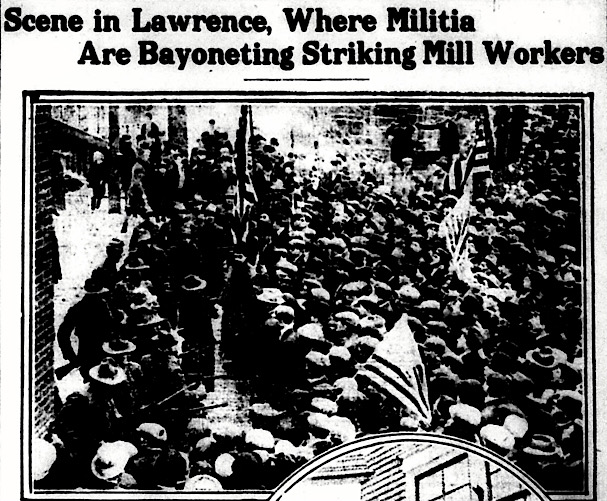
LAWRENCE, Mass., Jan. 30.-Murder was committed on the street in this city today, when an 18-year old Syrian boy striker was bayoneted by a member of a squad of Massachusetts militia on Oak street, and died later in the Lawrence hospital.
The dead boy, John Rami [Ramey], was stuck through the back like a pig as he and some companions were endeavoring to escape from an absolutely unprovoked assault by the soldiers, who are under instructions to look for trouble and when they had it to use steel and ball cartridges as often and as accurately as possible. Many of the militiamen are under-graduates of Harvard University, the president of which is a large shareholder in the Lawrence mills.
Although the police, who witnessed the murder of Rami, declare the boy was doing nothing wrong, the authorities are endeavoring to shift the blame for the lad’s death upon the strikers, and the report has been spread that it is doubtful who killed him. For several hours after the murder the authorities were terrified least the strikers, learning of the fate of the boy, should demand and take vengeance, and every effort was made to hush up the details of the tragedy.
The squad of militiamen, one of whom was responsible, has evidently concocted a story, probably with the connivance of their officers, for they are industriously lying about the matter, declaring they were not near enough to the boy to stab him, and that it was one of his fellow strikers who took his life.
Rami, according to eye-witnesses, was walking along Oak street, with seven companions. As they neared a corner of the street, where a squad of eight armed militiamen were standing, one of the boys said, jestingly:
“There are the soldiers now. Let’s have some fun with them.”
Stabbed in Back.
Immediately the man in charge of the squad ordered the soldiers to charge. Rami, unable to run as fast as his companions, brought up the rear. His steps were slightly retarded by the slippery pavement and he appeared to stumble. As he did so, one of the militiamen caught up with him, and thrusting viciously forward, stuck his bayonet into Rami’s back.
The boy screamed and staggered forward. He ran a few more steps and fell, fainting. Officials at the hospital where he was taken would not say how far the long bayonet blade went into his lungs…..
Strike Leader is Arrested.
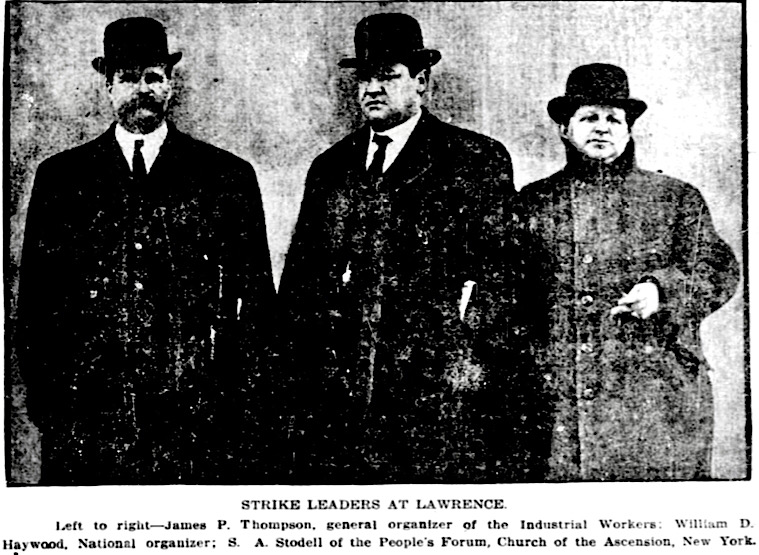
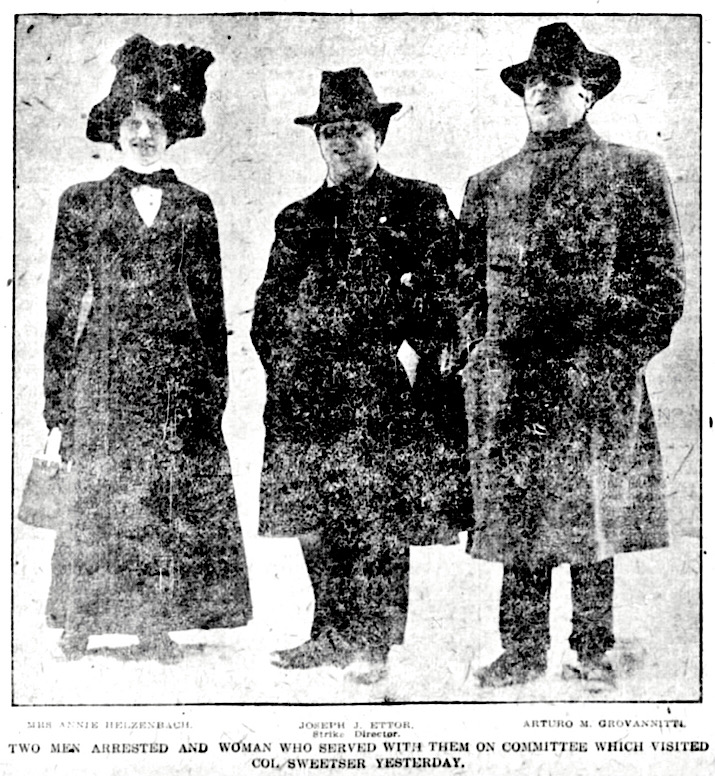
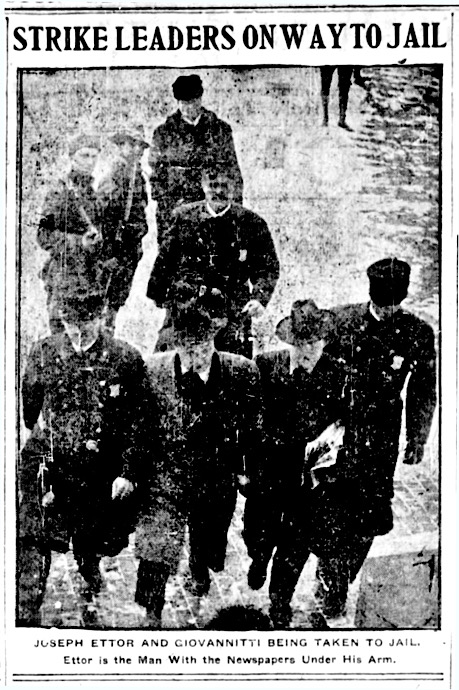
Joseph J. Ettor, of New York, national organizer of the Industrial Workers of the world and leader of the woolen strike here, was arrested shortly before midnight on a charge of being an accessory to the murder of Annie La Pizza [Anna LoPizzo], the Italian striker who was killed during the clash in Union street early last evening. Ettor was taken into custody at the hotel where he is stopping when he was about to go to bed and was taken to the police station, where he was locked up. An extra guard of militiamen was thrown about the station for fear that when the news went abroad and attempt might be made by the strikers to storm the place and rescue Ettor.
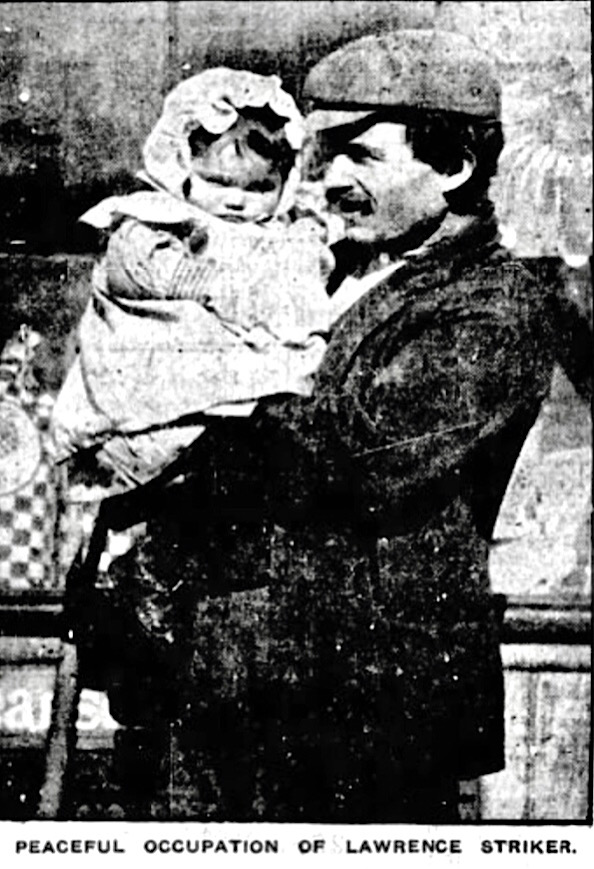
The strike is assuming its real character-a hunger strike, it is a strike in which empty bellies clamor for food, in which children cry for life’s joys, and woman fight desperately with their men to save themselves from prostitution. And every hour the 25,000 victims of a merciless corporation’s greed realize more clearly the nature of their fight, and grow more grimly determined to win.

 —————
—————
 —————
—————
 —————
—————
 —————
—————
 —————
—————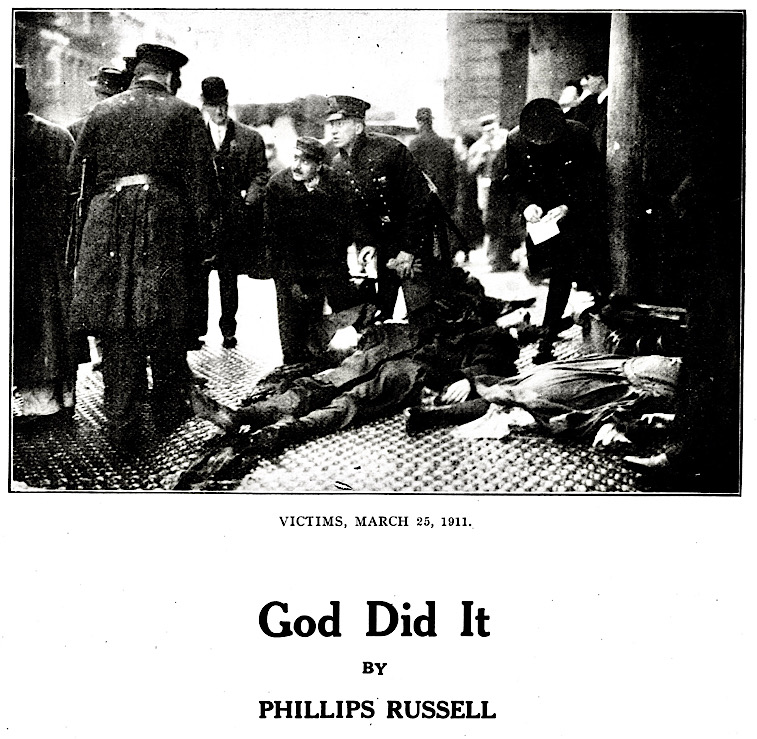 A NEW YORK jury composed of capitalistic cockroaches has absolved Harris & Blanck of the murder of 147 young workers in the Triangle shirtwaist factory fire of March 25, 1911.
  —————
—————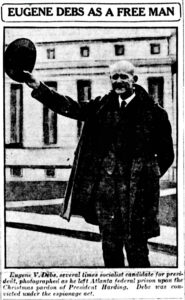 IT was Christmas morning. By the President’s order a man was to be released from prison in Atlanta some time that day and proceed to Washington-no one seemed to know just when. But at six o’clock we newspaper men were tipped off to go to the warden’s house, where Debs was said to be having his breakfast. We waited. An hour passed and then Debs, in his blue denim prison raiment, was ushered out a side door of the Warden’s house into a car and shot back to prison. We then were certain the President had not succeeded in getting his prisoner past our lines during the night. That was something, for few men have left prison supposedly free under circumstances as mysterious as these which attended the release of Eugene V. Debs. And, perhaps, no handful of reporters ever faced so strange a task as that of watching a prison so the President of the United States couldn’t sneak a prisoner up to Washington without anybody knowing it.
 —————
—————
 —————
—————
 —————
—————
 —–
—–
 —–
—– —–
—–