Hellraisers Journal – Monday April 1, 1912
Lawrence, Massachusetts – Strikers’ Children Welcomed Home
From The Boston Sunday Globe of March 31, 1912:
BY FRANK P. SIBLEY.
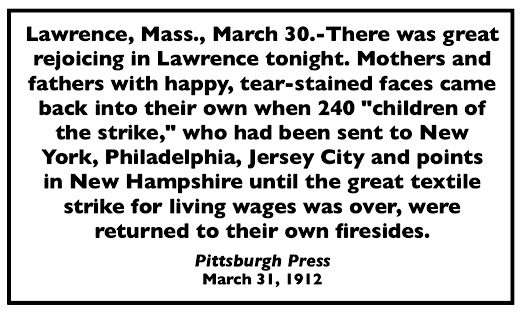
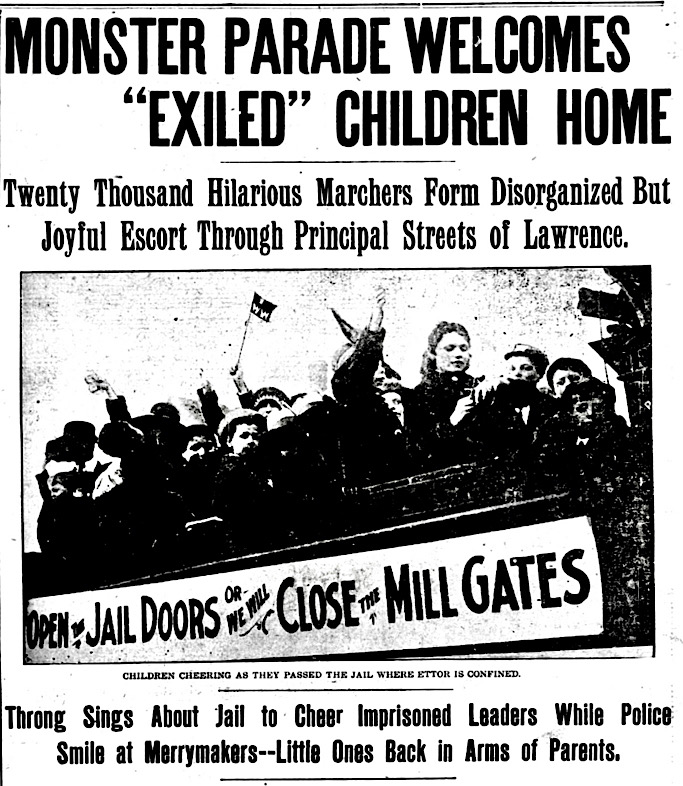
LAWRENCE. March 30-Into the swarming hundreds round the railroad station the train moved slowly, its bell ringing constantly.With shouts the police forced open a passage across the platform from the station door to the train steps. Women fought to get through that line of police. And then the children passed between train and station and were loaded into the waiting wagons.
If one shut his eyes and disregarded the temperature and forgot that the cries which shivered the air into raucousness were of joy and not of rage, he could imagine that the scene of the morning of Feb. 24 was being enacted again.
But no man could shut his eyes, and nobody could mistake the shouts of delight and the laughter and the excited chatter in a dozen tongues, and nobody could mistake the wine of Spring in the air for the bitter cold of a Winter morning, and if he could, the half-dozen enthusiastic bands which were tooting joyously in the background would tell him that this was the return of the children of the textile operatives to the battle ground where their fathers [and mothers] have won.
Hellraisers Journal – Sunday March 31, 1912 Lawrence, Massachusetts – Child Workers Must Pay Boss for Drink of Water
From The Coming Nation of March 30, 1912:
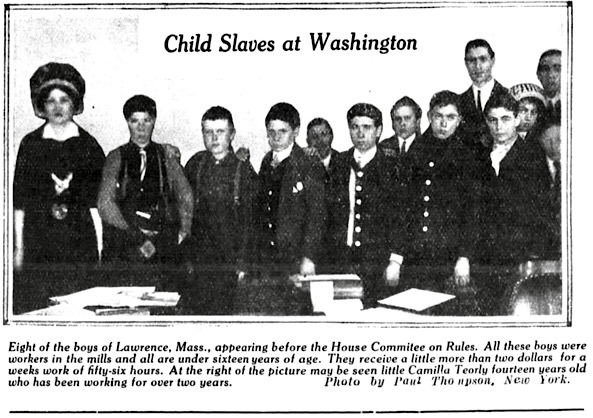
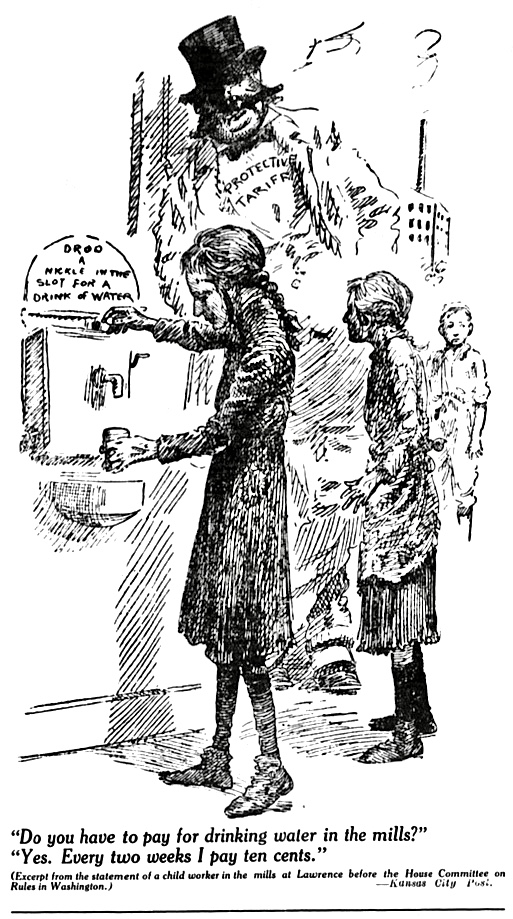
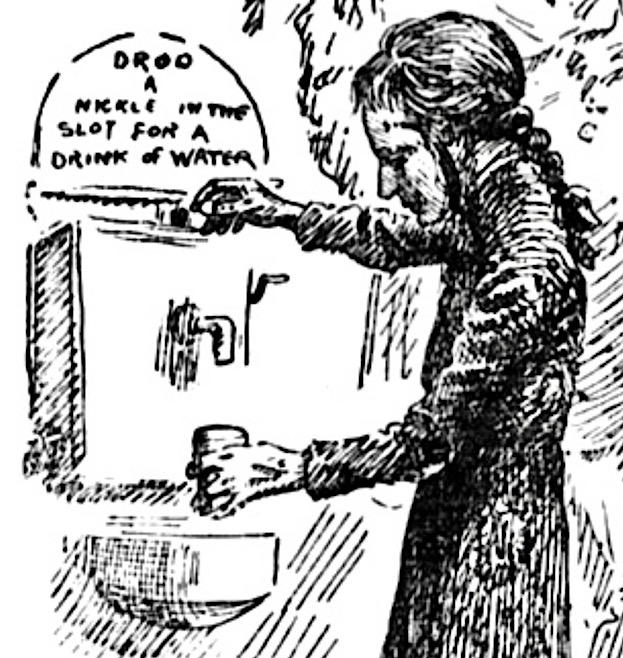
“Do you have to pay for drinking water in the mills?” “Yes. Every two weeks I pay ten cents.” (Excerpt from the statement of a child worker in the mills at Lawrence before the House Committee on Rules in Washington.) – Kansas City Post.
Hellraisers Journal – Saturday March 30, 1912 Child Strikers of Lawrence, Massachusetts, with Big Bill Haywood
From the Waxahachie Daily Light (Texas) of March 23, 1912:
—–
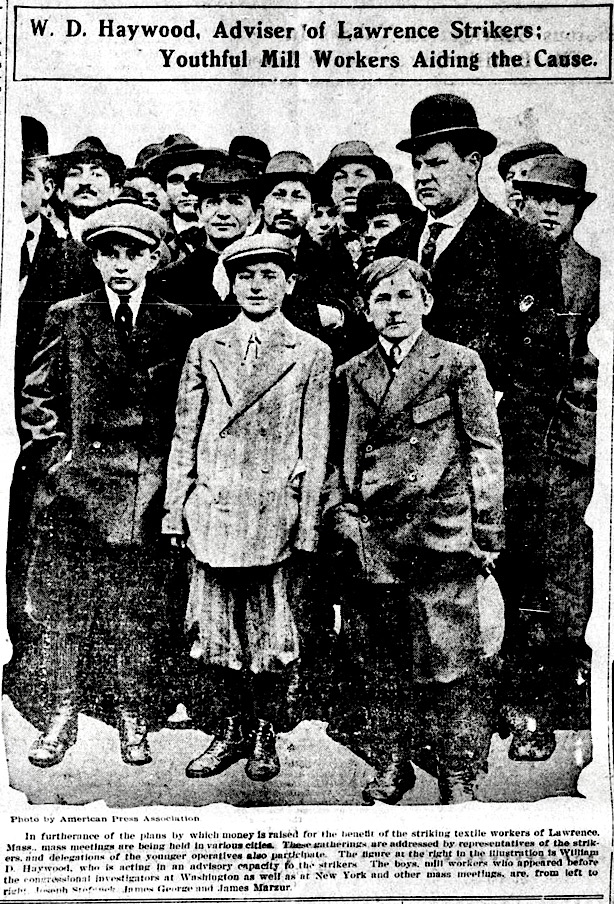
In furtherance of the plans by which money is raised for the benefit of the striking textile workers of Lawrence, Mass, mass meetings are being held in various cities. These gatherings are addressed by representatives of the strikers, and delegations of the younger operatives also participate. The figure at the right in the illustration is William D. Haywood, who is acting in an advisory capacity to the strikers. The boys, mill workers who appeared before the congressional investigatory at Washington as well as at New York and other mass meetings, are, from left to right Joseph Stefanck, James George and James Marzur.
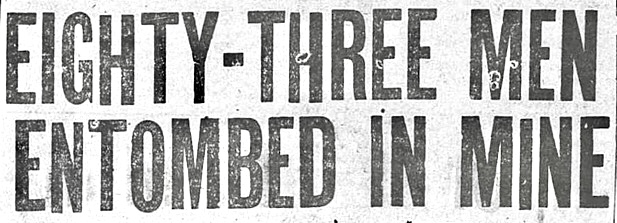
Hellraisers Journal – Friday March 29, 1912 Jed, West Virginia – Eighty-Three Coal Miners Entombed
From The Fairmont West Virginian of March 26, 1912:
———–
———-
(By United Press.)
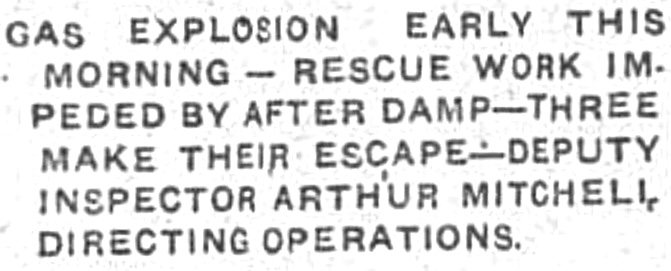
WELCH. W. Va., March 26.-Eighty-three men are entombed in the mine of the United States Coal and Coal Company at Jed, three miles from here.
An explosion of gas occurred in the mine at 7:30 o’clock this morning. Eighty-six men were at work and only three were able to reach the out- side.
Following the explosion after damp pervaded the entire workings of the mine making it impossible for immediate rescue work to be begun.
Deputy State Mine Inspector Arthur Mitchell arrived from Bluefield an hour after the explosion occurred.
Miners who had worked during the night and had gone home were roused and formed rescue parties.
It is possible that some of the imprisoned men may have escaped the explosion and may have reached a part of the mine not penetrated by the after damp.
———-
GOVERNMENT RESCUE ARE ON SCENE.
WASHINGTON, March 26.-Immediately after learning of the Jed mine disaster the United States Bureau of mines ordered two special rescue cars full of equipment to be sent to the aid of the entombed miners. The Pittsburg rescue crew is also enroute. Car No. 7 is reported to be only an hour’s run from the mine. The Pittsburg car is under the direction of Mining Engineer Dike.
———-
MINE WORKED DAY AND NIGHT.
The Jed mine worked day and night shifts employing about a hundred and fifty men, both whites and negroes.
The mine was worked on a non-union basis.
When news of the explosion spread, women and children gathered at the mouth of the mine and refused to leave, hysterically urging the the rescue parties to greater efforts.
It is not believed the mine workings are on fire.
It is thought some men may have reached pockets where they were working and closing up openings in the pockets of the main shaft may be safe.
Hellraisers Journal – Thursday March 28, 1912 Mother Jones News Round-Up for February 1912, Part II The Four Score Hard Winters of Labor’s Heroine by Lawrence Todd
From The Tacoma Times of February 14, 1912:
Four Score Hard Winters Has Mother Jones Seen, and She Is a Heroine in Labor’s Ranks Still ———-
BY LAWRENCE TODD.
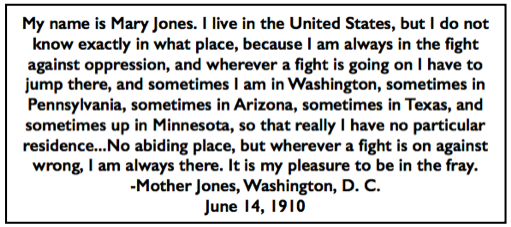
“Where do you live, ‘”Mother Jones?” asked the chairman of a Congressional investigating committee of a little old woman in rusty black.
She had kindly, determined Irish features and the most piercing and confusing of blue Irish eyes. Brave, kindly, faith-inspiring eyes the old woman had, and a motherly way of speaking when she was not aroused. But this chairman was trying to defend the steel barons from the charge of enslaving their men.
“I live in the United States, sorr,” she replied.
“But where-in what state have you a home?”
“Where the big thieves are wringing their dollars out of the blood and bone of my poor, miserable people, sorr,” came back the reply, in a voice like that of an accusing judge. “Sometimes it is among the slaves of the Alabama iron mines; sometimes with the gold and silver miners of Arizona, where the Southern Pacific has fastened itself on their throats; sometimes with the boys on the northern copper range, and often in the coal miners’ shacks in Pennsylvania or West Virginia. Where you send your militia where men are shot and women driven from their homes at night by armed bullies, there I stay.”
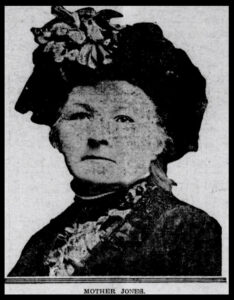
“Mother” Jones is nearly 80 years of age. What she told the corporation congressman is literally true. For more than a generation she has been an organizer for the Western Federation of Miners and for their brothers, the United Mine Workers. Strikes she has seen and taken a part in, since she was a little girl in a southern cotton mill. Once she led 1,500 women of the coal miners’ families against a Colorado sheriff and his deputies. The sheriff for once was driven back from the strikers picket line.
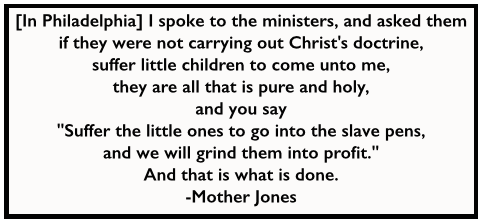
At another crisis, when the children of the Philadelphia factories were crying for protection, “Mother” Jones shocked the community by organizing a great parade of 7,000 crippled and maimed boys and girls, ragged and pale, underfed and haggard as factory children always become, to march through the streets of the fashionable shopping quarter. Always she is making a fight against social wrongs. Usually she is dramatic about it. Always her warm heart and her fearless tongue, and her white forehead that has more than once been pressed by the muzzle of a deputy’s gun, endear her to the wretched people who spend their days in factories and mines.
Just now the miners have lent “Mother” to the striking stoop employes of the Harriman railroads in the western country, where she is making appeals to the women to do picket duty. Incidentally she visited the convention of the California State Building Trades council at Fresno, and urged the delegates to stand by their officials, Tveitmoe and Johannsen, indicted in connection with the alleged dynamiting conspiracy.
Hellraisers Journal – Wednesday March 27, 1912 Mother Jones News Round-Up for February 1912, Part I Found in Colorado, Wyoming, Illinois, Ohio and Indiana
From the Appeal to Reason of February 3, 1912:
The California Building Trades convention [of late January] unanimously adopted a resolution calling for a conference between the Socialist Party, the state A. F. of L. and the State Building Trades, with a view to united political action for the working class. Job Harriman, Mother Jones and Alexander Irvine were among the speakers at the convention.
—————
[Photograph added.]
From the Denver Rocky Mountain News of February 7, 1912:
ROOSEVELT ‘MONKEY CHASER,’ DECLARES ‘MOTHER’ JONES ———-
“WALL STREET WILL ELECT HIM NEXT PRESIDENT,” SAYS WOMAN LABOR LEADER. ———-
That Theodore Roosevelt is a “monkey chaser,” but will be elected the next president of the United States despite the fact, is the opinion of “Mother” Jones, who arrived in Denver yesterday to investigate labor conditions.
“I have no doubt that Roosevelt will be the next president,” she says. “Of course, I have no use for him, but he plays to the galleries, and a Wall street will elect him.
“He is the fellow who sent guns to murder the working men in the strike of 1904 [Telluride, November 1903].
“Taft is right in with him, but I think that Taft is more of a gentleman than Roosevelt is.”
“Mother” Jones will make an address at Eagle hall tomorrow night, under the auspices of the Western Federation of Miners.
———-
From Denver’s United Labor Bulletin of February 8, 1912:
“MOTHER” JONES SPEAKS TO FEDERATED SHOPMEN
Strike Is Already Won, Says “Mother” Many Entertainments for Benefit of Strikers
“Mother” Jones spoke to a large crowd at Eagles’ hall Wednesday night, and during her address but one man left the hall. She spoke to the striking Federated Shopmen, and her discourse covered a period of two and one-half hours. “Mother” Jones has passed through the entire life of the labor movement in the United States. The daughter of a miner and later a miner’s wife, she was reared and spent her life in the labor movement. She has a wonderful memory, and in her address she followed the evolution of the labor movement in the United States, and told of how labor has been exploited by capital to the detriment of the human race.
“Mother” Jones has been traveling over the Harriman system, and said that the strike of the shopmen was won now, and it was only a matter of time until the roads will sign up. She said that on one occasion where a train on which she was riding had a nine-hour schedule it took the train thirty-six hours to make the trip.
From Rawlins Republican (Wyoming) of February 8, 1912:
MOTHER JONES HERE
Last Thursday evening in the Danish hall Mother Jones spoke to the striking shopmen and several of their friends. The crowd was very enthusiastic and frequently applauded the speaker.
Mother Jones is a strong and vigorous speaker and does not hesitate to call a spade a spade. She assured the strikers that she was confident that a settlement of their troubles would be made in the near future, advised them to remain firm in their demands and not desert the cause for which they had been fighting for so long. She urged the men strongly to remain away from the saloons and gambling houses and prophesied that if this was not done much discredit would be thrown upon the cause they represent.
As is usual in labor leaders, she strongly denounced the capitalist class and even took a shot at several of she religious organizations.
Hellraisers Journal – Wednesday March 26, 1902 Eugene V. Debs on Opines on Kept Preachers, Labor and Socialism
From the Milwaukee Social Democratic Herald of March 22, 1902:
Battle Cry of Superstition.
———-
The Church Protests in Vain Against the March of Civilization. ———-
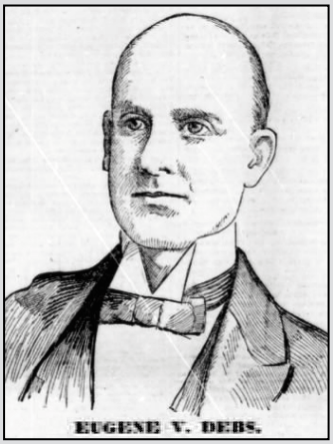
By EUGENE V. DEBS.
The socialist movement encountered a great shock at Buffalo a few days ago. One Quigley, a Catholic bishop, and another Stauffer (Stuffer?) of the Protestant persuasion, jointly and severally assailed social democracy, the latter gravely declaring that it was the “unhatched egg of anarchy”-in other words, a bad egg. The bishop vaulted into the arena, made due exhibition of his asininity, and in the name of the hierarchy proclaimed excommunication as the fate of all who cast their lot with the wicked socialists.
No opposition to organized labor, declared the bishop, was intended, except in so far as it was tainted with the virus of socialism-a hint that union men would be wise to profit by.
It is not my purpose to write about religion, or to interfere with that of any man. I am trusting to the light and logic of the future to abolish creeds and dispel the darkness of superstition.
But we have those in the socialist movement who are so supersensitive that they rise in passionate protest when the church is even mentioned. They are doubtless honest and sincere, but their prejudice is such that if the orders and injunctions of such priests as Quigley and Stauffer could be and were obeyed, they would look on in silence and submission, while the church with iron boots crushed out the socialist movement and the sun of labor set in gloom to rise no more.
What has the church, as such, ever done for working men and women except to keep them in darkness, preach obedience to their masters, and promise them a future home in heaven as the reward of patience and submission in the present hell?
The fulmination of this precious combination at Buffalo reveals the true attitude of the church, which profanes the name of Jesus Christ. In all its pomp and power today it stands for all he abhorred and against all he loved; and socialists would be worse than cowards, they would be base-born traitors not to speak the truth and challenge the enemy of the socialist movement in whatever form he may appear; and when the church consents to prostitute its functions in the service of the ruling class, its robes turn into rags and every honest man should help to strip it naked and expose the whited sepulcher to the world.
For more than 25 years I have watched the church in its attitude toward labor and I know it is the enemy of the toilers and strives and strains to keep them in industrial bondage. The freedom of the working class will mean the end of the church as we know it today. It will simply be out of a job.
During the Chicago strikes the priests and preachers grew hysterically violent in demanding the shooting and hanging of the strikers in the name of the meek and merciful Jesus. All denominations melted into one and all the ministers were likewise a unit in defense of the corporations and denunciation and damnation of the strikers.
There is something almost melancholy in seeing a meek, sad-eyed, dyspepsic preacher suddenly grow fierce and bloodthirsty. It seems strange, but it is easily accounted for. The priest is simply the echo of the capitalist. if he declines the function he ceases to preach.
In every labor strike I have ever known the church and those who speak for it have lined up solidly with the corporations. This has been and must be the attitude of the church whose priests now direct its fiery fulmination against socialism at Buffalo.
Through all the centuries the church has been the handmaid of tyranny and oppression-there she stands today, red with impotent rage because socialism has stripped her of her mask and challenged her to do her worst. Can the church extinguish the socialist movement? Can a bat snuff out the sun? It is high time the working class were opening their eyes, time that they were discarding the sacred (?) symbols of superstition and proclaiming their royal right to represent themselves without the vulgar and impertinent intervention of priests who are but the emissaries of their oppressors and exploiters.
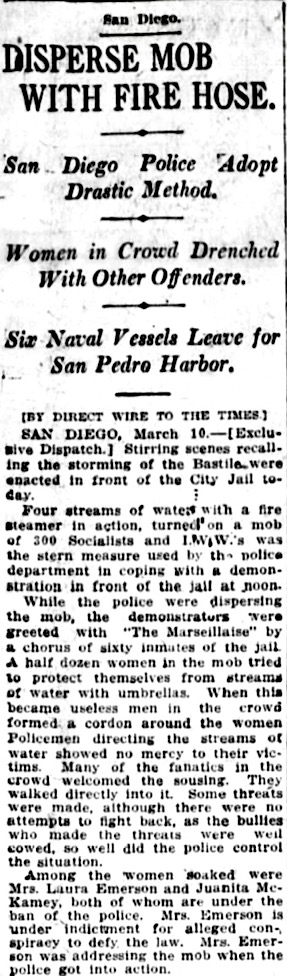
Among the women soaked were Mrs. Laura Emerson and Juanita McKamey, both of whom are under the ban of the police. –Los Angeles Times, March 11, 1912 —————
Hellraisers Journal – Saturday March 23, 1912 San Diego, California – Fellow Worker Stumpy Reports on Vicious Police Action
From the Spokane Industrial Worker of March 21, 1912:
SAN DIEGO IS ABOUT ALL IN Vicious Actions Show Fight Is About Won ———-
Los Angeles Times March 11, 1912
To the “Worker:”-The fifth week of the free speech fight here has made a seething cauldron of human passions in this would-be exposition burg of fleas and oppression.
The M. and M. has raised a fund of five million dollars to crush organized labor in general and the I. W. W. in particular on the Pacific coast, and they have selected San Diego as the point of attack, though they are not overlooking a chance to make trouble in various other places. There has been 216 arrests to datefor street speaking, and over 200 of these are in jail now and intend to stay there until free speech is established. More men are coming in every day and speaking in the restricted district. The city and county jails here are full and 70 men have been sent to the jails of other counties. Tomorrow the city will start building a stockade where unknown amounts of rock are to be broken by I. W. W.’s.
We have the support of all classes of labor here in this fight. The carpenters union has levied a fine of ten dollars a day on any of its members who will work on the city stockade. All others are equally as loyal.
Two evenings ago an enthusiastic meeting was held in front of the U. S. Grant Hotel (just outside the sacred ground) and the aristocratic guests of that ten-dollar-a-day dump of snobbery were thoroughly acquainted with San Diego’s infamy.
Although we were clearly outside the forbidden ground the bosses could not forgive the telling of the truth. At the street meeting last evening a crippled man bought ten “Workers” of a newsboy for free distribution, when the brave cop who wears badge No. 10 struck him a terrific blow and valiantly landed the poor cripple on his back.
Today, March 10, has seen the climax of police brutality and the patience of the citizens has been tested almost to the breaking point. In the morning a meeting was held in front of the county jail to cheer the boys who are behind the bars. Not a policeman was in sight, and the meeting was very orderly and soon adjourned to the city jail to give the boys there a cheer and a song.
Here the scene was different. It was truly representative of Russia-or San Diego. More than a score of uniformed police and plain clothes thugs were lined up n the sidewalk in front of the jail. Behind a heavily barred gate, with blanched face, stood the infamous captain of police, Sehon, directing the work of brutality of his minions.
The meeting had proceeded but a few minutes when the police were ordered to turn the hose on the crowd. In this they were no respecters of persons. Hundreds of men were drenched and knocked down by the force of more than 100 pounds pressure per square inch. One man was knocked down by a police man before the hose was turned on him. Four young girls were nearly drowned before they could get out of the way. A woman past sixty years of age was struck on the side of the head by the stream of water and nearly paralyzed. Mrs. Emerson, who was speaking at the time, had the box washed from under her feet, and she and Mrs. Wightman were soaked [also soaked was Juanita McKamey, the Joan of Arc of San Diego]. A man named Patterson put an American flag over his shoulders and stepped into the street, but even this was no protection, as one bull tore it from his shoulders and another hustled him off to jail. Later Patterson’s father tried to take him some dry clothes but the brave bulls denied him that privilege. A woman who was going from a neighbors to her own home was drenched and driven by the stream as long as she was in range. A man and his wife who were going home from church with their baby in a buggy were struck and the baby nearly drowned before they could get away.
Many other instances of brutality are reported, but they did not come under my personal notice.
Aside from the wholly unwarranted action of the police nothing was more noticeable than the tone of subdued anger among the thousands of spectators. The brave (?) actions of the noble (?) police continued for nearly three hours, and every minute of the time the crowd could have been led to crush the entire police force by the sheer weight of numbers, but the I. W. W.’s were everywhere counseling peace. Only for this cool-headed action it is not doubted that the streets of San Diego would tonight be drenched in blood that would take many streams of water to wash away.
The police have but one more card to play.
The daily papers have followed Otis’ lead and are now counselling the murder of the boys in jail. The San Diego Tribune of the 5th inst., has the following works in an editorial: “Why are the tax payers of San Diego compelled to endure this imposition? Simply because the law which these lawbreakers flout prevents the citizens of San Diego from taking the impudent outlaws away from the police and hanging them or shooting them! This would end the trouble in half an hour.” Will they do it?
There is a bunch of the worst gun men of the West here, just “hanging around.” But these men do not come into a trouble zone by accident.
Two men were arrested for speaking tonight. The police have tried a new method. Heretofore there have been twelve to twenty bulls at the corner of 5th and E streets to make arrests, but last night there was but one when the speaking started. In a few minutes, however, 25 bulls came charging down the street at a run, cracking all the heads they could reach. Many were severely injured. One man was knocked insensible and had to be carried from the street. A woman was beaten until her hair was clotted with blood. She, too, was carried from the street. And this is the U. S.! The Mexican line should have been run north of San Diego, then we could have laid the crimes of the police to “Barbarous Mexico” instead of to the Christianized Otis gang.

 —————
—————
 —————
—————
 —————
————— —–
—– —————
————— ———–
———–
 —————
—————
 —————
————— The California Building Trades convention [of late January] unanimously adopted a resolution calling for a conference between the Socialist Party, the state A. F. of L. and the State Building Trades, with a view to united political action for the working class. Job Harriman, Mother Jones and Alexander Irvine were among the speakers at the convention.
 —————
————— The socialist movement encountered a great shock at Buffalo a few days ago. One Quigley, a Catholic bishop, and another Stauffer (Stuffer?) of the Protestant persuasion, jointly and severally assailed social democracy, the latter gravely declaring that it was the “unhatched egg of anarchy”-in other words, a bad egg. The bishop vaulted into the arena, made due exhibition of his asininity, and in the name of the hierarchy proclaimed excommunication as the fate of all who cast their lot with the wicked socialists.
 —————
————— Elizabeth Gurley Flynn, the New York Girl Who Went to Jail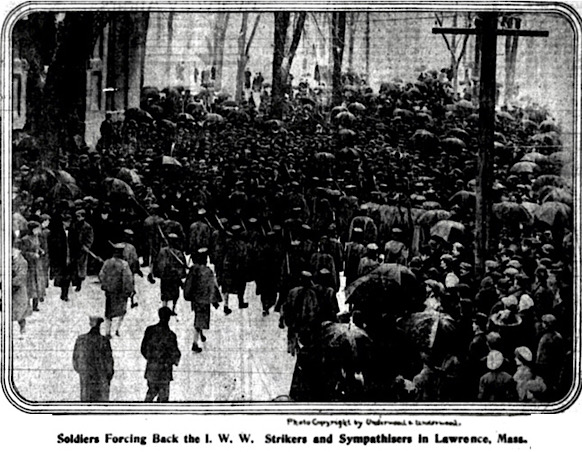
 —————
—————