Hellraisers Journal – Thursday August 10, 1922 U. S. Department of Labor Report States 610,000 Coal Miner Now on Strike
From the Duluth Labor World of August 5, 1922:
610,000 MINERS IN COAL STRIKE ———- Department of Labor Completes Coal Fields Survey.
Washington, Aug. 3.-Following a survey of the coal industry, the department of labor announces that there are 610,000 miners on strike and 185,000 miners at work. Listed with the latter are 10,000 union pump men and firemen who have remained at work to keep the properties from being destroyed by water flooding the mines.
A significant part of the report is the statement that of the 13,000 Kansas miners, but 1,000 are working. This is the state it will be remembered, that prevents strikes by law. Colorado, also, has a law which outlaws strikes under certain conditions, but only 4,000 of the 19,000 miners before the strike was called are working.
Cossack-ridden Pennsylvania reports that not a man of the 155,000 anthracite miners are working, and but 20,000 of the 175,000 bituminous men are working.
Despite the terroristic policy of West Virginia coal owners, and the aid given them by the state, there are 40,000 of the 90,000 coal miners on strike.
The states that report a 100 per cent strike are: Illinois, 90,000 out; Ohio, 50,000 out; Indiana, 30,000 out; Iowa, 15,000 out; Montana, 5,000 out; Michigan, 3,000 out.
Wyoming reports 7,000 on strike while 8,000 were employed before the strike. The same situation is reported by Arkansas, NewMexico, Oklahoma and several other states.
Hellraisers Journal – Friday August 9, 1912
Kanawha County, West Virginia – Gunthugs Brutalize Women and Children
From the Evansville Press of August 7, 1912:
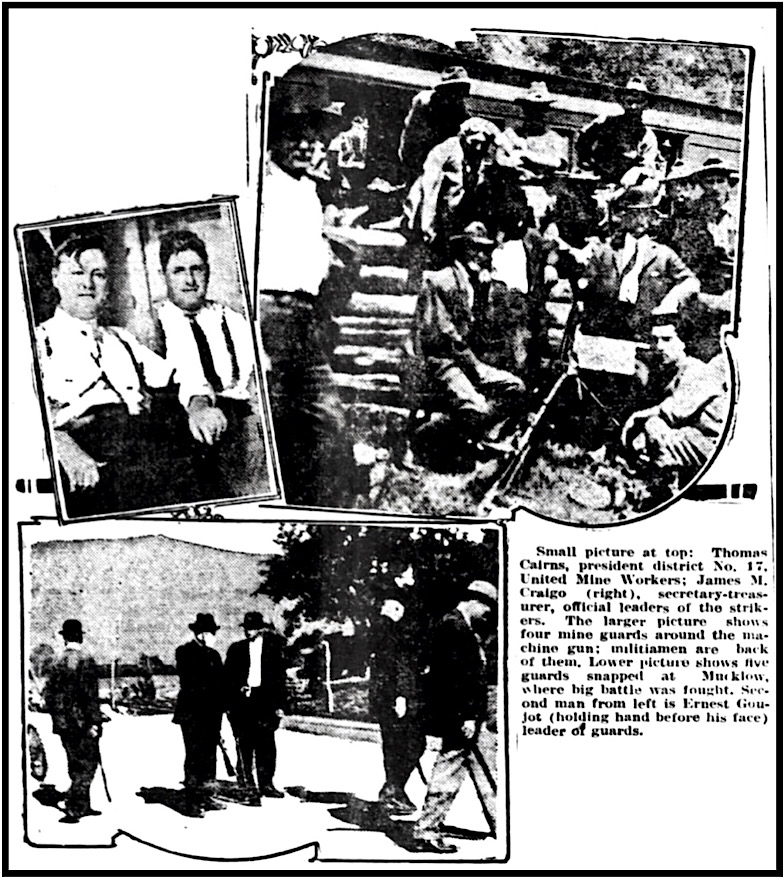
Small picture at top: Thomas Cairns, president district No. 17, United Mine Workers; James M. Craigo (right), secretary-treasurer, official leaders of the strikers. The larger picture shows four mine guards around the machine gun; militiamen are back of them. Lower picture shows five guards snapped at Mucklow, where big battle was fought. Second man from left is Ernest Goujot (holding hand before his face) leader of guards
———-
BY E. C. RODGERS.
Staff Special.
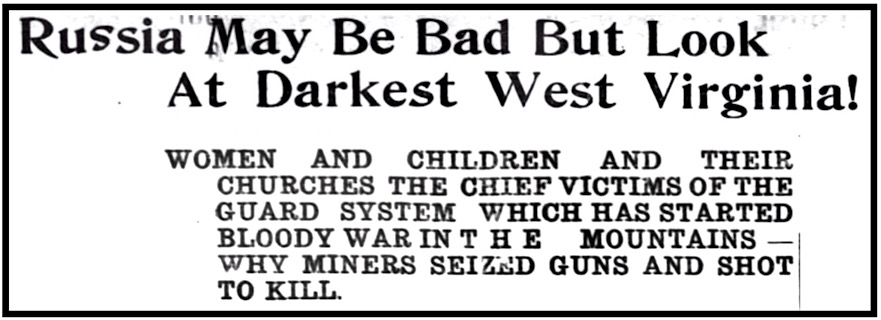
CHARLESTON, W. Va., Aug. 7.-The bloody conflict now raging in West Virginia started with the violation by the coal mine operators of an agreement to pay 2 1-2 cents a ton increase to the miners. Today, with dead men’s bodies in the valleys and in the mountains and with thousands of miners thirsting for blood and refusing to be denied, it is as much a war as that which reddens the soil of Mexico or the sands of Tripoli.
Every lead of my investigation of causes leads directly to the guard system, to the conduct of the army of guards the Baldwin-Felts concern of Staunton, Va., put into the field the minute the strike started.
Early one morning in June a company of guards came down on the Italian settlement at Banner. Lining up the ignorant foreigners the leader said: “If you don’t go to work we’ll blow your brains out!”
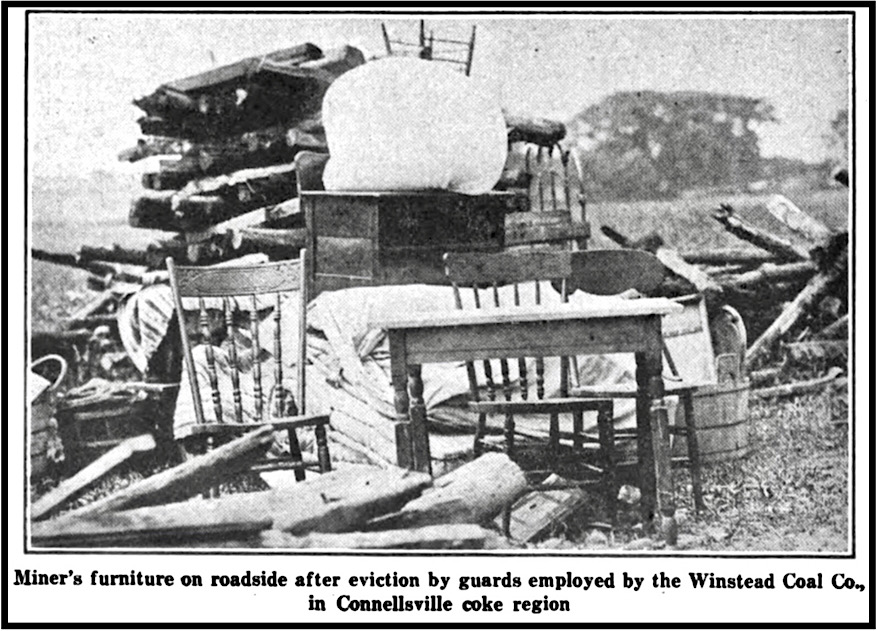
The guards then began the work of eviction. From house to house they went. “Go to work or get out!” they yelled, and threw furniture and all out of windows and doors.
Half the village was at break fast. Every meal was thrown into the road. To Tony Seviller’s cabin they came. “Get out!” they roared. Mrs. Seviller [Seville] was in bed. Roughly they ordered her out. “
“My God! Can’t you see I am sick, just let us stay here until my baby is born,” she pleaded.
Ernest Goujot was the guard leader. “I don’t give a damn,” he explained. “Get out or I’ll shoot you out!” Mrs. Seviller’s baby was born soon after in a tent furnished by the national mine workers.
Six other babies have been born in those tents down at Holly Grove, the only land not owned by the mine companies, and where several thousand people live in tents.
I have looked up the record of this Goujot, captain of the guards. He was in the West Virginia penitentiary for murder, and was paroled. Then he joined the Baldwin-Felts gang of labor fighters. In the 1902 strike he, with a squad of guards, shot up Stanford. Three women, seven children and a score of men were killed in their beds.
Now he leads the mine guards in the dare-devil campaigns. His men are on the average about like him. Many are proved ex-convicts. Once in a while a respectable man gets to be a mine guard. One such, Davison by name, quit. Handing his guns to Noah Farrell, Mucklow mine storekeeper, he said:
“I got my belly full of this business. I got a mother of my own and I’ll starve before I’ll abuse any woman or kid like you wanted it done here.”
Hellraisers Journal – Thursday August 8, 1912
Mother Jones Speaks at Mass Meeting, Demands End of Rule by Gunthug
August 4, 1912, Montgomery, West Virginia Mother Jones Speaks to Six Thousand Miners at the Baseball Park
West Virginian August 5, 1912
Fellow Workers: Let me say this to you, that not one person wins a strike, that it takes the combined forces of the oppressed, the robbed, class to get together and win a strike. The operators, the money power, never in all of human history have won a strike. You have never lost a strike, that is, the workers have not. You have simply rolled up your banners and retreated for a while until you could solidify your army and then come back and ask the pirates, “What in hell are you going to do about it?”
This hero worship must stop. We don’t owe any debt of gratitude individually.
Now, we are here today, as we have been—this is the outcome of an age-long struggle. It did not begin yesterday nor today. It is an age-long struggle, and it has crossed the oceans to you. It is about to crystallize, it is about to come aboard. The ship is sailing, it calls for pilots to come aboard. I want to say to you that all the ages of history have been ages of robbery, oppression, of hypocrisy, of lying, and I want to say to you tyrants of the world—(Railroad train whistling)—They got that gang to blow off hot air. (Applause.) I want to say to you tyrants of the world that all the centuries past have been yours, but we are facing the dawn of the world’s greatest century, we are facing the dawn of a separate century.
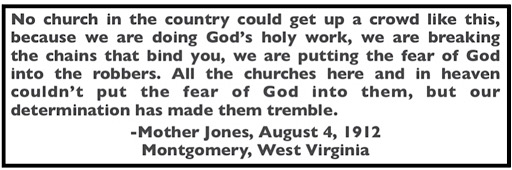
This, my friends, is indicative of what? No church in the country could get up a crowd like this, because we are doing God’s holy work, we are breaking the chains that bind you, we are putting the fear of God into the robbers. All the churches here and in heaven couldn’t put the fear of God into them, but our determination has made them tremble.
What happened on Paint Creek? Did the church make the operators run and go hide in the cellar? (Applause.)
I don’t know who started the racket, but I know that Mr. Operator began to shake, the marrow in his back melted, and he had to go into the cellar to hide himself.
Now, my friends here, twelve years ago I left the great battle that closed in the State of Pennsylvania, and came in here. We had fought a tremendous battle there. We fought that battle until Mr. Hanna said, “These workers are men and women, we have got to do something, we have got to blind them, we have got to hoodwink them some way. Let us start the Civic Federation.” The Republic hurrahed for peace and harmony is coming. Mark Hanna stood at the top of the game. We had them trembling, and they didn’t know where to get off at.
And so they got the Civic Federation, they got Morgan, Belmont, and the labor leaders. I said, “That is only a ‘Physic’ Federation, what are you joining it for?” There are some fellows in the labor movement, when their heads get swelled, they sit down with the thieves. They had their feet under the table, twenty-six thieves and twelve labor leaders, and you stood for it. I begged them not to join it, and some of them left it. They stuck their feet under the table and drank champagne, and the bloody thieves, when we had the women fighting for bread, that gang of commercial pirates were feasting on our blood in New York. And then we stand for it. And when those fellows come along you say “Hurrah” and the whole gang drunk.
Now that wouldn’t do. They got the women so as to keep the labor leaders up in tune. They got women to join. They got a welfare department in their Civic Federation, and after a while the leaders and parasites and bloodsuckers they thought they would hoodwink us. One went up to Washington, it was…Morgan’s daughter. I happened to be in Washington. They were running to the free soup bowls to get a lunch. An Irish machinist ran in and had a piece of bologna that long (measuring on her arm about a foot), and a chunk of bread in the other hand. One of the women said to him, “Oh, my dear man, don’t eat that, it will give you indigestion.” He said, “The trouble with me is I never get enough to digest, indigestion, hell.” The half of you fellows never get enough to digest. You never got a good square meal in your life, and you know you never did. But you furnish the square meals for the others who rob and oppress you.
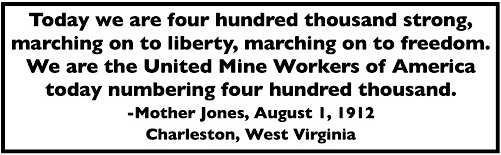
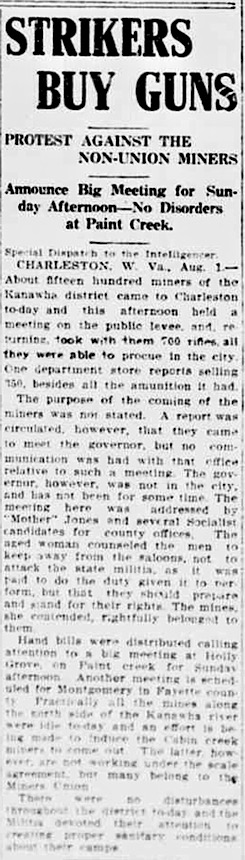
Hellraisers Journal – Wednesday August 7, 1912 Charleston, West Virginia – Mother Jones Speaks to Striking Miners
Thursday, August 1, 1912, Charleston Levee -Mother Jones speaks to striking miners from the back of a dray wagon.
The Wheeling Intelligencer August 2, 1912
Now, you have gathered here today for a purpose. Every movement made in civilization has had an underlying purpose. You have reached the century in human civilization when the charge of human slavery must forever disappear. (Applause.)
You, my friends, in my estimation, have stood this insult too long. You have borne the master’s venom, his oppression, you have allowed him to oppress you. When we said, “a little more bread” he set out to get the human blood-hounds to murder you. Your Governor [Glasscock] has stood for it. He went off to Chicago [Republican convention] and left two Gatling guns with the blood-hounds to blow your brains out.
Then you elected a sheriff, that began to shake like a poodle dog the night of the trouble on Paint Creek. He began to tremble and ran into a store to be sheltered. I have never in all my life—in all the battles I have had—taken back water, and why should a public officer do it—elected by the people. The best thing you can do is to apply to some scientist to give you some chemicals and put into a nursing bottle, give it to them fellows and tell them to go away back and sit down. (Applause.)
This industrial warfare is on. It can’t be stopped, it can’t be put back, it is breaking out over all the nation from the city of Mexico clean through to the border of Canada, from the Atlantic Ocean clean across the oceans of the world; it is the throbbing of the human heart in the industrial field for relief. They are preaching appeal to the Legislature, they appeal to Congress—and I must give this Congress credit—I always want to give credit where credit is due—you have had more labor bills passed in the last session than in all the days of your Congress.
I was in Washington not many weeks ago. I sat up in the gallery watching the voters. I was watching the fellows who would vote against your bill. One fellow, when they asked for roll call, he got up among those who didn’t want it, but when the vote came he had to be registered on the Congressional Record, he took mighty good care that his vote was in your favor Why? Because the whole machine of capitalism realize for the first time in history that there is an intellectual awakening of the dog below, and he is barking. Have you been barking on Paint Creek?
I want to say, without apology, without fear of the courts, without fear of jails, you have done what ought to have been done a long time ago. When-when a corporation which is bleeding you to death, would go and hire,-send over the nation and hire human blood-hounds to abuse your wife, your child, it is time every man in the State should rise.
I saw an inscription on your statehouse, and looked at it,-because I know Virginia. I know the whole machine of capitalism; they locked me up and put me out of the State and shook their fists at me and told me not to come back again. I told them to go to hell, I will be back tomorrow.
Hellraisers Journal – Wednesday August 6, 1902 “Mother Jones” by William Mailly, Part III: Courage and Devotion
From The Socialist Spirit of August 1902:
“MOTHER” JONES
BY WILLIAM MAILLY
[Part III of III]
[Versatility and Power]
The most fertile writer of romance would never select a woman 60 years of age as the central figure of a story, and yet “Mother” Jones has had a career as full of diversity and adventure as could be devised by any disciple of Dumas. One can easily imagine a Joan of Arc, a D’Artagnan, or a Richard of the Lion Heart, but who would ever hit upon a little woman with grey hair as the daring leader of a crusade? There is material here for some genius to immortalize in the years to come. I have only space here for three incidents that, briefly related, will serve, perhaps, to illustrate the versatility and power of “Mother” Jones.
Several years ago, while passing through Montgomery, Alabama, after one of her investigations of conditions in the Southern cotton mills, she visited the Democratic convention, which was in session at the time. One of the delegates, an acquaintance, suggested that she address the convention, and she assented. When the proposition was made several delegates who knew “Mother” objected, but the others, with true Southern chivalry, and their historic regard for women, voted down all objections, and she was given the floor. They regretted their chivalry afterwards.
“Mother” thanked the convention for the courtesy extended to her, but immediately asked: “What about the women you have working in the mills of Alabama, sixteen hours a day, for two and three dollars a week? Don’t you think they’re entitled to some consideration?”She then proceeded to roast the Democratic state administration for its treachery toward the workers and particularly for its repeal, a few years previously, of the law prohibiting the employment of children under twelve years of age in factories. When she got through there was consternation in the convention. Several delegates remonstrated, but others took it up, and when “Mother” left they were still fighting. The papers next day denounced the attempt “to bring discord into the Democratic party by allowing a labor agitator to address the convention.”
One winter, when the snow lay deep upon the ground, “Mother” Jones’ duties as organizer took her into a Pennsylvania mining camp, where there were no friendly faces and the mine owners were prepared to fight her. She hired a room in the only boarding house, kept by a widow, in the place.Then she went out and got up her meeting. It was late when “Mother” returned; she was tired, but the rest she expected when she reached her room was not to be hers that night.
Hellraisers Journal – Tuesday August 5, 1902 “Mother Jones” by William Mailly, Part II: Found in West Virginia
From The Socialist Spirit of August 1902:
“MOTHER” JONES
BY WILLIAM MAILLY
[Part II of III]
[Standing with Strikers]
During this time she was also working on the skirmish line of the trade union movement, going here and there, assisting where she could in winning battles on the economic field. She was in Chicago during the famous strike of 1894, and no great struggle but has known her since. It was her work in the bituminous miners’ strike of 1897 that first attracted universal public attention, although labor agitators almost everywhere knew her. At that time she braved a cordon of deputies in West Virginia in order to get the miners there to quit work, and in the Pittsburg district her pathway was lined with thugs employed to intimidate her, an effort which was, of course, a failure. From that time her name has been anathema to the coal operators of America.
Her exploits during these latter years would fill a good-sized book. Travelling overland through Nebraska and other western states in a waggon, speaking and distributing literature on socialism; securing employment in southern cotton mills to investigate conditions first hand; conducting a successful strike of packers in the stock yards of Omaha; another of four thousand silk mill girls in Scranton, Pa., extending over four months; a seven months’ miners’ strike at Arnot, Pa., another victory and one which marked a new era in the mining industry of that region-these and others constitute a record unequaled by anyone. For the past two years her time has almost wholly been taken up in organizing the miners of West Virginia, whose indifference to organization and subjection to the mine-owners has made that State a source of injury to the whole miners’ union.
[Organizing in West Virginia]
It is here where “Mother” has encountered more dangers than in all her experience, for the state has been heretofore entirely under control of the capitalists, and the entrance of agitators has been opposed in every shape and manner. It was for this very reason that “Mother” went there.She has been able to do what no man or any number of men could accomplish, even had they wanted to. The present strike of 20,000 men, after years of abject slavery, is the direct result of her work. Injunction after injunction has been issued against her, but she has gone right on. As I write this the news comes that, after awaiting sentence for several days, following upon being found guilty of contempt of court for violating one of these injunctions, the same judge has dismissed her with a reprimand. In this he showed more wisdom than such as he are usually credited with, but the effectiveness of the reprimand is doubted.
It remained for President John Mitchell to recognize the value of this woman’s great ability and provide the opportunity to put it to full account. Through him she has been a national organizer of the United Mine Workers for the past three years, and her work has more than justified his action. It is conceded and acknowledged by all that she has done more than anyone else to solidify the miners into a strong national organization. She has infected the whole mining industry with her enthusiasm and by her socialist teaching she has turned the thoughts of thousands of workers towards the greater mission in store for them. In view of this it is easy to understand why every one of the thousand delegates to the national convention just adjourned, wept when they bade farewell to her upon her departure to West Virginia to receive sentence from a capitalist court.
Courageous almost to the point of recklessness, she knows no danger when occasion requires it. Her defiance of a court’s injunction is not mere bravado nor shallow “playing to the galleries.” She realizes the probable cost of such action, but she believes it is necessary—some one must do these things, else there will be no progress. Underneath her apparent indifference to injunctions, Pinkerton Thugs and prison cells lies the motive born of a definite purpose. If needs be she would yield her freedom gladly if by so doing she believed the workers would the more quickly gain theirs.Nevertheless, there is nothing incendiary about her; she trusts in the efficacy of the ballot, and has no sympathy with those who teach otherwise.
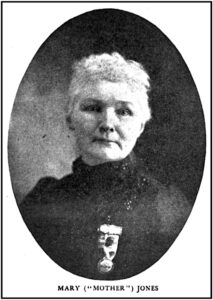
Hellraisers Journal – Monday August 4, 1902 “Mother Jones” by William Mailly, Part I: Working Class Joan of Arc
From The Socialist Spirit of August 1902:
“MOTHER” JONES
BY WILLIAM MAILLY
[Part I of III]
“Mother” Jones has been compared to Joan of Arc, but she is more than that.
The French maid derived her inspiration from the mystical creations of a brain inflamed by religious ecstasy. She was the slave of her own imagination. She fought for the “divine right of kings,” dying a victorious sacrifice to a cause which, dominant in her day, will soon cease to disfigure the world. Her rightful place as the fanatical representative of medieval mummery has already been assigned her.
But “Mother” Jones absorbs inspiration from living men and women; their hopes and fears, their scant joys and abundant sorrows, are hers also to laugh with and to weep over. She deals with things that are, to fashion the better things that will be. And her cause is the one that will release mankind from material subserviency and mental obliquity, to finally rejuvenate and glorify the world.
In this only are they alike: John of Arc was peculiarly the product of the material conditions of her time, just as “Mother” Jones is of the conditions existing to-day. Each would have been impossible at any other period. As Joan of Arc typified the superstition and mental darkness of the people who hailed and followed her as one gifted with supernatural power, so “Mother” Jones is the embodiment of the new spiritual concept and clearer mentality characteristic of the awakening working class of our day. She is the incarnation of the spirit of revolt against modern industrial conditions—the spirit which finds fullest expression in the world-wide Socialist movement.
For “Mother” Jones is, above and beyond all, one of the working class. She is flesh of their flesh, blood of their blood. She comes of them, has lived their lives, and, if necessary, would die to make their lives happier and better. She loves the workers with a passionate love stronger than the love of life itself. Her advent marks the stage of their progress towards emancipation.
It is the recognition, unconscious perhaps, of this affinity with them that constitutes the real source of her strength with the working people. Instinctively they feel she is one of them. When she speaks they listen to one of their own kind. Thus she becomes a veritable magnet that draws them together, ofttimes in spite of themselves.
For “Mother” Jones is no orator, in the technical sense of the term. Her rhetoric might be more rounded, her phrases more polished, and even her voice gentler than years of indiscriminate speaking, in and out of doors, have left it. But if they were, she would probably be less successful in her work. Her apparent weaknesses are really aids, rather than hindrances. Her language is plain, her illustrations crude but vivid, and she has a facile wit. And her voice is the more effectual because it is not sweet nor silvery, but rather harsh at times. Nevertheless, I have known that voice to arouse working men to frenzy and again soften them into tears. It is the soul that speaks.
So the working people understand and trust her. Only the demagogue or shyster among them fear her keen eye and ready tongue. She has the faculty of ferreting out such as these, and sooner or later they feel it. She is seldom deceived in her judgment of men or women. Absolutely sincere herself, she quickly detects insincerity in others. She is as impatient of hypocrisy as she is free from it. Her face tells its own story.
Hellraisers Journal – Saturday August 3, 1912
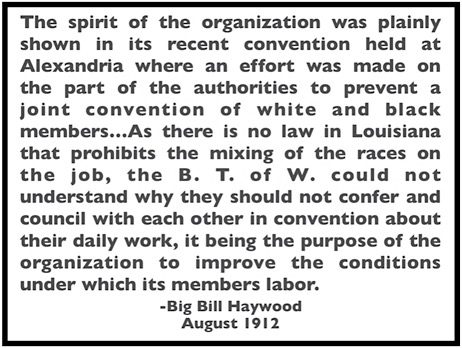
Brotherhood of Timber Workers Organizing Campaign in Louisiana
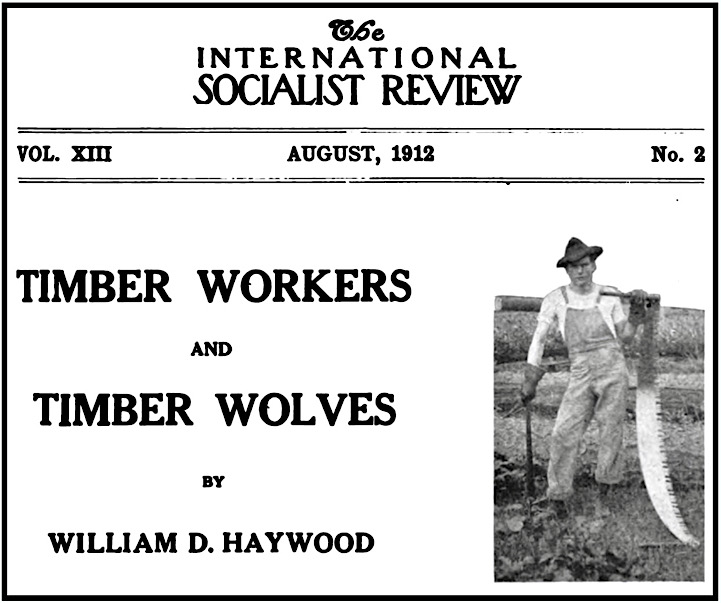
From the International Socialist Review of August 1912:
[Part II of II]
Before the campaign of organization [Brotherhood of Timber Worker] now inaugurated by the Industrial Workers of the World is closed the lumber barons of Dixieland will have learned that it is impossible to fell trees with rifles and saw lumber with six shooters.
It should be mentioned here that of the nine men arrested four are non-union men, two of them, John and Paul Galloway, being owners of the Lumber Company. All are charged with murder. This, perhaps, indicates that the Trust has not entirely corralled the officialdom of Louisiana. It is certain that they are in bad repute with the business element in nearly all of the towns as their commissaries have been the means of controlling nearly the entire earnings of their employees, who are compelled to trade with the companies or lose the only means they have of making a living.
To maintain their absolute control of the camps the lumber companies, with the aid of their thugs, patrolled the towns, in some places inclosures were built around the mills and shacks. Notices were posted warning away union men, peddlers and Socialists.
Only a few days ago, H. G. Creel, one of the Rip-Saw editors on a lecture tour, was roughly handled at Oakdale and DeRidder, La. He was compelled to leave the first-named place, being threatened and intimidated by gun-men.
The small merchant realizes that if the workers are allowed to trade where they choose some of their money would pass over their counters and they know if wages are increased there would be a corresponding increase in their day’s receipts. This will account for the fact that the small business man and farmer have given their sympathy and a measure of support to the growing union of timber workers.
Arthur L. Emerson and Jay Smith, both Southern born, are the men around whom interest centers. They are the men who organized the Brotherhood of Timber Workers. Emerson had made two trips to the West-one to the Lumber District to the Southwest and the other to the Northwest. It was during the time that he worked with the lumber jacks of the Pacific Coast that he learned the need of organization. This thought was especially developed when he came in contact with the Lumber Workers’ Union of St. Regis and other points in the Bitter Root Range of Mountains. Being a practical lumber jack and saw mill hand and mill-wright himself, he saw at once the discrepancy in wages between the Pacific Coast and the Gulf States and upon his return to Dixieland he immediately took up the burden of organizing the workers as the only possible means of bringing up their wages and conditions to the level of the already too-low Western scale.
Hellraisers Journal – Friday August 2, 1912 Lake Charles, Louisiana – A. L Emerson, President of B. T. W., in Jail
From the International Socialist Review of August 1912:
[Part I of II]
A. L. EMERSON, President of the Brotherhood of Timber Workers, is in jail at Lake Charles, La. He was arrested following the shooting at Grabow, La., where three union men and one company hireling were killed outright and nearly two score of men were more or less seriously wounded.
The shooting is the outcome of the bitter war waged against the members of the Brotherhood of Timber Workers by the Lumber Trust for the last eighteen months. The scene of the tragedy that occurred on Sunday, July seventh, is a typical Southern lumber camp. The mill at this place is operated by the Galloway Lumber Company. In common with all others, it is surrounded by the miserable houses where the workers find habitation, the commissary store of the Company being the largest place of business in the towns. A strike has been on at this place since the middle of last May. The single demand on the part of the union men was for a bi-weekly pay day. Heretofore the pay days have been at long intervals-usually a month apart.
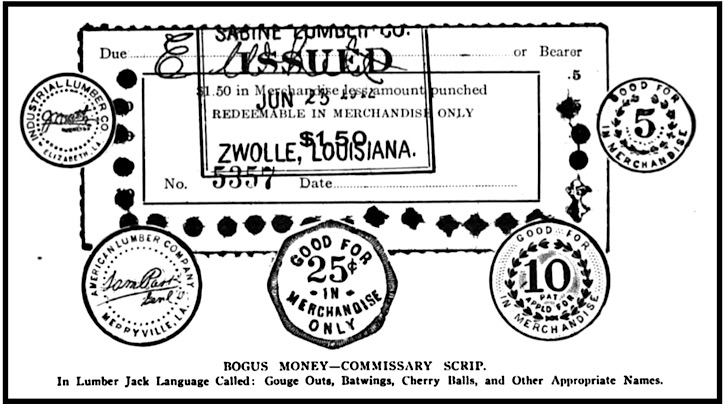
During the intervening weeks, when the men were in need of money to meet the necessities of life, they could secure advances on their pay but not in real money. They were compelled to accept Company Scrip payable only in merchandise and exchangeable only at the company commissary. If accepted elsewhere it is uniformly discounted from 10 to 25 per cent on the dollar.
In the commissary stores where the cash prices are always from 20 to 50 per cent higher than at the independent stores, the company has established another means of graft by making two prices-the coupon or scrip price being much higher than that exacted for real cash.
The conditions at Grabow can be used as an illustration of nearly all of the other lumber camps of the South.
The commissary store is not the only iniquity imposed upon the Timber Workers. For miserable shacks they [are] compelled to pay exorbitant rents; sewerage there is none; there is no pretense at sanitation ; the outhouses are open vaults. For these accommodations families pay from $5 to $20 a month. In one camp worn-out box cars are rented by R. A. Long, the Kansas City philanthropist, for $4 a month. Insurance fees are arbitrarily collected from every worker, for which he receives practically nothing in return, but whether his time be long or short-one day or a month-with the company, the fee is deducted. The same is true of the doctor fee and the hospital fee, which, in all places, is an imaginary institution. The nearest thing to a hospital that the writer saw was an uncompleted foundation at DeRidder, the place visited a few days prior to the Grabow tragedy. The gunmen and deputy sheriffs are an expensive innovation in the manufacture of lumber. These miserable tools are to be found everywhere and are used to browbeat and coerce the workers.

 —————
—————
 —————
—————
 Small picture at top: Thomas Cairns, president district No. 17, United Mine Workers; James M. Craigo (right), secretary-treasurer, official leaders of the strikers. The larger picture shows four mine guards around the machine gun; militiamen are back of them. Lower picture shows five guards snapped at Mucklow, where big battle was fought. Second man from left is Ernest Goujot (holding hand before his face) leader of guards
 —————
—————
 —————
—————
 —————
—————
 —————
————— —————
————— —————
—————
 —————
—————
 —————
—————