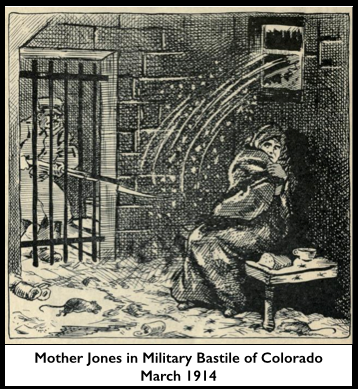
You ought to be out raising hell.
This is the fighting age.
Put on your fighting clothes.
-Mother Jones
Hellraisers Journal, Sunday January 14, 1917
From the American Socialist: Henry Dubb Works Risk-Free
Henry Dubb by Ryan Walker
Hellraisers Journal, Sunday January 14, 1917
From the American Socialist: Henry Dubb Works Risk-Free
Henry Dubb by Ryan Walker
If that is frenzy, I plead guilty
and I notify the Globe
I shall not soon recover.
-Luella Twining
Hellraisers Journal, Sunday January 13, 1907
From the Appeal to Reason: New York Workers Aroused!
Luella Twining of Denver can now be found in New York City assisting in the organization of the defense movement for Comrades Haywood, Moyer and Pettibone by the working men and women of that city.
From the Appeal to Reason of January 12, 1907:
NEW YORK IS AROUSED
—–
Working Class of City Organizing
Powerful Defense Movement
for W.F.of M. Officials.
—–By Luella Twining.
—–
New York, Jan. 4.-New York workingmen and women are demonstrating the solidarity of the working class. The second meeting of the Moyer, Haywood and Pettibone conference, composed of all workers who want to save their brothers in Idaho, irrespective of race, color, creed or politics, was more enthusiastic even than the first. Many new delegates were seated. Among the unions represented were the District Council of the Carpenters and Joiners, Central Federated Union, Brewers, Bill Posters, Typographical Union, Tobacco Workers, Bakers and Confectionary, Cloak and Suit Tailors, Cigar Makers, Butchers, Hat and Cap Makers, Beer Drivers, Beer Bottlers, Painters and Decorators, Steam Fitters, Bricklayers, Machinists, United Hebrew Trades, Sick and Death Benefit and Waiters. All of these trades were represented by more than one local, most of them by three or four.
The financial secretary reported the receipt of $2,760.20 for the “Defense Fund,” and $1,500 for the “Agitation Fund.” While we are laying particular stress on the necessity of money to carry on the trial, still we are setting forth also the necessity for agitation. We shall hold many meetings to warn the workers of the murder that is being planned in Idaho. We shall also distribute tons of literature setting forth the facts. New York City shall be buried in papers and pamphlets. Everybody shall know of this conspiracy, planned in New York, in that magnificent stone building on Broadway, and to be executed in that desolate, isolated region of Idaho. We do not intend to wait till our brothers are in their graves for the working class to say: “We did not know, we thought they would have a fair trial.”
The unions visited show intense interest. Many of them are holding special meetings for the reason that their by-laws do not permit them to give more than a prescribed sum. For instance, the “Sheet and Metal Workers” gave the maximum amount at their regular meeting. They held a special meeting the next week and gave $500. No unions before which speakers have appeared have refused to assist. All have displayed the greatest enthusiasm and expressed their indignation in burning words at the foul conspiracy to break up organized labor, and all resistance to capitalistic encroachment. They realize that Standard Oil, successful in ridding themselves of Moyer, Haywood and Pettibone, would be like wild animals after having a taste of human blood, and thirsting for more. They know they would be the next victims.
The action of the Central Federated Union, in displaying such intense interest in the “Moyer, Haywood and Pettibone Conspiracy” was a hard blow for the prosecution. The Globe commented on it editorially, and said that the C. F. U. should not have allowed such statements to be made on its floor. They called me a “Maenad” (frenzied woman). I suppose that was for portraying the sufferings of Comrade Haywood’s invalid wife, also the agony she has endured during the long year in which her husband has been incarcerated in a cell, denied every right of an American citizen. If that is frenzy, I plead guilty and I notify the Globe I shall not soon recover. I am not alone. The C. F. U. all became “frenzied,” gave all they could and promised all moral support possible.
Hellraisers Journal, January 12, 1917
San Francisco, California – Frame-Up of Tom Mooney Examined
Writing in this month’s edition of the International Socialist Review, Robert Minor, Treasurer of the International Workers’ Defense League, exposes a few interesting details in the ongoing frame-up of the San Francisco labor leader, Tom Mooney:
The Suitcase Ghost
By ROBERT MINOR
LIKE the giant trees that astonish the eye of the traveler, like the wonderful climate and other marvels of the state, California produces the most amazing manifestations of the Labor Struggle.
Since the McNamara plea of guilty, there has been a ghost in nearly every labor dispute. That ghost is “the Suitcase.” There is a suitcase in every strike. Sometimes made of yellow leather, some times of black morocco, the suitcase is more often built of nightmares—pure imagination. But the suitcase, in one form or another, is a California institution.
When made of more than imagination, the suitcase has usually been (since the McNamara case) in the hand of an agent of the corporations, and loaded with dynamite.
In Stockton, three years ago, Anton Johannsen, labor organizer, “got the drop on” a gunman who came to his hotel room to kill him for the Merchants,’ Manufacturers’ and Employers’ Ass’n. The trapped gunman confessed that it was his intention, after killing Johannsen, to place a suitcase of dynamite in his room, another suitcase of the same explosive in the Santa Fe station checking room, with the check slipped into the pocket of the Secretary of the Building Trades Council. One of the other plotters, J. J. Emerson, was caught by a bungling policeman with a suitcase of dynamite, confessed to the plot to “plant” it so as to blame the strikers, but was, of course, acquitted in spite of the confession. (What are courts for?) Ed Nolan and Tom Mooney were instrumental in the expose.
In the same strike, Warren K. Billings, then 19 years of age, out of a job, was accosted by strangers who offered him $50 to carry a suitcase to Sacramento, to be delivered to two men whom he was to meet in a saloon. The boy accepted the offer. The men waiting for him in the saloon in Sacramento proved to be detectives, the suitcase contained dynamite, and Billings was given a two-year sentence.
When an explosion occurred in the San Francisco preparedness parade and killed ten persons, the blame was laid upon labor organizers with a suitcase. This in spite of the fact that the most reliable witness, a prominent physician, and several others whose names the police promptly lost, stated that they had seen a large, cylindrical bomb thrown.
I am yours in the struggle for
a nobler civilization.
-Mother Jones
Hellraisers Journal, Thursday January 11, 1917
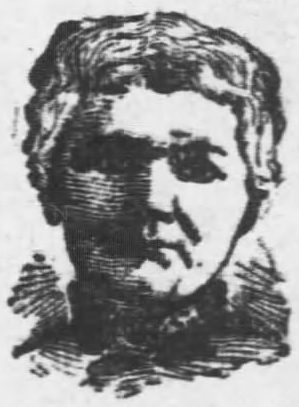
Mother Jones Found in Nation’s Capital During Month of December
From Washington Evening Star of December 11, 1916:
APPEAL TO PRESIDENT TO
PARDON LABOR MAN
—–
Frank P. Walsh, John P. White and “Mother” Jones
at the White House.
—–
President Wilson remained indoors all of today, having been prevented from a morning game of golf. He worked upon various matters that have been pending some time. In the afternoon he had engagements for a number of visitors. He received Frank P. Walsh, former chairman of the industrial commission; John P. White, president of the United Mine Workers, and “Mother” Jones, labor’s incessant champion. They asked the President, it was said, to grant a pardon to a labor leader erroneously convicted and sentenced to prison….
———-
[Photograph added.]
Hellraisers Journal, Thursday January 10, 1907
Mother Jones Found Featured in Socialist and Labor Press

As to the actual whereabouts of Mother Jones during the month of December 1906, we could find very little. However, we were able to find her featured in an article in the Appeal to Reason and as the author of an article in the Duluth Labor World. The article in the Appeal details the campaign, last fall, of William Dettrey in Pennsylvania where he ran as the Socialist candidate for the U. S. House of Representatives from Luzerne County. The article notes the hard work done by Mother Jones during that campaign and the lack of interest shown by the two most famous union leaders in the American labor movement.
From the Appeal to Reason of December 1, 1906:
DETTREY’S CAMPAIGN IN PENSLYVANIA.
—–BY ONE OF THE BOYS.
—–
Hellraisers Journal, Wednesday January 9, 1907
From Ada County Jail, Idaho – Big Bill Haywood Writes to Family

From his cell in the Ada County Jail, beneath the Courthouse where he will be put on trial for his life, William D. Haywood, Secretary-Treasure of the Western Federation of Miners, sends out a daily letter to his invalid wife in Denver. His wife, Nevada Jane Minor Haywood and his two daughters, Vernie and Henrietta, remain in that city and hope for the return of the husband and father who was kidnapped by the authorities of Colorado and Idaho and spirited away to Boise aboard the “Kidnappers’ Special” on February 18th of this past year.
From The Leavenworth Times of Kansas, January 5, 1907:
Accused Miner Sends Daily Letter To Wife
Denver, Colo., Jan. 4.-There is a chapter in the life of Wm. D. Haywood, leader of the Western Federation of Miners and accused accomplice in the assassination of former Gov. Steunenberg, of Idaho, now in jail at Boise, Idaho, awaiting trial, not generally known. The story this chapter tells places this one accused and censured as an anarchist in the true light of faithful and home-loving father and husband.
More than anything we attorneys can do,
is what the Appeal to Reason,
through its readers can do.
-Clarence Darrow
Hellraisers Journal, Tuesday January 8, 1907
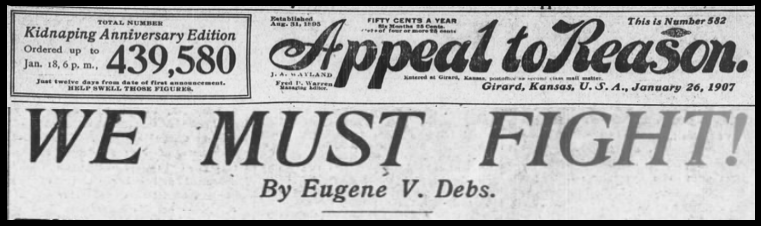
From the Appeal to Reason: Debs Issues Calls for Action
From the Appeal of January 5, 1907:

Hellraisers Journal, Sunday January 7, 1917
From The Masses: Thoughts on War from Becker and Untermeyer
“Now will you enlist?” by Maurice Becker
Hellraisers Journal, Saturday January 6, 1917
From the Mesabi Range, Minnesota, Comes News of Plea Agreement
The International Socialist Review of January 1917:
Victory on the Mesaba Range
By HARRISON GEORGE
We were all ready to go to press when the following telegram came in. We feel sure all REVIEW readers will be interested in the brief sketches that follow:
Virginia, Minn., Dec. 15, 1916.
Tresca, Scarlett, Schmidt, Mrs. Masonovitch, Orlandich, [F]reed, Phil Masonovitch, Nikich, Cernogorovich year sentence each. All cases against Gilday, Greeni, others dismissed. Full statement will follow. Funds needed here meet honor bound obligations. All committees rush balance funds on hand here. All together for freedom Everett and all class war prisoners.
Ettor, Gilday, Flynn.
CARLO TRESCA, who was born in Sulmona, Italy, in 1879. Entering the labor movement at an early age, he became editor of a Socialist paper in his native town when he was only twenty years old. By 1904 he had shown his worth by being many times sent to prison on political charges. In 1903 he was elected secretary of the largest labor organization of Italy, the Syndicate of Firemen and Railroad Engineers. In 1904, however, he was given choice of eighteen months penal servitude or ten years exile for political offenses, and, choosing exile, he landed in America in August, 1904. As organizer and editor he continued his fight for labor, now being editor of an Italian paper in New York, LL’Avenire [L’Avvenire]. Jailed for months on different occasions, he was attacked by an assassin, who is said to have been an emissary of the Italian consul in Pittsburgh and his throat badly slashed. In the last six years Tresca has taken part in all big strikes of the I. W. W., which involved Italian workers. Lawrence, Little Falls and Paterson are only a few of the many strikes where thousands cheered when Tresca stood before them. Now he is on trial for murder. The witness against him has said that when a certain remark was made by another speaker, Tresca smiled and said, “Good, good!” For a smile and one short word, twice uttered, Tresca has been charged with murder!
It is a privilege and a duty even by sacrifice
to advance our priceless cause.
-John R Lawson
Hellraisers Journal, Friday January 5, 1917
From The Masses: FW Flynn on Behalf of Minnesota Defendants

The following article was obviously written for The Masses by Fellow Worker Flynn, I. W. W. organizer, before the plea agreement was reached in the cases of the strikers and organizers charged with first degree murder in connection with the strike of iron miners up on the Mesabi Range of northern Minnesota. The article is nevertheless valuable for the information given regarding the defenses campaign along with a short history regarding “criminal conspiracy” as related to labor struggles, past and present. Tomorrow’s Hellraisers will present an article from this month’s edition of the International Socialist Review, written by Harrison George, which claims the plea agreement as a victory for the strikers and for the cause of labor in general.
From The Masses of January 1917:
The Minnesota Trials
Many of our friends fail to appreciate the magnitude of the Minnesota strike, involving 15,000 miners and the United States Steel Corporation, and are beguiling themselves into belief that the murder cases pending are not serious.
Mrs. Masonovitch [Masonovich], the woman prisoner, wife of one of the strikers, is a particularly pathetic and appealing figure, a young and beautiful Montenegrin woman, mother of five children, one a nursing baby. She speaks little English, does not understand the proceedings, looks frightened and bewildered and clings frantically to her children. If the parents should be convicted these little ones would be practically orphans. The older ones, twelve and eight, bright, nice boys, tell very clearly what happened on July 3, the night of the tragedy, how the deputies came to arrest their father, how one struck their mother and threw her to the floor, how the fight then started in which Mr. Myron was killed, and how Nick Dillon, the notorious gunman, shot and killed Thos. Ladvalla [Tomi Ladvalla-WE NEVER FORGET], a bystander. If the episode was not connected with a strike, it would be comparatively easy to clear these poor people.