Hellraisers Journal – Saturday June 10, 1899
Wardner, Idaho – Cruelties Committed Against Miners Under Military Government
From The San Francisco Call of June 8, 1899:
BARBARITIES PRACTICED AT WARDNER
—–
Editor Walker Alleges Great Cruelties
Under Military Government.
—–
INQUEST ON A DUMMY
—–
Soldiers Ordered to Shoot Down
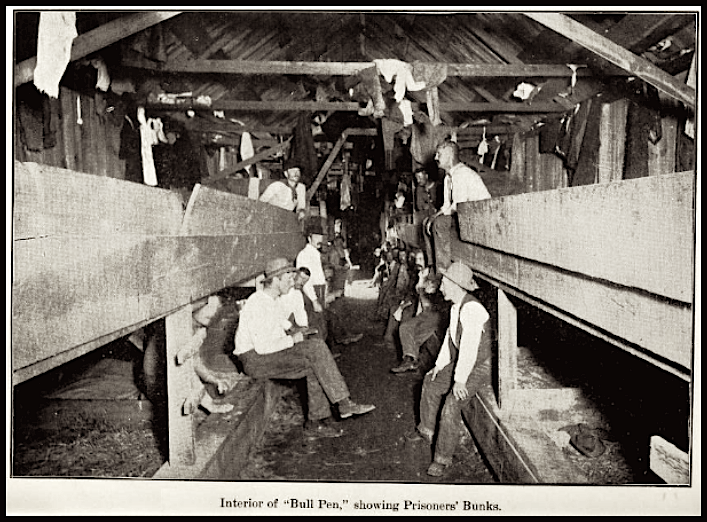
Prisoners in the “Bull Pen”
if They Flee From Fire.
—–
Special Dispatch to The Call.
—–
Despite the military censorship something that has rather more the semblance of truth than anything that has been sent out so far, is beginning to come from the Coeur d Alenes.
There are two sides to the story of the mining troubles there. It appears labor leaders assert that the Miners’ Union has not been always and altogether to blame. General Merriam, according to the labor side of the story, has gone greatly beyond even what military necessity would mandate in the suppression of riot. A general order to shoot down men if they should seek to escape death by fire can hardly be justified by anything that has occurred in Idaho so far.
—–
BOISE. Idaho, June 7.—W. J. Walker, editor of the Freeman’s labor journal and an organizer fur Western labor, tells a pretty tough story concerning General Merriam and Governor Steunenberg’s military rule in the Coeur d’Alene country. Mr. Walker, being one of the principal leaders in labor matters in the Northwest, is kept posted on the progress of affairs in the Coeur d’Alenes, and he says he knows whereof he speaks in the assertions he makes.
Hellraisers Journal – Sunday June 8, 1919
May Day Celebrated at Ft. Leavenworth by Reds of All Stripes
From The Liberator of June 1919:
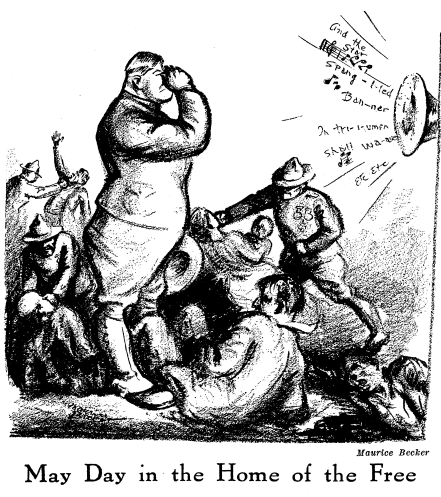
May Day in Ft. Leavenworth
By a Socialist C. O.
WHILE Cleveland was having its fatal May Day demonstration and while other free American cities were engaged in bloody rioting and fighting between citizens and police, with soldiers pitching in on both sides and shavetail ex-officers going into “action” for the first time, the militant Socialists imprisoned in Fort Leavenworth were observing the international revolutionary Labor Day under U. S. military sanction.
The open air red flag parade was witnessed by a crowd of soldiers who offered no opposition but viewed it with apparent approbation. The one day stoppage of prison work by the celebrants met with the approval in advance of the prison authorities who made special arrangements to permit the rebel group to assemble and observe the day. Civilians and Q. M. sergeants and children on their way to school looked with amazement on the unprecedented prison scene as it unfolded itself behind the double lines of barbed wire surrounding the stockade-annex of the Disciplinary Barracks.
We respect [the IWW] as one of the
social and political movements
in modern times that draws no color line.
-WEB DuBois for The Crisis ———-
Hellraisers Journal – Saturday June 7, 1919
Fellow Worker Ben Fletcher, Prisoner at Leavenworth, Remembered
From The Crisis of June 1919:
I. W. W.
[by W.E.B. Du Bois]
Fellow Worker Ben Fletcher
AN editorial in the Easter CRISIS (written during the Editor’s absence) has been misunderstood and was, perhaps, itself partially misleading.
Mr. F. H. M. Murray of Washington, D. C., writes us:
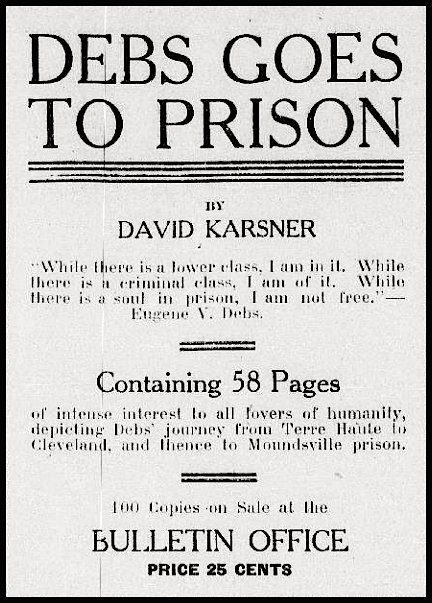
In a recent editorial in your magazine the statement is made that there are no Negroes among the Industrial Workers of the World. While I am certain that the statement is erroneous, I am not at this moment able to lay my hands on anything in print to confirm my denial, except the following from an article in last Sunday’s New York Call magazine, by David Karsner, who reported the trial of the big batch of members of the I. W. W- in Chicago last summer and later the trial of the five Socialists at the same place. He is writing about Judge Kenesaw M. Landis, who presided at both trials and who imposed upon the hundred or so I. W. W., who were convicted, and the five Socialists, sentences aggregating over nine hundred years in prison and fines aggregating over two millions of dollars. Mr. Karsner says:
“There was only one defendant among the I. W. W., to my knowledge, who refused to believe in Judge Landis [during the trial]. He was Ben Fletcher, the sole Negro defendant. One day in the corridor I asked Ben what he thought of Judge Landis. Ben smiled broadly, ‘He’s a fakir. Wait until he gets a chance; then he’ll plaster it on thick.’ Ben was a sure-thing prophet, for the Judge plastered him with ten years, and his counsel said with not enough evidence to invite a reprimand.”
Hellraisers Journal – Friday June 6, 1919
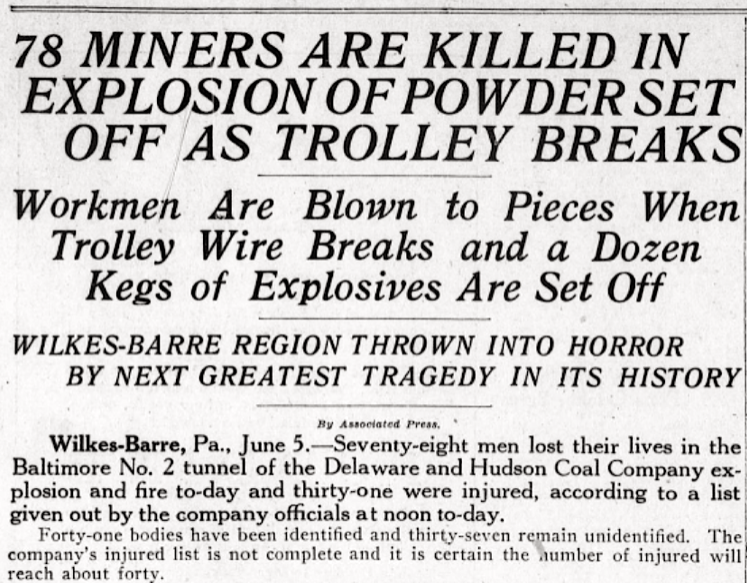
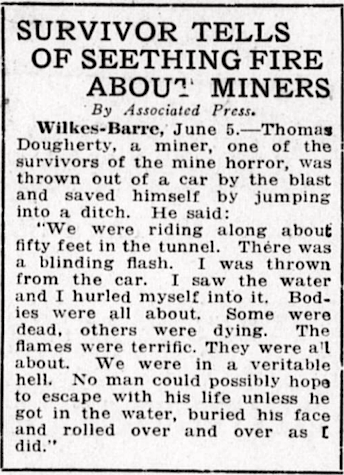
Wilkes-Barre, Pennsylvania – Coal Miners Perish in Flames of Mine Fire
From Pennsylvania’s Harrisburg Telegraph of June 5, 1919:
—–
Sparks Ignite Powder
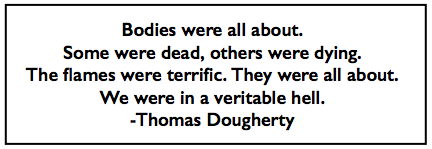
More than 100 mine workers were riding to their work crowded into what is known as a “trip” of mine cars, drawn by a motor. The rear car carried twelve kegs of black powder used for blasting loose the coal in the chambers. When the train had gone about 200 feet from the entrance the trolley wire snapped. The sparks it emitted touched off the powder.
Hellraisers Journal – Saturday June 5, 1909
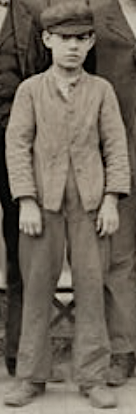
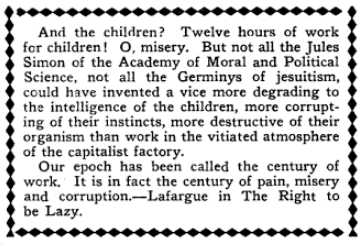
“The Apostate” by Jack London, The Story of a Child Laborer
From The International Socialist Review of June 1909:
A Story of Child Labor
“THE APOSTATE”
BY JACK LONDON.
F you don’t git up, Johnny, I won’t give you a bite to eat!”
The threat had no effect on the boy. He clung stubbornly to sleep, fighting for its oblivion as the dreamer fights for his dream. The boy’s hands loosely clenched themselves, and he made feeble, spasmodic blows at the air. These blows were intended for his mother, but she betrayed practiced familiarity in avoiding them as she shook him roughly by the shoulder.
“Lemme ‘lone!”
It was a cry that began, muffled, in the deeps of sleep, that swiftly rushed upward, like a wail, into passionate belligerence, and that died away and sank down into an inarticulate whine. It was a bestial cry, as of a soul in torment, filled with infinite protest and pain.
But she did not mind. She was a sad-eyed, tired-faced woman, and she had grown used to this task, which she repeated every day of her life. She got a grip on the bedclothes and tried to strip them down; but the boy, ceasing his punching, clung to them desperately. In a huddle at the foot of the bed, he still remained covered. Then she tried dragging the bedding to the floor. The boy opposed her. She braced herself. Hers was the superior weight, and the boy and bedding, the former instinctively following the later in order to shelter against the chill of the room that bit into his body.
As he toppled on the edge of the bed it seemed that he must fall head-first to the floor. But consciousness fluttered up in him. He righted himself and for a moment perilously balanced. Then he struck the floor on his feet. On the instant his mother seized him by the shoulders and shook him. Again his fists struck out, this time with more force and directness. At the same time his eyes opened. She released him. He was awake.
“All right,” he mumbled.
She caught up the lamp and hurried out, leaving him in darkness.
Hellraisers Journal – Sunday June 4, 1899
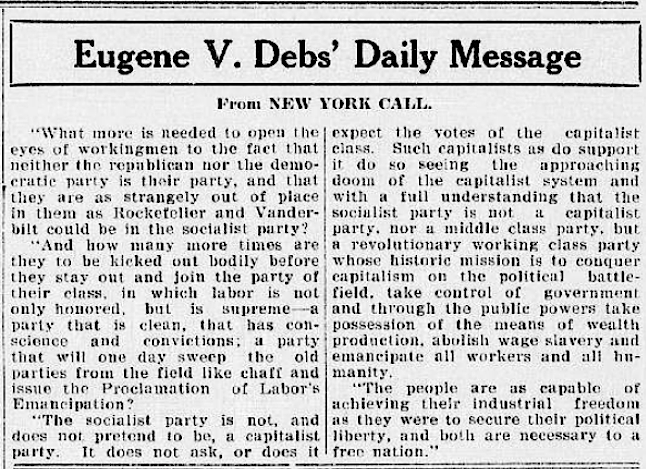
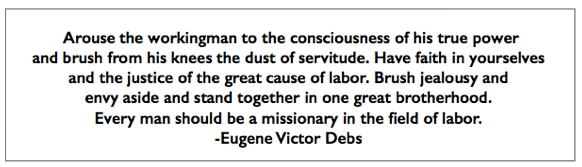
Comrade Debs Has Successful Tour of Texas for S. D. P. of A.
From the Social Democratic Herald of June 3, 1899:
Texas is Coming
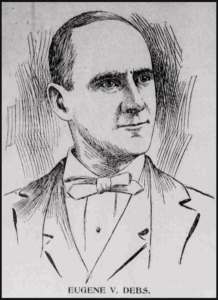
[by Eugene V. Debs]
Houston, Texas
[May 21, 1899]
Beginning at Nashville on the 10th of May, this trip has been fruitful of results beyond all expectations. Nearly every meeting has been crowded and in some places many were turned away. Farmers have come in from 30 and 40 miles distant.
At Nashville the Socialist Club voted unanimously to join the Social Democratic Party. At Memphis, I am satisfied the Independent Socialist Society will follow suit. William Pinard, the national organizer of the Barbers’ Union and one of the most progressive trade unionists, will join at Memphis and enter our list of organizers.
At Little Rock a branch is organizing. At Dallas, Fort Worth, Bonham, Cleburne, Waco, San Antonio, and Houston, branches will soon be in active operation.
I have some good news for our comrades from Texas. I feel warranted in saying that the Socialist Party of Texas will soon be in the Social Democratic Party. At Bonham I had a conference with William E. Farmer, the veteran editor of The Social Economist and president of the party. He is heartily with us. At San Antonio I had an extended conference with the Executive Board of the Socialist Party of Texas. We canvassed the situation thoroughly. They unanimously resolved to issue an address to the party, recommending that their locals attach themselves to the Social Democratic Party. A referendum vote is now being taken. I do not have the least doubt that all the locals in the state will come to us in a body.
A committee of the Houston Section S. L. P. [Socialist Labor Party] has just called on me and we had a most pleasant interview. They are true comrades and I was happy to meet them. I assume the responsibility to predict that it will not be long before the comrades who compose this section will be in our party. Let the good work proceed.
The outlook everywhere is immensely cheering. My heart leaps with anticipation for the future. It is coming. The triumph is near. Onward comrades!
Hellraisers Journal – Tuesday June 3, 1919
Winnipeg, Manitoba – Soldiers and Police Support General Strike
From The Butte Daily Bulletin of May 31, 1919:
(Special United Press Wire.)
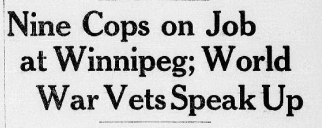
Winnipeg, May 31.-The police force now consists only of nine men, 181 officers having automatically been discharged yesterday when they refused to sign an agreement with the city severing their connections with labor.
The policemen had voted their approval of the demands in the general strike, but had not voted to strike themselves. An effort is being made to have the mounted police do the city patrolling.
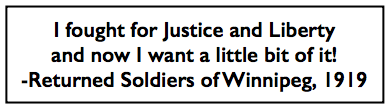
Returned soldiers asked that the principle of collective bargaining be placed in the provincial statutes and also asked that the city officials with draw their demands on the police.
———-
[Emphasis added.]
From the Winnipeg Strike Bulletin of June 2, 1919:
THE SOLDIER AND THE STRIKE
The severest jolt the financial magnates of Winnipeg ever got was administered by the returned soldiers early in the strike, when the mass meeting representing all the returned soldier bodies reversed the decision of the combined executives and threw in their lot with the strikers.

 ———-
———-
 ———-
———-
 ———-
———- ———-
———- ———-
———-F you don’t git up, Johnny, I won’t give you a bite to eat!”
 ———-
———- ———-
———- ———-
———-