
 —————
—————
Hellraisers Journal – Friday July 12, 1901
Mother Jones News Round-Up for June 1901, Part IV
Found Speaking at Memorial for Martyrs of St. Louis Streetcar Strike
From The Indianapolis Journal of June 14, 1901:
“Mother” Jones in the City.
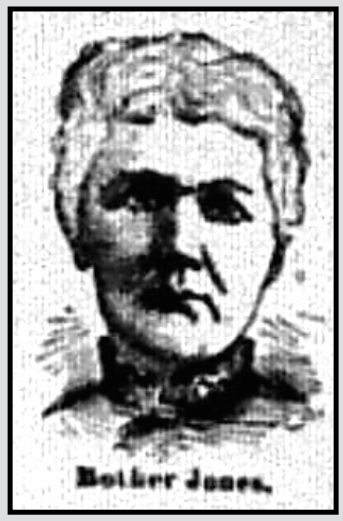
“Mother” Jones, known the United States over by organised labor, and particularly by members of the United Mine Workers of America, with whom she has been personally identified in many strike, made an unexpected visit to the Mine Workers’ headquarters yesterday. She is on her way to St. Louis to deliver an address, and then will visit the Illinois miners. “Mother” Jones is a regularly employed organizer of the miners’ organization now, and is said to be one of its most successful workers, especially in time of strikes.
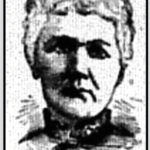
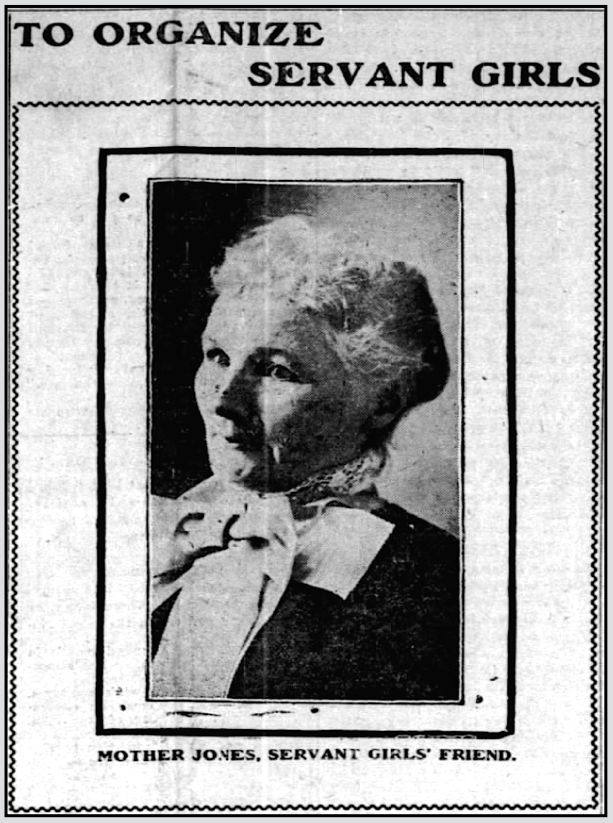
[Drawing of Mother Jones added.]
From the St. Louis Post-Dispatch of June 17, 1901:
MOTHER JONES SPOKE
———-HER ADDRESS WAS FEATURE OF
LABOR MEMORIAL SERVICES.
———-
LEON GREENBAUM PRESIDED
———-
Exercises Were Held in Memory of Men
Killed in Street Car Strike Riot.At the Odeon Sunday afternoon, services in memory of the three men killed, June 10, 1900, during the parade of former street car employes on Washington avenue, were held under the auspices of the Central Trades and Labor Union.
The hall was well filled, the widows of George Rine [Ryne] and Arthur E. Burkhart [Ed Burkhardt], two of the men killed, being among those present. Each was accompanied by two little children.
The principal address was made by “Mother” Mary Jones of Chicago. All of the speeches had special reference to the street car strike, its causes and the conditions which preceded it, with a general bearing upon the rights of organized labor.
Leon Greenbaum presided and the services were in charge of the memorial committee of the Central labor body, consisting of J. H. Rakel, chairman; David Kreyling, secretary; R. M. Parker, treasurer; A. Hamberg and Leon Greenbaum. Music was furnished by the United Singing Societies.
In opening the meeting, Mr. Greenbaum, who was the Socialist candidate for mayor last spring, reviewed the events which led up to the strike of 1900. He described the scene on Washington avenue, when Thomas Rine and Burkhart fell before the riot guns of the posse.
William M. Brandt, business agent of the Cigar Makers’ Union, who helped organize the street car men in preparation for the strike, told of the conditions as he found them at the time the work was undertaken.
“Mother” Jones, the organizer of the Mine Workers’ Union, was next introduced and made an address of two hours’ duration. She was received with cheers from the audience, which proclaimed her the “friend of the laboring man,” and was frequently interrupted by applause. Her remarks were directed chiefly against corporations and the trusts.
She said she was engaged in helping the miners of Maryland win a strike while the St. Louis trouble was in progress, and, hence, was unable to be here, but her heart went out in sympathy to those who were struggling for their rights.
She advocated a revolution, if Congress and the state legislatures did not soon “give the people their rights.”
“Mother” Jones said she had been charged with inciting trouble, and believed that, in rousing the people, lay the only safety for this country.
“The most dangerous thing on earth,” she declared, “is a contented slave.”
 —————
————— —————
—————
 —————
—————
 —————
—————
 —————–
 —————
—————
 —————–
![From The Progressive Woman of July 1911:The above picture includes most of the delegates to the Unity Convention of 1901 the convention where the Socialist party came into existence. It was held at Indianapolis, Indiana, beginning July 29. The picture was taken on the east front of the state capitol. A number of the faces will be familiar to many readers.There were about one hundred and twenty-five delegates present, among whom were the following women: Corinne S. Brown, Martha A. Biegler, Margaret Haile, Elizabeth H. Thomas, Sula Lowrie, Mrs. Max S. Hayes, Martha H. McHugh and Carrie Rand Herron.The Unity Convention was called for the purpose of attempting to unite the various Socialist parties of the country. The largest of these were the Social Democratic Party and the Springfield wing of the Socialist Labor Party. The other wing of the Socialist Labor Party did not take part in the convention. State parties in Iowa, Kentucky and Texas, not affiliated with any national organization, were represented.The various factions that united in calling the convention had patched up their differences sufficiently to support the same ticket the year before. Animosities were very bitter, however. Had it not been for the withdrawal of various local and state organizations from the national organizations, thus decreasing their membership, it is hardly probable that the two national organizations could have been persuaded to consent to try to form an organic union.The main actions of the convention were the adoption of a national constitution, a national platform, a resolution on Socialism and trade unionism, a resolution on injunctions, and a resolution on the negro question.The platform came in for a hot discussion, especially the immediate measures. As adopted, it contained, among others, a provision for "equal civil and political rights for women."The resolutions were also warmly discussed. In fact, everything was warmly discussed. Socialists are always very earnest in their debates, and the bitter feelings which the delegates brought along made them especially earnest at that convention.But the great debate came on the constitution. Hot does not begin to express it. It was scalding, vitriolic. All the rancor in the hearts of the delegates was poured out in blistering words. At times it seemed to the most optimistic that unity was hopeless, and that we must disperse and go back to our several locals with the doleful confession that we had failed in our mission. But, out of it all came agreement-agreement on the famous Section Four of Article Twelve. Get out your national constitution and read it. It is historic. It is the state autonomy provision. Around it raged the battle as to whether we could organically unite. Its adoption made unity possible.Then came better feelings and a great relief. We went home with joy in our hearts, because we bore the glad tidings of a solidified Socialist Party-united-facing the enemy.---------------[Emphasis added.]](https://weneverforget.org/wp-content/uploads/2021/07/Delegates-to-Unity-Founding-Convention-of-SPA-July-Aug-1901-Prg-Wmn-p3-July-1911.png)
 —————
—————
 —————
—————