
There are no limits to which
powers of privilege will not go
to keep the workers in slavery.
-Mother Jones
Hellraisers Journal, Sunday January 28, 1917
From The Survey: “The boys in jails are a cheerful lot.”
The boys in jail are a cheerful lot….When they disliked their food, says a conservative newspaper, they went on strike and “sang all night.” Sang all night! What sane adults in our drab, business-as-usual world would think of doing that? Who, in fact, could think of doing it but college boys or Industrial Workers of the World, cheerfully defying authority?
So says Anna Louise Strong in the latest issue of The Survey. The entire article from the January 27th edition can be found below:
Everett’s Bloody Sunday
A Free Speech Fight That Led to a Murder Trial
By Anna Louise Strong
EXECUTIVE SECRETARY SEATTLE COUNCIL OF SOCIAL AGENCIES
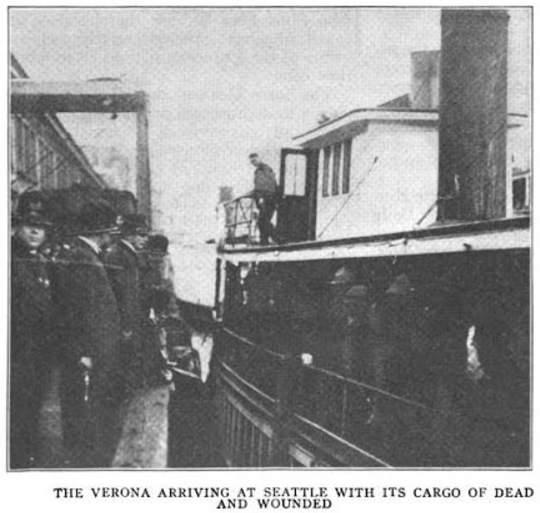
THE biggest “labor trial” in the history of the country is now on in Everett, Wash. Seventy-four men are accused of first-degree murder-seventy-four workers who participated in a conflict in which five workers and two deputies were killed. The side which lost the most men is also the side charged with murder. “Might makes right—legally,” explains the I. W. W.
Everett’s “bloody Sunday” is already a familiar word, almost a byword, throughout the labor press. Yet the occurrences in Everett are little noticed by daily papers or magazines of general circulation, much less the causes that led up to it.
Everett is a small city to the north of Seattle. Its main business is lumber. The big mill-owners control its Commercial Club. Eighteen months ago wages were reduced in the shingle mills of Everett, this in the face of the increasing cost of living. The promise was made that when the market improved wages would be raised again. Early last year shingle prices rose, but wages did not follow, and on May 1 the shingle-weavers went out on strike. The usual complications resulted: a group of employers refusing to meet the officers of the union; a picket line; imported strike-breakers, better known for their fighting ability than for their working skill; minor altercations in which the power of the law was used practically invariably against the workers. Such was the background of the I. W. W. free speech fight.
During all this time the I. W. W. organization had maintained a small headquarters in Everett, but had made little headway. It had no connection with the shingle-weavers, and had made little impression upon them. But the I. W. W. started a street-speaking campaign and leaped into public notice as soon as the police and special deputies began dragging them from their soap-boxes to jail. It is stated that the first arrest made was of a man who was reading from the United States Industrial Relations Commission report. “That sort of stuff don’t go here,” said the outraged policeman, overhearing the terrific indictment of working-class conditions in America. Arrested men were beaten and severely handled; they were made to run the gauntlet between rows of deputized citizens, and the old, old, always unsuccessful policy of suppression of speech by violence was attempted.