Hellraisers Journal: William Z Foster on the Alschuler Award: “How Life Has Been Brought into the Stockyards,” Part III

Share

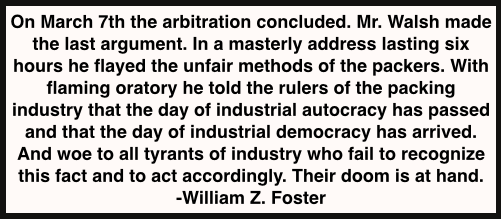
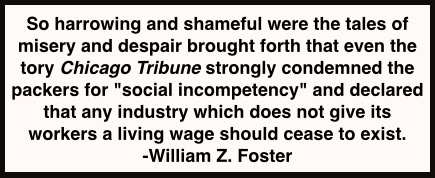
Quote WZF, re Walsh closing for Packinghouse Workers, LnL, April 1918

~~~~~~~~~~~~~~~~~~~~~~~~~~~~~~~~~~~~~~~~~~~~

Hellraisers Journal, Sunday April 7, 1918
Victory! for Packinghouse Workers by William Z. Foster, Part III

From Life and Labor of April 1918:

HOW LIFE HAS BEEN BROUGHT
INTO THE STOCKYARDS
A Story of the Reorganization of the Packing Industry

William Z. Foster
Secretary Chicago Stockyards Labor Council

The main questions, touching wages, hours and conditions of labor, involved in the Stockyards arbitration hearing before Judge Alschuler, and his decision concerning them, are of overwhelming importance, both in principle and in consequence. Just how far-reaching will be the results of the decision one cannot now forecast. But lips stiffened by poverty will perhaps now learn to smile, and thousands of families will for the first time taste of life.

[Part III]

THE SHORTER WORKDAY

Chicago Stockyards, WZF, LnL p71, April 1918

A big battle raged around the question of the eight hour day. In this measure’ the packers saw typified the victory so earnestly sought by the workers. They bent every effort to defeat it. Although compelled to admit the justice, economy and inevitability of the eight hour day as a general proposition, they exhausted every pretext to prevent its consideration, for very obvious reasons, till after the war.

Their strong argument was that, due to the irregular supply of cattle, sheep and hogs, and the limited capacities of the plants, introduction of the eight hour day could only be brought about after months and years of rebuilding and other preparation. To establish it suddenly now would be disastrous. It would reduce the production of vitally necessary foodstuffs full 20 per cent. This would involve starvation for the boys in the trenches and very possibly the loss of the war.

To establish this contention the brainiest superintendents in the packing business piled complexities upon complications. But their efforts were in vain. The workers met and defeated them at every point. Samuel Gompers and Victor A. Olander made the general argument for the shorter workday, and a masterful one it was. Dennis Lane, John Kennedy, Martin Murphy, Tim McCreash, John Joyce and Joseph Selkirk, all skilled butchers, applied it to the packing houses. These union workers destroyed every technical objection raised by the superintendents, checking them one by one. Once, in the midst of the arbitration, they even went to Kansas City to ascertain the exact capacity of certain departments of the packing plants in that city. They routed the experts, horse, foot and dragoons, and proved beyond all question of doubt the practicability and economy of immediately establishing the eight hour day in the packing industry. At the first hour, seeing they were defeated, the packers urged the administrator in case he saw fit to shorten the workday, to make it apply only to the skilled trades—an insidious attack on the unions that did not pass without thorough exposure.
Continue reading “Hellraisers Journal: William Z Foster on the Alschuler Award: “How Life Has Been Brought into the Stockyards,” Part III”

Hellraisers Journal: William Z Foster on the Alschuler Award: “How Life Has Been Brought into the Stockyards,” Part II

Share

Quote WZF, re Poverty of Packinghouse Workers, LnL, April 1918


~~~~~~~~~~~~~~~~~~~~~~~~~~~~~~~~~~~~~~~~~~~~

Hellraisers Journal, Saturday April 6, 1918
Victory! for Packinghouse Workers by William Z. Foster, Part II

From Life and Labor of April 1918:

HOW LIFE HAS BEEN BROUGHT
INTO THE STOCKYARDS
A Story of the Reorganization of the Packing Industry

William Z. Foster
Secretary Chicago Stockyards Labor Council

The main questions, touching wages, hours and conditions of labor, involved in the Stockyards arbitration hearing before Judge Alschuler, and his decision concerning them, are of overwhelming importance, both in principle and in consequence. Just how far-reaching will be the results of the decision one cannot now forecast. But lips stiffened by poverty will perhaps now learn to smile, and thousands of families will for the first time taste of life.

[Part II]

DRASTIC ACTION TAKEN

Chicago Stockyards, WZF, LnL p68, April 1918

The cup was full. It was evident that the packers had no intention of living up to their agreement, but were seeking openly to destroy the unions, let the consequences be what they might. The unions accepted the issue. They at once broke off negotiations with the packers and sent the committee away to Washington again to demand that the President take over the packing houses, as the only way to guarantee their operation during the period of the war.

On January 18th the committee met with President Wilson, explained to him the imminent danger of a great strike in the packing houses and asked that he take steps to seize the industry. The President replied that the proposed remedy involved a big issue, that he would take it under advisement, and that in the meantime another, effort would be made to get a settlement through arbitration.

Continue reading “Hellraisers Journal: William Z Foster on the Alschuler Award: “How Life Has Been Brought into the Stockyards,” Part II”

Hellraisers Journal: William Z Foster on the Alschuler Award: “How Life Has Been Brought into the Stockyards,” Part I

Share

Quote WZF, re Organizing Packinghouse Workers, LnL, April 1918

~~~~~~~~~~~~~~~~~~~~~~~~~~~~~~~~~~~~~~~~~~~~

Hellraisers Journal, Friday April 5, 1918
Victory! for Packinghouse Workers by William Z. Foster, Part I

From Life and Labor of April 1918:

Life and Labor, Editors, and WZF, April 1918

The main questions, touching wages, hours and conditions of labor, involved in the Stockyards arbitration hearing before Judge Alschuler, and his decision concerning them, are of overwhelming importance, both in principle and in consequence. Just how far-reaching will be the results of the decision one cannot now forecast. But lips stiffened by poverty will perhaps now learn to smile, and thousands of families will for the first time taste of life.

[Part I of III.]

Chicago Stockyards, WZF, LnL p63, April 1918

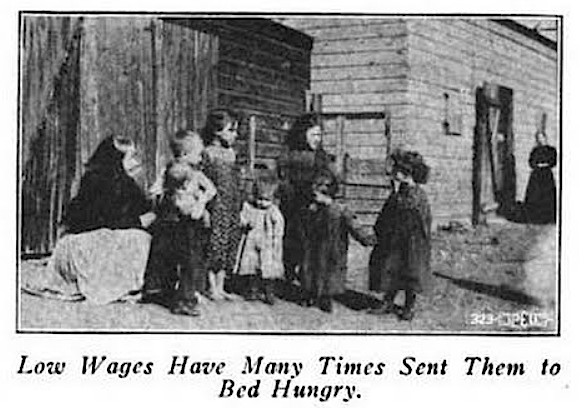
EIGHT MONTHS ago the vast army of packing house workers throughout the country were among America’s most helpless and hopeless toilers. Practically destitute of organization, they worked excessively long hours under abominable conditions for miserably low wages. Hope for them indeed seemed dead. But today all this is changed. Like magic splendid organizations have sprung up in all the packing centers. The eight hour day has been established, working conditions have been improved and wages greatly increased. From being one of the worst industries in the country for the workers the packing industry has suddenly become one of the best.

The bringing about of these revolutionary changes constitutes one of the greatest achievements of the Trade Union movement in recent years. A detailed recital of how it occurred is well worth while.

Since the great, ill-fated strike of 1904 the packing trades unions had put forth much effort to re-establish themselves. But, working upon the plan of each union fighting its own battle and paying little or no heed to the struggles of the rest, they achieved no better success than have other unions applying this old-fashioned and unscientific method in the big industries. Complete failure attended their efforts. No sooner would one of them gain a foothold than the mighty packers, almost without trying, would destroy it.

The logic of the situation was plain. Individual action had failed. Possibility of success lay only in the direction of united action. Common sense dictated that all the unions should pool their strength and make a concerted drive for organization. Therefore, when on Friday, July 13, 1917, exactly thirteen years after the calling of the big strike, Local No. 453 of the Railway Carmen proposed to Local No. 87 of the Butcher Workmen that a joint campaign of organization be started in the Chicago packing houses, the latter agreed at once. The two unions drafted a resolution asking the Chicago Federation of Labor to call together the interested trades and to take charge of the proposed campaign.

Continue reading “Hellraisers Journal: William Z Foster on the Alschuler Award: “How Life Has Been Brought into the Stockyards,” Part I”

Hellraisers Journal: Great Chicago Labor Trial Begins; Elizabeth Gurley Flynn Granted Separate Trial

Share

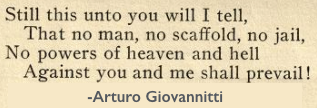
Quote Giovannitti, Prevail

~~~~~~~~~~~~~~~~~~~~~~~~~~~~~~~~~~~~~~~~~~~~

Hellraisers Journal, Thursday April 4, 1918
Chicago, Illinois – Federal Trial of I. W. W. Underway

From The Salt Lake Tribune of April 1, 1918:

100 I. W. W.’S WILL GO TO TRIAL TODAY
—–
Government’s Charged Include Sabotage,
Intrigue and Conspiracy.
—–

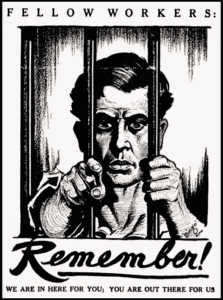
WWIR, In Here For You, Ralph Chaplin, Sol Aug 4, Sept 1, 1917

CHICAGO, March 31.-More than 100 Industrial Workers of the World will go on trial tomorrow before Federal Judge Landis, charged with conspiracy to disrupt the government’s war programme.

One hundred and sixty-five men and one woman were named in the true bill returned by the September grand jury, but forty escaped capture. Cases against ten have been dismissed, and three, including the woman, Elizabeth Gurley Flynn of New York, have been granted separate trials.

The government’s charges against the defendants include allegations of sabotage, including the slowing down of production and the wanton spoilage of material, propaganda for strikes to delay the output of war munitions and covert intrigue against military service.

Continue reading “Hellraisers Journal: Great Chicago Labor Trial Begins; Elizabeth Gurley Flynn Granted Separate Trial”

WE NEVER FORGET: Lon Amos Millsap Who Lost His Life in Freedom’s Cause, Kansas City General Strike of 1918

Share

Pray for the dead
and fight like hell for the living.
-Mother Jones

~~~~~~~~~~~~~~~~~~~~~~~~~~~~~~~~~~~~~~~~~~~~

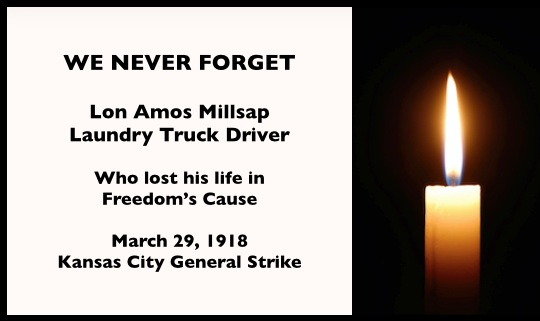
WNF, Kansas City, MO, Lon Amos Millsap, March 29, 1918
———-

Lon Amos Millsap, Labor Martyr
Kansas City General Strike, March 29, 1918

On March 29, 1918, Lon Amos Millsap, striking laundry truck driver, gave up his life in Kansas City Research Hospital. He died of a gunshot wound to the abdomen. The kept press claims that the strikers had been rioting (throwing rocks) when fired upon by armed company guards at the Globe Laundry two days earlier, March 27th, the first day of the Kansas City General Strike.

Lon Amos Millsap was born October 28, 1885, in Platte County, Missouri. At the time of his death he was 32 years old, single and a striking laundry driver. He is buried at Mount Washington Cemetery at Independence, Missouri.

M. L. Millsap, address: 2728 Brooklyn, provided the personal information for the death certificate, and was most likely a relative.

Buried in the same cemetery is the mother of Lon Millsap, Nancy Belle Heller Millsap, who died on July 27, 1927, at age 76. His father was John S. Millsap, date of death not known.

Continue reading “WE NEVER FORGET: Lon Amos Millsap Who Lost His Life in Freedom’s Cause, Kansas City General Strike of 1918”

Hellraisers Journal: Kansas City Striker, Lon Amos Millsap, Dies in Hospital from Gunshot Wound to Abdomen

Share

Pray for the dead
and fight like hell for living.
-Mother Jones

~~~~~~~~~~~~~~~~~~~~~~~~~~~~~~~~~~~~~~~~~~~~

Hellraisers Journal, Tuesday April 2, 1918
Kansas City, Missouri – Lon Amos Millsap, Labor Martyr

Rose for Labor Martyrs, Sc Victory Choir Red Flag

Lon Amos Millsap, striking laundry truck driver, gave up his life in Kansas City Research Hospital on Friday March 29th. He died of a gunshot wound to the abdomen. The kept press claims that the strikers were rioting when they were fired upon by armed guards at the Globe Laundry. Two other strikers were injured but are expected to live.

The following articles tell of the shooting and of the death of Brother Millsap.

From The Fort Scott Tribune of March 28, 1918
-Inset added is from The Leavenworth Post of March 31, 1918:

TROOPS TO CURB STRIKE.
—–

RIOTING IN KANSAS CITY STRIKE,
WHICH IS SPREADING SLOWLY.
—–

THREE WOUNDED YESTERDAY
—–
Strikers Wrecked Laundries and Restaurants,
and Stoned Street Cars;
Not So Many Disorders Today.
—–

Continue reading “Hellraisers Journal: Kansas City Striker, Lon Amos Millsap, Dies in Hospital from Gunshot Wound to Abdomen”

Hellraisers Journal: From The Social Democrat: “Song of the Factory Slave” by Ernest Jones

Share

They’ll find me still unchanged and strong,
When breaks their puny thrall;
With hate for not one living soul,
And pity for them all.
-Ernest Jones

~~~~~~~~~~~~~~~~~~~~~~~~~~~~~~~~~~~~~~~~~~~~

Hellraisers Journal, Friday April 1, 1898
“The coming hope, the future day, When wrong to right shall bow.”

From The Social Democrat of April 1898:

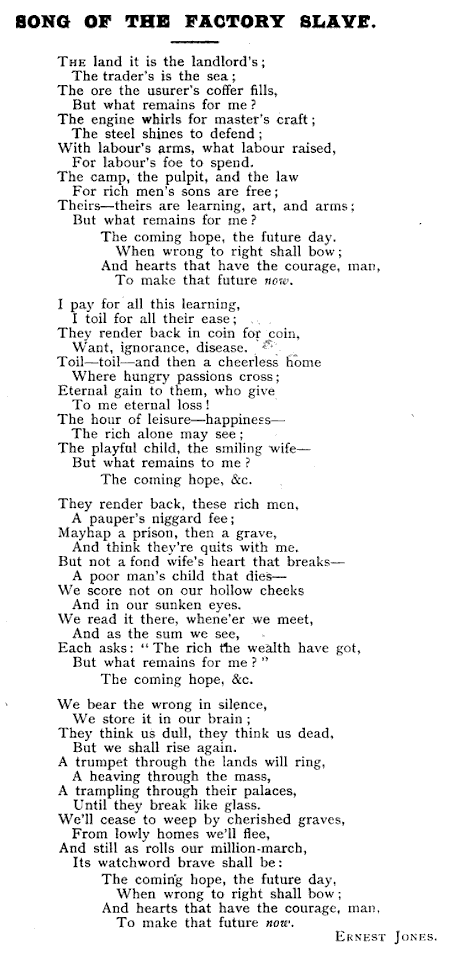
Song of Factory Slave by Ernest Jones, ScDem Apr 1898

Continue reading “Hellraisers Journal: From The Social Democrat: “Song of the Factory Slave” by Ernest Jones”

Hellraisers Journal: From The Social-Democrat: Anniversary of Paris Commune Celebrated by Socialists World-Wide

Share

C’est la lutte finale
Groupons-nous et demain
L’Internationale
Sera le genre humain.
-Eugène Pottier – Paris, June 1871

~~~~~~~~~~~~~~~~~~~~~~~~~~~~~~~~~~~~~~~~~~~~

Hellraisers Journal, Thursday March 31, 1898
Paris Commune Celebrated Annually by Socialists

From The Social Democrat of March 1898:

ScDem Mar 1898

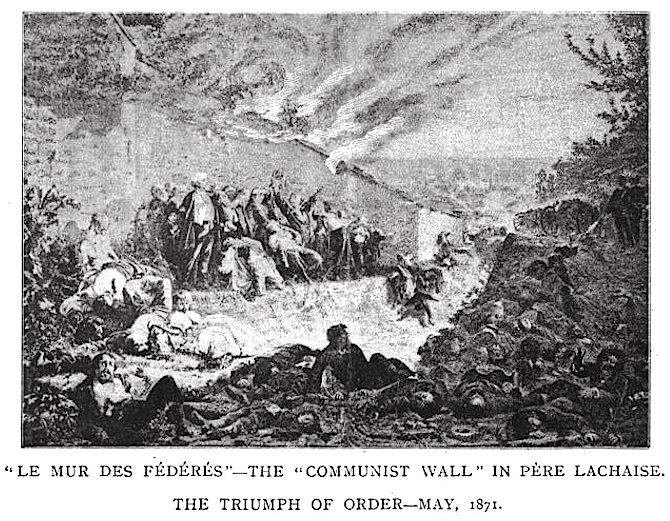
Triumph of Order over Paris Commune May 1871, ScDem Mar 1898

THE COMMUNE OF PARIS.

The 18th of March, the anniversary of the Paris Commune, is annually celebrated by Socialists throughout the world. The Commune of Paris is an event unique in history. It was the first working-class government that the world had ever seen. For the first time the working people had seized the reins of government, and taken into their hands the administration of a great city. No wonder the possessing classes were alarmed; no wonder all the forces of “respectability,” of reaction and obscurantism, rallied to the government of the “little man,” Theirs, and his gang of Imperialist mouchards and Royalist ruffians at Versailles. The revolution of the Parisian proletariat was not a mere political movement, it was a menace to all those interests which live and thrive by the enslavement, the exploitation, and the plunder of the workers.

The history of this epoch-marking insurrection is an oft-told tale. Who, among Socialists, does not know of the desertion of Paris by the reactionary Assembly; of the measures for disarming the Parisian National Guards; of the attempted seizure of the guns on the heights of Montmartre in the morning of the 18th of March; how that attempt was frustrated, and how the troops sent to carry it out fraternised with the National Guards, and shot the officer who ordered them to fire upon the people?

Continue reading “Hellraisers Journal: From The Social-Democrat: Anniversary of Paris Commune Celebrated by Socialists World-Wide”

Hellraisers Journal: Letter to New York Call from Atlanta Penitentiary Describes Two American Political Prisoners

Share

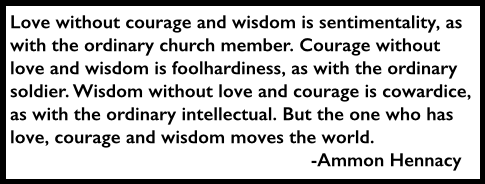
Quote Ammon Hennacy, Love Courage Wisdom, Bk of Ammon

~~~~~~~~~~~~~~~~~~~~~~~~~~~~~~~~~~~~~~~~~~~~

Hellraisers Journal, Saturday March 30, 1918
From The New York Call: A Letter from the Atlanta Pen

New York Call, March 21, 1918

The New York Call on March 24th published a letter written by Ammon A. Hennesey who, having been convicted of distributing literature against the draft, is now serving a two-year sentence at the Atlanta Federal Prison. Hennesey began serving his sentence on July 31, 1917. He hales from Columbus, Ohio, and is described as an “Irish America Socialist.”

Imprisoned with Hennesey is John T. Dunn, a Socialist from Providence, Rhode Island, who was sentenced to twenty years having been convicted under the Espionage Act of 1917.

Described also is William V. McCoy, a “Virginia mountaineer” from big Stone Gap, West Virginia who was convicted of conspiring to seize U.S. property and oppose the government. McCoy was sentenced to five years in prison and began serving his sentence on August 17, 1917. Despite the fact that he is sixty-one years old Mr. McCoy was sent to “the hole” in January and remains there at this time.

Continue reading “Hellraisers Journal: Letter to New York Call from Atlanta Penitentiary Describes Two American Political Prisoners”

Hellraisers Journal: Elizabeth Gurley Flynn on Tour in New England; Speaks in Providence and Buffalo

Share

You ought to be out raising hell.
This is the fighting age.
Put on your fighting clothes.
-Mother Jones

~~~~~~~~~~~~~~~~~~~~~~~~~~~~~~~~~~~~~~~~~~~~

Hellraisers Journal, Sunday March 29, 1908
Providence, Rhode Island – Miss Flynn Speaks to Textile Workers

From The Industrial Union Bulletin of March 28, 1908:

The Flynn Lectures

EGF, ab Sept 1907, LOC

Enclosed find clipping from Providence Journal giving report of Miss Elizabeth Gurley Flynn’s lecture. The Providence Tribune printed her picture and a full column report of the meeting, but the editor’s fine Italian hand shows clearly throughout the article; it is evident that in his opinion the kind of talk dealt out by Miss Flynn is not good reading, unadulterated, for readers of the Tribune. This was the bumper meeting of a series of lectures run every Sunday evening by Textile Union 530, I. W. W. The first one, with Organizer Thompson as speaker, drew a large audience, and it grows larger at every meeting, rain or shine. The last meeting taxed the seating capacity of the hall. The speakers are limited to an hour and a quarter, after which the floor is thrown open for questions and remarks, with a five-minute limit, and no one is given the floor twice until all who wish to speak are done. There is no doubt that it is this feature of the meetings that draws the crowd. As speakers we have had, so far, two professors from Brown University, a lawyer with “radical” ideas, a high school principal who believes in Socialism, a couple of single-taxers, two Socialist party men, Frank Bohn, who gave a fine lecture, “The Working Class in American History,” and Miss Flynn. I understand that Organizer Thompson is on the docket for next Sunday, with the “Materialistic Conception of History” as the subject.

The following is from the Providence Journal:

Miss Elizabeth Gurley Flynn addressed a large gathering in Textile Hall, Olneyville square, last evening under the auspices of Textile Local 530 and spoke on “Industrial Unionism.” Her coming had been the topic of discussion of local textile workers for several days and the hall was filled in spite of the disagreeable weather. She was received with enthusiasm. After her address several of those present plied her with questions and there was a general debate on the labor question.

Continue reading “Hellraisers Journal: Elizabeth Gurley Flynn on Tour in New England; Speaks in Providence and Buffalo”