Hellraisers Journal: From the International Socialist Review: “How I Was Kidnaped” by Manuel Sarabia, Part II

Share

Quote Mother Jones Save Our Mexican Comrades, AtR p3, Feb 20, 1909———-

Hellraisers Journal – Wednesday May 12, 1909
Manuel Sarabia Tells Story of Illegal Arrest and Deportation, Part II

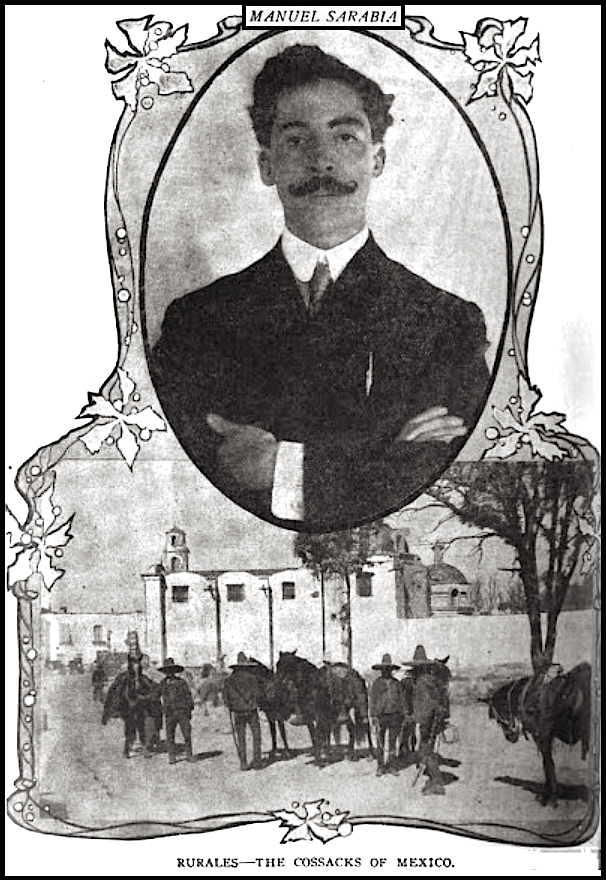
During the month of July 1907, Mexican Patriot Manuel Sarabia was arrested without warrant from off the streets of Douglas, Arizona, driven across the border, and handed over to Mexican rurales. We offered Part I of his telling of that event in Tuesday’s Hellraisers, and complete the story of his ordeal below.

From the International Socialist Review of May 1909:

[Manuel Sarabia Turned Over to Mexican Rurales]

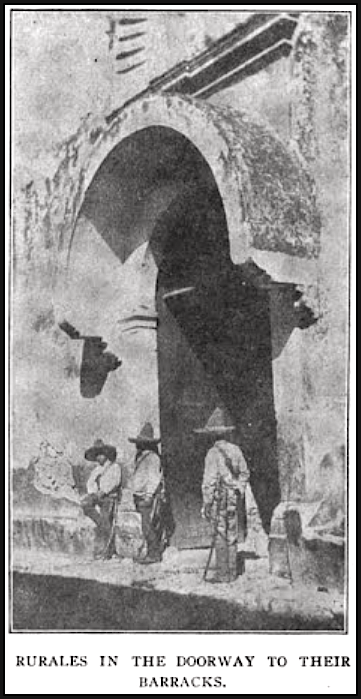
It was a short, quick ride—not more than five minutes in time—when the brakes of the machine brought us to a stop. I was lifted from my seat and helped out upon the ground. A familiar jingle struck my ear. Yes, there they were—bridles and spurs—the rurales!

https://play.google.com/books/reader?id=Z6o9AAAAYAAJ&printsec=frontcover&pg=GBS.PA857

They pulled the handkerchief from my eyes, and my fate was before me. Armed with carbines whose barrels glinted in the moonlight, ten big-hatted rurales sat upon their ponies, in a half circle, facing me. Two of them were busy with a riderless mule. I quickly guessed what was to be his burden—my poor, unwilling body.

Quick orders passed to the men from their officer, and I was lifted to the mule’s saddle. With a piece of rawhide they bound my feet together under the mule’s belly, jerked it tight until the thongs cut into my flesh, and then mounting their horses waited the command to commence the night’s ride.

THE MAN IN THE CARRIAGE.

I had been delivered to the rurales at a small border town of a hundred adobe houses called Agua Prieta, governed by one Laguna, the jefe de policia. Standing a short distance down the street, close to the custom house, I noticed a carriage. As soon as the officer saw me securely tied on the mule, he loped his horse to the side of this vehicle and, after saluting those in the interior, received instructions which set our cavalcade in motion, the carriage leading the way.

My mule was a stubborn beast and could only be jerked into a racking trot with the aid of a stout riata which the rurale in front had bound to the pommel of the saddle. Tied as I was, not able to sit easily to the gait of the galling brute, I was soon worn to the point of agony. My pleadings with the rurales to either go at a lope or slow down to a walk, brought no response but curses, and I closed my mouth and gritted my teeth to deaden the pain.
Continue reading “Hellraisers Journal: From the International Socialist Review: “How I Was Kidnaped” by Manuel Sarabia, Part II”

Hellraisers Journal: From the International Socialist Review: “How I Was Kidnaped” by Manuel Sarabia, Part I

Share

Quote Mother Jones Save Our Mexican Comrades, AtR p3, Feb 20, 1909———-

Hellraisers Journal – Tuesday May 11, 1909
Manuel Sarabia Tells Story of Illegal Arrest and Deportation

During the month of July 1907, Mexican Patriot Manuel Sarabia was arrested without warrant from off the streets of Douglas, Arizona, driven across the border, and handed over to Mexican rurales. We offer Part I of his telling of that event below, and will complete the story of his ordeal tomorrow.

From the International Socialist Review of May 1909:

Manuel Sarabia, Rurales, ISR p352, May 1909
—–

How I Was Kidnaped

STORY OF MY ESCAPE FROM THE RURALES AND
HERMOSILLO PENITENTIARY
—–

BY MANUEL SARABIA
—–
Continue reading “Hellraisers Journal: From the International Socialist Review: “How I Was Kidnaped” by Manuel Sarabia, Part I”

Hellraisers Journal: From the International Socialist Review: John Murray on the Prisons of Diaz, Part III

Share

Quote Freedom Ricardo Flores Magon, ed, Speech re Prisoners of Texas, May 31, 1914———-

Hellraisers Journal – Tuesday April 6, 1909
John Murray on the Horrors of the Private Prisons of Diaz, Part III

From the International Socialist Review of April 1909:

Mex Rev, Diaz Prison by Murray, ISR p737, ISR Apr 1909

[Part III, Conclusion]

[John Murray’s interview with the escaped prisoner, Antonio, continues:]

The sick man’s pauses in this narrative were frequent. At times the old lady give him water to drink, and then again he would take two puffs at a cigarette rolled by the president, all of which kept him going to the end of his story.

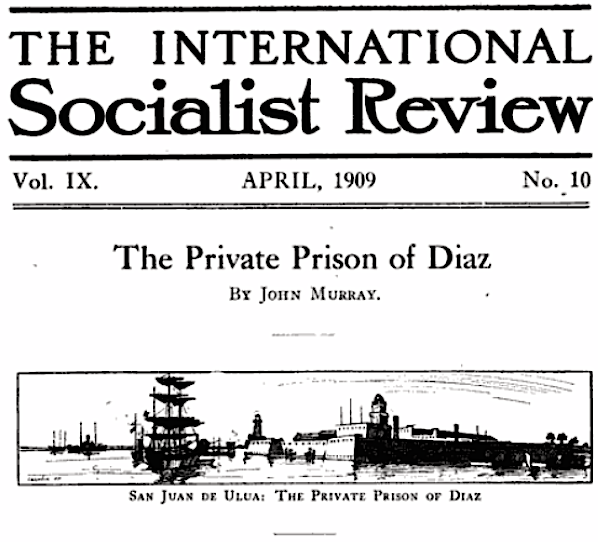
We were accused of participating in the rebellion started in September, 1906, by the Junta Revolucionaria Mexicana in Jimenez, and in Acayucan. Chained in gangs with two hundred others, we were brought to the fortress and political prison of San Juan de Ulua.

Some of us were betrayed by that Judas, Captain Adolfo Jimenez Castro, an officer of the post at Cuidad Juarez, while others were betrayed by Trinidad Vasquez at Cananea.

Among the number were persons entirely innocent of any participation in the rebellion, but they received neither consideration nor mercy, and, like many of us, saw their homes burnt by the soldiery and their families left to starve.

Continue reading “Hellraisers Journal: From the International Socialist Review: John Murray on the Prisons of Diaz, Part III”

Hellraisers Journal: From the International Socialist Review: John Murray on the Prisons of Diaz, Part II

Share

Quote R Magon re John Murray, ISR p643, Mar 1909———-

Hellraisers Journal – Monday April 5, 1909
John Murray on the Horrors of the Private Prisons of Diaz, Part II

From the International Socialist Review of April 1909:

Mex Rev, Diaz Prison by Murray, ISR p737, ISR Apr 1909[Part II]

[John Murray at San Juan de Ulua Prison, continues speaking with the sympathetic soldier…]

Without a word the soldier turned and walked towards the archway. I followed at his heels and we made our way around outside the walls, entered the arsenal and climbed an inner staircase to the battlements of the fortress.

Pointing out to sea, my guide showed me a small man-of-war coming into the harbor.

“That’s the ‘General Bravo’—look at it. Keep looking at it, senor, and while we are here alone I will stand behind your back and tell you all I know of the martyrs imprisoned in Ulua.

The friends of Magon in the army are many. Here, in Ulua, all would be glad to see a way out of this hell—but will it ever come?”

I answered as I believed, in all sincerity, “It will come,” and with a look of encouragement the young soldier went on:

Six months ago I came to Ulua from Sonora, and never once have I seen the political prisoners. But this I saw with my own eyes:

Late on a Sunday afternoon, a boat with two occupants came rowing towards the guardhouse of the west side landing. I saw it before the others, being far-sighted, and this my first day of guard duty on the island. As the boat touched the pier, a white-haired lady wrapped in a black shawl, and trembling with age, was just able to mount from the rocking gunnel to the first stone step, where she sank down, panting and exhausted. The oarsman was a small, black Indian from the mountain tribes near Orizaba. Martin Jose Pico, our hook-nosed, thief-of-a-sergeant—ration-robbing is his trade-roughly demanded her pass, but she had none.

This was such a strange occurrence—a white-haired woman of over eighty years trying to gain entrance to the prison without credentials—that the officer of the day was summoned.

Captain Garcia likes not old women, and to the black figure seated at his feet on the stone step, his words were short and sharp:

“Speak! What do you want?”

“To see a boy who is imprisoned here,” replied the trembling, low-toned voice of the old lady.

“A boy? We have no boys. Who is he?” testily demanded the officer.

Juan Sarabia,” replied the white-haired woman.

At this name the captain took a sudden step back, for of all the prisoners most strictly kept “incommunicado” is this famous revolutionist, Juan Sarabia. Even to mention his name is forbidden the soldiers of Ulua.

White-faced, the officer gripped the old lady by her arm and stuttered a rasping question:

“Fool! who are you?”

“His mother,” came the answer.

Continue reading “Hellraisers Journal: From the International Socialist Review: John Murray on the Prisons of Diaz, Part II”

Hellraisers Journal: From the International Socialist Review: John Murray on the Prisons of Diaz, Part I

Share

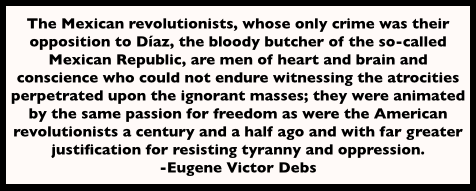
Quote EVD Mex Revolutionairies, AtR p2, Oct 10, 1908———-

Hellraisers Journal – Sunday April 4, 1909
John Murray on the Horrors of the Private Prisons of Diaz, Part I

From the International Socialist Review of April 1909:

Mex Rev, Diaz Prison by Murray, ISR p737, ISR Apr 1909
—–

[Part I]

Mex Rev, Diaz Prison by Murray, A, ISR p737, ISR Apr 1909S soon as we were alone at the end of the pier breasting the Vera Cruz harbor, the little, pock-marked secretary of the revolutionary group pulled from his pockets a piece of grey stone and held up before my eyes.

“Look at that!”

I took the fragment from his slim, brown fingers and turned it over curiously. It was a piece of coarse, grey coral.

“See! It’s porous. Now do you understand? The whole prison’s built of it.”

With an upward jerk of his hand he leveled an accusing finger at the white-washed walls of the fortress-prison shining in the sun across the waters of the blue bay.

“There it stands! On that island, yonder! San Juan de Ulua! The foulest spot in all Mexico—Diaz’ private prison for his political enemies!”

The corners of the man’s mouth drew down into a snarl and his eyes narrowed to burning slits of hate as he gazed in the direction of the fortress.

Continue reading “Hellraisers Journal: From the International Socialist Review: John Murray on the Prisons of Diaz, Part I”

Hellraisers Journal: “Mexico’s Peon-Slaves Preparing for Revolution” by John Murray, Part III: the Mexican Revolutionaries

Share

Quote Freedom Ricardo Flores Magon, Speech re Prisoners of Texas, May 31, 1914———-

Hellraisers Journal – Wednesday March 3, 1909
Mexico City -John Murray Meets with Mexican Revolutionaries

John Murray recently returned from Mexico and has written an article about that experience for this month’s edition of the International Socialist Review. Below we offer the conclusion of that article in which Mr. Murray meets with a group of Mexican Revolutionaries.

Mexico’s Peon-Slaves Preparing for Revolution

BY JOHN MURRAY
[Part IIII]
—–

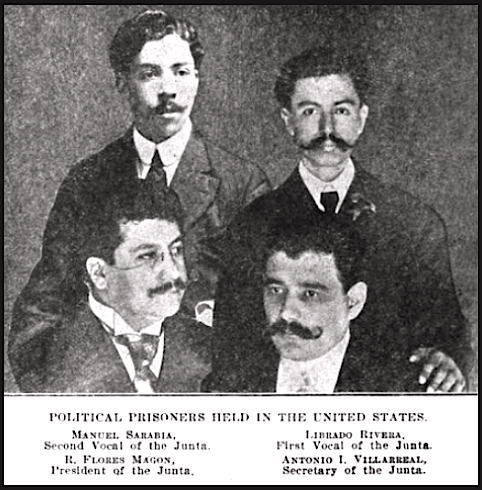
Mex Rev, Sarabia, R Magon, Rivera, Villarreal, ISR p642, Mar 1919

We turned into the mouth of a narrow street, cobbled from wall to wall. Herbierto knocked at a door. A window swung open above our heads and a voice called out, “Is that the doctor?”

“It is,” answered Senora Moreno. “Is the child still sick?”

“Yes, come in quickly,” replied the watcher, closing the window.

“A sick child?” I questioned, as the door opened and we stumbled through the dark passageway.

“No,” meaningly answered Herbierto. “A sick country, with the revolution as the only medicine.”

And the woman added: “That was the pass word.”

Around an oblong table in the room we entered sat two dozen men, as dissimilar in their appearance as their native land is varied, Mexico is half desert and half tropics and breeds its people small, light-skinned and still-tongued, or swarthy, heavy-boned and voluble, as unlike each other as sand and sage brush are to mountain torrents and black jungle-land.

“A friend from Los Angeles,” explained Herbierto to the group watching me in surprised silence, but as he read my credentials from Magon their faces changed and when the signature was reached, a slim, black-eyed boy warmly grasped my hand, asking the question which seems to echo through Mexico:

“How is Ricardo?”

I gave them greetings from their imprisoned leader. He was their hero, their master-mind, whose years of unflinching struggle against the crushing powers of the Dictator had kept hope in Mexico alive; and in return I heard the news of the revolutionary movement.

Continue reading “Hellraisers Journal: “Mexico’s Peon-Slaves Preparing for Revolution” by John Murray, Part III: the Mexican Revolutionaries”

Hellraisers Journal: “Mexico’s Peon-Slaves Preparing for Revolution” by John Murray, Part II: The Rio Blanco Massacre

Share

Quote John Murray re Rio Blanco Martyrs, ISR p653, Mar 1909———-

Hellraisers Journal – Tuesday March 2, 1909
At Mexico City – John Murray Learns Details of Rio Blanco Massacre

John Murray recently returned from Mexico and has written an article about that experience for this month’s edition of the International Socialist Review. Below we offer part two of that article in which Mr. Murray arrives in Mexico City and hears the story of the Rio Blanco Massacre.

Mexico’s Peon-Slaves Preparing for Revolution

BY JOHN MURRAY
[Part II]
—–

Mex Rev, Sarabia, R Magon, Rivera, Villarreal, ISR p642, Mar 1919—–

Black clouds gathered against the mountains and as the City of Mexico was reached the deluge broke.

A sandal-footed, brass-tagged “cargador” seized my bags and carried them from the Pullman’s steps to a blue-flagged coach.

I kept my face glued to the carriage window and asked myself this question: “Mexico, Mexico, Mexico is—what?” The answer seemed to rise from the passing throng of bent-backed, human burden bearers, “Mexico is a land of cargadores.”

With leather thongs passed across their foreheads and around their heads, cargadores carrying as much as three hundred pounds, trotted by without a stumble. And in the steps of these men followed the women and children likewise loaded.

In no other country in the world does the human back so stagger under a dead weight as here in Mexico.

Arriving at the hotel in front of the Alameda, I went immediately to my room, locked the door and got out my list of addresses in cipher. It was a wearisome task to figure them out, one by one, but I dared not run the risk of being taken by the police and having them find names of Mexican revolutionists given me by the Junta in Los Angeles—that would mean prison for all. One person in Mexico in particular had been recommended to me by Magon. I would see him first.

Continue reading “Hellraisers Journal: “Mexico’s Peon-Slaves Preparing for Revolution” by John Murray, Part II: The Rio Blanco Massacre”

Hellraisers Journal: From the International Socialist Review: “The Tour of the Red Special” by Charles Lapworth

Share

Quote EVD re Red Special, AtR p2, Sept 19, 1908
~~~~~~~~~~~~~~~~~~~~~~~~~~~~~~~~~~~~~~~~~~~~~

Hellraisers Journal – Friday December 4, 1908
The Journey of Red Special as Told by Charles Lapworth

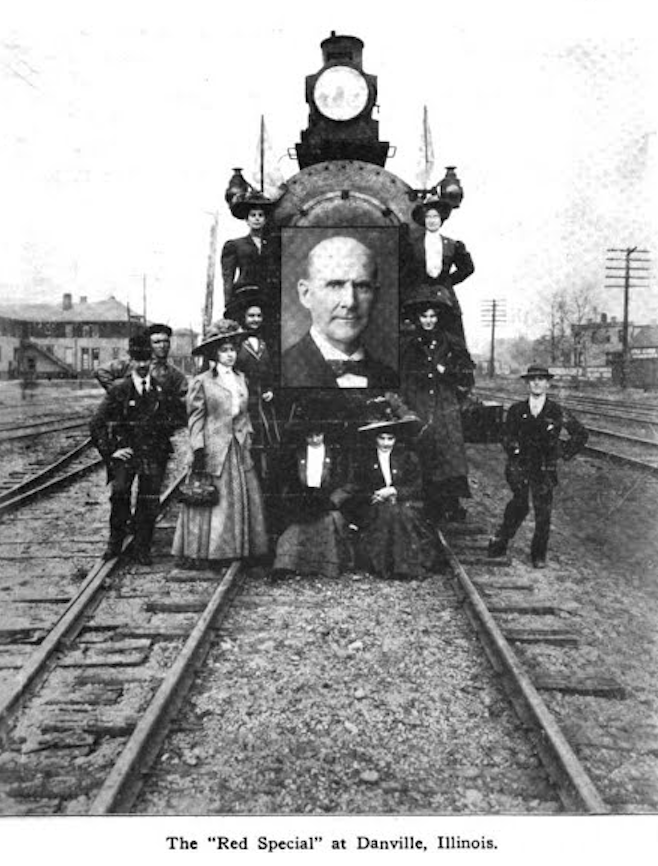
In this month’s edition of the Review, Comrade Lapworth tells the inspirational story of the journey of the Red Special which carried Eugene Debs, the presidential candidate of the Socialist Party of America, across the nation, ending with a big rally and last campaign speech at Terre Haute.

From the International Socialist Review of December 1908:

The Debs Red Special

EVD Red Special Cover Photo at Danville, ISR p1033, Dec 1908

Continue reading “Hellraisers Journal: From the International Socialist Review: “The Tour of the Red Special” by Charles Lapworth”

Hellraisers Journal: From the Socialist Review: Vincent St. John on the IWW’s Revolutionary Industrial Unionism

Share

Quote fr IWW Preamble, IUB July 11, 1908
~~~~~~~~~~~~~~~~~~~~~~~~~~~~~~~~~~~~~~~~~~~~~
Hellraisers Journal – Thursday September 24, 1908
Industrial Unionism and the Revolutionary Labor Movement of the World

IWW Gen Adm Emblem, IUB, Mar 14, 1908

With the fourth annual convention of the Industrial Workers of the World now underway at Brand’s Hall in Chicago, Illinois, we find this a good time to republish the following article by Vincent St. John wherein he discusses Industrial Unionism as practiced by the I. W. W. Fellow Worker St. John currently serves as the I. W. W.’s General Organizer and Assistant Secretary-which position may change by the end of this year’s convention.

From the International Socialist Review of September 1908:

The Economic Argument for Industrial Unionism.
[by Vincent St. John]

IU by St J, ISR p172, Sept 1908HE SUBJECT of industrial unionism is to-day receiving the attention of the revolutionary labor movement of the world. And the opposite wing of the labor movement, the conservatives, are likewise studying it, but with the aim of defeating its revolutionary object.

Different schools of industrial unionism are springing up. This in itself is a proof that the subject is of general interest, and that it is forcing itself upon those in the labor movement who formerly waved it aside as a visionary and impracticable scheme.

As the Industrial Workers of the World is to-day the only organization of general scope, in the United States, that strictly adheres to the revolutionary principle of industrial unionism, it justly claims the right to speak with authority on the subject. Without revolutionary principles, industrial unionism is of little or no value to the workers.

Continue reading “Hellraisers Journal: From the Socialist Review: Vincent St. John on the IWW’s Revolutionary Industrial Unionism”