 —————
—————
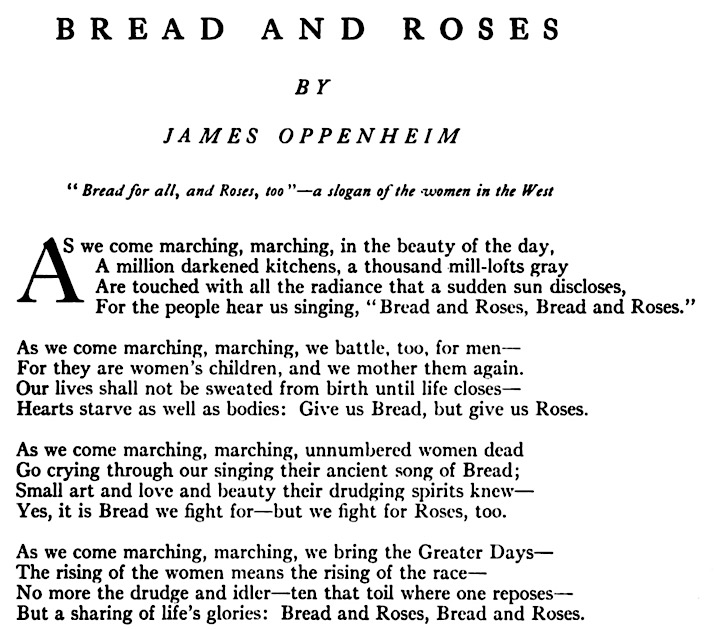
From The American Magazine of December 1911:
Judy Collins – Bread and Roses – Judy Collins
Lyrics by James Oppenheim
—————
Judy Collins – Bread and Roses – Judy Collins
Lyrics by James Oppenheim
 —————
—————
Hellraisers Journal – Sunday January 21, 1912
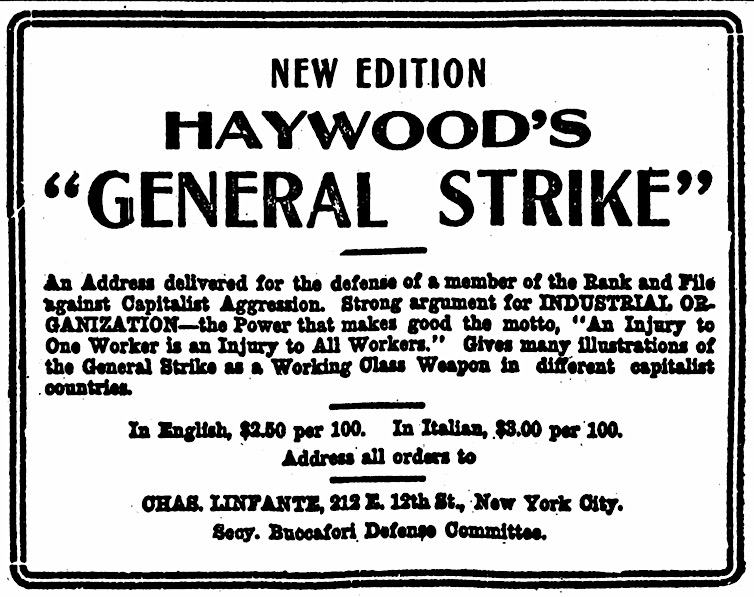
“General Strike” by Big Bill Haywood, New Edition
From the Spokane Industrial Worker of January 18, 1912:
 —————
—————
Hellraisers Journal – Saturday January 20, 1912
Lawrence, Massachusetts – Militia Attacks Strikers; Strike Committee Issues Appeal
From The Boston Daily Globe (Evening) of January 17, 1912:
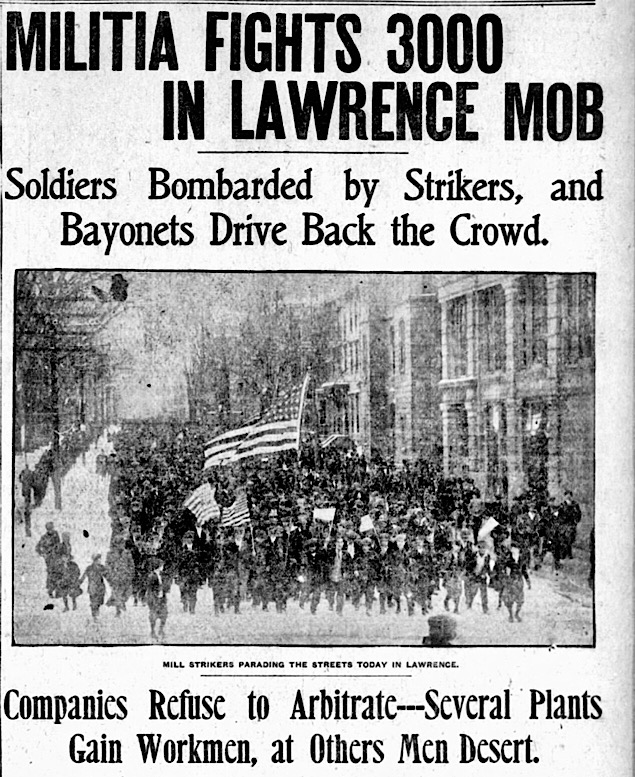
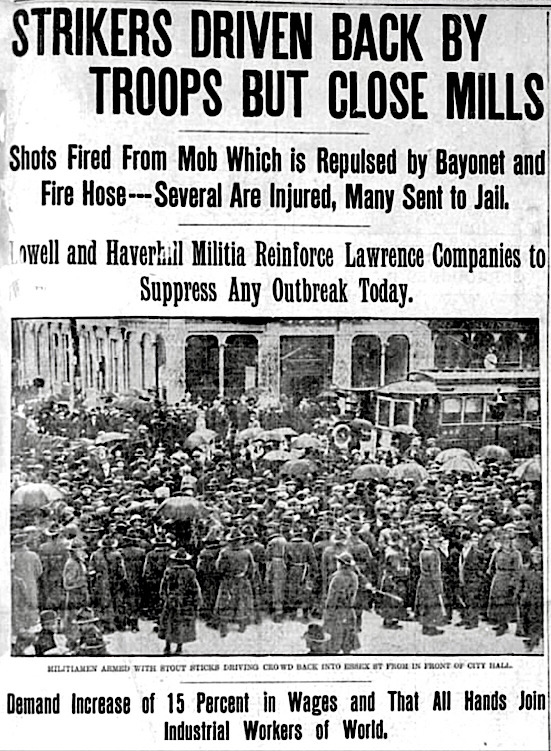
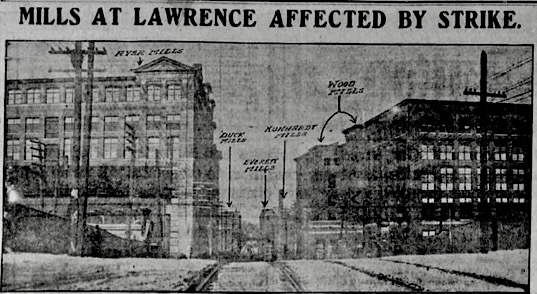
LAWRENCE, Jan 17-Conflict between the textile strikers and State militiamen who have the mill district of the city in charge broke out afresh today. A mob of 3000 strikers who had paraded through the city was subdued only by the vigorous use of clubs and swords by members of Battery C, Light Artillery, of Lowell, when the strikers entered the mill district, within which zone martial law has been declared…
The larger part of the crowd was driven back, and the combat ceased for a moment. After being forced up Hampshire at the strikers began to bombard the soldiers with ice, bricks and tin cans, several of the militiamen being hit. None suffered serious wounds. Many of the strikers sustained injuries to heads and bodies by clubs and swords, and two had their faces badly cut in the same manner. Several children were trampled upon in the melee.
———-
Flag to Protect Them.
The strikers wee finally allowed to go up Canal st and when they reached the Lawrence Duck mill bridge, half a mile away, they made an attempt to cross [but Lieut. Davies] ordered the strikers to continue down Canal st without crossing the bridge.
An interesting episode occurred here. One of the strikers, who was carrying a big American flag, held it up and cried out, “This is the American flag; it can go anywhere.”…
In another moment Lieut Davis had ordered the men to “charge bayonets,” and the flag was trailed in the snow by the Italians, who had stampeded when the strikers were forced to retreat before the bristling steel. No trouble developed beyond this point, the crowd ultimately dispersing.
———-
[…..]
Appeal to Non-Strikers.
An appeal issued today to English speaking and other mill operatives not on strike through the agency of the strike committee which was distributed on the picket lines and at meetings during the day was in part as follows:
To all workers, men and women, and all those who sympathize with their aspirations for a better day:
We, striking textile workers, who in the past suffered untold exploitations, outrages and insults, have reached the limit of human resignation and endurance. We submit to a candid world in brief our grievances and reason for revolt. Our wages have been gradually reduced, machines have been speeded to the point that in order to keep up with them we have o strain to the limit of endurance.
Taking advantage of a law that was passed to reduce the long working days of women and children, the mill owners reduced our wages and average of 5 percent.
Urged to “Strike all Together.”
According to the figures of the mill owners themselves, last pay day, Jan. 11, 25,000 workers received a total wage of $150,000, or an average wage of $6 for a week’s work.
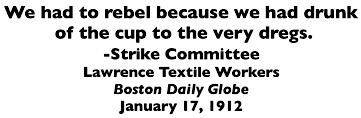
We had to rebel because we had drunk of the cup to the very dregs.
We are opposed to rioting, opposed equally and strenuously, even though it hides its brutalities under the cloak of law and order and armed with bayonets.
These reasons and others too numerous to mention are sufficient, we believe, to entitle us to the support of all fellow-workers and friends.
We urge and plead with all who wish our case well to express themselves in words and deeds in no mistaken way.
Workers, remember! An injury to one is an injury to all. Strike all together; stick together. All to victory.
(Signed)
Strike Committee.—————
Note: emphasis added throughout.
—————
Hellraisers Journal – Friday January 19, 1912
Lawrence, Massachusetts – Young Striker, Dominico Rapsardo, Bayoneted by Soldier
From The Boston Globe (Morning Edition) of January 16, 1912:
By JOHN W. CARBERRY.
Lawrence, Jan 15-In an attempt to prevent the operation of the woolen mills today, strikers and their sympathizers incited a riot which compelled the City Government to summon police aid from Salem, Lynn, Haverhill, Everett and Lowell, and to call into service eight companies of militia……
Today, in the clash between militiamen and those supporting the cause of the striking textile workers, one youth, Dominico Rapsardo, was stabbed in the breast by a soldier, and is seriously, though not mortally, wounded.
Many others were injured by being struck with the butts of rifles and the clubs of policemen.
More than 30 were arrested charged with damaging property and disturbing the peace…
—–
[…..]
Rapsardo Is Struck Down.
[About 10 a. m., at the Atlantic mills, militiamen with fixed bayonets, charged the strikers and drove them across the bridge at Canal st.]
In the charge Dominico Rapsardo of 51 Essex st was wounded. The crowd was packed so densely that those in front did not fall back quickly enough to suit the soldiers, and young Rapsardo received a thrust from a bayonet in his left breast. he fell fainting to the street, and was hastily driven to the General Hospital, badly injured. The bayonet had penetrated the flesh between the ribs, but doctors believed that no vital organ had been pierced.
[…..]
—————
Hellraisers Journal – Thursday January 18, 1912
Lawrence, Massachusetts – Fellow Worker Joe Ettor Urges Strikers to Fight On
From The Boston Sunday Globe of Jan 14, 1912:
Mayor Scanlon Addresses Big Mass Meeting.
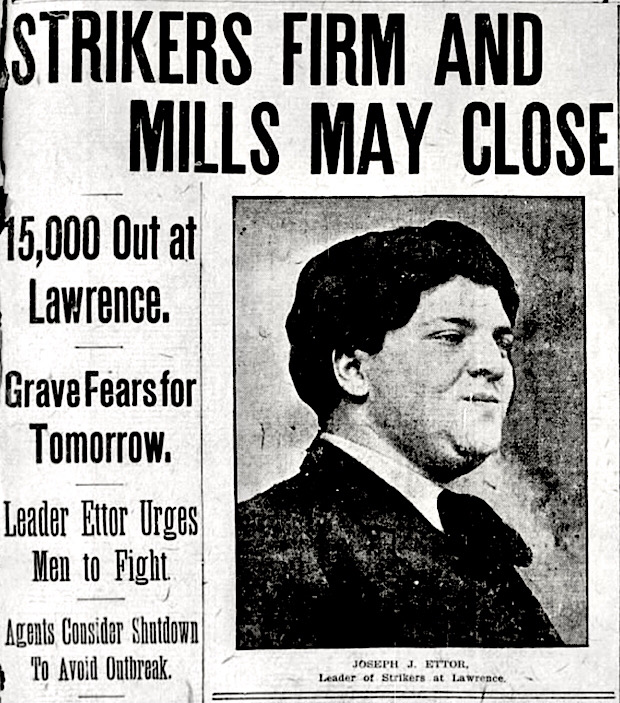
———-LAWRENCE, Jan. 13-Tonight sees approximately 15,000 Mill operatives out of employment and grave apprehensions are felt that this number may be further increased Monday morning. Some of the mill agents and owners contemplate a general shut down. About 4000 of the men now out are strikers and the rest have been forced out by the closing of several mills.
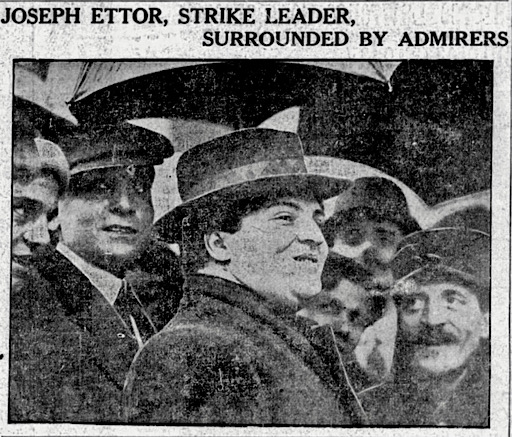
Joseph J. Ettor of New York, a member of the Executive Board of the Industrial Workers of the World, who has assumed the position of leader of the strikers, in an impassioned speech at a mass meeting in the City Hall this afternoon, urged his audience of 1300 men and women to bend their efforts toward preventing any secession from their ranks…..
[He exhorted:]
Monday morning you have got to close the mills that you have caused to shut down tighter than you have them now.
It is up to you to encourage all to stand by the cause of the workers and get them not to go to work Monday morning. If you want to avoid blood shed remove the cause.
You cannot win by fighting with your fists against men armed or the Militia, but you have a weapon that they have not got.
You have the weapon of labor and with that you can beat them down if you stick together.
[Mayor Scanlon warned that the strikers must obey the law, to which Ettor replied:]
Must Be Firm, Exhorts Ettor.
Leader Ettor said that he, too, was for calmness and for anything that would prevent bloodshed, but, nevertheless, he must insist that whatever blood was spilled was not on the head of the working people, but on those who ground down the laboring class.
[He declared:]
While we wish to be cool and clam, at the same time we must be determined to win the contention for which you have struck. We are here to consider your interests alone. It’s up to you to win, and to do so you must hold together.
He was enthusiastically received and when he later addressed the Italians in their natural tongue there was further demonstration.
[Gilbert Smith, secretary-treasurer of Local 20, I. W. of W., presided at the meeting. Also speaking were Joseph Langiet (French), August Detollanaere (Belgian), Charles L. Webert (Polish), Michael Rusecky (of United Mine Workers, Pittston, Penn., Lithuanian).]
At the conclusion committees were chosen to represent the different nationalities involved in the strike in arranging a plan of action to be reported to a mass meeting in Franco-Belgian Hall tomorrow evening.
—————
 ———————-
Hellraisers Journal – Tuesday January 17, 1922
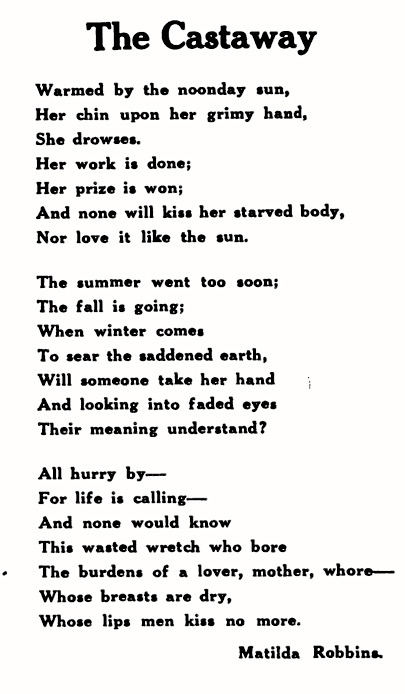
”The Castaway” -a Poem by Matilda Robbins
From The Industrial Pioneer of January 1922:
 —————
—————
Hellraisers Journal – Saturday January 13, 1912
New York City – Haywood and Hillquit Debate Labor Question at Cooper Union
From The New York Call of January 12, 1912:
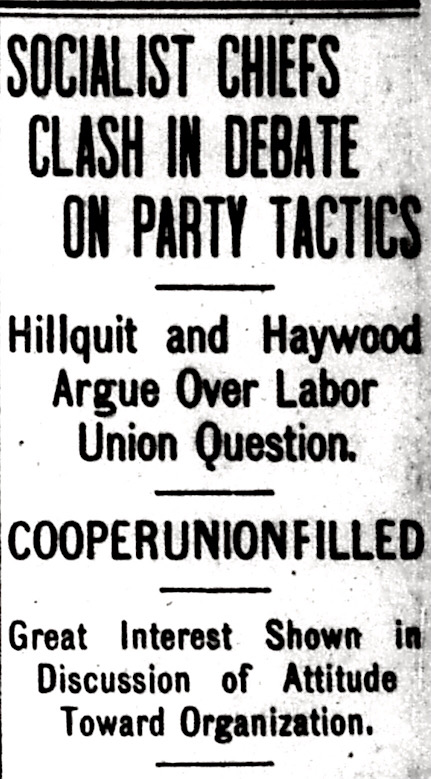
The first of a series of meetings for the discussion of the various problems confronting the Socialist party of America was held in Cooper Union last night with Julius Gerber, organizer of Local New York, which has arranged these meetings, presiding.
The big hall was jammed to the doors and the audience followed every word of the protagonists with breathless interest.
The meeting was a sort of family affair, only holders of red cards being allowed in the hall. A few Socialist Labor party men smuggled themselves into the crowd on borrowed S. P. cards. They were promptly recognized and Chairman Gerber asked that they leave the hall, which they did.
The subject of the discussion last night was “What shall the attitude of the Socialist party be toward the economic organization of the workers?”
William D. Haywood and Morris Hillquit were the debaters. Each of them was given an hour, the time being divided as follows: half an hour for the outline of the debate by each speaker, then each one got twenty minutes for rebuttal and finally ten minutes for closing the discussion.
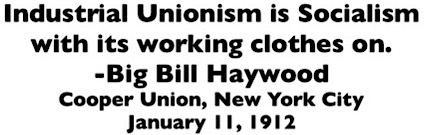
Haywood opened the discussion. The burden of his arguments in the main was that the Socialist party should go among the workers and begin a propaganda for industrial unionism, for one big union. He assailed the American Federation of Labor and said that the Socialist party is acquiescing in the policy of the American Federation, which was a distinctly anti-Socialist and capitalist policy.
Industrial Form Superior, But-
Hillquit in his reply to Haywood said that there can be no question in the mind of any Socialist that the industrial form of organization is superior to the craft organization. But he did not believe that the Socialist should begin preaching industrialism outside of organized labor. The Socialist party, he said, should keep up its policy of trying to reach the workers in their present unions. The policy has been successful, Hillquit said, as is shown by the fact that every union affiliated with the American Federation of Labor has Socialists in important positions, as well as in the rank and file. These men have been elected to these positions by the rank and file, he said, because they were Socialists.
[…..]
Haywood’s Final Reply.
Haywood took the floor to reply in his final ten minutes.
He declared there is nothing in common between the policies of the American Federation of Labor and the Socialist party. The former, he said, is craft conscious as opposed to the class consciousness of the latter. He went on to show that by high initiation fees, curtailment of apprentices and even closing of books, membership is kept down and would-be members excluded…..
He went on to say that he had never advocated anything else but the organization of the workers as one man, and that he had believed and still believes the craft form of organization to be “ethically unjustifiable and tactically suicidal.”
At the same time he urged the necessity for political action, the political power to be used, not after the social revolution, but under present conditions, citing as an instance of its use the turning of the police against strikebreakers instead of against strikers.
Haywood explained that in criticizing the American Federation of Labor he criticized its leaders, who were members of the Knights of Columbus and of the Civic Federation executive.
Hillquit Finds Mystery Deep.
In taking the floor to close the debating. Hillquit declared that the mystery had deepened, seeing that Haywood did not oppose the rank and file of the A. F. of L. but the members of the Executive Committee of the Civic Federation…..
The difference between the speaker’s policy and Haywood’s, Hillquit declared, was that the former, while condemning the policies of Samuel Gompers, made efforts to educate the rank and file, while Haywood was ready to kick over and destroy the whole A. F. of L.
[…..]
[Emphasis added.]
 ———————-
Hellraisers Journal – Saturday December 30, 1911
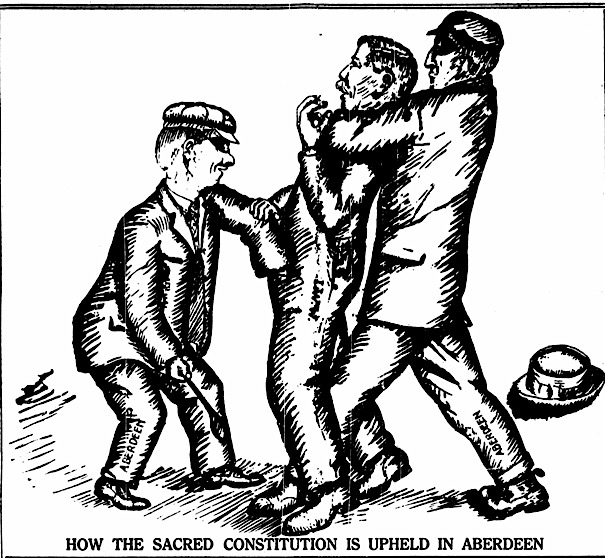
Aberdeen, Washington – The Constitution as Upheld for Fellow Workers
From the Spokane Industrial Worker of December 28, 1911:
——-
WAKE UP GOVERNOR HAY.
—————Tacoma, Wash, Dec. 17, 1911.
Honorable Marion E. Hay,
Governor of the State of Washington,
Olympia, Wash.Sir:-
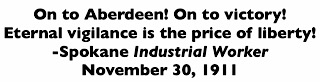
We, the undersigned, do hereby respectfully call your attention to the lawlessness which, as we are informed, now exists and for some time past existed in Aberdeen, Chehalis county, in this state.
We herewith enclose affidavits to show that workingmen who have been charged with no crime whatever have been compelled to leave said city by an irresponsible mob of brutal men armed with guns and cubs-a proceeding for which we are advised, there is no authority in law and which, we submit, is to a marked degree, against the peace and dignity of our state.
Our laws, as we are informed, provide that persons charged with a crime may be arrested and after being found guilty in the manner prescribed by law, may be punished. Such punishments, we are informed, may be fine, imprisonment, the infliction of death penalty upon the offender, and in certain cases the performance of an operation to prevent procreation.
There is no law providing that persons, guilty or innocent, desirable or undesirable may be run out or town.
Trusting that you may, in the exercise of your authority as chief executive of our state, see your way clear to suppress all lawlessness and assuring you of our ability and willingness to furnish much or evidence of the character herewith enclosed, we beg to remain, respectfully yours,
ED GILBERT.
A. J. AMOLSCH.
MANS BECKER.[Emphasis added.]
———-
 ———————-
Hellraisers Journal – Thursday December 14, 1911
From Yale, Oklahoma, Frank Little Exhorts Men Not to Scab on Fellow Workers
From the Payne County Farmer (Yale, Oklahoma) of December 13, 1911:
The Explanation.
Editor Payne Co. Farmer: In the issue of Dec. 6 there was a letter from Texas, by Mrs. J. B. MacClain. She states that, in that county, the sawmills are idle for the want of men.
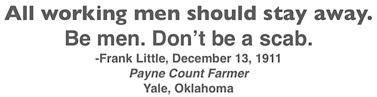
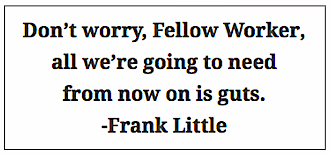
The sawmill worker of Texas and Louisiana have been fighting the lumber trust, trying to force them to pay living wages. There has been a strike on in that country for some time. All working men should stay away. Be men. Don’t be a scab.-F. H. Little, organizer of the I. W. W.
—————
[Photograph added.]
 ———————-
Hellraisers Journal – Monday December 12, 1921
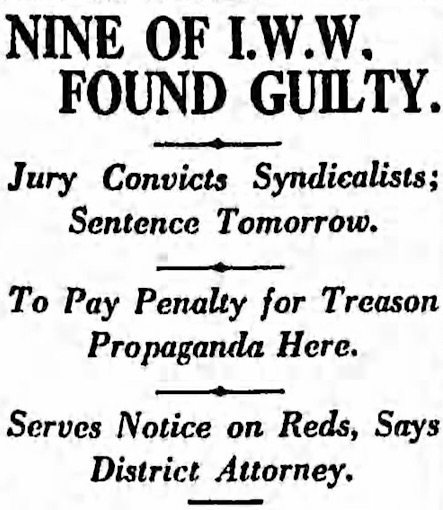
Los Angeles, California – Fellow Workers Found Guilty of Criminal Syndicalism
From The Los Angeles Times of December 8, 1921:
Nine defendants in the I.W.W. criminal syndicalism, case in Judge Willis’s court were found guilty last night. The Jury found Manuel Engdal not guilty since he not only denied membership in the organization, but a membership card in his name was not produced. The eleventh defendant, Thomas Bailey, was dismissed several days ago.
The defendants acted as their own attorneys. Most of them were charged with two counts, membership in the I.W.W. and treasonable propaganda. They will be sentenced tomorrow at 9:30 a.m. The convicted men are William Baker, Ben Whittling, R. Bendig, Abraham Shocker, Henry Matlln, James Olson, W. I. Fruit, Louis Allen and Edward Peters. The case has been under way since November 10. Dep. Dist.-Attys. Turney and McCartney conducted the prosecution.
“I regard this conviction as one of the most important ever secured in the courts of this country,” said Dist.-Atty. Woolwine last evening. “It serves notice upon the Reds of the world that they cannot with impunity enter America and here hatch plots and schemes for the overthrow of our government and institutions.”
—————