WE NEVER FORGET: Four Standard Steel Car Strikers Gunned Down by Company Gunthugs & City Police of Hammond

Share

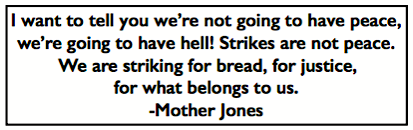
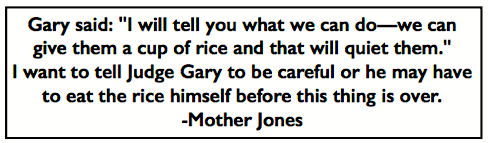
Quote Mother Jones, Pray for dead, Ab Chp 6, 1925———-

We Never Forget, ed Sept 9, 1919, Hammond IN, 4 Strikers Killed———-

WE NEVER FORGET
The Hammond Massacre of September 9, 1919

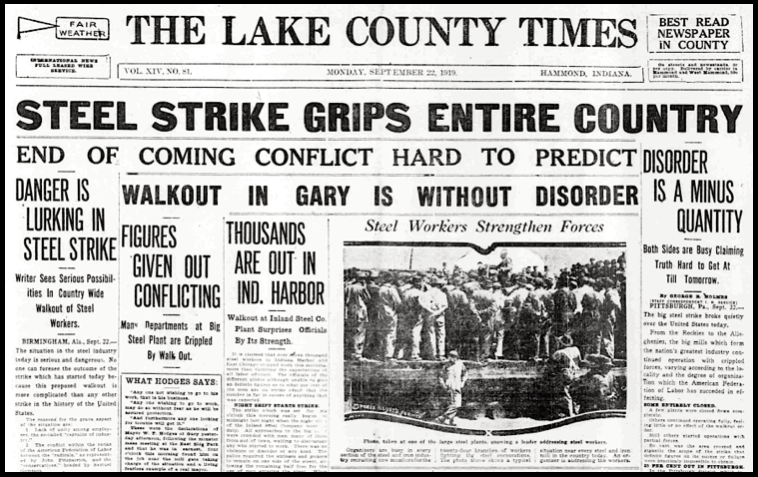
Headline from Hammond’s Lake County Times of September 9, 1919:

WNF, Hammond IN Dead Litter Street, Lake Co Tx p1, Sept 9, 1919

From the Locomotive Firemen’s Magazine of September 15, 1919:

The Hammond Strike

WNF, Hammond IN List of Dead, Lake Co Tx p1, Sept 9, 1919

At Hammond, Ind., four strikers were killed and two score or more seriously wounded in a fight on September 9, in which, according to press reports, the steel company’s armed guards and city police fired more than one hundred shots.

The strike at Hammond started on August 18, when approximately 2,000 of the Standard Steel Car Company’s employes demanded the eight-hour day, recognition of their union and that their pay be raised from the present rate of 42 cents an hour to 50 cents an hour. On August 21 eleven companies of militia were quartered in Hammond and these state troops remained there a week, leaving on August 28. There was no disorder until September 2, when strike breakers were put to work and the strikers picketed the plant.

Mayor Brown of Hammond determined not to ask for state troops again, press reports state, and relied on policemen armed with sawed-off shotguns, and armed guards employed by the Standard Steel Car Company to maintain order.

Continue reading “WE NEVER FORGET: Four Standard Steel Car Strikers Gunned Down by Company Gunthugs & City Police of Hammond”

WE NEVER FORGET: Young Men Shot Down by State Guardsmen During the Boston Police Strike of September 1919

Share

Quote Mother Jones, Pray for dead, Ab Chp 6, 1925———-

WNF Six Young Men Killed During Boston Police Strike, Sept 10-13, 1919———-

WE NEVER FORGET
Young Men Shot Down by State Guardsmen
September 10-13, 1919, During the Boston Police Strike

During the Boston Police Strike of 1919, six young men were gunned down by Massachusetts State Guardsmen who had been ordered into the city of Boston by Governor Calvin Coolidge. Five young men, ranging in ages from 15 to 31, were executed for the crime of playing craps on the street corners. One was killed for running away after an argument with a guardsman.

Robert Sheehan-15
Henry Grote-16
Raymond Barnes-18
Gustave Geist-25
Anthony Czar-30
Arthur B. McGill-31

Continue reading “WE NEVER FORGET: Young Men Shot Down by State Guardsmen During the Boston Police Strike of September 1919”

WE NEVER FORGET: Officer Richard D. Reemts Who Lost His Life September 11, 1919, During the Boston Police Strike

Share

Quote Mother Jones, Pray for dead, Ab Chp 6, 1925———-

WNF Richard D Reemts, Sept 11, 1919, Boston Police Strike———-

WE NEVER FORGET
Officer Richard D. Reemts
Who Lost His Life in Freedom’s Cause
September 11, 1919, in the Boston Police Strike

Boston Police after Strike Vote Sept 8, Strike Began Sept 9, 1919

From The Boston Daily Globe
-of September 12, 1919:

Reemts, Striking Policeman
Shot at South End, Dies
—–

[…..]

Striking Policeman Killed

The first shooting affair of yesterday [Thursday September 11th] was very unfortunate for the cause of the striking policemen. The victim was former patrolman Richard Reemts, who was attached to the Roxbury Crossing station.

He was 36 years old, married, and lived at 14 Akron st, Roxbury….

From The Boston Daily Globe of September 13, 1919:

Notice of Death

Reemts-In this city, Sept. 11. Richard D., beloved husband of Catherine Reemts (nee Bresnahan). Funeral on Monday at 8:30 a. m. from his late home, 14 Akron st., Roxbury. Funeral high mass at St. Joseph’s Church, Circuit st., at 9 o’clock. Late member of Division 10, Boston Police Department. Presence of relatives and friends requested. Auto cortege.

Continue reading “WE NEVER FORGET: Officer Richard D. Reemts Who Lost His Life September 11, 1919, During the Boston Police Strike”

Hellraisers Journal: Whereabouts and Doings of Mother Jones for August 1909, Part II: Found in San Antonio, Fighting for Imprisoned Mexican Revolutionaries

Share

Quote Mother Jones Save Our Mexican Comrades, AtR p3, Feb 20, 1909———-

Hellraisers Journal – Monday September 13, 1909
Mother Jones News Round-Up for August 1909, Part II:
-Found in San Antonio, Fighting for Mexican Revolutionaries

From the Beaumont Daily Enterprise of August 20, 1909:

“MOTHER” JONES GETTING BUSY
—–
She Will Actively Enter Fight For
“Liberty in Old Mexico.”

Special to the Enterprise.

Mother Jones, Elkhart IN Dly Rv p2, Crpd, July 19, 1909

San Antonio, Texas, Aug. 19-Much interest has been aroused in the case of Thomas [Tomás] Sarabia and Jose [José] M. Rangel, who are in the county jail charged with violation of the United States neutrality laws, by the arrival of “Mother Jones,” who will hold a series of mass meetings, protesting against the imprisonment of the men and the coming of Andrea Villareal [Villarreal], sister of Antonio Villareal an alleged revolutionist, now in prison in Los Angeles, Cal. The first of these meetings will be held Saturday night [August 21st] in a large tent on East Houston street and will be addressed by “Mother Jones.” Andrea Villareal is expected to arrive Monday.

It is a noteworthy fact that the Mexican population of the city are taking a great interest in the matter pertaining to the imprisoned men. This is particularly noticeable among the laboring class of the Mexicans and the matter is being discussed in all quarters. The wealthy class and also Americans who have financial interests in Mexico are trying to belittle the matter and say it is the work of sensation mongers. They feel confident that the United States will uphold the Mexican government and extradite the men now being held. It is expected that these meetings will do much to encourage the cause of the revolutionists in the proposed overthrow of the Diaz government and will tend to arouse feelings against Diaz. “Mother Jones” says she will have much of interest to say at the protest meeting. “Mother Jones” figured prominently in the strikes in the anthracite regions and the Western Federation of Miners and is accountable for the release of Manuel Sarabia from prison. When Manuel Sarabia, brother of Thomas Sarabia, now in the Bexar county jail was arrested in Douglas, Ariz, two years ago, he was taken into Mexico. It was charged that he was taken across the line without the due process of law, and “Mother Jones” started the first meeting of protest. It resulted in a movement which ended only with a decision by the United States supreme court and Sarabia was returned to the United Sates from a Mexican prison. He met a wealthy Boston girl while in Arizona and married her several months ago. “Mother Jones” will tell the story of the rescue of Manuel Sarabia.

———-

Continue reading “Hellraisers Journal: Whereabouts and Doings of Mother Jones for August 1909, Part II: Found in San Antonio, Fighting for Imprisoned Mexican Revolutionaries”

Hellraisers Journal: Whereabouts and Doings of Mother Jones for August 1909, Part I: Found in Texas, Missouri, & Kansas

Share

Quote Mother Jones, We Will Rest, UMWC Jan 27, 1909———-

Hellraisers Journal – Sunday September 12, 1909
Mother Jones News Round-Up for August 1909, Part I:
-Found Speaking in Texas, Missouri, and Kansas

Mother Jones, Elkhart IN Dly Rv p2, Crpd, July 19, 1909

From The Houston Post
-of August 1, 1909:

Socialist Meeting at Tyler.

(Houston Post Special.)

TYLER, Texas, July 31.-About fifteen campers with outfits from Van Zandt and Henderson counties arrived this evening to attend the socialist encampment which commences Monday and lasts until Saturday of next week. The speakers for the encampment are prominent in the socialist party and includes Colonel Dick Maples, “Mother” Jones and Rev. Mr. Andrews.

———-

From The Kansas City Star
-of August 4, 1909:

“Mother Jones,” the well known Socialist lecturer, is announced for a lecture Friday night in the circuit court room at Independence under the auspices of the Independence Socialist club.

From Appeal to Reason of August 7, 1909:

WESTERN FEDERATION
—–

The convention of the Western Federation of Miners which recently adjourned was the most progressive in the history of that organization. There were some exciting debates and there were some minor elements with extreme tendencies, but on the whole the convention was composed of the clear-eyed, honest and progressive workers whose highest purpose it was to place their organization in the van of the working class movement…..

Mother Jones and Emma F. Langdon were the honored guests of the convention and made rousing speeches to the delegates. Mother is called “The Uncrowned Queen” by the rugged miners of the mountain states who have reason to know her for her fearless and faithful devotion to their interests at a time when it was at the peril of her life…..

From the Kansas City, Kansas, Labor Record of August 13, 1909:

Continue reading “Hellraisers Journal: Whereabouts and Doings of Mother Jones for August 1909, Part I: Found in Texas, Missouri, & Kansas”

Hellraisers Journal: Winthrop D. Lane for The Survey: “Uncle Sam: Jailer” – IWWs in Kansas Hell Holes-Insanity & Death

Share

Quote Ralph Chaplin, When we claim our Mother Earth, Leaves 1917———-

Hellraisers Journal – Thursday September 11, 1919
I. W. W.’s Languish in Kansas Hell Holes, Part V & VI of Series by W. D. Lane

From The Survey of September 6, 1919:

IWW KS, Uncle Sam Jailer by WD Lane, Survey p806, Sept 6, 1919
—–
IWW KS, Investigation by WD Lane, Survey p806, Sept 6, 1919
—–

[Parts V & VI of VI.]

V

Several times in this account I have referred to the jails described as having been “chosen” by the United States government for the confinement of prisoners awaiting trial. Let us see what justification there is for the use of this word.

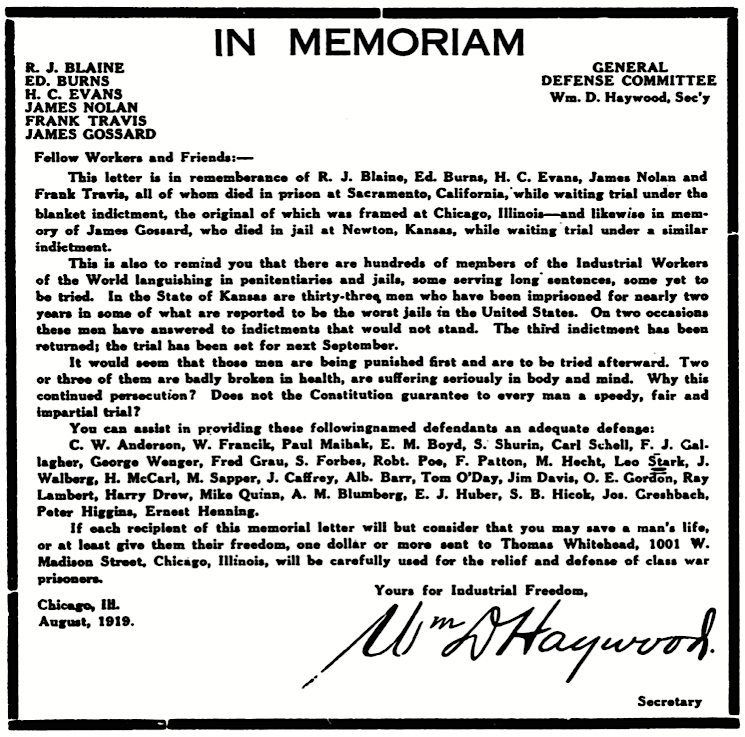
The thirty-four men held under the Wichita indictment were originally taken into custody November 21, 1917. These men were all engaged in the oil industry in Kansas. They were, for the most part, young men, some of them married, some not. Judging from their names-Anderson, Boyd, Gordon, Forbes, Stark, Sapper, Barr, Poe, Gossard, Davis, etc.—many of them were of American or Allied extraction; some foreign names were among them, but only five, so far as I learned, were accused of being enemy aliens. The indictment against them charged violation of the espionage law, the food control law and the selective service law.

On March 10, 1918, a motion to quash this indictment was filed by their attorneys. No ruling on this motion was ever made. The attorneys stood ready, therefore, to go to trial on September 24, the day set. To their surprise, a new indictment was returned on that very day. This was drawn on lines similar to the previous Chicago indictment, which had resulted in sending nearly a hundred I. W. W.’s to prison for terms varying from a few days to twenty years. The attorneys could not at once accept trial on this new indictment, and so they were granted until March 10, 1919, in which to plead.

The men who, in September, had already spent ten months in jail awaiting trial, thus faced another five and a half months of confinement. Miss Lowe, their attorney, undertook to find as comfortable jails as possible, in which, she hoped, they might be allowed to spend the winter. They were then in the Sedgwick county jail, having been transferred to it for the trial. Sheriff Sprout, at Hutchinson, agreed to take twelve of the men, and the sheriff in Winfield, where there was a modern, sanitary jail, agreed to take sixteen. Thinking that she had thus arranged accommodations for twenty-eight, Miss Lowe reported her action to the United States district attorney, Fred Robertson, who was prosecuting the case. Mr. Robertson turned a deaf ear to her plea. In vain did she dwell upon the physical condition of the men and the consequences of spending another five months amid overcrowding and filth. Mr. Robertson said that prisoners had no voice in choosing their places of incarceration, and declared.that he intended to ask Judge John C. Pollock, judge of the United States district court for Kansas, to have all of the men placed in the Wyandotte county jail in Kansas City. This was one of the worst in the state.

Continue reading “Hellraisers Journal: Winthrop D. Lane for The Survey: “Uncle Sam: Jailer” – IWWs in Kansas Hell Holes-Insanity & Death”

Hellraisers Journal: Winthrop D. Lane for The Survey: “Uncle Sam: Jailer” – IWWs in Kansas Hell Holes-Sedgwick County Jail

Share

Quote Ralph Chaplin, When we claim our Mother Earth, Leaves 1917———-

Hellraisers Journal – Wednesday September 10, 1919
I. W. W.’s Languish in Kansas Hell Holes, Part III & IV of Series by W. D. Lane

From The Survey of September 6, 1919:

IWW KS, Uncle Sam Jailer by WD Lane, Survey p806, Sept 6, 1919
—–
IWW KS, Investigation by WD Lane, Survey p806, Sept 6, 1919
—–

[Parts III & IV of VI.]

III

Another jail chosen by the United States for the confinement of its prisoners awaiting trial is the Wyandotte county jail at Kansas City, Kan. I shall not go into detail about this. As at Topeka, the men are kept in an inside stockade or “tank;” this has fourteen or sixteen cells and a somewhat larger bull pen than the other. The pen is artificially lighted. Little attention is paid to ventilation. Although there were upwards of thirty men in the jail at the time of my visit, only one of the thirty-six windows was opened wide and another was opened about two inches. The men complained bitterly of the cold nights, a complaint that I could readily understand when I saw what was provided them for covering. For two nights I had been cold underneath three thicknesses of blanket and a spread, and on one of these nights had got up and placed my overcoat over me. Yet these men had a single blanket apiece, which they could fold at most into two thicknesses.

The toilets, located in an end cell, were dirty and had broken seats. The men ate their meals in their cells, after wards washing their own pans and dishes. The only places where they could wash these were in the bathtub or in the tub in which they washed their clothes. The smell of garbage was almost constantly in their nostrils, since the can for the refuse from their meals was kept inside the tank and was emptied only two or three times a week. It was full when I saw it and gave off a strong odor.

Continue reading “Hellraisers Journal: Winthrop D. Lane for The Survey: “Uncle Sam: Jailer” – IWWs in Kansas Hell Holes-Sedgwick County Jail”

Hellraisers Journal: Winthrop D. Lane for The Survey: “Uncle Sam: Jailer” – IWWs in Kansas Hell Holes-Shawnee County Jail

Share

Quote Ralph Chaplin, When we claim our Mother Earth, Leaves 1917———-

Hellraisers Journal – Tuesday September 9, 1919
I. W. W.’s Languish in Kansas Hell Holes, Part II of Series by W. D. Lane

From The Survey of September 6, 1919:

IWW KS, Uncle Sam Jailer by WD Lane, Survey p806, Sept 6, 1919
—–
IWW KS, Investigation by WD Lane, Survey p806, Sept 6, 1919
—–

[Part II of VI.]

II

To begin with the Shawnee county jail at the state capital of Kansas, Topeka. Ten members of the I. W. W. were confined there at the time of my visit. These were held under what has come to be known as the Wichita indictment. Their original arrest had occurred in November, 1917, so that they had been continuously confined in one jail or another for a year and two months. All of this time they were awaiting trial.

The Shawnee jail is a typical county lock-up in structure. Its outer walls are of brick. Men are confined in a sort of room within a room, formed by constructing a rectangular stockade inside the brick walls. The walls of this stockade are of steel lattice work, the bars of the lattice being about two inches wide and the holes about two inches square. It is through these holes that light and air enter. The cells are built in two facing rows inside the stockade. Their rear walls are the walls of the stockade itself and they open toward its center. In length the stockade is about thirty-five feet, in width twenty-six.

There are five cells in each row. Each cell is seven feet wide, seven feet long and seven feet high. Ordinarily two men are placed in each of these, but when the jail is crowded additional bunks are slung from the sides and four men sleep in this space. The central part of the stockade, that not occupied by cells, is thirty-five feet long and twelve feet wide. This is the prisoners’ livingroom, the only area besides their cells to which they have access. Light enters the jail proper through windows in the outer brick walls. These windows are frosted. The light must, therefore, pass through these frosted windows, through the steel lattice work and travel the length of the cells before it reaches this inner space. The result is that no daylight ever reaches this part of the stockade. The sun was shining brightly on the day of my visit, but its rays did not penetrate to this central area. A single electric bulb burned in the ceiling and shed a ghostly glimmer over the faces of the men; this bulb is kept lighted day and night. It was possible to read in only three of the cells and then only by standing close to the latticework. On cloudy days the men light candles.

Continue reading “Hellraisers Journal: Winthrop D. Lane for The Survey: “Uncle Sam: Jailer” – IWWs in Kansas Hell Holes-Shawnee County Jail”

Hellraisers Journal: Winthrop D. Lane for The Survey: “Uncle Sam: Jailer” – IWWs Locked Up in the Hell Holes of Kansas

Share

Quote Ralph Chaplin, When we claim our Mother Earth, Leaves 1917———-

Hellraisers Journal – Monday September 8, 1919
I. W. W.’s Languish in Kansas Hell Holes, Part I of Series by W. D. Lane

From The Survey of September 6, 1919:

IWW KS, Uncle Sam Jailer by WD Lane, Survey p806, Sept 6, 1919
—–
IWW KS, Investigation by WD Lane, Survey p806, Sept 6, 1919
—–

[Part I of VI.]

I

EARLY this summer, a dozen lines in an eastern news paper conveyed the news that a hundred members of the I. W. W., migratory workers in the oil fields and wheat belt of Kansas, had been locked up in the jails of that state, and that more would be locked up as soon as they came out of the “jungle” into the towns and cities. This information was significant for reasons not appearing on the surface. It meant, if the experience of other members of the I. W. W. during the two years preceding was any guide, that these men faced an indefinite confinement in Kansas jails awaiting trial; that they would be kept in semi-dark and disease-breeding cells; that they would be fed insufficiently; that they would live with rats and vermin; that they would be crowded into quarters too small for them and would spend their days within smell of their own excreta; that they would be kept absolutely idle and that their faculties would suffer from disuse; that at times their only protection against physical abuse would be the strength of their own numbers; that for months at a stretch they would not see the real light of day, much less be allowed out-of-doors; and that some of their number would in all probability go insane or attempt suicide or die.

That is what it is to live in many Kansas jails today.

The evidence for these statements is to be found in the conditions under which other members of the I. W. W. have lived in Kansas jails for two years past. I went to these jails last January and saw the conditions under which these men lived with my own eyes. My purpose was not to befriend the I. W. W., with the philosophy or tactics of which I had no personal concern, but to answer the question: What kind of jailer is Uncle Sam?

Continue reading “Hellraisers Journal: Winthrop D. Lane for The Survey: “Uncle Sam: Jailer” – IWWs Locked Up in the Hell Holes of Kansas”

Hellraisers Journal: West Virginia Miners Declare They Will March on Logan County to Help Their Brothers Organize

Share

Quote Mother Jones, Kaisers here at home, Peoria IL Apr 6, 1919———-

Hellraisers Journal – Sunday September 7, 1919
4,000 Armed Miners Gather Near Marmet to March on Logan County

From the The West Virginian of September 6, 1919:

WV UMW, Armed Miners March, WVgn p1, Sept 6, 1919WV UMW, Armed Miners March Logan ed, WVgn p1, Sept 6, 1919

(By Associated Press)

CHARLESTON, Sept. 6-According to information received from a local operator who refused to be quoted the coal operators of the Guyan field yesterday unloaded a car load of machine guns at different places in Logan county as a means of preparation to meet the hosts of invading miners from the Kanawha and Coal river fields.

The five hundred armed miners who left Oak Grove this morning on the march across the hills to Coal river with the Guyan field of Logan county their object was to be joined at Racine and Little Coal River by about 3,000 more armed men according to information received here by coal operators.

The additional armed forces were said to be assembled at Racine and on Little Coal river early this forenoon awaiting the crowd from Oak Grove.

W. M. Petry, vice president of District No. 17 United Mine Workers of America said there were 4,000 armed miners on the march this morning to the Guyan fields, but disclosed no information regarding their whereabouts at that time.

Petry said the men absolutely refused to listen to the appeal of Governor Cornwell and the orders of the union officials. They refused to listen to any of us, Mr. Petry said and declared their intention of marching into Logan county to help their brothers organize.

Continue reading “Hellraisers Journal: West Virginia Miners Declare They Will March on Logan County to Help Their Brothers Organize”