 —————
—————
Hellraisers Journal – Sunday July 21, 1901
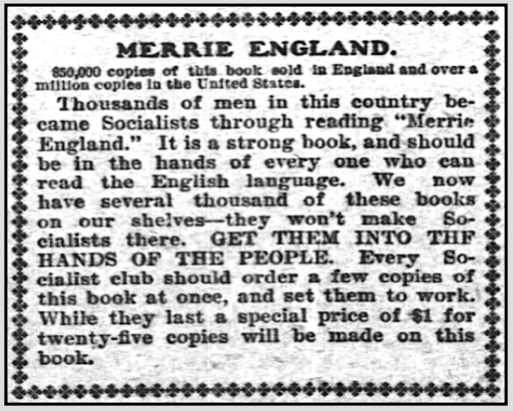
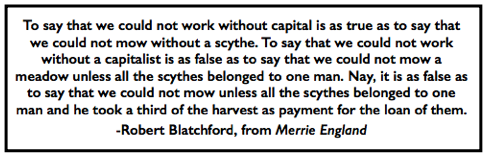
Merrie England by Robert Blatchford, “A Plain Exposition of Socialism”
From the Appeal to Reason of July 20, 1901:
—————
Hellraisers Journal – Sunday July 21, 1901
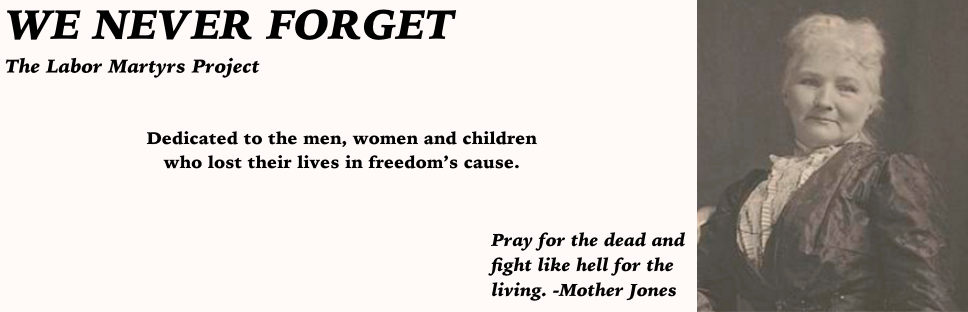
Merrie England by Robert Blatchford, “A Plain Exposition of Socialism”
From the Appeal to Reason of July 20, 1901:
 —————
—————
Hellraisers Journal – Thursday July 20, 1911
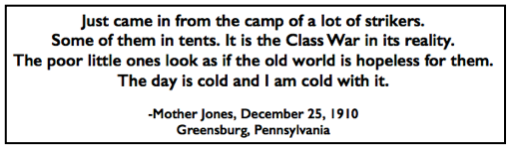
Mother Jones News Round-Up for June 1911, Part II
Found Pleading Cause of Striking Miners of Westmoreland County
From The Indianapolis Star of June 28, 1911:
WOMAN PLEADS FOR MINERS
———-“MOTHER JONES TELLS TALE
———-
Describes Hardships of Pennsylvania Strikers,
but Urges Board to Encourage Men
to Continue Fight.
Following an address by “Mother” Jones, known to all miners of the country, members of the executive board of the United Mine Workers of America yesterday adopted resolutions relative to the strike in the Irwin district in western Pennsylvania, where about 6 000 mine workers have been out for a year and a half.
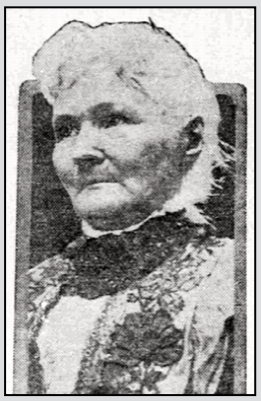
Mrs. Jones, who is 79 years old, has spent most of her time in the strike region during the past year and is thoroughly familiar with conditions there. She told the members of the executive board of the hardships which the miners and their families have endured during the strike and urged the board to adopt resolutions commending the strikers and advising them to continue the fight.
Her address had the desired effect upon the members of the board, and a committee was appointed to draw up resolutions.
PLEDGES CONTINUED SPPORT.
The resolutions provide that the executive board indorse the strikers and urge them to continue their fight, and the board pledges its continued support to the miners. It is also provided that a general meeting be held in the region, at which a vote is to be taken to ascertain if a majority of the miners favor the continuance of the strike
The miners organization is spending about $90,000 a month to support the families of the strikers. It is said that the operators refuse to recognize the organization in the district and will not consider any compromise.
Francis Feehan president of the Pittsburg district and a number of organizers also appeared before the board yesterday to present their views on the strike.
“Mother” Jones expects to return to the Irwin district soon to continue her work among the families of the strikers.
—————
[Photograph added.]
 —————
—————
Hellraisers Journal – Wednesday July 19, 1911
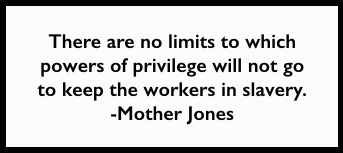
Mother Jones News Round-Up for June 1911, Part I
Found with “Characteristic Style” at Rally on Behalf of McNamaras
From the Appeal to Reason of June 3, 1911:
Solidarity at Pittsburg.
[Mother Jones Speaks.]By Telegraph to APPEAL.
Pittsburg. Pa., May 27.-The most tremendous labor demonstration Pittsburg ever saw occurred tonight. Thirty thousand indignant working men and women marched through the principal streets in protest against the kidnaping of McNamara, congregated at west side and yelled themselves hoarse at every telling point made by the speakers. Hundreds of policemen guarded the streets in squads and mingled with the monster crowd.
Socialists, Industrial Workers and craft unionists were thoroughly united on this occasion and all made the very earth tremble with their yells of defiance. The spirit of solidarity prevailed as it has never been known to prevail before, and Pittsburg is alive to its power. The echo will be heard in the morning to the cell doors of the victims in Los Angeles and to every nook and corner of America. Capitalists will realize once again that they have to deal with an aroused and awakened class. The chant was started tonight by Comrade Debs that was used in the Moyer-Haywood case “If McNamara die, twenty million working men will know the reason why.”
The first speaker of the evening was Comrade Fred H. Merrick, who is under indictment for libeling a Judge here in Pittsburg. Debs followed, and not only described the McNamara case in detail, but also analyzed the Pennsylvania strike and reviewed the great strike of the Pennsylvania railroad employes. His force and eloquence inspired the multitude and something will drop if the enthusiasm of the crowd was an indication.
Mother Jones in characteristic style appealed to the assemblage to be men and stand together, both on the political and economic field. De Leon, of New York, also spoke.
GEORGE D. BREWER.
———-
[Photograph added.]
 —————-
Hellraisers Journal – Monday July 18, 1921
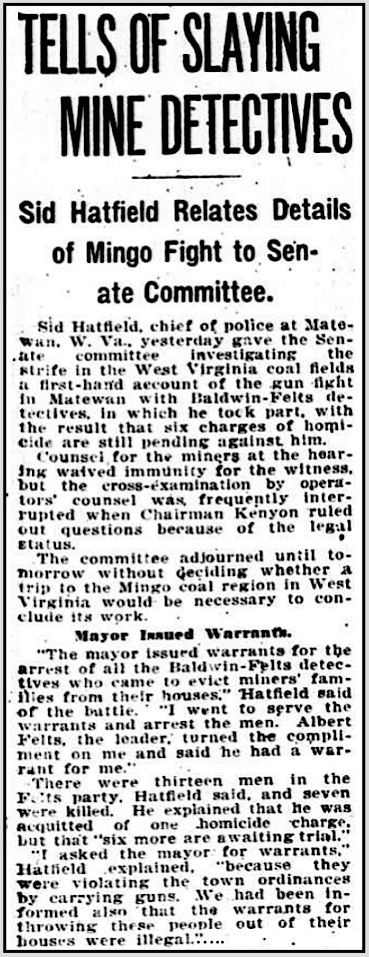
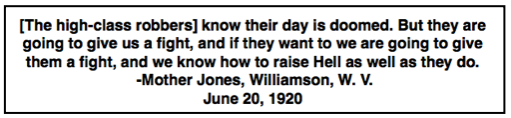
Washington, D. C. – Sid Hatfield Tells of Battle with Baldwin-Felts Gunthugs
From the Washington Evening Star of July 17, 1921:
 —————
—————
Hellraisers Journal – Sunday July 17, 1921
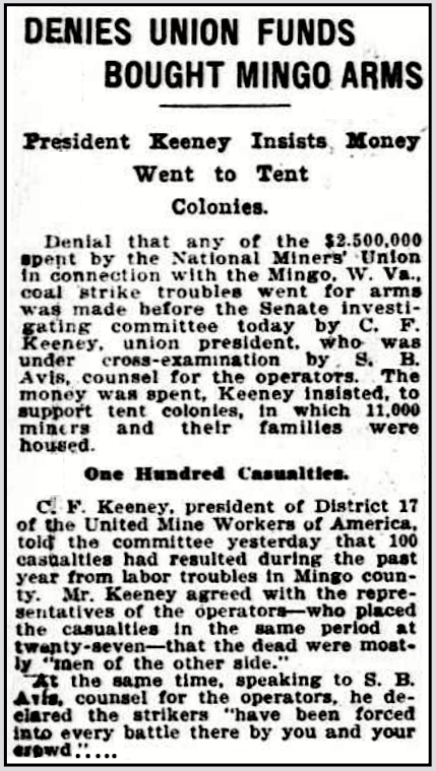
Washington, D. C. – Frank Keneey Testifies on Behalf of Mingo Miners
From the Washington Evening Star of July 16, 1921:
—————
Hellraisers Journal – Saturday July 16, 1921
Washington, D. C. – Frank Ingham Before Senate Investigating Committee
From the Washington Evening Star of July 15, 1921:
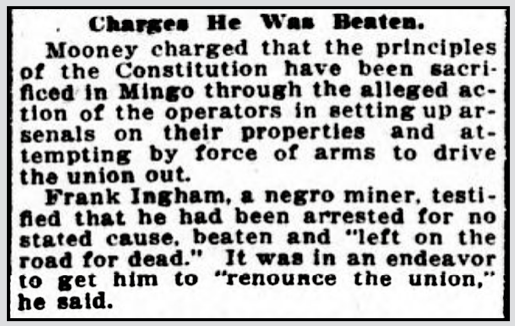
From Hearings before Senate Committe
-Now Investigating West Virginia Coal Fields
-July 14, 1921, excerpt from testimony of Frank Ingham:
Mr. INGHAM. Then they [McDowell County sheriff’s deputies] drove the car down there between Welch and Hemphill, and there they stopped and they dragged me out of the car, and they took me about 100 yards away from the car and then they began to beat me over the head and back with these iron clubs, and then when they decided that I was dead, when they decided that there was not any life in me, they drew off of me and stood and talked, and Ed Johnson, the sheriff’s deputy , he came back to me and kicked me in the face…He holds the position of deputy sheriff under Sheriff Daniels, and he come back and he kicked me in the face and he robbed my pocket…Well, I had prayed earnestly to God, and I believe that God heard me and that he answered my prayer, and I was conscious all the way. I had $25.07 in my pocketbook, and I also had a receipt from Mr. R. H. Campbell; I had borrowed $100 from him and I had a receipt from him and one from Dr. Hamburger, and my railroad ticket…Ed Johnson [took those things]….I never got anything [back].
And then they went off and they left me lying in the woods, and they went out to the road and they got in their machine and drove back toward Welch, and the automobiles ran out of my hearing. I raised my head up from off of the ground, and I stayed there until I collected strength enough to get out of the road, and then I went out to a little coaling station, I believe they call it the Farm coaling station, I believe they call it that, and an engineer was there and a fireman was there coaling up an engine, and they asked me what was the matter with me and I told them that I had been in the hands of the mob. They asked me what I had been in the hands of the mob for and I told them because I belonged to the union.
[Emphasis added.]
 —————
—————
Hellraisers Journal – Friday July 15, 1921
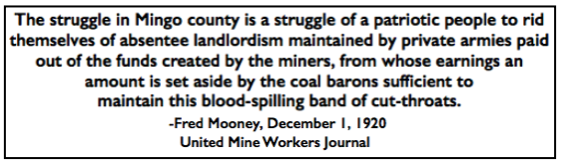
Washington, D. C. – Fred Mooney Testifies on Behalf of Mingo Miners
From the Washington Evening Star of July 14, 1921:
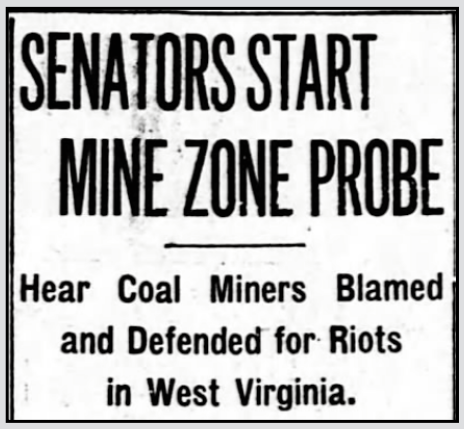
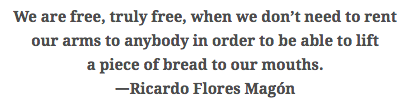
Peace may be near in Mingo county, W. Va., where several hundred coal miners have been on strike for more than a year, it was developed today before hearing begun before a sub-committee of the Senate committee on education and labor to determine the causes of the industrial situation in Mingo county.
Members of the committee, headed by Senator Kenyon, sought to ascertain whether the Governor of West Virginia had acted upon the suggestion submitted three days ago by the miners. Questions asked by members of the committee carried a suggestion that the committee might attempt to bring the sides to the coal controversy together if it were found that a real basis had been suggested for a compromise.
Fred Mooney, secretary-treasurer of District 17, the miners’ union, representing the Mingo field, told the committee that the strikers were ready to go back to work if the operators would receive them without prejudice and would not insist upon employing only non-union labor…..
—————
[Emphasis added.]
 —————
—————
Hellraisers Journal – Friday July 14, 1911
Members of P. L. M. Junta Arrested in Los Angeles
From the Spokane Industrial Worker of July 13, 1911:
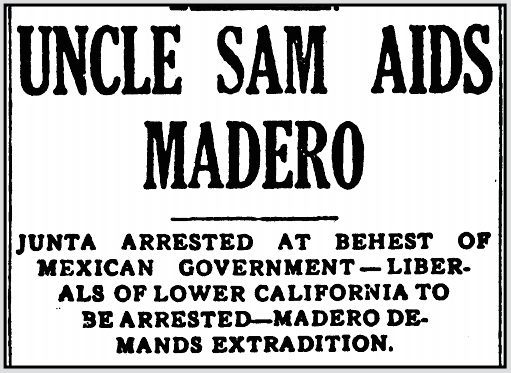
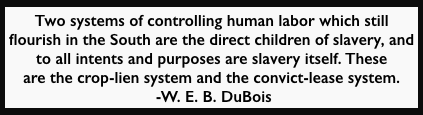
SAN DIEGO, Cal., June 28.-Already Madero the Dictator, has shown “the claw and the fang.” He has, through his Governor Vega of Lower California, demanded the return of the Liberals to Mexico, and warrants have been issued by the United States calling for the arrest of every man who participated in the capture of Tijuana on May 9. The charges are “murder and arson.” The charge is merely a pretext to get them into the power of Madero., where unarmed they will be slaughtered like lambs.
It will be impossibles to arrest the privates as they can’t be identified, but the officers have been arrested and the Mexican government has commenced extradition proceedings. It is now up to every revolutionist to let the government know that if these men are turned over to Mexico, we will have OUR INNING. We must not permit this deal to come off.
The men now arrested are: C. R. Pryce, former commander at Tijuana; J. R. Mosby, J. B. Laflin, Jos, Reed, and two Mexicans. These six men are arrested in San Diego, and as IMMEDIATE ACTION WAS IMPERATIVE, E. E. Kirk, a radical attorney, has been engaged by us to defend them.
Besides this, through Madero’s orders, four members of the Los Angeles Liberal Junta have been arrested, and the capitalist class will try to put them in prison again, where they have already served several years for being Mexican revolutionists. The case the Junta members is being handled by a Los Angeles lawyer. Kirk is a San Diego attorney and as we are without funds to defend our fellow workers, we appeal to every “RED” to remit what he can. If you cannot afford to send us a dollar or fifty cents or more, send it as a loan. Send the money to E. E. Kirk, Union Building, San Diego, Cal., who will issue a receipt for it. These receipts will be treated as notes if you so desire and we will repay them later, as soon as we can.
Remember, we must not let our fellow workers be returned to Mexico to be shot. Stir up public sentiment about this. Get busy. These men fought like men, on the deserts of Mexico. YOU do your part of a man. Yours in the Perpetual Revolution.
STANLEY M. GUE.
—————
[Emphasis added.]
 —————
—————
Hellraisers Journal – Saturday July 13, 1901
Mrs. Douglass Speaks at Buffalo Convention of National Assoc. of Colored Women
From The Buffalo Review of July 12, 1901:
Convict Lease System.
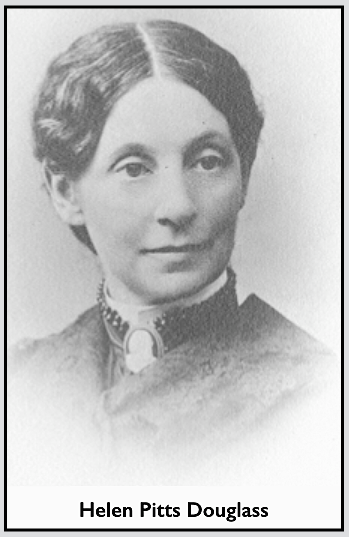
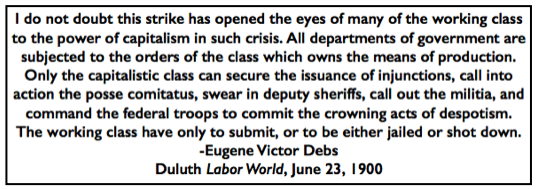
There was a larger attendance at last night’s session than at any time during the convention [of the National Association of Colored Women]. After vocal music by a local musical club, the president, Mrs. Terrell, introduced the chief speaker of the evening, Mrs. Frederick Douglas, widow of the man who espoused the negro’s cause so earnestly during his life time. Mrs. Douglas has gone deep into the study of the convict lease system of the South, and it was of that she spoke last night.
She explained why the system came to be adopted. After the war, she said, many of the Southern cities had no penitentiaries and they had many prisoners, sentenced for small or great offenses. They were leased to companies whose only interest was to wring every cent possible out of their labor. Mrs. Douglas said it has been proved that in the State of Alabama the death rate in the convict camps is 41 out of 100, annually, and at one investigation only three prisoners were found to have survived an eight-year sentence and not one lived to complete a ten-year imprisonment.
She spoke of the conditions in the convict camps in Georgia, Florida, Arkansas and other states where the greatest cruelty is practised on the prisoners, the large majority of whom are negroes. Boys, women and men are chained together in gangs and the utmost immortality prevails among them. Mrs. Douglas said the cruelty of the punishments inflicted on the prisoners equals that of inquisition times, the disease and filth that abounds in the camps are beyond description.
The National Association of Colored Women is seeking to arouse the people of the United States to the enormity of the evil of the lease system. The women feel they are powerless to stop the evil but they are anxious to enlist the help of all right-minded Americans…..
[Photograph, emphasis and paragraph breaks added.]
 —————
—————
Hellraisers Journal – Friday July 12, 1901
Mother Jones News Round-Up for June 1901, Part IV
Found Speaking at Memorial for Martyrs of St. Louis Streetcar Strike
From The Indianapolis Journal of June 14, 1901:
“Mother” Jones in the City.
“Mother” Jones, known the United States over by organised labor, and particularly by members of the United Mine Workers of America, with whom she has been personally identified in many strike, made an unexpected visit to the Mine Workers’ headquarters yesterday. She is on her way to St. Louis to deliver an address, and then will visit the Illinois miners. “Mother” Jones is a regularly employed organizer of the miners’ organization now, and is said to be one of its most successful workers, especially in time of strikes.
[Drawing of Mother Jones added.]
From the St. Louis Post-Dispatch of June 17, 1901:
MOTHER JONES SPOKE
———-HER ADDRESS WAS FEATURE OF
LABOR MEMORIAL SERVICES.
———-
LEON GREENBAUM PRESIDED
———-
Exercises Were Held in Memory of Men
Killed in Street Car Strike Riot.At the Odeon Sunday afternoon, services in memory of the three men killed, June 10, 1900, during the parade of former street car employes on Washington avenue, were held under the auspices of the Central Trades and Labor Union.
The hall was well filled, the widows of George Rine [Ryne] and Arthur E. Burkhart [Ed Burkhardt], two of the men killed, being among those present. Each was accompanied by two little children.
The principal address was made by “Mother” Mary Jones of Chicago. All of the speeches had special reference to the street car strike, its causes and the conditions which preceded it, with a general bearing upon the rights of organized labor.
Leon Greenbaum presided and the services were in charge of the memorial committee of the Central labor body, consisting of J. H. Rakel, chairman; David Kreyling, secretary; R. M. Parker, treasurer; A. Hamberg and Leon Greenbaum. Music was furnished by the United Singing Societies.
In opening the meeting, Mr. Greenbaum, who was the Socialist candidate for mayor last spring, reviewed the events which led up to the strike of 1900. He described the scene on Washington avenue, when Thomas Rine and Burkhart fell before the riot guns of the posse.
William M. Brandt, business agent of the Cigar Makers’ Union, who helped organize the street car men in preparation for the strike, told of the conditions as he found them at the time the work was undertaken.
“Mother” Jones, the organizer of the Mine Workers’ Union, was next introduced and made an address of two hours’ duration. She was received with cheers from the audience, which proclaimed her the “friend of the laboring man,” and was frequently interrupted by applause. Her remarks were directed chiefly against corporations and the trusts.
She said she was engaged in helping the miners of Maryland win a strike while the St. Louis trouble was in progress, and, hence, was unable to be here, but her heart went out in sympathy to those who were struggling for their rights.
She advocated a revolution, if Congress and the state legislatures did not soon “give the people their rights.”
“Mother” Jones said she had been charged with inciting trouble, and believed that, in rousing the people, lay the only safety for this country.
“The most dangerous thing on earth,” she declared, “is a contented slave.”