Hellraisers Journal – Thursday September 29, 1921 Mother Jones Speaks at United Mine Workers Convention, Part III
Indianapolis Convention of the United Mine Workers of America Sixth Day, September 26, 1921, Mother Jones Speaks, Part III of IV:
Muncie Morning Star September 27, 1921
The gunmen were driven out of there [Cabin Creek, West Virginia] and there has been peace ever since. They were driven out of Paint Creek, where they had sent a death special with thirty deputy sheriffs on board. When they wanted that special car equipped to send up the mountain the painters at Huntington said they wouldn’t paint it. The machinists said they wouldn’t equip it. Some other men were asked to do it and they said: “We will talk about it tonight and ask the Lord”—they were Holy Rollers. Well, the Lord must have told them to do it because in the morning they equipped the train and later that armored car fired into the tents of the strikers.
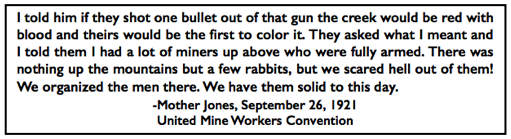
Here are the machine guns that were turned on us (exhibiting a picture). I went up to speak to the boys and the guns were turned on them. I didn’t see them until I got on the track. There were twenty-five of those gunmen who turned on those law-abiding citizens. I put my hands on the guns. One fellow told me to take my hands off the gun. I said: “No, sir; my class go into the bowels of the earth to get the materials to make these guns and I have a right to examine them. What do you want?” He said: “We want to clean out those fellows, every damn one of them.” I told him they were not doing anything wrong, that they were only trying to earn money for their wives and children. I told him if they shot one bullet out of that gun the creek would be red with blood and theirs would be the first to color it. They asked what I meant and I told them I had a lot of miners up above who were fully armed. There was nothing up the mountains but a few rabbits, but we scared hell out of them! We organized the men there. We have them solid to this day.
Those are the guns they sent across seven states to Colorado when the men there struck. The railroad men hauled them. Those are the guns that murdered the women and children at Ludlow, Colo. Here are the Baldwin thugs (showing several pictures). Here are some of the boys who were killed. Some young men joined the militia in Colorado, but when they found they were called out to turn their guns on the miners they went home. The mine owners said they would have to have an army. Here they are in this picture. They were not citizens of the state. The laws of Colorado said a man must be a citizen before he could put on the uniform, but these were the private armies of overlords and they kept committing crimes against the miners and their families until the horror of Ludlow shocked the country. Here is the picture of the children who were murdered.
Hellraisers Journal – Wednesday September 28, 1921 Mother Jones Speaks at United Mine Workers Convention, Part II
Indianapolis Convention of the United Mine Workers of America Sixth Day, September 26, 1921, Mother Jones Speaks, Part II of IV:
Indianapolis Star September 27, 1921
We then went into the Fairmont Field. One night while holding a meeting in New England I paid a fellow to go and circulate bills. We held a meeting on the sand lot. The United States marshal and the deputy marshal were there. When the meeting closed I went away. A little boy told me to get into a buggy and he would drive me to the interurban. When I was going over a dark bridge there were six or eight fellows at the company’s store. One fellow asked me where I was going. I said I was going into Fairmont and asked him to take care of the slaves because if he didn’t I would have to hunt a job for him next day.
Barney Rice, Joe Poggiani and another fellow from Indiana were there. I was hoping the boys would come, because those fellows could throw me into the river and say I committed suicide. Barney Rice came out calling: “Police! Police!” I asked what was the matter and he said they were killing Joe, that he was alone in the dark bridge and he had broken no law. The interurban turned the corner and I told those fellows to hurry. I ran into the bridge and the fellows who had attacked Joe had run away. He had a deep cut in his head. I dragged Joe out and bound his head up with a piece of my underskirt. I asked the interurban men to hurry him into Fairmont and they did.
Next day the boys came down to see Joe. There wasn’t a detective or a gunman that didn’t run out of the city that night. Every one of the cowards left. I had about 150 men at the hotel, and the general manager asked: “Mother, what can I do for the boys?” I said: “Send up a couple of drinks for the boys, because they need it.” There wasn’t a gunman stayed in town that night. Even the United States marshal got scared, but no- body was hurt except Joe.
That was the start of this thing. Later on I went into Wise County. Old Dad Haddow of Iowa was with me. The colored people gave us their church for the meeting. The gunmen told us we couldn’t hold a meeting there and we went out and held it at the corner of two roads. I said: “Dad, have you a pistol?” He said he had and I told him he had better show it. I told him the law said if the pistol was exposed, even a little bit, he would be safe, but if he had it concealed he might be arrested. Those hounds got around Dad and nearly tore him to pieces. They took him to the oflice and those fellows came, the general manager with them, and said: “Mother Jones, what is the matter? I am astonished, really astonished! The idea of you going into the house of God with a pistol!” “Don’t you know,” I said, “that I know God never comes around a place like this—he stays a damned long way from a place like this.”
The gunmen were there and I was arrested. The old man was nearly scared to death. They fined him $25. He didn’t want to pay it, he wanted to appeal, but I said we would pay it. I paid the $25. That evening one of the men who had been in the crowd came to me and said: “Mother Jones, I want to pay my respects to you for paying that $25 as quick as you did. The scheme was to lock you up and burn you in the coke ovens.” And you women raised those brutes! It is horrible to think of.
We battled on and here and there we organized and got better conditions for the men. In 1902 a board member and your President, John L. Lewis, went up Kelly Creek. They chased him out. I was determined to organize that Creek. I went to the town at Eastbrook and in the morning went across by ferry, then walked six miles. The company was paying two deputies to keep me out but we got into the mining camp. I told a merchant my business and he said we could use a hall over his building. I rented that for four months. I took the men down and organized them that night. The company suspected there was something wrong and the next day discharged forty of the men. Then the drivers got restless and came out. I was determined to finish the job and on Sunday went through the camp with the boys marching. I told them to ask every fellow they saw sitting on the steps of the houses to be an American and come down. They came.
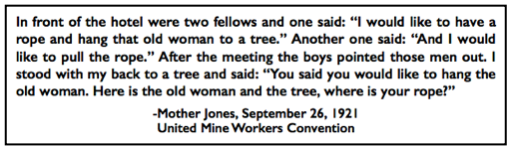
We told Jack Roan, the manager, who had come over from Columbus that day, to come out. He didn’t come out. In front of the hotel were two fellows and one said: “I would like to have a rope and hang that old woman to a tree.” Another one said: “And I would like to pull the rope.” After the meeting the boys pointed those men out. I stood with my back to a tree and said: “You said you would like to hang the old woman. Here is the old woman and the tree, where is your rope?” They ran away because there were more than a thousand men at the place. Since that day there has been no strike and no disturbance, but there is one thing we failed to do—we did not educate them thoroughly, because bringing them into the union was only the kindergarten; we should have educated them after they came in but we failed to do that.
Hellraisers Journal – Tuesday September 27, 1921 Mother Jones Speaks at United Mine Workers Convention, Part I
Indianapolis, Convention of the United Mine Workers of America Sixth Day, September 26, 1921, Mother Jones Speaks, Part I of IV:
Indiana Daily Times September 27, 1921
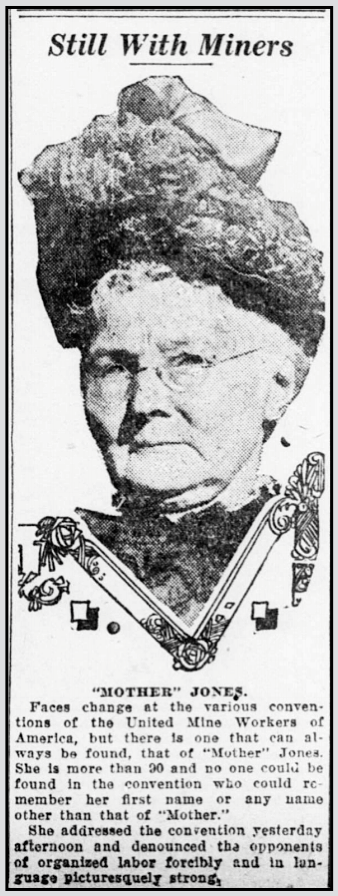
Vice-President Murray: I understand that Mother Jones has just arrived in the convention and I am going to request Brother David Fowler to escort her to the platform. It isn’t necessary that I should introduce Mother Jones to you at this time; it isn’t necessary that I should eulogize the work she has performed for the coal diggers of America, and I will simply present to the convention at this time our good friend, Mother Jones.
ADDRESS OF MOTHER JONES
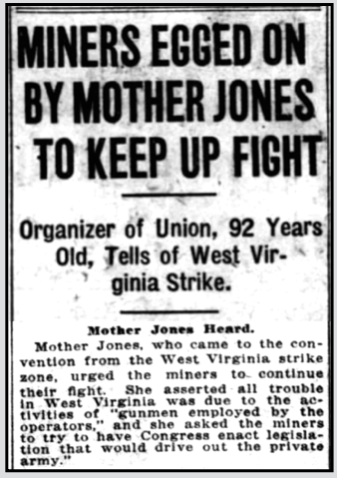
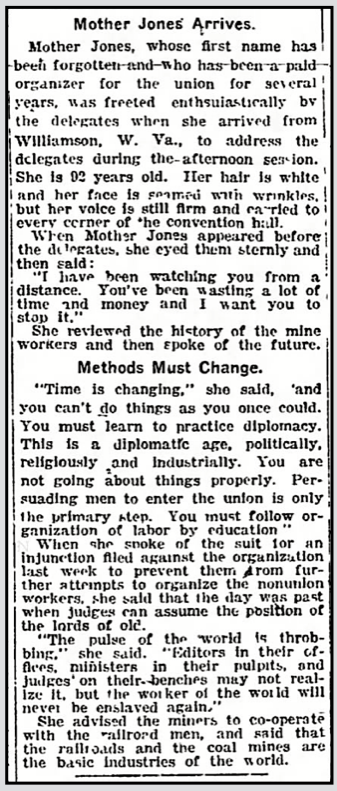
Mr. Chairman and Delegates: I have been watching you from a distance, and you have been wasting a whole lot of time and money. I want you to stop it.
All along the ages, away back in the dusty past, the miners started their revolt. It didn’t come in this century, it came along in the cradle of the race when they were ground by superstition and wrong. Out of that they have moved onward and upward all the ages against all the courts, against all the guns, in every nation they have moved onward and upward to where they are today, and their effort has always been to get better homes for their children and for those who were to follow them.
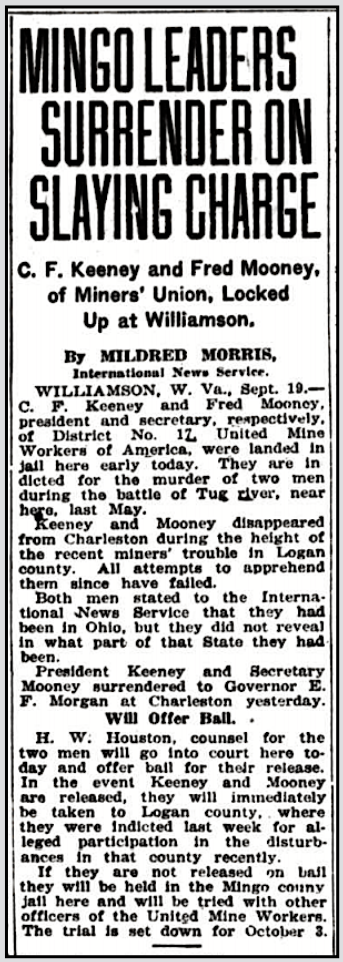
I have just come up from West Virginia. I left Williamson last Friday and came into Charleston. I was doing a little business around there looking after things. We have never gotten down to the core of the trouble that exists there today. Newspapers have flashed it, magazines have contained articles, but they were by people who did not understand the background of the great struggle.
In 1900 I was sent into West Virginia; I went there and worked for a while, taking a survey of the situation. At that time men were working fourteen hours a day and they did not get their coal weighed. They weighed a ton of coal with an aching back, dug it, loaded it and didn’t know how much was in it. However, we have moved onward and today they get their checkweighman, they get paid in cash instead of in company money as they used to; but that wasn’t brought around in an easy manner, it wasn’t brought around arguing on the floor.
I walked nine miles one night with John H. Walker in the New River field after we had organized an army of slaves who were afraid to call their souls their own. We didn’t dare sleep in a miner’s house; if we did the family would be thrown out in the morning and would have no place to go. We walked nine miles before we got shelter. When we began to organize we had to pay the men’s dues, they had no money.
At one time some of the organizers came down from Charleston, went up to New Hope and held a meeting. They had about fourteen people at the meeting. The next morning the conductor on the train told me the organizers went up on a train to Charleston. I told Walker to bill a meeting at New Hope for the next night and I would come up myself. He said we could not bill meetings unless the national told us to. I said: “I am the national now and I tell you to bill that meeting.” He did.
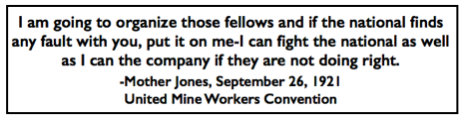
When we got to the meeting there was a handful of miners there and the general manager, clerks and all the pencil pushers they could get. I don’t know but there were a few organizers for Jesus there, too. We talked but said nothing about organizing. Later that night a knock came on the door where I was staying and a bunch of the boys were outside. They asked if I would organize them. I said I would. They told me they hadn’t any money. Walker said the national was not in favor of organizing, they wanted us only to agitate. I said: “John, I am running the business here, not the national; they are up in Indianapolis and I am in New Hope. I am going to organize those fellows and if the national finds any fault with you, put it on me—I can fight the national as well as I can the company if they are not doing right.”
Hellraisers Journal – Sunday September 25, 1921 Mingo County, West Virginia – Senate Probe Resumes; Gunthugs Infest State Militia
From The Labor World of September 24, 1921:
Reports from the West Virginia mining region all tell of a peaceful situation. Those miners who had jobs have returned to work, the private gunmen are sleeping on their arms and the remaining 1,200 Federal troops are bivouaced amid the shady valleys and hillslopes of Boone and Kanawha counties. No further casualties have been reported General Bandholtz has been recalled to Washington by Secretary of War Weeks and the command of United States troops has been turned over to Col. Carl A. Martin, senior officer of the 19th Infantry.
A delegation of operators called on President Harding and Secretary Weeks with a request that the troops bet kept in the war zone until Governor Ephriam A. Morgan has organized two or three regiments of State militia authorized by the last session of the legislature. Miners claim that the State militia is being built up of men in the employ of the coal operators and deputy sheriffs who served under Don Chafin of Logan county during the “invasion.”
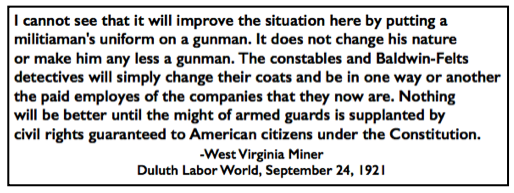
[Said one of the miners:]
I cannot see that it will improve the situation here by putting a militiaman’s uniform on a gunman. It does not change his nature or make him any less a gunman. The constables and Baldwin-Felts detectives will simply change their coats and be in one way or another the paid employes of the companies that they now are. Nothing will be better until the might of armed guards is supplanted by civil rights guaranteed to American citizens under the Constitution.
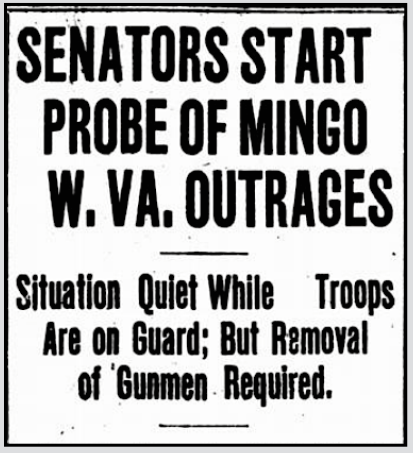
The Senate committee is now at West Virginia and will continue its investigation of the mining trouble. Senator Kenyon of Iowa is believed that if the public is made acquainted with the facts that such a storm protest will be aroused that the West Virginia officials will be forced to correct the evils complained of. Very little help can be expected in the way of national legislation.
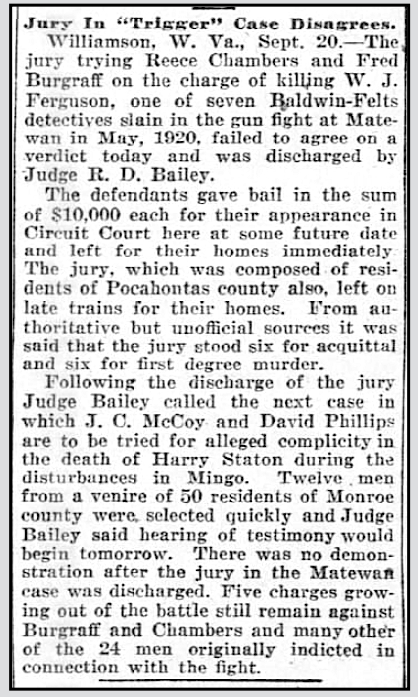
Taking of testimony in the trial of cases growing out of the killing of ten men, seven of them Baldwin-Felts detectives, at Matewan last May, was postponed for a few days owing to illness in the family of Judge R. D. Baily.
Hellraisers Journal – Saturday September 23, 1911 West Virginia’s Mine Guard System, Brutal Thugs Hired by Coal Operators
From The Labor Argus of September 21, 1911:
The blackest spot that stains the pages of the history of West Virginia is the damnable guard system, employed by the coal barons of our state. Such conditions as exist on Cabin Creek, New River and other non-union coal fields of the state, are a disgrace to civilization, and an outrage on American manhood. The brutalities of the hired thugs of the capitalists and coal operators, surpass that of the Cossacks of Russia. The peonage practiced by Barbarous Mexico, of which we read with horror, is practiced here in our own county and state.
Russianized West Virginia, where the law-abiding citizens are subject to brutalities and outrages equaled only by those endured by the oppress, ignorant and brow-beaten peons of Mexico. Every crime known to criminality has been committed by these hired convicts of the coal barons.
These men will stop short of no crime. Men have been murdered by these desperados, for no other offense than belonging to a Labor Union. To go into Cabin Creek or New River districts and declare yourself a labor organizer, is to invite death. All the excuse these guards want is to slug and murder a workingman, is to know that he is a union man. To even be known as a union sympathizer is all the provocation necessary to become the object of a brutal attack by the gun-men.
[…..]
Governor Glasscock in his address on Labor Day said he believed in organized labor. But his actions when he commissions and legalizes these outlaws, belie his words. In the first place, these men are not commissioned as coal company guards, but as railroad detectives. But the railroads don’t pay them a cent, as they draw their salaries from the coal companies. This is a fraud on the face of the transaction. We can show that these guards are maintained by the coal companies, and commissioned by the Governor, for the sole purpose of fighting organized labor; in other words, the United Mine Workers. If this is not so, why do they not need guards in the organized field? If they are railroad detectives, why do they assault and murder men for belonging to the Miner’s Union?
These men are retained for no other purpose than to keep the miners from organizing, and to brow-beat and brutalize them into humble submission to the coal barons. They were commissioned for that purpose only and the Governor knew it when he commissioned them.
If the words spoken by Governor Glasscock on Labor Day to the effect that he believed in organized labor that the workers had a right to organize for mutual protection were true, why does he commission these brutal guards at the behest of the coal barons to fight the organization? Why does he not protect the working men in the exercise of their rights?
Our governor is nothing but a spineless jellyfish, and a tool of the corporations. A man nominated and elected by the special interests. According to Governor Glasscock’s own words, he is either a coward or a liar. He either don’t believe in the right of labor to organize, as he said he did, or he is too big a coward to protect them in the exercise of these rights.
Next week we will take up the crimes committe by these guards and show that they have been given protection by the officials.
Hellraisers Journal – Wednesday September 21, 1921 Lick Creek Tent Colony, Mingo County – Senators Hear Miner’ Side of Conflict
From the Baltimore Sun of September 19, 1921:
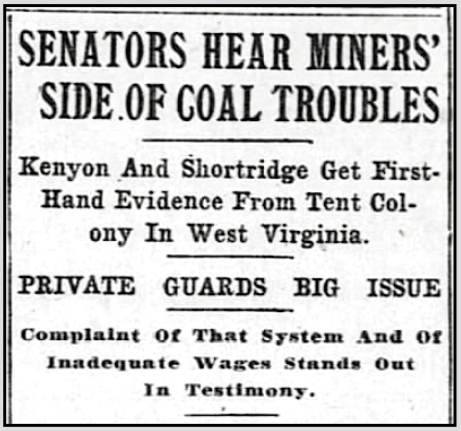
Williamson, W. Va., Sept. 18.-Senator Kenyon’s investigating committee, boiled down finally to himself and Senator Shortridge, of California, went among the people in the Lick Creek tent colony today to get the miners’ side of the underlying cause of industrial troubles in the Mingo region.
There was no comment from the committee after 50 or more men and women had been questioned. Tomorrow the operators will be heard and then Senator Kenyon and his associate will determine how far to proceed and where under the Senate resolution directing the inquiry.
The tent colony is populated by miners who have been on strike 14 months. The first of the group whose testimony was obtained was George Echols, a negro preacher, 75 years old, who showed the ragged gaps in his tent, put there, he testified, by “State constabulary or private guards.” Inside, the old man picked up his month-old baby, born in a home with only the earth as flooring, and proudly displayed it to Senator Shortridge as an evidence of healthy living outdoors in the Mingo Mountains.
Women Eager To Talk.
Wide slashes and bullet holes in other tents also were pointed out as alleged evidence of some of the colony’s hardships. News that the Senatorial party was on the way brought out a big attendance, the women being the most eager to talk. From individual groups the Senators tried to find out how the trouble might be settled. Most of the miners declared they had not been amply paid for their work; that while they might make $8 a day, expenses for tools, dynamite and other things cut the net to $3. Other alleged grievances were against the so-called “mine-guard” system, and the claim of the men that once they joined the union they were instantly fired.
The witnesses also complained that many men from the colony had been put in jail and not told of the charges against them. Howard Hanvers, one of the spokesmen, said they objected to enforcement of law by private guards.
“Have any mine guards been shot by miners?” Senator Kenyon asked, and the witnesses agreed that while they had heard such reports they had no direct knowledge.
Told Of Breedlove Murder.
The story of Alexander Breedlove, who was shot to death last June near the camp, when a 13-year-old boy, alone with him in a thicket begged that he be not deserted, was told in detail by half a dozen witnesses. The men said after Breedlove was captured he was given one minute to pray and fell dead with a prayer on his lips. Senator Kenyon found that the boy, Willie Hodges, lives in Huntington, and efforts will be made to get his testimony.
Just after his arrival Senator Kenyon was presented with a memorial from local counsel of the United Mine Workers, setting forth their side of the case along with a series of charges against the operators. The memorial covered broadly the same ground touched on by the union heretofore.

 —————
—————
 —————
—————
 —————
—————
 —————
—————
 —————
—————
 —————
—————
 —————
—————
 —————
—————
 —————
—————
 —————
—————