Hellraisers Journal: From the International Socialist Review: The Land Renters Union in Texas by T. A. Hickey, Part I

Share

Quote Robert Blatchford, Merrie England p149 150, Commonwealth 1895—————

Hellraisers Journal – Friday September 6, 1912
“The Land Renters Union in Texas” by T. A. Hickey, Part I

From the International Socialist Review of September 1912:

Texas Land Renters Union 1, ISR 239, Sept 192

[Part I of II]

TO UNDERSTAND the renters union situation it is necessary to know the immense amphitheater upon which the tragedy of their lives is staged. Texas is the largest state in the Union in area. Between El Paso and Texarkana, a distance greater than from Boston to Milwaukee, and from the Gulf of Mexico to the Panhandle, there lies 212,000 square miles. This is an area as large as Germany, with 55,000 square miles to spare and 57,000 square miles larger than France. It is sixth in population amongst states, containing 4,000,000 people. Less than five per cent of the population is foreign, thus making it the most American of all the states. The factory system is practically unknown, sixty-five per cent of the people living in small towns, villages, cross-road settlements and farms. More cotton is raised in Texas than in any other geographical division in the world, including the valley of the Nile. The enormous production of this great staple makes Texas the greatest agricultural state in the Union, for cotton still is king.

The people of Texas have never been noted for conservative methods. By tradition and training they are cast in a revolutionary mould. When the great cities of New England, New York and the middle west saw their proletariat bound to the chariot wheels of capitalism without much thought of protest, the Texas worker, the much despised one-gallus fellow at the forks of the creek, was striking fearlessly though blindly at his oppressors.

And thus it has come to pass that the Greenback party, the Union Labor party, the Populist party, the Farmers’ Alliance, the Grange, the Wheel and the Farmers’ Union have in the past reached their highest development in the Lone Star State.

Agricultural Evolution Plain Here.

In no place in the world can the trend of capitalism along the lines of agriculture be observed at first hand as it can in Texas. The great steam plows and mechanical cotton pickers on bonanza farms can be observed side by side with primitive methods of agriculture, that Potiphar’s men might have used in Egypt.

Of still greater benefit to the student of economic development is the fact that this tremendous area has been taken over, within the lives of men now living, by a few great capitalists who possess greater landed possessions than any landlord in Europe ever dreamed of.

I have ridden in buggies over dozens of Texas counties when on a schoolhouse campaign and have had pointed out to me by my driver the great cattle trails over which the cowboys drove their mighty herds to Kansas. The cowboy now is as extinct as the dodo so far as the open country is concerned, and a large number of the survivors are now washing dishes in Chinese restaurants in Fort Worth.

The trail is obliterated, the land is fenced in and the locomotive engineer has taken the place of the cowboy. It is of this fenced-in land that I would write, because, with the coming of the barbed wire the gaunt specter of tenantry raised its head in Texas.

Renters Unknown in 1860.

In 1860 land renters were unknown in Texas. Land could be secured literally for a song. This in spite of the gigantic land frauds that had been going on for years, particulars of which can be found in the chapters on Land Frauds in Texas in Myers’s great work, The History of the United States Supreme Court.

A story is told with much relish in Texas that vividly illustrates how easily land was secured at that time. A cattleman rode across the Concho River in ’60, dropped off his horse at a tent saloon and found himself unable to pour out his liquor because he was shaking all over with laughter.

“What are you laughing at, Mr. Brown?” inquired the bartender. Said Brown: “I met a durned fool across the line in Coke county this morning. I swapped him a section of land for a calf. The durned fool couldn’t read and I’ll be dad gassed if I din’t work off two sections on him.” From this true tale it can be seen that landlordism did not menace the people when the guns roared out at Fort Sumter.

Enormous Land Holdings.

After the war renting commenced. The lines had commenced to tighten even while the armies were battling at the front. Cattle companies fenced in multiplied thousands of acres. The legislature gave away to individuals and corporations many millions of acres. Their gifts to railroads alone amounted to thirty-six and one-half millions of acres, and by the runover system the railroads come into possession of several million acres more. Three million acres was given for the building of the state capitol, which was a scab job. As a result of the wholesale gifts to sharpers the public domain dwindled and enormous land holdings became the order of the day.

Continue reading “Hellraisers Journal: From the International Socialist Review: The Land Renters Union in Texas by T. A. Hickey, Part I”

Hellraisers Journal: Martial Law Declared in Paint Creek-Cabin Creek Strike District of West Virginia; Militia Collects Weapons

Share

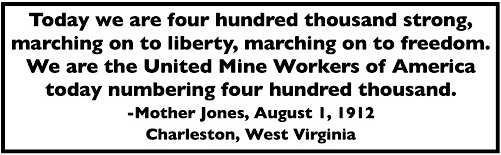
Quote Mother Jones, UMW Strong, Speech Charleston WV Levee, Aug 1, 1912—————

Hellraisers Journal – Thursday September 5, 1912
Martial Law Declared in Paint Creek-Cabin Creek Strike Zone

From The Wheeling Intelligencer of September 4, 1912:

HdLn WV Martial Law Declared, Wlg Int p1, Sept 4, 1912

Special Dispatch to the Intelligencer.

CHARLESTON, W. Va., September 3.-With more than 200,000 rounds of ammunition, seven modern Colts’ machine guns, fifteen hundred rifles of various kinds, from the highest priced and most modern make, down to the ordinary 22-caliber and bushels of revolvers, that is the term used by the militia authorities in answering the question as to the number of concealed weapons they now have-is the sum total of artillery the state captured during the first twelve hours of martial law in the Paint and Cabin Creek section of Kanawha county and of the Kanawha coal district.

Promptly at 6 o’clock this morning the proclamation went into effect. The nine companies of state militia with every available officer was scattered through the district and promptly at the hour fixed swooped down on store and cabin, operators residence and fortifications constructed by the coal operators and took possession of all firearms and other dangerous weapons. In no instance today was it necessary to arrest in order to secure weapons. That the miners and any of the mine guards had an idea that martial law was coming and got beyond the reach of the militia is definitely known.

Attack a Surprise.

This district is mountainous, making it possible for great numbers of men to conceal themselves and then attempt to escape under cover. While some may be successful the militia has stretched out along the boundary line to guard against just such a condition. The territory embraced in the proclamation is about twenty miles in length and from seven to twelve miles wide and contains at the present time about 18,000 or 20,000 people. Under the West Virginia law the rules and regulations of the regular army control in case of martial law is:

“A court-martial and a military commission have been appointed which may try offenses committed by either soldiers or citizens in the territory under martial law,” said Governor Glasscock today.

“For this duty I have selected men in whom I have the highest confidence because their power is almost ultimate and they may impose such punishment, including death, as they deem proper in the exigencies of the occasion.” 

[…..]

[Emphasis added.]

Continue reading “Hellraisers Journal: Martial Law Declared in Paint Creek-Cabin Creek Strike District of West Virginia; Militia Collects Weapons”

Hellraisers Journal: From The North American Review: “The Miners and the Law of Treason” by James G. Randall, Part II

Share

Quote Fred Mooney, Mingo Co Gunthugs, UMWJ p15, Dec 1, 1920—————

Hellraisers Journal – Monday September 4, 1922
Charles Town, West Virginia – Miners on Trial for Treason Against the State, Part II

From The North American Review of September 1922:

THE MINERS AND THE LAW OF TREASON

BY JAMES G. RANDALL

[Part II of II]

Billy Blizzard and Family, Lt Dg p14, June 17, 1922

Turning to the case of the miners, we find that the offense for which they (or rather a selected number of them) are held is treason against the State of West Virginia. In the Constitution of the State of West Virginia there is the following provision:

Treason against the State shall consist only in levying war against it, or in adhering to its enemies, giving them aid and comfort. No person shall be convicted of treason unless on the testimony of two witnesses to the same overt act, or on confession in open court. Treason shall be punished, according to the character of the acts committed, by the infliction of one or more of the penalties of death, imprisonment or fine, as may be prescribed by law.

It will be noticed that the provisions in the West Virginia Constitution resemble those of the Federal Constitution in the definition of the offense and the requirements as to evidence sustaining the overt act, but that the State Constitution goes farther than that of the United States in that it specifies the general nature of the punishment. An examination of the West Virginia code shows that the punishment, as further defined by the Legislature, shall be death, or, at the discretion of the jury, confinement in the penitentiary not less than three nor more than ten years and confiscation of the real and personal estate. Withholding knowledge of treason, attempting to justify armed insurrection by written or printed words, or engaging in an unlawful assemblage, are punishable by lesser penalties, thus indicating that these offenses are regarded as distinct from treason itself. As to what constitutes “levying war” against the State, this is largely a matter for interpretation by the court, and it appears that Judge Woods has made considerable use of Federal as well as State decisions in determining his rulings.

The acts for which the miners are on trial took place in connection with the serious outbreak of August, 1921. As a climax of years of growing hostility, during which the United Mine Workers had made repeated efforts to unionize the mine fields of Logan and Mingo counties, several hundred men assembled on August 20 at Marmet, West Virginia, with the intention of making some kind of demonstration or attack, the exact purpose of which is disputed. An important feature of the case is that the Governor had previously proclaimed martial law in Mingo County, and had sent State troops into that county to preserve order. It is the contention of the prosecution that the acts of the miners constituted a defiance of this martial law, and an intention to resist the troops.

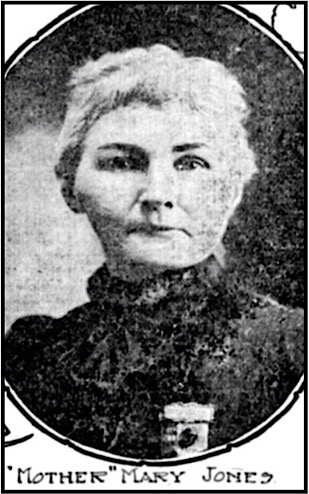
An appeal by “Mother Jones”, a well-known leader among the miners, failed to disperse them, and the armed force, picturesquely uniformed in blue overalls and red bandanna handkerchiefs, proceeded on their march. The first violence occurred at Sharples in Boone County, where a small force of State police was resisted by the miners while seeking to serve warrants upon men wanted by the Logan County authorities. Several miners were killed and from this time the march assumed much more alarming proportions. By the time the Boone-Logan county line was reached the invaders numbered about eight thousand. Don Chafin, sheriff of Logan County, raised a defending force of approximately two thousand which he commanded until, after some delay, Governor Morgan commissioned Colonel Eubanks to take charge with State troops. For over a week the opposing “armies” confronted each other over an extended mountainous battle-front in the neighborhood of Blair, and there was considerable detached fighting. On the defending side three deputy sheriffs were killed, and it was for their deaths that the indictments for murder were drawn. Probably more than twenty of the invaders lost their lives.

Continue reading “Hellraisers Journal: From The North American Review: “The Miners and the Law of Treason” by James G. Randall, Part II”

Hellraisers Journal: From The North American Review: “The Miners and the Law of Treason” by James G. Randall, Part I

Share

Quote Fred Mooney, Mingo Co Gunthugs, UMWJ p15, Dec 1, 1920—————

Hellraisers Journal – Sunday September 3, 1922
Charles Town, West Virginia – Miners on Trial for Treason Against the State, Part I

From The North American Review of September 1922:

THE MINERS AND THE LAW OF TREASON

BY JAMES G. RANDALL

[Part I of II]

Battle of Blair Mt, WV Today by Bushnell, Guards, Gunthugs, Spies, UMWJ p5, Sept 15, 1921

Once again the quiet village of Charles Town, West Virginia, in the historic Shenandoah valley, has furnished the setting for a memorable State trial. As in 1859, when John Brown went to the gallows for a traitorous assault which was misconceived as a stroke for Abolition, so in the present year the eyes of the nation have been focused upon this same little county seat while hundreds of miners have faced trial on indictments for murder and treason in connection with the “insurrection” of August, 1921. Twenty-four of the miners who were associated with the armed march of several thousand men directed against the coal fields of Logan and Mingo counties have been charged with the grave offense of “treason”, and it is with this phase of the question that the present article proposes to deal. Many circumstances unite to make the trials notable. The long continued efforts of the United Mine Workers to unionize the West Virginia fields, the elaborate litigation which included several federal injunction suits, the huge scale as well as the gravity of the indictments, the intensity of the industrial disputes involved, and the challenge to the State authorities to uphold elemental social order and yet deal fairly with both sides in an unusually bitter struggle-all these factors lift the case above the level of an ordinary criminal proceeding. Without attempting, however, to discuss the industrial phases of the “miners’ war”, the writer proposes to view the cases from a restricted angle and to consider their relation to the history of treason in our legal system.

Though the charge against the miners is the rara avis of treason against a State, the analogy of this crime with treason against the United States is very close, and it may therefore be useful to recall some of the outstanding points in the history of national treason. Treason is the only crime which the Federal Constitution undertakes to define. It consists “only in levying war against the United States or in adhering to their enemies, giving them aid and comfort”. To prove treason, the commission of an overt act must be established by at least two witnesses, unless there is a confession in open court. Congress has no authority to fix the nature of the crime, and can neither enlarge nor restrict the offense beyond the constitutional definition. Congress may, however, fix the punishment, and among the acts passed by the first Congress ever assembled under the Constitution was the Treason Law of 1790, which established the penalty of death for this highest of crimes.

In the course of time a well recognized body of principles has grown up around the law of treason. Thus it is recognized that “constructive treason” has no place in our legal system. There must be an actual levying of war. A mere plotting, gathering of arms, or assemblage of men is not treason, in case no overt act is committed. The “levying war”, however, has been rather broadly defined by our courts. Besides formal or declared war, it includes an insurrection or combination which forcibly opposes the Government or resists the execution of its laws. Engaging in an insurrection to prevent the execution of a law is treason, because this act amounts to levying war. The mere uttering of words of treasonable import does not constitute the crime, nor is mere sympathy with the enemy sufficient to warrant conviction.

Treason differs from other crimes in that there are no accessories. All are principals, including those whose acts would, in the case of felonies, make them accessories. Those who take part in the conspiracy which culminates in treason are principals, even though absent when the overt act is committed.

Continue reading “Hellraisers Journal: From The North American Review: “The Miners and the Law of Treason” by James G. Randall, Part I”

Hellraisers Journal: From the International Socialist Review: “The Walker”-Written in Essex County Jail by Arturo Giovannitti

Share

Quote Giovannitti, The Walker, Rest My Brother—————

Hellraisers Journal – Monday September 2, 1912
“The Walker” by Arturo Giovannitti, Written in His Jail Cell, Lawrence, Mass.

From the International Socialist Review of September 1912:

ISR Sept 1912 p201

Continue reading “Hellraisers Journal: From the International Socialist Review: “The Walker”-Written in Essex County Jail by Arturo Giovannitti”

Hellraisers Journal: From the Duluth Labor World: “Gene Debs Defines Labor Leaders Duty”-Do Not Vote for Enemy of Workers

Share

Quote EVD, Socialist Ripe Trade Unionist, WLUC p45, May 31, 1902—————

Hellraisers Journal – Monday September 1, 1902
Comrade Eugene Debs on Class Consciousness and the Ballot

From the Duluth Labor World of August 30, 1902:

GENE DEBS DEFINES LABOR LEADERS DUTY
———-

EVD, LW p1, Aug 30, 1902

The time is near at hand when a member of a union will be expelled just as promptly for casting a scab ballot, that is to say for supporting the party of the enemy of labor, as if he took the place of a member while out on strike. Indeed, there may be some justification for the latter, but there can be none for the former act of treason, except alone that of ignorance. And thus it is the duty of the true leader to use his best efforts to overcome, so that the workers on all occasions, economically, politically, and otherwise, can use their entire organized class power in resisting the capitalist system, and in charging it at every point until finally it is overcome and the world’s workers stand forth free men.

The action taken by the three national conventions of labor organizations recently held at Denver [W. F. M., A. L. U. and United Association of Hotel and Restaurant Employes] in adopting a working class political program, has created widespread interest in every part of the country. The reactionary element predict for the new policy speedy and complete failure. So certain are they of this that they do not hesitate to misrepresent the action of the conventions and bear false testimony against those who took part in them. A number of misleading statements have appeared in the papers, and others are quietly circulated to bring the personnel of the conventions into disrepute, and this is engaged in by those who lack the courage to openly charge and face the men who led the movement which culminated in a new departure, which promises to remould the entire labor movement of the country, and bring it up-to-date in all its economic and political equipment.

The two men who led and inspired the conventions were Edward Boyce, president of the Western Federation of Miners, and Daniel McDonald, president of the Western, now the American Labor Union. McDonald was unanimously reelected upon that issue and holds his position by practically the unanimous confidence of the members of his great and growing organization. Edward Boyce retired from official life, honored by every true man and only hated by those who found him staunch and incorruptible, and utterly incapable of being swerved from his duty to his fellowmen. The name of this man will be honorably written in the history of trades unionism, as he has already written it in the deeds of duty that live forever.

I need not, at this time, repeat the terms of the essential change which has taken place in the Western labor movement. It is all summed up in this single statement that it has adopted a working-class political platform and is now equipped for united action in the political field in every contest until the victory is finally won.

Continue reading “Hellraisers Journal: From the Duluth Labor World: “Gene Debs Defines Labor Leaders Duty”-Do Not Vote for Enemy of Workers”

Hellraisers Journal: Joe Ettor from Essex County Jail at Lawrence, Massachusetts: Strong, Resolute and “Eager for the Fray”

Share

Quote Joe Ettor, ed, Thank You, IW p1, Aug 29, 1912—————

Hellraisers Journal – Saturday August 31, 1912
Joe Ettor Writes from Essex County Jail at Lawrence, Massachusetts:

From the Spokane Industrial Worker of August 29, 1912:

Letter from Joe Ettor in Jail, IW p1, Aug 29, 1912

[Photograph added.]

Continue reading “Hellraisers Journal: Joe Ettor from Essex County Jail at Lawrence, Massachusetts: Strong, Resolute and “Eager for the Fray””

Hellraisers Journal: Forty-Eight Miners Believed Lost, Trapped by Flames in Argonaut Gold Mine at Jackson, California

Share

Quote Mother Jones, Pray for dead, ed, Ab Chp 6, 1925—————

Hellraisers Journal – Tuesday August 29, 1922
Jackson, California – Miners Trapped by Flames at Argonaut Gold Mine

From the Spokane Daily Chronicle of August 28, 1922:

HdLn Miners Trapped by Flames Jackson CA MnDs, Spk Chc p1, Aug 28, 1922

Continue reading “Hellraisers Journal: Forty-Eight Miners Believed Lost, Trapped by Flames in Argonaut Gold Mine at Jackson, California”

Hellraisers Journal: Statement of Comrade Eugene Victor Debs, Presidential Candidate of the Socialist Party of America

Share

EVD re Socialism v Capitalism—————

Hellraisers Journal – Wednesday August 28, 1912
“The Supreme Campaign Issue” by Eugene Debs, S. P. A. Presidential Candidate

From The Pittsburg Press of August 27, 1912:

WHAT EUGENE V. DEBS STANDS FOR

A concise statement by the Presidential candidate of the
Socialist party on “The Supreme Campaign Issue.”

Written especially for THE PITTSBURG PRESS.

BY EUGENE V. DEBS

EVD, Ptt Prs p1, Aug 27, 1912

The supreme issue in this campaign is Capitalism versus Socialism. The Republican hosts under Taft, the Democratic cohorts under Wilson and the Progressive minions under Roosevelt are but battalions of the army of capitalism.

Opposed to them are the ever augmenting phalanxes of the world’s workers, organizing in the ranks of the Socialist party, to do battle for the cause of Socialism and industrial emancipation.

Nothing in the political history of the world has presented so inspiring vision as the formation of the battle lines for the campaign in America.

For the first time since the civil war is a political cleavage upon a great moral question. It is the question of the right of one class of human beings exploiting another class of human beings to the very point of physical existence.

It is a question of human freedom versus human slavery.

This question is as old as the race, but for the first time in human history the issue is stripped of all subterfuge and the exploited class have the political power in their own hands to accomplish by peaceful means their own emancipation.

No longer can the political harlots of capitalism betray the workers with issues manufactured for that purpose. The beating of tariff tom-toms, the cry for control of corporations, the punishment of “malefactors of great wealth,” the wolf cry of civic righteousness under capitalism, will not avail the politicians in this campaign.

Neither will the purely political issues of direct legislation, the recall, direct election of senators, or the economic reforms promised, of old-age pensions, minimum wage, industrial insurance and welfare of labor, about which the politicians of capitalism are now so much concerned, bring aid or comfort to them, for the people know that all of these are a part of the program of Socialism and that they are only seized upon by designing men who are not Socialists in an effort to deceive the people and prolong the reign of capitalism.

Taft may have stolen delegates enough to secure his renomination, but it remained for Roosevelt to burglarize the Socialist platform in order to secure his election under false pretenses.

The millions of American tillers of the soil and toilers of factory, mine and railroad, have abandoned once and forever all political parties of whatever name which do not challenge the very existence as an institution, and they are in open, organized and intelligent revolt against the system.

They have bunched all the so-called issues of all the capitalist parties, along with wage-slavery, poverty, ignorance, prostitution, child slavery, industrial murder, political rottenness and judicial tyranny, and they have labeled it “Capitalism.” They are bent upon the overthrow of this monstrous system and upon establishing in its place an industrial and social democracy in which the workers shall be in control of industry and the people shall rule.

The Socialist party offers the only remedy, which is Socialism.

It does not promise Socialism in a day, a month, or a year, but it has a definite program with Socialism as its ultimate end. Its advocates are men and women who think for themselves and have convictions of their own and they are in deadly earnest.

The hour has struck! The die is cast and Socialism challenges the institution of Capitalism. 

[Emphasis added.]

Continue reading “Hellraisers Journal: Statement of Comrade Eugene Victor Debs, Presidential Candidate of the Socialist Party of America”