Hellraisers Journal – Thursday June 22, 1911 Greensburg, Pennsylvania – Mothers and Babes Locked Up in Rat-Infested Jail
From the Arkansas Democrat of June 20, 1911:
MOTHERS AND BABES TO JAIL ———- In Famous Westmoreland Coal Strike, Which Has Been in Progress Nearly 18 Months, Company is Said to be Taking Severe Steps to End Trouble. ———-
(By Gilson Gardner.)
Greensburg, Pa.-(Staff Special.)-The famous Westmoreland coal strike, which has been in progress nearly a year and a half, has reached a new stage. To win, the coal companies now find it necessary to send mothers with babes and little girls to the county bastile.
A little crippled girl, 14 years old, was sitting on the front porch of her home when the village scab went by on his way from work. The little girl began to laugh at the scab and to sing, “Will There Be Any Stars in My Crown?” For this the town constable, Pat McDonough, in behalf of the Westmoreland Coal Company, swore out a warrant and had it served by the deputy constable. The little crippled girl was arrested, taken to Irwin, a village two miles away, where she was brought up before the local justice of the peace-“Squire” H. L. Meeroff. Tho squire found the cripple girl guilty of “breaking the peace” and sentenced her to the county jail for 20 days. So the prisoner was taken 10 miles to Greensburg, where she was locked up in a jail provided for hardened criminals.
Hellraisers Journal – Tuesday June 21, 1921 Miners’ of Mingo County, West Virginia, Fight for Right to Organize
From The Survey of June 18, 1921:
The Conflict on the Tug
[-by Winthrop D. Lane]
Kansas City Star of June 18, 1921
THE gunfire that has been awakening echoes in West Virginia Hills as well as in the United States Senate chamber, where a resolution calling for a Senate investigation of the industrial trouble in that state has been under discussion, is neither a new nor an unexpected feature of the conflict over unionism in the coal fields there. No doubt some of the pictures recently drawn of the reign of feudism in that country have been too vividly colored; private families are not now engaged in the planned extermination of each other as they once were. But if the feud is no longer an active and malignant eruption in the life of the region, the tradition of feudism remains. The men who shot their personal enemies from ambush or in the open did not die without issue; their descendants still tramp the West Virginia and Kentucky hills in large numbers, sit at clerk’s desks in stores and village banks and even occupy the sheriff’s and county clerk’s offices.
The fact is that in the mines and mining communities of those regions there are today men who saw their fathers or grandfathers take their guns down from the wall, go a hundred yards from the house and lie in wait for prospective victims. Life is not held as dearly in such a civilization as in some others. The traditional method of settling disputes is too much by the gun; and when two men cannot agree, the courts are likely to find that the arbitrament of the law has been superseded by the arbitrament of the levelled pistol barrel.
Introduce into such a community, now, an acute modern industrial conflict. Let capital enter and bring forth coal from the hills. Let the whole country become an industrial area. Let the trade union enter and try to persuade the workers to organize. Let the owners and managers of coal mines say: “You shall not organize. We will not let you.” The methods that have been used to settle other disputes will be resorted to in settling this. The nature of the trouble is different, but the way of meeting it is the same. There are in the mines of West Virginia many men who know nothing of this tradition, who were brought up in other environments. But there are also, both in the mines and among the general population, many to whom the tradition is a keen memory. They are familiar with the use of firearms; most of them possess guns. They regard a fight between capital and labor as no different, in the tactics evoked, from any family or domestic quarrel.
Hellraisers Journal – Monday June 20, 1921 Lick Creek Tent Colony, Mingo County – Attorney West Describes Raid
From The Wheeling Intelligencer of June 18, 1921:
MINE WORKERS’ LAWYER MAKES ALLEGATIONS OF RUTHLESS ACTS AT THE MINERS’ TENT COLONY ———- Declares State Police and Volunteers Were Disorderly and Destructive When They Raided the Homes of Union Miners ———-
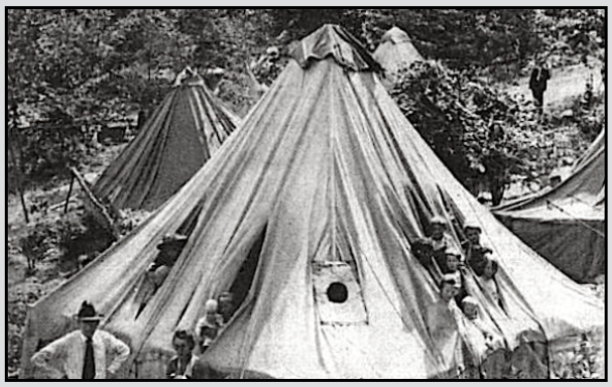
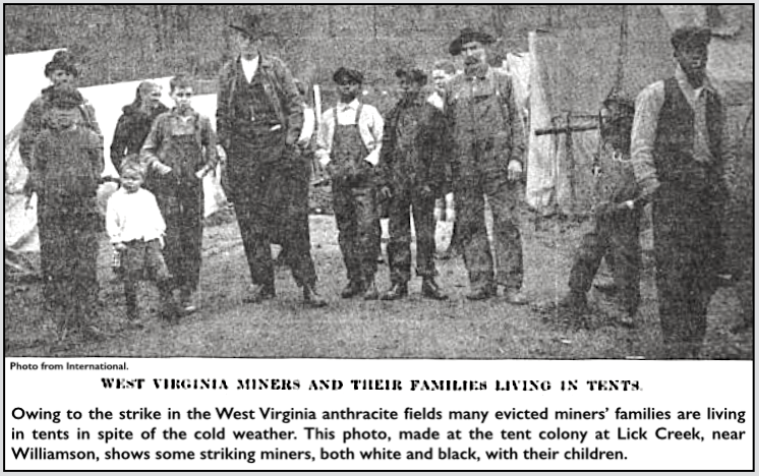
Lick Creek Tent Colony after Raid of June 14, 1921
Special to The Intelligencer.
Charleston, Va., June 17-Secretary-treasurer Fred Mooney, of District Seventeen, United Mine Workers of America, tonight made public the following report just received from the union’s lawyer, Thomas West, who was detailed to make an investigation of the activities of the state police in raiding tent colonies of union coal miners in Mingo county:
Williamson, W. Va., June 16.
H. W. Houston, Charleston, W. Va.
Dear Sir-On yesterday morning I visited the Lick Creek tent colony for the purpose of taking some statements regarding the outrage perpetrated there on the day before [June 14]. I found that the state police and their volunteer confederates [company gunthugs] had ripped up twenty or more tents. Some of them had probably a hundred slits up them, averaging about six feet each, and had knocked the legs out from under their cooking stoves and the stove pipes down, and where they found anything cooking on the stove they swiped it off into the coal box, as a rule found just back of the stove. They found some tables set for dinner and they turned these with the legs up and the dishes and food left on the under side.
They broke open every trunk and rifled every drawer. They dumped all the clothes they found out into the middle of the floor and kicked them all over the place. They dumped an organ out of one man’s tent over the hill and hit a phonograph with an axe or some other heavy tool.
They poured kerosene oil into a churn of milk found in one of the tents and in others they found such oil and poured it into the meal and flour. In one tent they found a considerable quantity of canned fruit and they put this on the bed clothes after turning them upside down on the bed and broke it up. They put the mattresses on the floor and ripped them open and put the springs on top of them.
Hellraisers Journal – Sunday June 19, 1921 Lick Creek Tent Colony, Mingo County – The Death Alex Breedlove
June 18, 1921, Affidavits of James Williams and Willie Hodge:
STATE OF WEST VIRGINIA, County of Mingo, to wit:
James Williams, being duly sworn upon his oath, says that he is a resident of the Lick Creek tent colony and that he was there on the 14th day of June, 1921, when the same was raided by State police and their confederates and deputy sheriff, and when Alex Breedlove was murdered; that he was about 30 feet from Breedlove when he was shot and saw James Bowles, State policeman, shoot him; Bowles was about 6 or 7 feet from Breedlove, and Breedlove had his hands up above his head at the time he was shot; Bowles said to Breedlove, “Hold up your hands, God damn you, and if you have got anything to say, say it fast,” and Breedlove said, “Lord, have mercy,” and instantly the gun fired and Breedlove fell. They were standing facing each other and Breedlove just above him on the hill.
At the same time Victor Blackburn, a special State police, was shooting at Garfield More, who was behind a tree, the same tree that Breedlove had just been behind, and after Bowles had called Breedlove to come out from behind the tree and put up his hands and come to him and he had done so and then was shot, Bowles immediately turned his gun on Garfield Moore, but did not have time to fire until he was shot in the back by another State police who was lying flat down on the ground straight down the hill below Policeman Bowles; that at the crack of his rifle a half dozen or more women who were there screamed out, “Look out, man, you are shooting your own men,” and ask him to get away from there; that he would get them all killed.
Affiant thereupon said to the man who had shot Bowles, “Yes; you done shot this man up here now,” and at that he said to affiant, “You are a damn liar, you damn black———-, you get away from there.” And thereupon the said police who had shot Police Bowles fainted and was carried off the ground by Willie Ball and carried under a bridge across Lick Creek. He remained under this bridge 30 or 40 minutes, with a lot of union miners who had taken shelter under said bridge.
JAMES WILLIAMS.
Subscribed and sworn to before me this the 18th day of June, 1921.
THOMAS WEST, Notary Public.
Willie Hodge, being duly sworn, says that he was present when Alex Breed love was shot and that the statement made about his shooting by James Williams is correct.
WILLIE HODGE.
Sworn to before me this the 18th day of June, 1921.
Hellraisers Journal – Thursday June 16, 1921 Lick Creek Tent Colony of Mingo County – Striker Alex Breedlove Shot Down
From The New York Herald of June 15, 1921:
ONE KILLED, TWO HURT IN NEW MINGO FIGHT ————— 47 in Tent Colony of Idle Miners Are Arrested. ———-
WILLIAMSON, W. Va., June 14.-One men was killed, two others were wounded and forty-seven residents of the Lick Creek tent colony of idle miners near Williamson are held in the county jail as the result of the fight to-day at Lick Creek between authorities and the colonists.
Alex Breedlove is dead, while James A. Bowles, State trooper, was wounded and Martin Justice, in charge of the colony, received wounds in the cheek and leg.
The fight started after Major Tom Davis, commanding Mingo under martial law proclamation, had returned to Lick Creek with reinforcements of citizen State troopers to arrest about two-score of the idle miners, as his forces had been fired on in the vicinity earlier in the day. Trooper Bowles, in charge of a party of citizen State police [deputized company gunthugs], encountered several men near the colony. Orders from Bowles to throw up their hands brought shots, it was said, resulting in Breedlove’s death and in the wounding of Bowles.
Hellraisers Journal – Wednesday June 12, 1901 Mother Jones News Round-Up for May 1901, Part II Found Organizing in Pennsylvania and West Virginia
From The Muncie Daily Times of May 16, 1901:
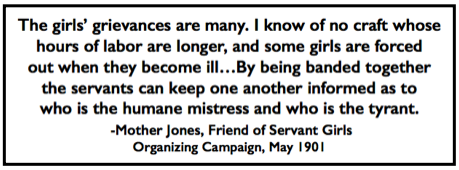
SERVANT GIRLS’ UNION. ———- Mother Jones’ Rules For Kitchen and Nursery Work.
“Mother” Jones is preparing to organize a servant girls’ union at Wilkes-barre, Pa., as well as in Scranton and has drawn up these rules, says the New York World, which the union will enforce at each, “place:”
Ten hours’ work a day and no more.
An increase in wages according to the the size of the house and the work required.
No one shall work for less than $3 a week.
Cooks shall not act as ladies maids or take care of babies.
Nursegirls shall not be required to act as cooks.
It shall not be necessary to stay in nights while the mistress goes out.
If more than ten hours work a day shall be required, a double shift must be employed.
An amusement room shall be furnished for the girls so that they shall not be required to sit in the kitchen all the time.
Visitors shall be allowed to call upon them any night they are off duty.
Wages must be paid every week.
They shall have the privilege of putting their clothes in the family wash.
Their meals shall be the same as those of the family.
Hellraisers Journal – Tuesday June 11, 1901 Mother Jones News Round-Up for May 1901, Part I Found Standing with Silk Mill Strikers of Pennsylvania
From The Scranton Republican of May 2, 1901:
SILK MILL STRIKERS
———-
Girls at the Klotz Works
Back at Their Frames
-Mill at Taylor Still Idle.
———-
MOTHER JONES’ BIRTHDAY ———-
Today all is serene at the silk mills of Scranton. Klotz mill, the first to go on strike, resumed operations yesterday. The reason they did not start Tuesday was because the proprietor persisted in retaining Emily Mailet, a forewoman who was unsatisfactory to the strikers. A committee from the Klotz local waited on Mr. Klotz Wednesday afternoon with the result that he agreed to recognize the union, allowed them the 8 and 12 per cent. advance, and grunted the usual half holiday for five months of the warm weather. Besides this, he said that if the action of the forewoman in question should result in any further trouble he would investigate the matter thoroughly, and discharge her if the case so demanded.
[…..]
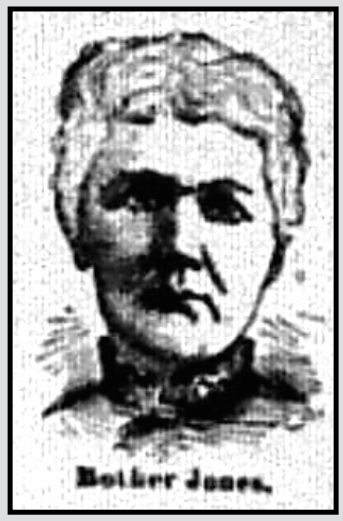
It is an interesting fact that yesterday marked a complete resumption of work among the Scranton silk mills, and it was also the birthday of “Mother” Jones, to whose vigorous efforts among the strikers this resumption is largely due. Yesterday marked the 58th milestone in her journey of life, and she said that before two years more shall have passed and she will have reached her 60th year, she expects to fight many another battle in the cause of labor. It is remarkable that a woman of her age, who has gone through so many excitable experiences, should be hail and hearty at the dawn of her 59th year and possess the vigorous mind that “Mother” Jones does.
Last evening she opened the entertainment of Harvey’s local in the “New hall” on Pittston avenue, and received hearty applause from the audience.
Hellraisers Journal – Friday June 10, 1921 Mingo County – Lick Creek Colony Raided; Striking Miners Arrested
From The New York Times of June 6, 1921:
ARREST FORTY IN MINGO. —– Military Authorities Accuse Them of Violating Martial Law.
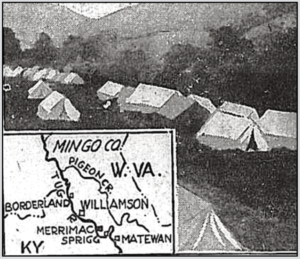
WILLIAMSON, W. V Va., June 5.-Forty-two men, residents of the Lick Creek Tent Colony of idle miners, near Williamson, were arrested today and locked up in the county jail charged with violating the proclamation of martial law recently imposed following disorders in the Mingo coal fields.
The purpose of the raid, said Captain U. R. Brockus of the State Police, was an attempt to bring to justice those who had fired upon motorists in the vicinity of the tent colony during the past few weeks. Decision to make the raid, it was said, followed when reports reached State Police Headquarters that an automobile in which five persons were riding was fired upon this morning. Five bullets struck the car, according to the reports, but no one was injured.
The arrests were made by State Police and deputy sheriffs, headed byCaptain Brockus and Sheriff Pinson, and consisted of about forty men, all heavily armed. No resistance was offered, but the authorities declared that eight armed men fled into the mountains when the posse reached the camp. One was captured after an exciting chase. The prisoners will be examined tomorrow.
—————
[Emphasis added. Photograph added from Literary Digest of Dec. 18, 1920.]
[Note: “deputy sheriffs” often means deputized company gunthugs.]
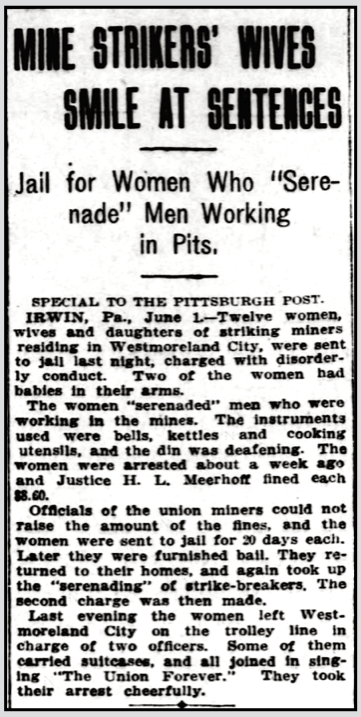
Hellraisers Journal – Sunday June 4, 1911 Greensburg, Pennsylvania – Miners’ Wives Sing on Their Way to Jail
From the Wilkes-Barre Times Leader of June 2, 1911:
MINERS’ WIVES ARE JAILED WHEN THEY SHOUT AT WORKERS ———- Eleven Torn from Families on Complaint of Coal Company Officials at Greensburg. ———-
TWO WERE CARRYING BABES —– Prisoners Will Have to Spend Thirty Days in Jail Unless Judge Changes Mind. —–
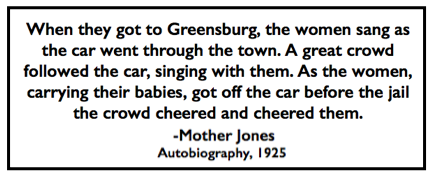
GREENSBURG, Pa., June 2.-With tearful faces, but defiant in their stand for their husbands, who are striking miners in the Irwin coal fields, eleven women were torn from their husbands and children, who had accompanied them to the Westmoreland county jail, and locked up to serve thirty-day sentences, imposed for disorderly conduct.
The women are from Westmoreland City, and it was alleged by the prosecutors, who are officers of the coal company, that the women had made the night hideous for the inhabitants with their shouting and had been a menace to the men who were working for the company [scabs].
They were arrested on warrants issued before Squire H. A. Meerhoff, of Irwin, who sentenced them.
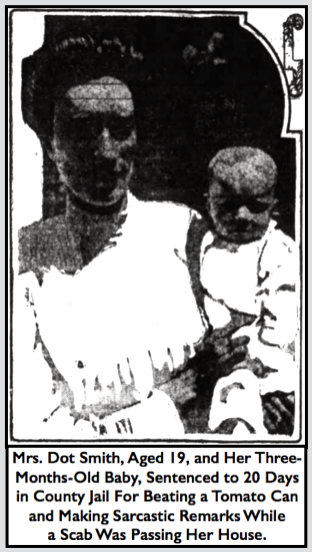
Two of the prisoners, Mrs. Margaret Means and Mrs. Dot Smith, carried babies in their arms. A crowd gathered around the jail when it became known that a band of strikers wives were being locked up.
Judge A. D. McConnell ordered twenty strikers who were brought before him from Latrobe and Bradenville, charged by the Latrobe Connellsville Coke Company with violating the court’s injunction, to pay the costs or stand committed. They were also ordered to remove their camp at Superior No. 2 within the next five days or be sent to jail.
This is the second bunch of strikers who were ordered to pay the costs for violating the court’s injunction issued a year ago restraining them from marching “by or near” company property. There is some talk among the United Mine Workers of making an appeal from the court’s decision, especially in the matter of ordering them to remove their camp, which is located on private property which they have leased.
—————
[Newsclip added from Pittsburg Post of June 2, 1911]

 —————
—————
 —————
————— —————
————— —————–
 —————
————— —————
————— —————
————— —————-