
 —————
—————
Hellraisers Journal – Tuesday February 28, 1922
Philadelphia Local 8 of I. W. W. on the Firing Line
From The Messenger of February 1922:
LOCAL 8 OF I. W. W. ON FIRING LINE
THE Administration’s policy toward the I. W. W. has been everything but frank, just and fair. On the contrary it has been mean, petty and cowardly. Believing that public sentiment was not as aroused and as insistent for the release of the members of the Industrial Workers of the World as it was for other prisoners charged with the violation of war-time laws it announced a different policy in dealing with the I. W. W. cases.
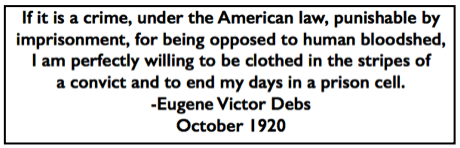
It was well established by the action of the Courts of Appeals of the seventh and eighth districts in the Chicago and Wichita cases, that the I. W. W.’s were found innocent of acts of sabotage or other industrial crimes. Their legal status now is the same as that of Debs before his release. In other words they are held in prison for expressing opinions in opposition to war.
As was pointed out in the foreword of the brief of attorney Otto Christensen, “many of the offenses that the I. W. W.’s were convicted of in the lower courts having been nullified by the action of the Court of Appeals, the legal basis for holding them in prison likewise has been changed.” “Since,” according to the Civil Liberties Union, the reversal of the industrial courts on which three-fourths of the evidence was introduced, these cases are in every essential analogous to the case of Mr. Debs.”
In view of the foregoing facts, it is apparent that the difference in policy in handling the cases of the Industrial Unionists, arises out of prejudice and class hatred.
It appears that the Administration acts not out of consideration for justice and right, established by facts and reason; but only out of fear of a general upsurge of an outraged public against blind, unreasoning intolerant, autocratic, Kaiser-like methods.
Recognizing this fact, Local 8 of the Marine Transport Workers of Philadelphia, has, in accordance with its general policy of enlightened, militant, revolutionary action, proceeded to arrange an intensive campaign of education and agitation in the interest of the 118 class-war and political prisoners still languishing in prison.
 —————
—————
 —————
—————
 —————
—————
 —————
—————
 —————
—————
 —————
—————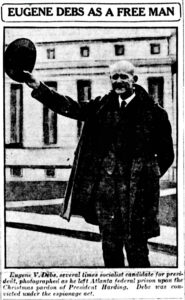 IT was Christmas morning. By the President’s order a man was to be released from prison in Atlanta some time that day and proceed to Washington-no one seemed to know just when. But at six o’clock we newspaper men were tipped off to go to the warden’s house, where Debs was said to be having his breakfast. We waited. An hour passed and then Debs, in his blue denim prison raiment, was ushered out a side door of the Warden’s house into a car and shot back to prison. We then were certain the President had not succeeded in getting his prisoner past our lines during the night. That was something, for few men have left prison supposedly free under circumstances as mysterious as these which attended the release of Eugene V. Debs. And, perhaps, no handful of reporters ever faced so strange a task as that of watching a prison so the President of the United States couldn’t sneak a prisoner up to Washington without anybody knowing it.