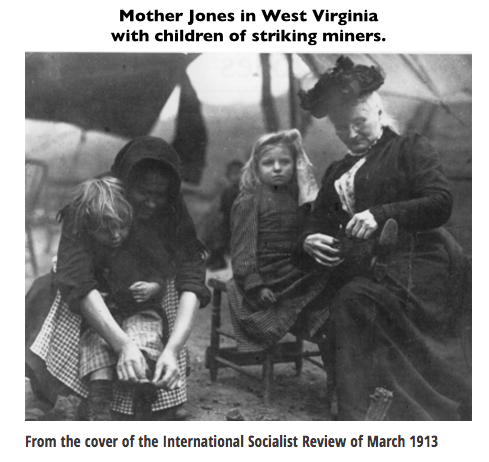
Pray for the dead
And fight like hell for the living.
-Mother Jones
~~~~~~~~~~~~~~~~~~~~~~~~~~~~~~~~~~~~~~~~~~~~~
Hellraisers Journal, Saturday April 28, 1917
Hastings, Colorado – 120 Coal Miners Trapped in Victor Mine
From the Spokane Daily Chronicle of April 27, 1917:
FIRE TRAPS 120 IN VICTOR MINE;
HINT WAR PLOT
—–
Rescuers Rush Into Smoke-Filled Shafts-
Fear Every Man Is Lost.
—–
—–
TRINIDAD, Col., April 27.-Fire in the Victor American Fuel Company mine No. 2, at Hastings, near here, is believed to have trapped 120 coal miners.
Reports were in circulation this afternoon that the fire was the result of a war plot, Austrian miners being suspected. A company of troops has been guarding the property for some weeks.
Fire was first noticed coming out of the mouth of the mine shortly after 9:30 this morning. Helmet crews which entered had made no report this afternoon as to whether or not they had reached the entombed men.
Heavy smoke was pouring from the mine at 1:20 o’clock and it was feared there was little hope of rescuing the men.
Rescuers are being hurried into the workings. At 1:50 o’clock this afternoon 50 men had descended to aid in the fight to save the entombed workmen.
A messenger who reached here from the scene said:
The fire broke out shortly before 9:30 o’clock, when smoke was seen coming from the mine. We think there was an explosion also, but there is no sign of it on the outside. Heavy smoke is pouring from the mine.
Not a word has come from the inside since the fire started.
To advocate peace with things as they are
is treason to humanity.
This is a class struggle and on class lines
it must be fought out to a finish.
-Ida Crouch-Hazlett
~~~~~~~~~~~~~~~~~~~~~~~~~~~~~~~~~~~~~~~~~~~~~
Hellraisers Journal, Saturday April 27, 1907
American Labor Responds to President Theodore Roosevelt
From The Montana News of April 25, 1907:
ORGANIZED LABOR AROUSED
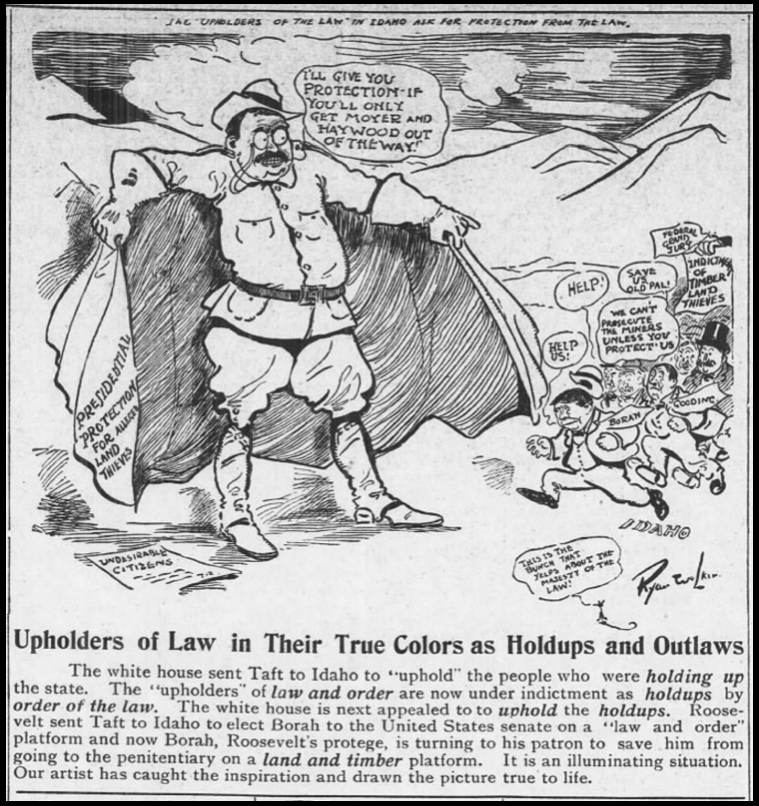
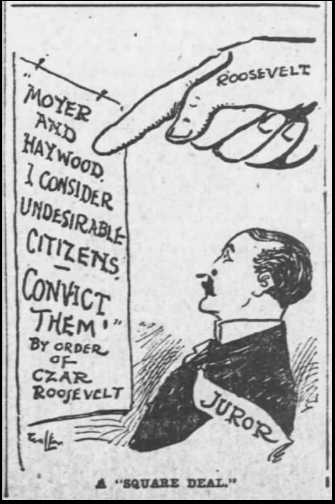
The statement of President Roosevelt in a letter to James S. Sherman, regarding the Harriman controversy, re-which he refers to Debs, Moyer, and Haywood as ‘undesirable citizens’ has raised a storm of protest among the labor unions and aroused to action those few that were hitherto luke-warm. The Executive Committee of the Moyer-Haywood Protest Conference of New York, representing over three hundred labor organizations, with a membership aggregating more than two hundred thousand men, addressed an open letter to the president protesting against the stand he has taken in this matter and asking him to “make such public amends as any true gentleman is bound to offer when inadvertently he has made a mistake and inflicted grievous wrongs upon men who have nothing to do with his personal quarrel.”
The Central Federated Union of New York adopted a motion calling upon Roosevelt to retract his statement that Moyer and Haywood are “undesirable citizens.”
The Boston Central Labor Union adopted a resolution condemning Roosevelt for “usurping prerogatives which neither the laws nor the constitution of the United States gave him.”
The workers flag is deepest red; It shrouded oft our Martyred Dead, And ere their limbs grew stiff and cold Their hearts’ blood dyed its ev’ry fold. -Jim Connell, 1889
~~~~~~~~~~~~~~~~~~~~~~~~~~~~~~~~~~~~~~~~~~~~~
Hellraisers Journal, Thursday April 26, 1917
From the International Socialist Review: “The Russian Revolution”
THE RUSSIAN REVOLUTION
“And let us not fear that we may go too fast. If, at certain hours, we seem to be running at a headlong and dangerous pace, this is to counter-balance the unjustifiable delays and to make up for time lost during centuries of inactivity.”
AS WE go to press, cablegrams bring the good news from Russia that “the national colors, with their eagles, have given place to plain red flags. The red flag of the Revolution is flying from almost every building in Petrograd, even over the famous winter palace of the Czar; tiny red ribbons have been distributed among the people and they are being proudly worn.”
While it is still too early to predict the results of the three day revolt, it is safe to say that the bloody absolutism of centuries is doomed and that the Russian people are on the way to a liberal democracy that will leave Germany the only remaining powerful autocracy on earth.
Hundreds of bread riots and strikes in many large cities culminated in mass action in Petrograd where 13,000 Cossacks were promptly dispatched to quell the “open and violent revolution of the people.” Several thousand imperial police were stationed about the city, provided with machine guns, with orders to mok [mow?] down the hungry crowds clamoring for bread.
You ought to be out raising hell.
This is the fighting age.
Put on your fighting clothes.
-Mother Jones
~~~~~~~~~~~~~~~~~~~~~~~~~~~~~~~~~~~~~~~~~~~~~
Hellraisers Journal, Wednesday April 25, 1917
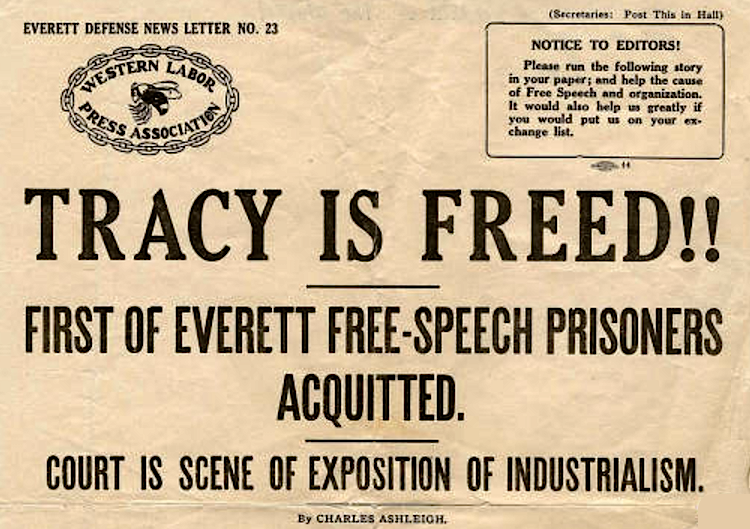
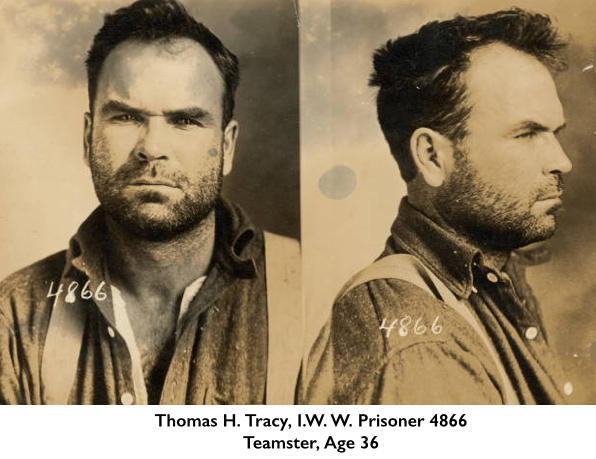
Seattle, Washington – Trial of Fellow Worker Tom Tracy Continues
On April 18th the trial of Tom Tracy was taken to the scene of Everett’s Bloody Sunday where deputized company gunthugs shot down five of our fellow workers who were engaged in a struggle there for Free Speech. The description of the Court’s visit to Everett is covered in the article below.
From the Seattle Union Record of April 21, 1917:
TRACY DEFENSE SCORES HEAVILY
By ALBERT BRILLIANT
The defense succeeded in striking another blow at the state’s evidence in the trial of Thomas H. Tracy, who is being tried as an abettor in a conspiracy to murder before Judge Ronald of King county superior court, when it subpoenaed Fred Luke, a deputy sheriff who was in the employ of Snohomish county at the time of the free speech fight and whose name has been constantly mentioned by the witnesses in the course of their testimony. This makes the second deputy who disclosed the inside of the Commercial club’s scheme, in stopping free speech.
Luke testified that he was present at Rowan’s meeting but did not hear anything said to which as an officer of the law he could take exception. The reason he caused the arrest of Rowan was because McRae had give him orders to. He denied that any violence or disobedience to authorities was ever advocated at I. W. W. meetings that he attended. He told about the crowd that gathered around the county jail, but it was “easily dispersed.” The fence that been broken down was there for a long time; it had rotten posts, the witness explained. There was no resistance at the time the crowd was dispersed. Mrs. Frenett was around but he did not hear her incite anyone to violence. When he was asked by Attorney Vanderveer why the deputies had white handkerchiefs he replied, “So we would not beat up our own men.”
A thousand times rather would I be
one of those men in Ada county jail
than Theodore Roosevelt in
the White House at Washington.
-Eugene Victor Debs
~~~~~~~~~~~~~~~~~~~~~~~~~~~~~~~~~~~~~~~~~~~~~
Hellraisers Journal, Wednesday April 24, 1907
From the Appeal to Reason: Eugene Debs on Theodore Roosevelt
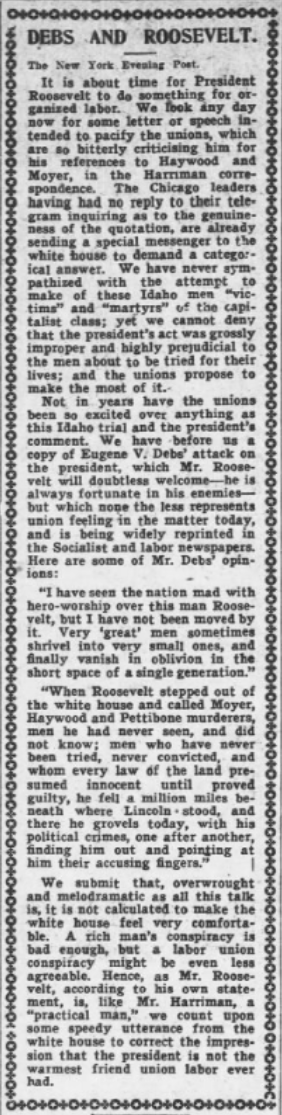
Eugene Debs, who, along with Bill Haywood and Charles Moyer, has been adjudged an “Undesirable Citizen” by President Theodore Roosevelt, had a few words to say upon the subject in this week’s edition of the Appeal to Reason:
When Roosevelt stepped out of the White House and called Moyer, Haywood and Pettibone murderers, men he had never seen and did not know; men who had never been tried, never convicted and whom every law of the land presumed innocent until proven guilty, he fell a million miles beneath where Lincoln stood, and there he grovels today with his political crimes, one after another, finding him out and pointing at him their accusing fingers.
No president of the United States has ever descended to such depths as has Roosevelt to serve his law-defying and crime-inciting masters.
The act is simply scandalous and without a parallel in American history.
What right has Theodore Roosevelt to prejudge American citizens, pronounce their guilt and hand them over to the hangman? In a pettifogging lawyer such an act would be infamous; in the president of the nation it becomes monstrous and staggers belief.
All that Roosevelt knows about Moyer, Haywood and Pettibone he knows from his friends, their kidnapers.
The millions of working men and women, embracing practically ever labor union in America, count for nothing with him. He is not now standing for their votes. He is fulfilling his obligation to the gentlemen (!) who put up the coin that elected him; paying off the mortgage they hold upon his administration.
Theodore Roosevelt is swift to brand other men who even venture to disagree with him as liars. He, according to himself, is immaculate and infallible.
The greatest liar is he who sees only liars in others.
When Theodore Roosevelt, president of the United States, denounced Charles Moyer, William Haywood and George Pettibone as murderers, he uttered a lie as black and damnable, a calumny as foul and atrocious as ever issued from a human throat. The men he thus traduced and vilified, sitting in their prison cells for having dutifully served their fellow-workers and having spurned the bribes of their masters, transcend immeasurably the man in the White House, who, with the cruel malevolence of a barbarian, has pronounced their doom.
A thousand times rather would I be one of those men in Ada county jail than Theodore Roosevelt in the White House at Washington.
Hellraisers Journal, Monday April 23, 1917
Ludlow, Colorado – John R Lawson Speaks at Memorial for Martyrs
Yesterday on the field where the Martyrs of the Ludlow Tent Colony lost their lives in Freedom’s Cause during the Ludlow Massacre, thousands of miners and their families gathered to remember and honor the sacrifice of those heroic men, women and little children. They came by special trains from Trinidad and other towns of Southern Colorado. Every road leading up to the former Colony was lined with automobiles and horse-drawn rigs.
Trains arriving at Ludlow station were met by a dozen bands as thousands of miners and their families, speaking many different languages, left the platform and marched to the site of the Black Hole where the two women and eleven children had perished three years earlier in the fight for shorter hours and higher wages and decent living conditions.
From Tollerburg came a parade of five thousand men and women, each one wearing a red bandanna and carrying a small American Flag. The Flag of Ludlow led the parade, perhaps reminding the strikers of the day in December 1913 when the Martyred Hero of Ludlow, Louie Tikas, had marched beside Mother Jones in Denver carrying that same flag.
Marching in the parade were John R. Lawson and Ed Doyle, who were enthusiastically greeted by the thousands who lined the roads to cheer as the parade pass by them to the site of the Ludlow Massacre.
Lawson and Doyle, although no longer officials of the United Mine Workers, are yet much beloved by the miners and their families who will never forget the courage of these two big men who never bowed before the terror of the company gunthugs nor cowered before the mine-guard infested militia.
Both Lawson and Doyle spoke from the platform to those assembled. They remembered the Ludlow Tent Colony, recounted the strike, and spoke of hope for a better future. They were followed by others speaking in Italian, Slavic, Spanish and Greek.
John Lawson dropped flowers into the The Black Hole of Ludlow were the women and children had perished when the militiamen had set fire to the tent above their heads.
Ceremonies ended with the band playing and the crowd singing, “Nearer My God to Thee.”
Pray for the dead
And fight like hell for the living.
-Mother Jones
~~~~~~~~~~~~~~~~~~~~~~~~~~~~~~~~~~~~~~~~~~~~~
WE NEVER FORGET
The Costa Family, Martyrs of Ludlow
THE TINIEST STRIKER
Cedi and Charlie Costa had three children in 1913, Tony-2, Lucy-4, and Onofrio-6. They lost little Tony that year to the flu. At the time of the Ludlow Massacre, Cedi had carried another baby to term. That tiniest striker is not on the list on the back of the Ludlow Monument, but is mentioned as one of our martyred dead in a few accounts of the massacre.
Jack Reed, who arrived in the Trinidad on about April 30th, gives this account:
Two days after the burning of Ludlow, a reporter, some Red Cross nurses, and the Rev. Randolph Cook of Trinidad, were permitted by the militia to search among the ruins of Ludlow tent colony. The battle was still raging, and the soldiers amused themselves by firing into the ruins as close as they could come to the investigators. Out of the cellar under Mrs. Petrucci’s tent, which Louis Tikas had tried so hard to reach, they took the bodies of eleven children and two women, one of whom gave birth to a posthumous child.
And from Walter H. Fink:
Death Beats Life
Death, represented by the Hamrock-Linderfelt butchers, beat Life in the struggle, and young strikers were the penalty. They were just some of the many cases where the innocent had to suffer.
One particular instance of the results of this butchery was had in the undertaking parlor that night.
The young striker was unarmed.
Its mother lay on a cold, hard slab at the morgue, a victim of the Hamrock-Linderfelt murderers. She was found in the death hole at Ludlow when the Red Cross Society visited the devastated city.
If the murderous thugs in Colorado’s national guard uniform had remained away from Ludlow, had not felt it necessary to massacre the innocents to earn their $3 additional pay from the coal operators, there would have been at least one little striker two days old. But the Hamrock-Linderfelt assassins’ lust for blood could not be denied.
Thursday morning when the woman was buried a little heap lay in her arms against a breast that never had or never would nurse it.
Beshoar identifies the mother as the “wife of Costa:”
The women and children, too, were buried from Holy Trinity church. Huge, horse-drawn drays carried the white coffins to the church and away again. One long box contained the wife of Costa who had died with the union song on his lips. Against her cold breast was a young striker who had never had an opportunity to nurse it.
~~~~~~~~~~~~~~~~~~~~~~
SOURCES
The Education of John Reed
Selected Writings
International Pub, 1955
The Ludlow Massacre
-by Walter H Fink
U. M. W. A., 1914
Out of the Depths
-by Barron B Beshoar
(1st edition 1942)
Colorado, 1980
Hellraisers Journal, Thursday April 19, 1917
From the United Mine Workers Journal: Ludlow Martyrs to be Honored
From this week’s Journal:
The Seed of Freedom
April 20th is the third anniversary of the day on which was perpetrated the crime that shocked humanity in every part of the civilized world, the massacre of unarmed men, women and babies in the little canvas city that the miners’ organization had built to shelter the evicted strikers of southern Colorado who had revolted against the conditions of servitude imposed upon them in the surrounding coal mine camps.
It is not the purpose of this article to recall the horrors of that day of shame; rather would we rejoice that the time is here when we can demonstrate that the victims of the Ludlow massacre did not die in vain, that there also “The blood of the martyrs is the seed of Freedom.”
On Sunday, April 22nd, organized miners from the towns contiguous to the field where the strikers’ tent colony was located and destroyed, will hold memorial services. From Hastings, the great mining camp of the Victor American Coal Company, once closed against every man known to have union sympathies, will come a solid delegation, all the miners of that camp all members of the United Mine Workers union. Every mining town from Morley in the south to Walsenburgh, Fremont County and the lignite coal fields north will send delegations of union men, who can today publish it to the world that they have affiliated with the organization of their industry.
They came, that none should trample Labor’s right
To speak, and voice her centuries of pain.
Bare hands against the master’s armored might!-
A dream to match the tolls of sordid gain!
-Charles Ashleigh
~~~~~~~~~~~~~~~~~~~~~~~~~~~~~~~~~~~~~~~~~~~~~
Hellraisers Journal, Wednesday April 18, 1917
From The Tacoma Times: An Interview with Charles Ashleigh
POET-TRAMP-JOURNALIST A CLOSE OBSERVER
OF BIG SEATTLE TRIAL
By Mabel Abbott
SEATTLE, Wash, April 17.-A poet, a tramp, a newspaper man and an I. W. W. sit each day at the press table in Judge Ronald’s courtroom, where a great class struggle is being fought around the stocky figure of Tom Tracy, I. W. W.
They are Charles Ashleigh.
He is in charge of publicity for the Everett Prisoners’ Defense league, and he is a radical of the radicals; so revolutionary that he even dares to defy the tradition that a revolutionist shall be a sinister and mysterious-looking person.
He is young, small, mild-mannered, and speaks literary English with a fine British accent.
He was born in London. As a boy he was for a time an assistant secretary in the Fabian society of socialists and free-thinkers, and saw and heard Bernard Shaw, H. G. Wells and other famous members.
A little later, he tramped through England with the army of the unemployed, haranguing the crowds and stirring the miners of South Wales to organization.
Loves Adventure.
Ordinary life was tame, naturally, after that, and Ashleigh, went to South America.
In Buenos Ayres he was for a little while in the accounting department of a railway; then he took a contract to string telegraph wires along the right of way.
He had never strung a wire in his life, or seen it done, but he hired a foreman who did know how, assembled a gang of Guarani Indians, and started out.
It was a colorful experience. “The Indians aren’t really a bad sort at all, you know,” Ashleigh explains, “but they do drink. One night the cook shot his brother, in my tent. They were all rioting around so it was hard to tell anything about it, and the authorities got hold of me, as being the handiest person, I suppose, and put me in jail, until the British consul came and cleared things up.” Continue reading “Hellraisers Journal: An Interview with “Poet-Tramp” and I. W. W. Journalist, Charles Ashleigh”→
They’ve got us down-their martial lines enfold us;
They’ve thrown us out to feel the winter’s sting,
And yet, by God, those curs can never hold us,
Nor could the dogs of hell do such a thing!
-Paint Creek Miner
Paint Creek, W. Va., 1913
~~~~~~~~~~~~~~~~~~~~~~~~~~~~~~~~~~~~~~~~~~~~~
Hellraisers Journal, Tuesday April 17, 1917 International Socialist Review: “A New Revolutionary Song Book”
“When the Leaves Come Out” by Ralph Chaplin is now available for sale from the Review or from The Industrial Workers of the World, Chicago.
A New Revolutionary Song Book— The most popular poem ever published in the REVIEW was, beyond any question, Ralph Chaplin’s famous “When the Leaves Come Out,” written at the time when the mine guards in West Virginia had been guilty of killing and injuring scores of striking miners. Many letters came to this office asking the name of the “Paint Creek Miner.”
These friends will be delighted to learn that the I. W. W. has brought out a book of poems and new songs by Ralph Chaplin, songs and poems as rhythmical with rebellion as the pulse of that splendid organization itself.
“When the Leaves Come Out” is a beautiful book with a cover, about which the I. W. W. has a right to boast, and the sketches within, by the author, are full of strength, revolutionary symbolism and artistic charm. The sign of Black Cat is everywhere.
Next month we hope to quote one or two of our favorite poems from this book. But in the meantime send in 50 cents and get it. We understand the I. W. W. sells this new book in quantities at 35 cents a copy. Address I. W. W., 164 W. Washington street, Chicago, Ill.
The cover of FW Chaplin’s new book features the drawing, “The Miner” by Charles A. Winter, published in the June 1913 edition of The Masses: