Hellraisers Journal: From Behind the Bars of the Cook County Jail, Fellow Workers Publish Weekly Menu

Share

Don’t worry, Fellow Worker,
all we’re going to need
from now on is guts.
-Frank Little

~~~~~~~~~~~~~~~~~~~~~~~~~~~~~~~~~~~~~~~~~~~~

Hellraisers Journal, Wednesday May 15, 1918
Chicago, Illinois – Worse and More of it in the Cook County Jail

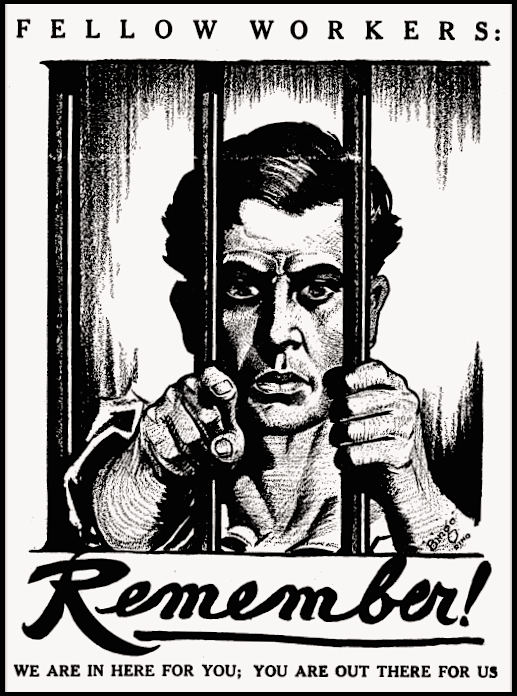
Remember Political Prisoners by Bingo, OH Sc, Mar 10, 1918

In Chicago, the Federal Trial of the Industrial Workers of the World is ongoing. The prosecution has been presenting its case, beginning on May 2nd, and shows no signs of wrapping things up any time soon. As Chief Prosecutor, Frank K. Nebeker, drones on and on, reading in his unrelenting monotone from the I. W. W. literature and letters seized in the federal raid upon Union Headquarters, the defendants, the jury, and the spectators struggle to stay awake. Meanwhile, we pause to remember that not all of our fellow workers have been able to secure bail, and they remained locked behind the bars of the Cook County Jail. From behind the bars of that institution, the class-war prisoners have managed to smuggle out the weekly menu from the Cook of Cook Jail.

From The Industrial Worker of April 27, 1918:

Menu Cook County Jail-1, Eat Bye and Bye, IW, Apr 27, 198Menu Cook County Jail-2, Eat Bye and Bye, IW, Apr 27, 198

Continue reading “Hellraisers Journal: From Behind the Bars of the Cook County Jail, Fellow Workers Publish Weekly Menu”

Hellraisers Journal: From The Brooklyn Daily Eagle: Reporter Talks with Louise Bryant & Interviews Jack Reed

Share

In the relations of a weak Government
and a rebellious people
there comes a time when every act of the authorities
exasperates the masses,
and every refusal to act excites their contempt.
-Jack Reed

~~~~~~~~~~~~~~~~~~~~~~~~~~~~~~~~~~~~~~~~~~~~

Hellraisers Journal, Tuesday May 14, 1918
Greenwich Village – Home of Jack Reed and Louise Bryant

After a short conversation with Louise Bryant, wife of John Reed, a reporter recently conducted an interview with Mr. Reed in the couple’s Greenwich apartment. Both Bryant and Reed were witnesses to the Bolshevik Revolution during their tour of duty there as war correspondents.

From The Brooklyn Daily Eagle of May 5, 1918:

TWO MONTHS LONGER OF KERENSKY AND GERMANY WOULD HAVE
RULED RUSSIA, SAYS JOHN REED
—–
Lenine and Trotzky Will Go Down Under 10,000 Feet the Moment
They Stop Representing the Masses-
People of the Bread Lines Real Rulers of Russia.
—–
Korniloff Allowed Riga to Fall to Scare the People Into Action-
If Kerensky Came Back the People Would Kill Him-
Lies About Bolsheviki Have Seriously Damaged
the American Cause in Russia.
—–

John Reed, Louise Bryant, Spart, Nov 1916The half-starved men and women on the bread lines are the rulers of Russia. The crowd is the government. The faction of which Kerensky was the head, once looked upon by the world as radical, became, comparatively, as conservative as Taft in his second campaign. This faction did not represent the crowd, so it fell, leaving Kerensky with about as much influence in Russia as one William Jennings Bryan has here. If Kerensky should return to Russia he would be killed. If he and his supporters and remained in power two months longer every city in Russia would have been under German control. Korniloff planned the fall of Riga to frighten the Russian people into action, and admitted it publicly. The Kerensky government, when the people threatened to take its power from it, practiced sabotage on the food supplies of the people, fomented strikes in the manufacturing plants, and closed down factories.

So, among many other things, says John Reed, war correspondent, soldier of fortune, unswerving Socialist, Bolshevik, Harvard graduate, friend and co-worker of Lenine and Trotzky, and the young American, who was some time ago reported as having been sent to America by Trotzky to act as American Consul General for the Bolsheviki. He returned to this country one day last week to face trial with Max Eastman, Art Young and others of the former editors of The Masses, who have been indicted on a charge of conspiring to encourage resistance to the draft.

Continue reading “Hellraisers Journal: From The Brooklyn Daily Eagle: Reporter Talks with Louise Bryant & Interviews Jack Reed”

Hellraisers Journal: From The Socialist Woman: Personal Liberty “As Some of Us See It” by Grace Woodward Smith

Share

Women are tired of being “included,”
tired of being taken for granted.
They demand definite recognition,
even as men have it.
-Josephine Conger Kaneko

~~~~~~~~~~~~~~~~~~~~~~~~~~~~~~~~~~~~~~~~~~~~

Hellraisers Journal, Wednesday May 13, 1908
From The Socialist Woman, A Monthly Magazine

On Women and Liberty by Grace Woodward Smith, Socialist Woman, May 1908

Continue reading “Hellraisers Journal: From The Socialist Woman: Personal Liberty “As Some of Us See It” by Grace Woodward Smith”

Hellraisers Journal: From The Harp: “To Irish Wage Workers in America” by Fellow Worker James Connolly

Share

We appeal to you then, fellow countrymen,
to rally around the only banner that
symbolises hope for you in America as in Ireland
–the banner of Socialism.
-James Connolly

~~~~~~~~~~~~~~~~~~~~~~~~~~~~~~~~~~~~~~~~~~~~

Hellraisers Journal, Tuesday May 12, 1908
James Connolly Speaks to Irish Workers of America

From The Harp of May 1908:

To Irish Wage Workers in America
James Connolly

Fellow-Workers:

James Connolly, 1902, Multitext of U College Cork

As all the political forces of the United States are busily engaged to-day in lining up for the great conflict of the Presidential election of 1908, as on every hand there is a measuring of strength, a scanning of ‘issues’, and a searching of souls we desire on our part to approach you for the purpose of obtaining your earnest consideration of our principles before determining where to cast your support in the campaign. Let us reason quietly together! We speak to you as fellow workers and as fellow countrymen, and we ask where do you stand in politics to-day? Hitherto the Irish in the United States have almost entirely supported the Democratic Party, but the time has come when the majority of thoughtful Irishmen are beginning to realise that as the causes that originally led to that affiliation are no longer existent, the affiliation itself must be reconsidered. Political parties must thrive or fail according to the present development of the class in society they represent, and cannot be kept alive by a mere tradition of their attitude in past emergencies. The antagonism of the Democratic party towards the Know Nothing movement in the past won for it the support of the Irish Workers, but Know Nothingism is not an issue to-day, and as the Democratic party is going down to an unhonored grave because of its inability to grasp the problems of our own time shall we Irish Workers suffer ourselves to be dragged to social perdition with it?

Continue reading “Hellraisers Journal: From The Harp: “To Irish Wage Workers in America” by Fellow Worker James Connolly”

Hellraisers Journal: Appeal to Reason Announces Socialist Party Convention & Socialist Women Send A Message

Share

Women are tired of being “included,”
tired of being taken for granted.
They demand definite recognition,
even as men have it.
-Josephine Conger Kaneko

~~~~~~~~~~~~~~~~~~~~~~~~~~~~~~~~~~~~~~~~~~~~

Hellraisers Journal, Monday May 11, 1908
Chicago, Illinois – National Convention of Socialist Party of America

From the Appeal to Reason of May 9, 1908:

The Convention
—–

Socialist Party of America Button

The greatest political convention ever held in the interest of the working class in the United States will begin its deliberations on May 10th in the city of Chicago. This convention will represent every state and territory in the union and it will be the only political convention which will adopt a platform and name national candidates wholly in the name, and for the benefit of the working class.

Compared to the conventions of capitalist parties this will be a unique gathering. It will consist of both men and woman and its deliberations will be marked by the one unvarying purpose to faithfully express in political terms the economic interests of the working class….

The Appeal sends greetings to the delegates assembled at Chicago. It has full faith in their ability to clearly see the important duties which lie before them, and in their fidelity to discharge those duties with equal credit to themselves and the party.

———-

[Photograph added.]

From The Socialist Woman of May 1908:

ARE THE INTERESTS OF MEN AND WOMEN IDENTICAL?
A Suggestion to the National Convention
—–

Josephine C. Kaneko.

Josephine Conger Kaneko, 1904 as M Josephine Conger, Little Love and Nature Poems

It is an oft repeated phrase among Socialist agitators that the interests of men and women of the working class are identical, and therefore there should be no methods of education and appeal instituted for one sex alone; but that all efforts of this kind should be directed from one point, whether it be newspaper, pamphlet, street corner or platform, to all persons regardless of sex, creed or color.

And on this theory our educational work has proceeded, in this country at least, for the past quarter of a century. That is, we think we have proceeded on this theory. But it does not take very careful thought on the matter to discover that we have not acted in accordance with our theory at all, but have worked always as a matter of expediency along the line of least resistance with the male portion of humanity. It has never been very likely that we could reach the workingman in his wife’s kitchen or nursery, or her little parlor, and as it has seemed more expedient to work with him than with her, we have followed him to his lair—to the street corner, to the trade union hall, to the saloon. We have opened our locals in localities where he could be most easily reached, and have accommodated the environment to his tastes and needs. The little room at the rear of the saloon has not been so comfortable as his wife’s parlor or sitting room, and sometimes no larger. but he has felt more at ease in it when congregating with other men, so the locals have in some instances been established in the rear rooms of saloons, and frequently in other dreary, comfortless halls which are always obnoxious to women.

We have said, half-heartedly, that women could come to our locals in these dreary places. But they haven’t cared to come to any great extent, any more than the men would have cared to meet in the women’s parlors. It has been plainly a discrimination in favor of one sex above another. But it has always seemed a matter of expediency.

Continue reading “Hellraisers Journal: Appeal to Reason Announces Socialist Party Convention & Socialist Women Send A Message”

Hellraisers Journal: Whereabouts and Doings of Mother Jones for April 1908-Found on Tour in Texas, Speaking for Socialist Party

Share

Quote Mother Jones, Palaces and Jails, AtR, Feb 29, 1908

~~~~~~~~~~~~~~~~~~~~~~~~~~~~~~~~~~~~~~~~~~~~

Hellraisers Journal, Sunday May 10, 1908
-Mother Jones News Round-Up for April 1908
–Found in Texas on Tour for the Socialist Party of America

From the Appeal to Reason of April 4, 1908:

Tri-State Edition, AtR p3, Apr 4, 1908

[…..]

Texas SP Speaker Dates, AtR p3, Apr 4, 1908

[…]

Mother Jones-Tyler, April 2-8; Chandler, 10; Brownsboro, 11; Athens, 13…

———-

Continue reading “Hellraisers Journal: Whereabouts and Doings of Mother Jones for April 1908-Found on Tour in Texas, Speaking for Socialist Party”

Hellraisers Journal: From the Appeal to Reason: Some Thoughts On Competition, Co-operation, and Socialism

Share

EVD Quote, cry for freedom, Duluth Truth, Feb 15, 1918

~~~~~~~~~~~~~~~~~~~~~~~~~~~~~~~~~~~~~~~~~~~~

Hellraisers Journal, Monday May 9, 1898
On Co-operation: “Love rules instead of hate.”

From the Appeal to Reason of May 7, 1898:

On Competition, Co-operation, and Socialism

AD, Co-operative Commonwealth by Laurence Gronlund, AtR p3, May 7, 1898

PUT two men in competition, let them set up in store, shop or factory and sell in the same territory, ans see how they will grow to dislike each other and try to outdo and break each other up. That is the natural effect of such relation and can no more be avoided than the law of gravity. The success of each fully depend on the failure of the other. Now let these two men combine, form a partnership, and see how each will at once begin to work for the success of the firm which means the success of his partner. Neither can do anything for himself without at the same time helping his fellow. Mutual interest takes the place of self interest, love rules instead of hate. Can you give any valid reason why the same will not be true with three men instead of two? or of three hundred or three millions instead of three? That is the principle of socialism-that the industrial relations of men should be mutual instead of competitive, that all industries should be owned and operated by all the people collectively instead of individually, it would mean peace, plenty and pleasure for all.

Continue reading “Hellraisers Journal: From the Appeal to Reason: Some Thoughts On Competition, Co-operation, and Socialism”

Hellraisers Journal: From the Latest I. W. W. Songbook: “Dump the Bosses Off Your Back” by John Brill

Share

If one man has a dollar he didn’t work for,
some other man worked for a dollar he didn’t get.
-Big Bill Haywood

~~~~~~~~~~~~~~~~~~~~~~~~~~~~~~~~~~~~~~~~~~~~

Hellraisers Journal, Wednesday May 8, 1918
From I.W.W. Songs, General Defense Edition

From Songs of the Workers, 14th Edition, April 1918:

Dump the Bosses Off your Back, LRSB, 14th Ed, Apr 1918

Continue reading “Hellraisers Journal: From the Latest I. W. W. Songbook: “Dump the Bosses Off Your Back” by John Brill”

Hellraisers Journal: From The Liberator: “On the Inside” by Bill Haywood, IWW Class-War Prisoners in Cook County Jail

Share

Such a group of men one is proud to be associated with
-workers, clean hearted, clear eyed;
all fighting for the principles so plainly set forth in
the Preamble of the Industrial Workers of the World.
-Big Bill Haywood

~~~~~~~~~~~~~~~~~~~~~~~~~~~~~~~~~~~~~~~~~~~~

Hellraisers Journal, Tuesday May 7, 1918
Big Bill Haywood on Conditions in the Cook County Jail

From The Liberator of May 1918:

On the Inside

By William D. Haywood

BBH, Str Prs Muncie IN, -p11 edit, Apr 25, 1918

CLANG! clang! a bell rang out, big iron doors slid back, the auto patrol wheeled up to the rear entrance of the Cook County Jail; and here we are.

We are in the wing of the “old jail,” a room about 60 by 60 with a double row of cells four tiers high; our cells face the alley to the west. Cells are six by eight, about eight feet high with ceiling slightly sloping to the rear.

This cell is parlor, bedroom, dining room and lavatory all in one. Decorations black and white-that is, the interior is painted solid black on two walls, black half way on the other two walls. The ceiling is mottled white. Wash bowl, toilet, water-pipe, small bench, a narrow iron bunk, flat springs, corn husk mattress, sheet and pillow case of rough material, blanket, tin cups and spoons, constitute the fittings of our temporary homes where we spend twenty hours out of every twenty-four, involuntary parasites, doing no more service to society than the swell guys who loll around clubs or attend the functions at fashionable resorts.

The reveille of this detention camp is the sharp voice of the “runner,” “Cups out! Cups out!”

It is the beginning of a new day. The light, streams through the grated. door and falls in a checkered pattern across the cell floor.

One stretches his body on the narrow cot and awakens to the fact that he is still in jail, accepting the situation philosophically, wondering, some of us perhaps, what manner of independence and freedom it was that our Forefathers fought for in this country.

A prison cell is the heritage we gain for the blood and lives our forefathers gave; they fought for religious freedom and left us with minds free from superstitious cant and dogma; they waged war for political justice; they carried on the struggle against chattel-slavery-these were the titanic battles that were fought, bringing us to the threshold of the greatest of all wars-the class war-in which we are enlisted as workers, against all kinds of exploiters.

Continue reading “Hellraisers Journal: From The Liberator: “On the Inside” by Bill Haywood, IWW Class-War Prisoners in Cook County Jail”

Hellraisers Journal: From the New Appeal: A Poem by Karl Marx Written During His Youth

Share

Anything but calm submission
To the yoke of toil and pain?
Come what may, then, hope and longing,
Deed and daring still remain.
-Karl Marx

~~~~~~~~~~~~~~~~~~~~~~~~~~~~~~~~~~~~~~~~~~~~

Hellraisers Journal, Monday May 6, 1918
Young Karl Marx: The Poet with a “fine spirit against tyranny.”

From The New Appeal of May 4, 1918:

Poem by Marx, AtR p4, May 4, 1918

Continue reading “Hellraisers Journal: From the New Appeal: A Poem by Karl Marx Written During His Youth”