You pity yourselves,
but you do not pity your brothers,
or you would stand together
to help one another.
-Mother Jones
~~~~~~~~~~~~~~~~~~~~~~~~~~~~~~~~~~~~~~~~~~~~
Hellraisers Journal, Wednesday July 27, 1898
Chicago, Illinois – Workers Walk in Rain as Street Cars Pass By
From the Appeal to Reason of July 16, 1898:
WHY DO WE WALK?
E. B. Webster in National Tribune.
As I started home from “down town,” when I reached Madison street I noticed hundreds of people walking, all going west.
I was intending to take a car, but seeing so many people walking, I says to myself: “The cars must have stopped.” But, no, the cars were moving right along, one every half minute.
Then why do the people walk? I determined to walk home with the rest and punish myself for having been dormant and letting the street railway company buy up the street for a few thousand dollars from the aldermen who had the power to give away what they never owned and had cost them nothing.
To speak for labor; to plead the cause
of the men and women and children who toil;
to serve the working class,
has always been to me a high privilege;
a duty of love.
-Eugene Victor Debs
~~~~~~~~~~~~~~~~~~~~~~~~~~~~~~~~~~~~~~~~~~~~
Hellraisers Journal, Sunday July 26, 1908
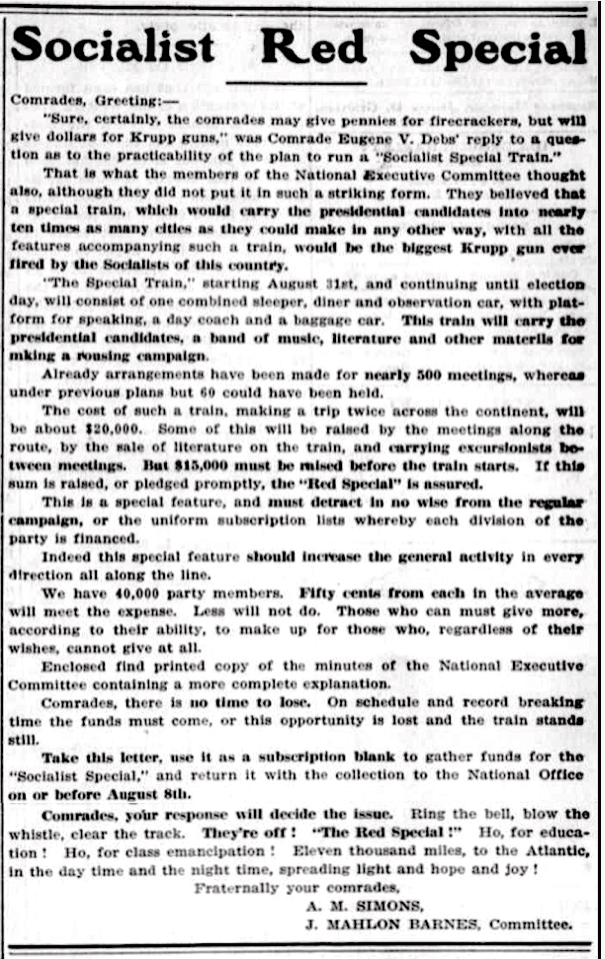
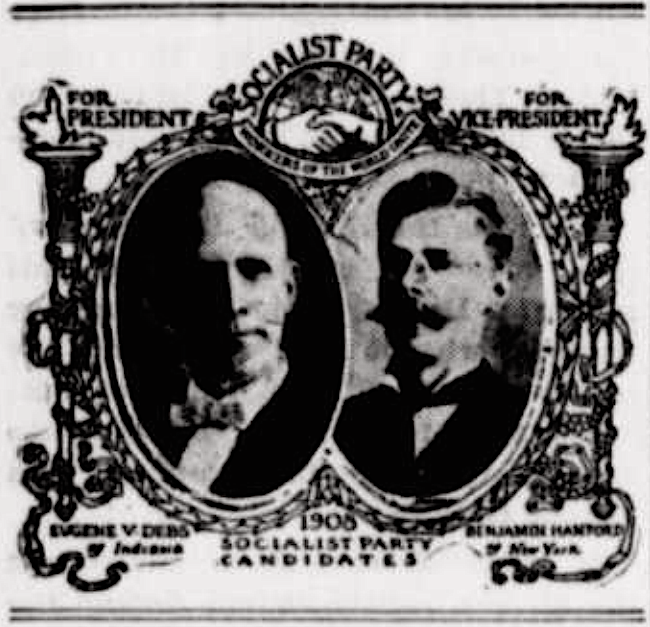
Socialist Party to Use “Special Train” for Debs Campaign
We are free, truly free, when we don’t need to rent
our arms to anybody in order to be able to lift
a piece of bread to our mouths.
―Ricardo Flores Magón
~~~~~~~~~~~~~~~~~~~~~~~~~~~~~~~~~~~~~~~~~~~~
Hellraisers Journal, Saturday July 25, 1908
From Los Angeles County Jail: “Open Letter” by Mexican Revolutionaries
From the Montana News of July 23, 1908:
MEXICAN REVOLUTIONISTS
APPEAL TO ROOSEVELT.
—–
—–
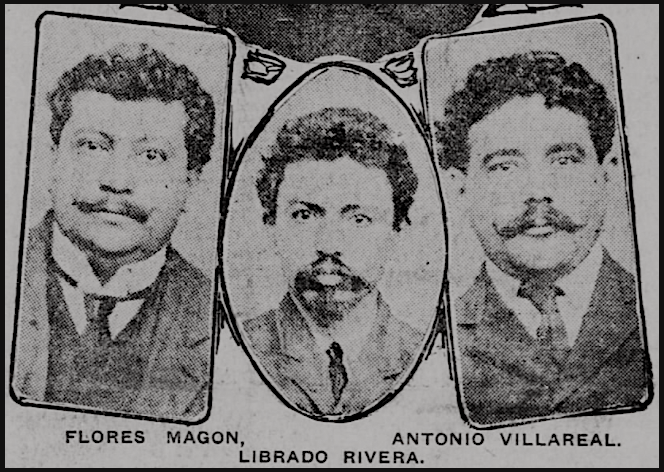
The “open letter”, of which this is a copy, was mailed to President Roosevelt, upon May 28, by Messrs. Magon, Villarreal, and River, the three Mexican political prisoners who are still in Los Angeles county jail. They have now been in prison over nine months without trial. If their case goes to the supreme court, they m ay be without trial for another year to come. So far, release under bond has been denied them, though it is at times granted even to persons accused of murder.
These men have violated no law. Their crime is that of working for the oppressed of their own country, agitating in behalf of education, improvement in the conditions of labor (throughout Mexico, men, women and children alike, work from 16 to 18 hours per day for wages of from 15 cents to 75 cents), and a more liberal government such as would permit freedom of speech and of the press, as well as election of public officials by the people. Such measures as these are contrary to the policy of the Mexican government. Therefore Magon, Villarreal, Rivera, and their associates are “wanted in Mexico.”
Newspapers and individuals are requested to help these men by giving all possible publicity to this letter.
I am not for peace.
As long as there is a kaiser
either in Europe or America
I am for war to clean him out.
-Mother Jones
~~~~~~~~~~~~~~~~~~~~~~~~~~~~~~~~~~~~~~~~~~~~
Hellraisers Journal, Wednesday July 24, 1918
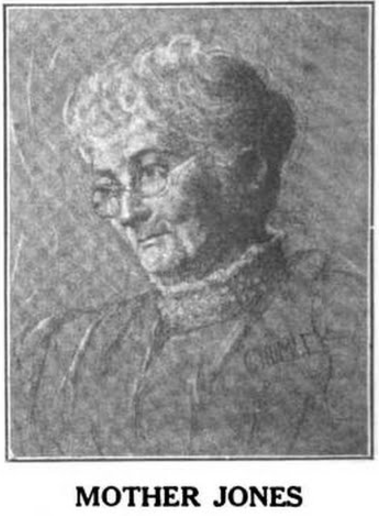
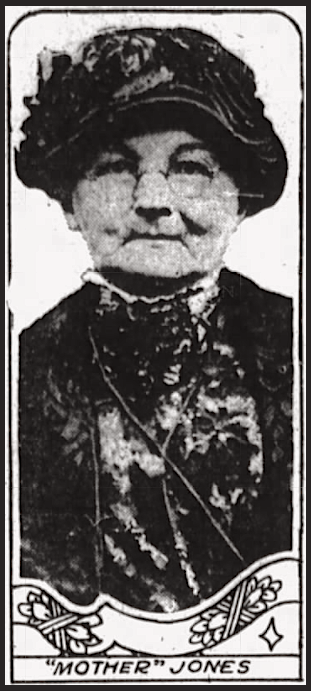
Mother Jones News for June 1918, Part II: Found in West Virginia
According to the June 25th edition of the Fairmont West Virginian, Mother Jones took a little time off from organizing the miners of West Virginia in order to organize playgrounds for the children of Clarksburg:
Mayor Joe Craddock, of Clarksburg, was a Fairmont visitor yesterday and ran into “Mother” Jones in front of the Traction offices. She touched him up about playgrounds at Clarksburg and he said he was at Fairmont to see the traction people about it but had postponed his talk on account of work. Then she made a strong plea for the kiddies, ending with-
The trouble is that dollars have been regarded as more sacred than the nation’s future.
———-
From the Fairmont West Virginian of June 11, 1918:
“Mother” Jones, in her talk at Haywood Junction Sunday, said:
I am not for peace. As long as there is a kaiser either in Europe or America I am for war to clean him out.
You can’t build a great nation
on a starved and cursed working class.
The workers are the bone and sinew of the nation.
-Mother Jones
~~~~~~~~~~~~~~~~~~~~~~~~~~~~~~~~~~~~~~~~~~~~
Hellraisers Journal, Tuesday July 23, 1918
Mother Jones News for June 1918, Part I: Found in West Virginia
Mother Jones was found in mostly in West Virginia during the month of June giving fiery speeches to the miners of that state who are now being rapidly organized into the ranks of District 17 of the United Mine Workers of America. For example, on Sunday June 9th, at Haywood Junction, West Virginia, she declared:
Don’t let the Kaiser know that we have men in West Virginia who will let their bosses kick them around and let their children open the doors in the mines for mules to pass….
There are old fellows around here living in the candle age still. There is a change in the thought of the world but these poor fellows can’t see it. This nation can make dollars any time it wishes but men and women cannot be turned out so easily and it takes nourishment, training and character to produce them. The clouds are breaking and the sun is beginning to shine for the workers. Labor went into this war to bring democracy to the world. You can’t build a great nation on a starved and cursed working class. The workers are the bone and sinew of the nation.
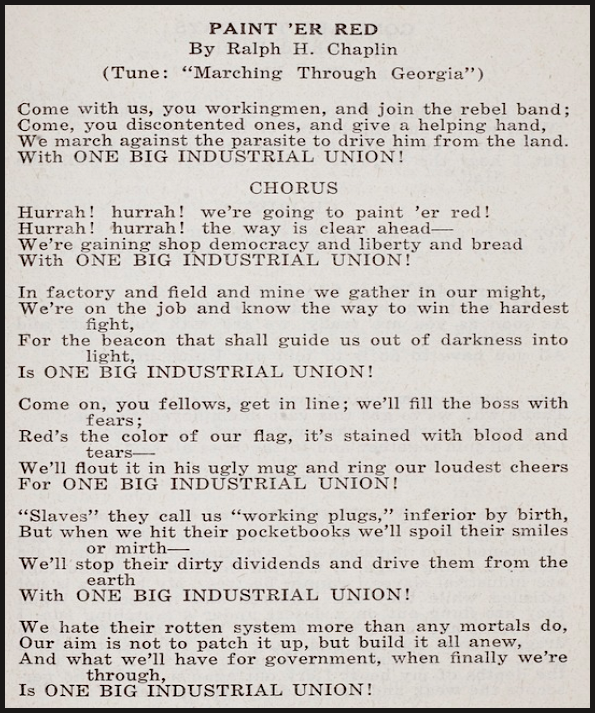
In factory and field and mine we gather in our might,
We’re on the job and know the way to win the hardest fight,
For the beacon that shall guide us out of darkness into light,
Is One Big Industrial Union!
-Ralph Chaplin
~~~~~~~~~~~~~~~~~~~~~~~~~~~~~~~~~~~~~~~~~~~~
Hellraisers Journal, Monday July 22, 1918
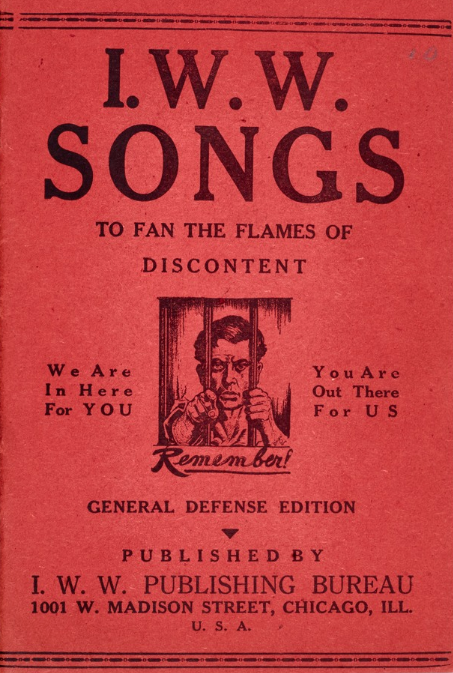
Chicago, Illinois – “I.W.W. Songs to Fan the Flames of Discontent”
Now is the time, Boys…
We can make it if you muster
all the strength you have left.
-Manus Duggan
~~~~~~~~~~~~~~~~~~~~~~~~~~~~~~~~~~~~~~~~~~~~
Hellraisers Journal, Sunday July 21, 1918
Chicago, Illinois – Butte Miners Describe Horrors of Mine Fire
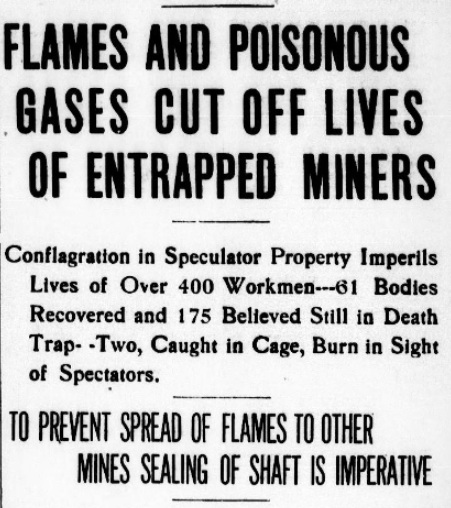
On June 15th, there came forward two miners from the city of Butte to testify for the defense in the federal conspiracy trial against leaders of the Industrial Workers of the World. The miners quietly and calmly described the horrors they had witnessed during and immediately following the mine fire that claimed the lives of 164 of their fellow miners.
From the Billings Morning Gazette of July 16, 1918:
BUTTE CITY OF WIDOWS SAYS WOBBLY
—–
The Daily Missoulian June 10, 1917
CHICAGO, July 15.-“Butte is a city of widows,” said Murta Shay [Murty Shea], a witness at the I. W. W. conspiracy trial today. John Muzilech [Musevich], a miner, told of the fire in the Speculator mine in June, 1917, declaring that the workers were trapped behind cement bulkheads which contained no doors. “We found the bodies piled in heaps against these bulkheads,” he said.
Joseph Kennedy, recording secretary of the Metal Mine Workers of Butte, testified he had joined the I. W. W. in 1917. Since 1909, he said, he had worked about six years under ground in Butte and had never seen a mine inspector in the workings.
George Taylor of Fernwood, Idaho, testified he had worked in lumber camps on St. Mary’s river for many years, but was made, a deputy sheriff last summer during the lumber strike there. He said there was no disorder but that many I. W. W. members who went into the woods to fight forest fires were arrested and locked in a stockade on their return.
—–
[Newspaper clipping added.]
Report from Defendant Harrison George:
[Testimony of Murty Shea]
Next upon the stand [June 15th] came a stalwart, broad-shouldered man, a pleasant-mannered Irish miner from Butte, who told in that nonchalant way usual to those whose every hour of labor is an hour of peril how he and a few other miners had fought their way through that hell of flame and smoke which swept the Speculator Mine in June, 1917, and left its sacrifice to greed in the form of 174 burned and mangled men. The story of this man, who walked out of the jaws of death into the Chicago courtroom is worth perusal.
The Word is said; the Time is nigh.-
Stand fast, O rebel clan!-
For, what are gallows or jails to us
Upbuilders of the Plan?
You cannot stay the Debtor’s Day,-
The Heritage of Man!
-Charles Ashleigh
~~~~~~~~~~~~~~~~~~~~~~~~~~~~~~~~~~~~~~~~~~~~
Hellraisers Journal, Saturday July 20, 1918
The Cook County Jail: “Ordeal of Iron and Stone and Monotony”
COOK COUNTY JAIL
in “The World.”
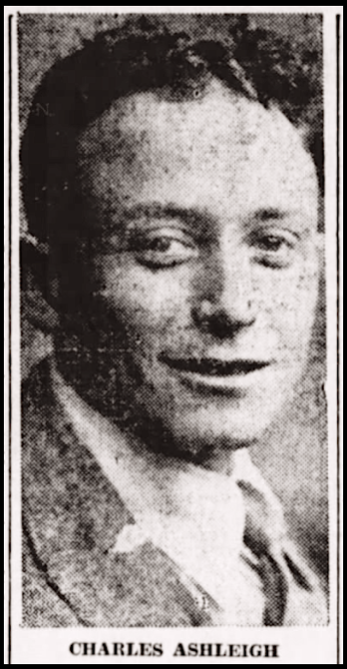
By Charles Asheigl [Ashleigh]
In the consideration of principles, theories and movements, we should never lose sight of the personal. Many people who are too bookfed, or whose cerebral diet has been too severely confined to the “practical,” or academic become inclined to live mentally among generalizations only. It is good to observe a great array of men-an army or a marching pilgrimage.
It is impressive, the sight of this moving mass in its slow and fluid immensity. But one should not forget that each unit of this host is a breathing bundle of emotions, a compact battle-ground, perhaps, of conflicting passions, warring instincts and twisted purpose. And some among them may even have souls which are as half-wild garden, purpled with the mist of dreams amidst which play the fountains of fantasy.
And so it is with us in jail. O friend of mine. You look upon us as a body, a band of men who are passing through this ordeal of iron and stone and monotony, so that one day, a larger and more colorful life shall be won for this world’s folk. A legion of crusaders, adventuring to win the Holy City of social and industrial freedom; a strong-souled company of knights, seeking the Holy Grail; which is liberty and myth and the space to laugh and love and live.
We are all this. It is indeed, true, that we represent the most significant and dynamic factor in America’s evolution towards a complete democracy political. In the mass we are all that, but considering us individually, each one of us adds to these common qualities the tang the color of his own personality.
Had the greatest meeting ever held in Coalgate-
thousands and thousands-woods full of ’em,
all blazing with zeal for Socialism.
-Eugene Victor Debs
~~~~~~~~~~~~~~~~~~~~~~~~~~~~~~~~~~~~~~~~~~~~
Hellraisers Journal, Sunday July 19, 1908
Coalgate, Oklahoma – Debs Draws Enthusiastic Crowd
From the Appeal to Reason of July 18, 1908:
Debs in Oklahoma
—–
—–
Eugene V. Debs spoke at the Fourth of July celebration at Coalgate, Okla., after several other orators had been heard in dead silence, and immediately had the 5,000 auditors aroused to enthusiasm and applause. letters to the Appeal describe it as a wonderful meeting. It was a non-partisan gathering, but the enthusiasm was all one way, and at the conclusion of Debs’ address 2,000 people followed him to the depot, two miles away, to cheer him when he took his departure.
On the night of the 5th, Debs spoke in Oklahoma City, on a warm evening, in a close hall, and was greeted by 2,000 people who paid an admission price to hear him. This is the more remarkable since Mr. Bryan, when speaking in the same hall, an admission being charged, a year ago, had only 500 auditors. The Daily News estimates Debs’ audience at 3,000, and says: “Though the evening was hot and the speech almost two hours long, very few people left the building. Fully half of the audience was made up of women, who joined in the liberal applause.”
From Debs.
Dear Appeal: Haven’t had a ghost of a chance to write-am constantly besieged and surrounded, early and late, on the trains, everywhere. Had the greatest meeting ever held in Coalgate-thousands and thousands-woods full of ’em, all blazing with zeal for Socialism. Great meeting at Oklahoma City and two at Fort Smith. Spoke four hours and a half, afternoon and evening, yesterday. Same great crowds and lusty enthusiasm everywhere. Am to meet Lincoln Steffens for interview in Everbody’s soon as he gets through with Denver convention. The people all through here are red-hot about the Appeal’s persecution. We passed through Olney, Okla., where the postmaster was reported to have burned the Appeals. He now denies it. The indignation is great. One comrade went to his postmaster and said: “If you destroy my Appeal. I’ll not squeal to Uncle Sam, but I’ll make it a personal matter with you.” The postmaster assured him he would get his paper right along. They daren’t refuse delivery.-E. V. Debs.
Hellraisers Journal, Monday July 18, 1898
Eugene V. Debs: “The Social Democratic Party of America lives.”
From the Chicago Social Democratic Herald of July 16, 1898:
The Future
To the Social Democratic Party.
Comrades:—
That I have not earlier sent greeting to my comrades is due to prolonged indisposition. The incessant work and travel of more than 20 years have temporarily placed me hors de combat [out of the fight]. But only temporarily. With returning health and strength my work will be continued. It is not a little disquieting to have to “let go,” even for a little while, when there is such urgent need for action.
The separation at the late convention was inevitable. It had to come. The contemplation of division was painful, as only those can fully realize who were party to it. But painful as it was, the operation had to be performed. And it was a success, for the Social Democratic Party of America lives. All the members are full fledged socialists. They are in accord with the program of international socialism. There is not only in the number opposed to independent political action, not one that asks or expects anything from any old capitalist party, by whatever name it may be called.
There is harmony. There is oneness of purpose, there is true-hearted fidelity to principle, there is unrelaxing energy, and these qualities in alliance presage success.
So I contemplate the course of events with serenity.