Hellraisers Journal – Monday July 2, 1900
St. Louis, Missouri – Strikers Slaughtered by Posse Comitatus
From the International Socialist Review of July 1900:
The Chicago and St. Louis Strikes
[Part II of II.]
St. Louis Republican of June 11, 1900
The St. Louis street car strike, like the one just described, started with various subjects of dispute and soon narrowed down to a question of the recognition of the right of the men to act together. From the beginning this strike was marked with acts of violence. However much this may be deplored the fact remains that so long as capital exists it is impossible for any large strike to continue for any length of time without the accompaniment of violence. This is especially true when lines of transportation are concerned.
When non-union men are so conspicuously engaged in treason to their class as they must be when they run street cars or railroad trains in time of strike it would require a stage of human development far above that of capitalism to produce the sort of human beings that will stand idly by and see their means of living taken away and not resort to violence. But before commenting further on the subject of violence during strikes a few observations are necessary. In the first place it is well to remember that the press is in the control of the present ruling capitalist class and always exaggerates any violence that may take place and in a great many instances, notably during the great railroad strike of 1894, manufactures out of whole cloth long and elaborate stories of acts of violence that never occurred at all. This in itself is sufficient proof of which class it is that deserves violence, “The wish is father to the thought.”
Hellraisers Journal – Sunday July 1, 1900
Chicago, Illinois – Great Lock-Out of Building Trades Continues
From the International Socialist Review of July 1900:
“The Chicago and St. Louis Strikes”
Part I of II.
At the beginning there were various points of contention, but as time passed these all gave way to one main point of contention, the question of the principle of federated trades. All the building trades of Chicago are federated for such common action as may be thought necessary in the Building Trades Council. The contractors insist that this body disband as a condition to any settlement whatever.
This is, of course, an absolutely impossible condition for the laborers, the concession of which would not be a settlement at all, but a crushing defeat. It would mean the setting back of labor one step in the long upward struggle of centuries; the abandonment of one vantage point gained at terrible cost. The individual union is almost if not quite as helpless in the face of the intensely concentrated capital of today as was the individual work man before the capitalist employer of a generation ago. This was especially emphasized in the Chicago struggle as the employers were all united in a Central Contractors’ Council. The fact that the contractors never dreamed of dissolving their central body proved the purely class nature of their demand and showed that the dispute was one that could be settled only by a test of strength.
Hellraisers Journal – Saturday June 30, 1900
Georges Creek Coal Region, Maryland – Mother Jones Organizing Coal Miners
From Wisconsin’s Kenosha Evening News of June 26, 1900:
MOTHER TO STRIKERS
—–
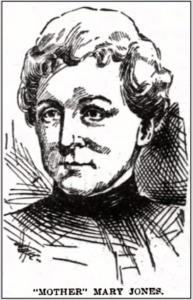
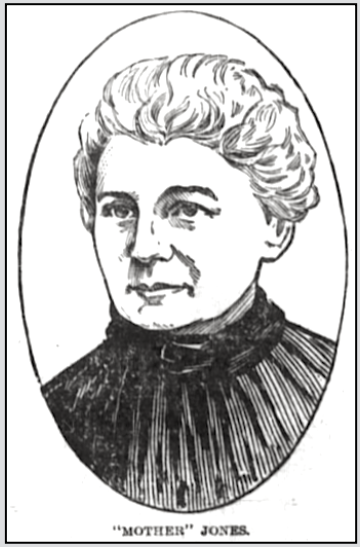
One of the most conspicuous figures in the strike of the Maryland coal miners is Mrs. Mary Jones, who is popularly known in labor circles as “Mother” Jones. She is an organizer and is apt to be found anywhere in the country during a strike.
“Mother” Jones is a matronly looking old lady of 60, with plump, red cheeks, pleasant blue eyes and abundant white hair.
As a writer,speaker and propagandist for socialistic doctrines, “Mother” Jones has been successful. She has been in reform movements for 20 years, mostly in the west, and for some time has been a newspaper correspondent, but her penchant is a strike, the harder the better. No matter where the trouble comes, there she goes-some way, somehow. She always refuses to take pay for her work and says she does not “help the boys” for what little money she can get.
Four years ago she stumped the state of Georgia for the child labor bill, and she tells some interesting stories about the children between 6 and 10 years working 14 hours a day for about 10 or 15 cents.
She took part in the coal miners strike of 1894, the American Railway union strike, the textile workers’ strike and countless other smaller strikes. When the miners were practically beaten in Arnatt [Arnot] last year, she went and organized the women and children. How she did it no one knows, but for nine months she held those miners together and finally won a settlement. When she left there a few weeks ago, the whole little coal region turned out in a body to see her go. Mrs. Jones says she will not leave the George’s creek coal region until the operators consent to meet the miners.
Hellraisers Journal – Friday June 29, 1900
Lonaconing, Maryland – Mother Jones Stands with Striking Coal Miners
From the Appeal to Reason of June 23, 1900:
Mother Jones has been doing her usual amount of good work with the coal miners of Lonaconing, Pa [Maryland]. A local paper says in an account of a strike meeting: “Mother Jones was then introduced and proved herself beyond question a remarkable woman. She received liberal applause, and a number of ladies were present to hear her.”
[Drawing and emphasis added.]
From the Washington Times of June 23, 1900:
VIEWS OE MOTHER JONES
—–
Woman Labor Leader Explains Her
Interest in the Cause.
BALTIMORE, June 22.-“Mother” Jones, the widely known labor leader, was in Baltimore today in the interest of the striking coal miners of the Georges Creek region. The Federation of Labor is arranging a series of mass meetings for the near future to be addressed by her.
Mrs. Jones does not look like the fiery agitator that she has been described. A motherly, good natured face is lighted by kindly blue eyes and crowned by silver hair. She is evidently over the half-century mark, but is as active as a young girl. “I love my work and it loves me,” she said when her physical vigor was commented upon. She speaks deliberately, with a pleasant voice suggestive of an ancestry to be credited to Ireland, and uses excellent language.
“Why shouldn’t a woman take part in all efforts for the benefit of labor?” she asked in response to a question. ”
Labor is the basis of all society. A woman should surely be interested in her surroundings and her home and do her part to uplift both. When did I begin this work? So many years ago that I have forgotten. I go wherever I think I can be of use. I have taken part in strikes all over the country, and have always urged peaceful methods. All these complex problems will be solved peacefully in time through the molding of public sentiment and the ballot box.
Am I a woman’s suffragist? Well, I have never been identified with the movement or belonged to any organization that was. I think beneficial results have always followed the placing of the ballot in woman’s hands. The excellent labor laws of Australia and New Zealand came only after women began to vote. Colorado, where women vote, is the only State that has taken steps to investigate the labor laws of Australia and New Zealand with a view of adopting them.
A woman becomes no less a woman when she studies social and political conditions and takes part in public affairs. A broadened intellect teaches her to love her home better. Such a woman, as a rule, loves her home and family better than the society woman who hands her children over to hired people to rear.
“Mother” Jones returned to western Maryland today, but will come to Baltimore again next week to make several speeches.
Hellraisers Journal – Sunday June 27, 1920
Atlanta Federal Penitentiary – Debs Greets Stedman with a Kiss
From the Appeal to Reason of June 26, 1920:
President Should Pardon Debs
William M. Reedy, in Reedy’s Mirror.
President Wilson should order the release from prison of Eugene V. Debs. He will, if he has any place in that heart which so throbs for humanity in the abstract, for the individual man. He will, if he has any admiration for a man whose convictions defy prison and death. He will, if he has any brotherliness for another who obeys those “voices” which Wilson himself hears and obeys as Socrates did his demon. He will not doom Debs to death for his opinions based on a higher law than that of that man-made, Hobbesian God, the State. I understand that Mr. Debs is in a much weakened condition as the result of his confinement, that his physical plight is such as to make his immurement during hot weather extremely dangerous.
Hellraisers Journal – Saturday June 26, 1920
Pike County, Kentucky – Miners Marched in Chains by Company Gunthugs
From The Buffalo Labor Journal of June 24, 1920:
EVICTED MINERS IN CHAINS
—–
Charleston, W. Va.-When Pike county (Ky.) miners joined the union they were evicted from company houses, chained together and marched in mud and rain 30 miles by armed guards.
This is one of the sensational statements made in a report to President Keeney, district No. 17, United Mine Workers’ union, by Thomas West, attorney, who investigated Pike county mining troubles. Pike county is opposite Matewan, where several persons were recently killed by Baldwin-Feltz detectives.
[Said the investigator:]
The miners were chained together and were walked in a pouring rain to Pike, 25 or 30 miles away. Mud was almost knee deep. Pike county deputies shot a man’s hands off on the Kentucky side of Borderland. About 30 of them were terrorizing both sides of the river. The Pike county deputies were all drunk. In my opinion they constitute one of the most dangerous gangs of men I ever came in contact with.
[Newsclip added from Ellsworth County Leader of Kansas of June 24, 1920.]
From the Duluth Labor World of June 26, 1920:
MINERS HAVE NO TIME FOR
W. VA. PRIVATE POLICE
—–
Protest Against Continued Use-
Demand That U. S. Senate
Make Investigation.
—–
INDIANAPOLIS, Ind., June 25.— Every possible effort is being made by the United Mine Workers of America to bring about a full and thorough investigation of conditions in West Virginia under which coal miners are employed. The recent battle between coal miners and coal company gunmen at Matewan, W. Va., in which 10 men were killed, has caused the officials of the union to redouble their efforts to induce congress to make a sweeping probe of the situation.
Operating under the guise of private detectives, hundreds of gunmen and thugs, nearly all with criminal records, are employed by coal operators of some fields of West Virginia, and these men enforce a reign of terror among the miners and their families. Miners are beaten, slugged and shot. They are arrested and thrown in prison on no valid pretext whatever.
Hellraisers Journal – Saturday June 25, 1910
Washington, District of Columbia – Mother Jones Remembers Martin Irons
From The Labor Argus of June 23, 1910:
Labor Progressing, Says Mother Jones
—–
Workers of Today Do Their Own Thinking Declares
“Stormy Petrel” In Special Interview
—–
Washington, D. C., June 22.-“The workingmen of this country are at last beginning to think for themselves.”
These significant words came from the lips of Mother Jones, the gray-haired labor agitator, who for the last thirty years has participated in every labor struggle of any prominence, whose presence on the field of action inspires courage and hope among the workers, and strikes terror in the hearts of the masters.
[Said Mother, as she is fondly called by the millions of her boys:]
In the years gone by, the workers were absolutely helpless and dependent on the ability and loyalty of the leaders. Today the leaders are absolutely helpless and dependent on the strength and intelligence of the rank and file.
The work of the old warriors of the labor movement, who have blazed the way with sacrifices for a cause that burned their souls, is bearing fruit. The workers are at last fired with the spirit of revolt and religiously and industrially they are working out their own salvation.
With the force and strength characteristic of the “Stormy Petrel,” and with a sudden brightening of her kindly face, she transmitted to her interviewer the thoughts that were stirring her soul when she uttered, “They are working out their own salvation.”
[Continued Mother Jones:]
There are any number of plain workingmen, who for clearness and logic in analyzing and understanding economic questions can give cards and spades to any Senator and Representative in Washington.
Workingmen of today exchange ideas and discuss important problems in the workshops, at their union meetings, and in their ever growing labor press. These are the most promising signs of the times.
Mother Jones has spent the last ten days in Washington, doing her utmost to secure a congressional investigation of the persecution of the Mexican political refugees in this country. When she was called upon to testify at the hearing on Representative Wilson’s resolution for an investigation of these outrages before the House committee on rules, Chairman Dalzell asked her to state the place of her residence.
“I live wherever the workers are fighting the robbers,” she replied to the surprise and embarrassment of a number of corporation men who are members of the committee.
Hellraisers Journal – Sunday June 24, 1900
St. Louis, Missouri – Streetcar Strikers Shot Down Returning from Picnic
From the Duluth Labor World of June 23, 1900:
ST. LOUIS OUTRAGE HOMESTEAD
—–
HOMESTEAD AND HAZELTON PALE
INTO INSIGNIFICANCE.
—–
Street Car Men Returning Home From a Picnic
Cruelly Shot and Murdered by Posse of Deputy Sheriffs-
Debs’ Strong Letter-Says No Strike is Ever Lost-
The Lesson is Worth the Cost.
—–
—–
The St. Louis street car strike is still on and will be, perhaps, for some time, as the St. Louis Transit Co. have positively refused to accept any proposition for arbitration whatever. Since then the St. Louis Central Labor Union has determined to fight the street car company to the bitter end, and adopted the following proposition for the election of a committee of 50 to form immediate organization and proceed to raise a fund of at least $100,000 to carry on the strike until it is won, the fund to be raised by an appeal to organized labor throughout the world, by personal appeals to every kind of organized bodies in St. Louis, and by such other means as may be deemed proper, closing with an appeal to the people of St. Louis to refrain from riding on the Transit cars, and to organizations, societies and associations of every kind in St. Louis, in sympathy with the movement, to make the street railway strike a special order of business at all their meetings, and to appoint committees to raise funds and continue to maintain an iron-clad boycott until the victory is won.
Mr. E. V. Debs was requested to come to St. Louis, but on account of illness was unable to do so. He however sent a very strong letter, which sums up the situation in a true light. The following from his letter will not be without interest:
Hellraisers Journal – Wednesday June 23, 1920
Williamson, West Virginia – Mother Jones Speaks at Public Meeting, Part II
Williamson, West Virginia – Sunday Evening June 20, 1920
-Mother Jones Speaks at Public Meeting in Front of Courthouse.
SPEECH OF MOTHER JONES at WILLIAMSON, PART II.
[Mother Jones on Agitators.]
The West Virginian June 22, 1920
I went to a meeting and the secretary of the steel workers went with me. He got up to speak. They took him. The next fellow got up; they took him. I got up. They arrested me. I wouldn’t walk. They had to ride me. A big old Irish buck of a policeman said, “You will have to walk.” “No, I can’t.” “Can you walk?” “No, I can’t.” “We will take you down to jail and lock you up behind the bars.”
After a few minutes the chief came along.
“Mother Jones?”
“Yes, sir.”
“There is some of the steel managers here want to speak to you.”
“All right, let the gentlemen come in. I am sorry gentlemen, I haven’t got chairs to give you.” (Laughter.)
One good fellow says, “Now, Mother Jones, this agitation is dangerous. You know these are foreigners, mostly.” “Well, that is the reason I want to talk to them. I want to organize them into the United States as a Union so as to show them what the institution stands for.”
“They don’t understand English,” he says.
I said, “I want to teach them English. We want them into the Union so they will understand.”
“But you can’t do that. This agitation won’t do. Your radicalism has got to go.”
I said, “Wait a minute, sir. You are one of the managers of the steel industry here?”
“Yes.”
“Wasn’t the first emigrant that landed on our shore an agitator?”
“Who was he?”
“Columbus. Didn’t he agitate to get the money from the people of Spain? Didn’t he agitate to get the crew, and crossed the ocean and discovered America for you and I?
“Wasn’t Washington an agitator? Didn’t the Mayflower bring over a ship-full of agitators? Didn’t we build a monument to them down there in Massachusetts. I want to ask you a question. Right today in and around the City of Pittsburgh I believe there has assembled as many as three hundred thousand people [bowing the knee to Jesus during Easter season.] Jesus was an agitator, Mr. Manager. What in hell did you hang him for if he didn’t hurt your pockets?” He never made a reply. He went away.
He was the manager of the steel works; he was the banker; he was the mayor; he was the judge; he was the chairman of the city council. Just think of that in America—and he had a stomach on him four miles long and two miles wide. (Laughter.) And when you looked at that fellow and compared him with people of toil it nauseated you.