Whereabouts and Doings of Mother Jones for December 1901, Part I: Found in Virginia Organizing Miners for the UMWA

Share

Quote Mother Jones WV Miners Conditions, ISR p179 , Sept 1901—————

Hellraisers Journal – Tuesday January 7, 1902
Mother Jones News Round-Up for December 1901, Part I
Found in Old Virginia Organizing Miners for U. M. W. of A.

From the Wilkes-Barre Daily News of December 2, 1901:

NONE WILL GO.

Mother Jones, Drawing, SDH p4, Mar 9, 1901

One of the agents who has been endeavoring to secure miners to go to Stonege [Stonega, near Norton] , Va., told a reporter Saturday that his mission was unsuccessful. Not one miner of ability consented to go.

Mother Jones is now at Stonege organizing the miners. She is not meeting with much success, but the fiery little woman never knew defeat. 

—————

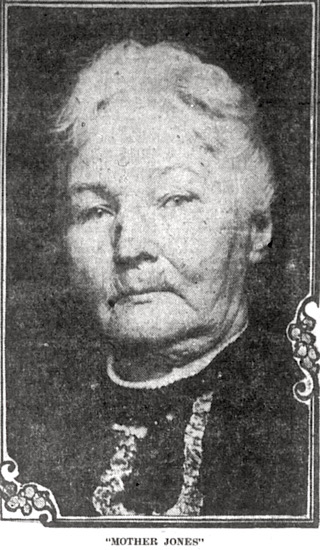
[Photograph added.]

From the Reynoldsville [Pennsylvania] Star of December 4, 1901:

Mother” Jones Friday Night.

“Mother” Jones, of Chicago, organizer for the U. M. W. of A., will deliver an address in Centennial hall Friday evening of this week, December fifth, in the interests of the Trades Unions of Reynoldsvllle. Everybody is invited to attend this meeting, as it will be a public meeting.

From The Richmond Dispatch [Virginia] of December 4, 1901:

MINERS’ STRIKE AT NORTON.
———-
The Situation in Wise County…

WISE, VA. , December 2.-(Special.)-The strike at the mines of the Norton Coal, Company, Norton, Va., still continues. One hundred and fifty men are out.

The strike is said to have been caused by the action of the superintendent in discharging several employees who had joined the recently-organized union at that/mine.

A general strike in this section of the coal-fields is thought to be imminent. It is almost the sole topic of conversation around the mining towns. It is said that the operators at the other mines will dispute the right of  the miners to organize, as the Norton Coal Company has done.

On the other hand, the general meeting of the union at Huntington, W. Va., ratified the Norton strike, thus showing their determination to organize in these fields.

In view of these facts, it. is hardly probable that a strike can be avoided…

From the Reynoldsville [Pennsylvania] Star of December 11, 1901:

“Mother” Jones, the labor organizer, who was to have delivered an address in Centennial hall last Friday evening, was called to Old Virginia on account of labor troubles there and could not come to this place. Thomas Haggerty said to representative of THE STAR that he expected to arrange to have “Mother” Jones come to Reynoldsvllle the latter part of this month.

Continue reading “Whereabouts and Doings of Mother Jones for December 1901, Part I: Found in Virginia Organizing Miners for the UMWA”

Hellraisers Journal: New York City Trembles at Great Strike of 4000 Humble Street Cleaners-by Big Bill Haywood, Part II

Share

Quote BBH One Fist, ISR p458, Feb 1911—————

Hellraisers Journal – Saturday January 6, 1912
The New York City Street Cleaners Strike of November 1911, Part II

From the International Socialist Review of January 1912:

THE STRIKE OF THE SCAVENGERS

By WILLIAM D. HAYWOOD

[Part II of II.]

ISR p391, Jan 1912

The city officials made every effort to break the strike, and although they resorted to the brutal tactics the employing and ruling classes are accustomed to use everywhere in like cases, they met with little success.

Detective agencies were enlisted and were paid $5 for each man they secured, the strikebreaker receiving for his services $3 per day. It requires at least three scabs to do the work of one husky garbage driver, in addition to the number of police required for guard duty. The change was an expensive experiment on the part of the city authorities.

There were many bitter popular demonstrations against the strikebreakers. One man was knocked senseless by a brick thrown from a near-by roof, and was then run over by a wagon that broke both of his legs. He died shortly after being taken to the hospital. A child was run over and killed by one of the mayor’s scabs. Some policemen were injured, but this is not worthy of particular mention, as they are all still alive. Many arrests were made and strikers were cruelly beaten.

 One of the chief lessons to be learned is the inefficiency of scab labor. This is obvious on every hand. While no particular skill is required in the collection of garbage and sweeping of streets, it requires a certain physical standard that is not reached by the casually employed, who do the work slowly, gingerly, spilling at least a third on the street in their clumsy efforts. This same inefficiency prevails in every shop strike, but there the bosses are able to furtively conceal their helplessness behind closed doors. The spirit of many a strike has been broken by apparent success which perhaps is as much of a failure as New York’s strike-breaking department.

ISR p393, Jan 1912

The importance of the least considered, even the scavenger in the machinery of modern living is another lesson to be learned. If this strike had occurred in the summer season the sweltering heat enveloping the piles of filth on the streets would have borne this home with deadly emphasis.

But the piles of garbage in the streets of America’s greatest city grew higher and higher. Abominable enough in other parts of town, the stench in east side streets was almost unendurable. So bad did the situation become that the Merchants’ Association issued an appeal to “good citizens” to come out and take the strikers’ places.

So frightened did the city officials become that they allowed the piles of garbage to be set afire, though this could not fail to do great damage to the streets and endanger lives and dwellings from flying sparks. Gaynor and Edwards declared they would never take the strikers back, but would turn over the street cleaning to· private contractors. Such is the deal handed to the workers under capitalist “municipal operation.”

The Socialist Party was quick to take a hand in the fight and held a big mass meeting in Cooper Union at which the treatment accorded the strikers was denounced.

The teamsters’ and truck drivers’ unions also pledged their “moral support,” but they didn’t give the strikers the kind of support they needed most. A general walk-out of all the teamsters in the city-“a stoppage of everything on wheels,” as one speaker put it-would have ended the fear of pestilence and won the garbage collectors’ strike for them in about one day. But that though “threatened,” never came.

[Emphasis added.]

Continue reading “Hellraisers Journal: New York City Trembles at Great Strike of 4000 Humble Street Cleaners-by Big Bill Haywood, Part II”

Hellraisers Journal: New York City Trembles at Great Strike of 4000 Humble Street Cleaners-by Big Bill Haywood, Part I

Share

Quote BBH One Fist, ISR p458, Feb 1911—————

Hellraisers Journal – Friday January 5, 1912
The New York City Street Cleaners Strike of November 1911

From the International Socialist Review of January 1912:

ISR Cv, Jan 1912

[Part I of II.]

If 4,000 Wall street brokers or 4,000 assorted employers suddenly left their offices or were carried off by a pestilence in New York, the life and activities of that city, after the first sensation, would go on much as usual. Society and industry would proceed with but little interruption. But when 4,000 humble street cleaning employes suddenly quit work in the metropolis in the second week in November [1911] the entire administration of the second greatest city in the world was upset and for a time demoralized. High-salaried officials could do little but gnash their teeth be carried out. Rich and powerful merchants shrieked and groaned at the sight of the piles of odoriferous garbage standing untouched in front of their palaces of profit. Comfortable and well-fed householders and property owners held their noses and begged the agitated city government to do something. Four million people were threatened with pestilence and disease, which inevitably would have been widespread had not these despised and usually silent workers chosen a cold and freezing period in which to strike.

On the night of November 8 these garbage wagon drivers went out, their demand being a return to the daylight collection of garbage instead of the continental system of night work recently installed by Mayor Gaynor. The men contended that they were imposed upon by this continental system, the work at night being much more of a strain, and that in addition the hours had been increased from eight to ten or eleven without any additional pay.

When the demand for a change was first made of Commissioner Edwards the garbage cleaners received the following bulldozing reply, duly expressive of the feelings of a politician toward his underlings:

I understand that there is some dissatisfaction on the· part of the drivers on account of night work. I want the drivers in the Department of Street Cleaning to thoroughly understand that night work will go on as usual, and any absentees or men failing to· go to work will be dismissed from the Department of Street Cleaning and never be allowed to return.

Stable foremen will suspend any men failing to go to work and will forward charges to the main office.

WILLIAM H. EDWARDS,
Commissioner.

This reply was backed up by the following communication from Mayor Gaynor to Edwards:

Sir: In regard to the threatened strike of the drivers and garbage collectors of your department, be so good as to notify them at once by general order to strike just as soon as they see fit. And see to it that not one of the strikers gets back into the city employment again. We can get along without them. It will inconvenience the householders for a few days, but they will stand it patiently. Let the contract system be resorted to, if necessary.

The city pays the men of your department the highest wages for the shortest hours, and in addition, a pension law was passed for them last winter. If they think they can make the city conform to their dictation by striking they will find themselves grievously mistaken. The city’s business has to be done as the charter prescribes, and no strike can force it to be done in any other way. The city is not in a position of a private employer and able to make any terms with its employes it sees fit.

W. ]. GAYNOR,
Mayor.

In the face of official opposition and stern determination as expressed by the foregoing communications, the men themselves stood firm, with at least the result that the political scientists have a practical lesson to help solve as well as discuss.

Thousands of wagon loads of garbage were piling up in the streets, and in the congested districts of the east side there were some streets almost impassable. Extraordinary efforts were made to remove garbage from business centers and elite residential districts. It is in this instance as in all others that the poor and uninfluential are discriminated against. The fashionable localities looked fairly clean, while just a few squares away in the tenement districts the fermenting piles of cast-off filth were breeding disease germs that would first attack the poor, but that might indeed ravage the city.

[Emphasis added.]

Continue reading “Hellraisers Journal: New York City Trembles at Great Strike of 4000 Humble Street Cleaners-by Big Bill Haywood, Part I”

Hellraisers Journal: From the New York Liberator: “What Is Social Equality” by Walter F. White of the N. A. A. C. P.

Share

Quote Claude McKay, Fighting Back, Messenger p4, Sept 1919

———————-

Hellraisers Journal – Wednesday January 4, 1922
Walter F. White on Social Equality and “The Negro Question in America”

From The Liberator of January 1922:

What is Social Equality

Walter F White, The Crisis p219, Mar 1918
Walter F. White

No speech uttered in the past decade on the Negro question in America has created such nation-wide comment as that of President Harding recently at Birmingham in which he declared that there must be complete economic, political, educational and industrial equality between white and colored people in the United States, but there must and can never be any “social equality.” “Men of both races may well stand uncompromisingly,” he said, “against every suggestion of social equality.”

There can be no objection raised to many of the utterances of Mr. Harding on that occasion. Much credit is due him for daring to say them in the South. The one point on which intelligent Americans will question his wisdom is the dragging in of that Southern shibboleth which has been used for a half-century to cover countless lynchings, the robbery and exploitation of nine million Negroes through the peonage system, the nullification to all practical intents and purposes of the thirteenth, fourteenth and fifteenth amendments to the Constitution, and the denial of common justice to Negroes in the South. That weapon which the South has used so effectively, especially in hoodwinking and gulling the North, is the charge that any Negro who attempts to better his own condition or that of his race is seeking to place himself as a social equal with the white people of that community.

But what is this thing called social equality? Herbert J. Seligmann, in his able analysis of the race question, “The Negro Faces America,” says:

What does the white American mean by social equality? To take the words at their face value, one would suppose he meant association of colored and white persons in the home, personal intercourse without regard to race. In practice the denial of social equality is not confined to personal relations, but includes civil procedure. The socially inferior Negro is exploited on the farm because white lawyers will not take his case against white planters. As soon as the bar of social inferiority is broken down the Negro threatens the white man with competition. Every demand for common justice for the Negro, that he be treated as a human being, if not as a United States citizen, can be and is met with the retort that the demand is for social equality. Instantly every chord of jealousy and hatred vibrates among certain classes of whites-and in the resulting atmosphere of unreasoning fury even the most moderate proposals for the betterment of race relations takes on the aspect of impossibilism. By the almost universal admission of white men and white newspapers, denial of social equality does not mean what the words imply. It means that Negroes cannot obtain justice in many Southern courts; it means that they cannot obtain decent education, accommodation in public places and on public carriers; it means that every means is used to force home their helplessness by insult, which, if it is resisted, will be followed by the administration of the torch or the hempen rope or the bullet.

Continue reading “Hellraisers Journal: From the New York Liberator: “What Is Social Equality” by Walter F. White of the N. A. A. C. P.”

Hellraisers Journal: Santiago Iglesias, Sent to Porto Rico as Organizer for A. F. of L., Arrested and Sentenced to Two Years

Share

Quote EVD, Starve Quietly, Phl GS Speech IA, Mar 19, 1910———————-

Hellraisers Journal – Friday January 3, 1902
San Juan, Porto Rico – Organizer Santiago Iglesias Sentenced to Two Years in Prison

From the International Socialist Review of January 1902:

THE WORLD OF LABOR

By Max. S. Hayes.

[…..]

Santiago Iglesias, who was sent to Porto Rico on an organizing expedition by the A. F. of L., and who was arrested the moment he stepped on shore for having led a strike, was sentenced to three years imprisonment [two years, three months, eight days].

[Emphasis added.]

From The San Francisco Call of December 13, 1901:

SF Call p2, Dec 13, 1901

Continue reading “Hellraisers Journal: Santiago Iglesias, Sent to Porto Rico as Organizer for A. F. of L., Arrested and Sentenced to Two Years”

Hellraisers Journal: From The Comrade: Mr. and Mrs. Lockwood, Socialists Propaganda with Aid of Lecture Wagon

Share

Quote EVD, Own the Sun Meter On Every Sunbeam, AtR p4, Nov 3, 1900—————

Hellraisers Journal – Thursday January 2, 1902
Guy H. and Theodocia Lockwood Travel in Wagon, Lecture for Socialism

From The Comrade of January 1902:

The Comrade p89, Jan 1902

How to reach the vast population scattered in the towns and small cities-is certainly a problem worthy of any socialist consideration. To be sure, the Socialist  movement in the United States has not as yet assumed that proportion in the large, industrial centers to make propaganda in the country a matter of pressing necessity. But the movement, although small, must from the very start take cognizance of all kinds of conditions and lay the foundations accordingly.

It is in this light that recognition must be given to Guy H. Lockwood and wife, who are at the head of a movement to build and equip automobile lecture wagons, designed to travel from town to town in the service of the socialist movement. To spread Socialism is, of course, the aim. The Lockwoods are convinced that much propaganda can be carried on among the farmers, provided socialism is presented to them in an “acceptable” form. The automobile, it is claimed, is the cheapest and most attractive means to accomplish the work.

Guy H. Lockwood is very enthusiastic over his scheme. He feels quite sure that it will be a success, and his experience during the past few years ought to count for much. Since 1897 he has been travelling in a wagon drawn by a pair of horses and preaching Socialism under great diversity of circumstances.

The “van method” of reaching the masses is not by any means original with the Lockwoods. In California the socialists have tried it with much success. Previous to his going East, Job Harriman, Vice-Presidential candidate of the S. D. P. in 1900, was in full charge of a well-equipped wagon mission, and his splendid work as speaker and organizer was a great factor in giving the socialists of the Golden State a handsome increase of votes in 1898.

The Comrade p89, Jan 1902

Continue reading “Hellraisers Journal: From The Comrade: Mr. and Mrs. Lockwood, Socialists Propaganda with Aid of Lecture Wagon”

Hellraisers Journal: Release of Eugene Debs, Who Will Continue to Wage War on War, Perplexes Harding Administration

Share

Quote EVD if Crime to oppose bloodshed, AtR p1, Oct 23, 1920—————

Hellraisers Journal – Saturday December 31, 1921
Comrade Eugene V. Debs Will Continue to Wage War on War

From The Atlanta Tri-Weekly Journal of December 29, 1921:

SCENES AT THE FEDERAL PRISON ON CHRISTMAS DAY

Atl Tri Wkly Jr p1, Dec 29, 1921

——-

Atl Tri Wkly Jr p1, Dec 29, 1921

——-

Atl Tri Wkly Jr p1, Dec 29, 1921

RELEASE OF DEBS IS NOW PERPLEXING TO ADMINISTRATION

Harding and Daugherty Are Not Sure It Was Wise
to Free Unconverted Radical
—————

BY DAVID LAWRENCE
(Leased Wire Service to The Journal._
(Copyright, 1921.)

WASHINGTON, Dec. 28.-Eugene V. Debs has left behind him here a trail of mingled emotions. The administration which set him free is somewhat sadder and wiser this morrow morn.

For both President Harding and Attorney General Daugherty, who have tried their gospel of “understanding” in trying to convert Debs to a life of peace instead of agitation are not so sure that they have succeeded. Their disposition is to say no more about the case and hope that Debs will not abuse the liberty that has been given him by becoming a center for more agitation, a rallying device for radicalism and professional exploitation of the working classes.

The Harding administration tried a unique experiment-one that has been clouded somewhat in mystery because of the very delicacy of the undertaking. It is a fact that Debs could have had a pardon long ago if he would have agreed to withdraw the views he expressed against this country’s entrance into the war…..

DEBS SAYS HE WILL WAGE WAR ON WAR

Washington, Dec. 27.-War against war is to occupy a great part of the future activities of Eugene V. Debs, freed from Atlanta penitentiary by executive clemency on Christmas day, according to his own announcement here today. The Socialist leader said he could make no concrete plans for the future until he reached his home in Terre Haute, Ind., for which he will leave Washington at 6:20 o’clock tonight.

Debs announced his determination to obtain if possible a vow from every man, woman and child in this country and every other country which he might visit, that they refuse to take up arms and go to war. But until world relations undergo a reformation, he asserted, wars would continue.

[He said:]

There will be war, in some form, and war growing progressively more and more destructive until a competitive world has been transformed into a co-operative world. Every war for trade sooner or later and inevitably becomes a war of blood.

Continue reading “Hellraisers Journal: Release of Eugene Debs, Who Will Continue to Wage War on War, Perplexes Harding Administration”

Hellraisers Journal: How the Sacred Constitution Is Upheld Against Fellow Workers in Aberdeen, Washington

Share

IW Nov 30, 1911———————-

Hellraisers Journal – Saturday December 30, 1911
Aberdeen, Washington – The Constitution as Upheld for  Fellow Workers 

From the Spokane Industrial Worker of December 28, 1911:

IW p1, Dec 28, 1911

——-

WAKE UP GOVERNOR HAY.
—————

Tacoma, Wash, Dec. 17, 1911.

Honorable Marion E. Hay,
Governor of the State of Washington,
Olympia, Wash.

Sir:-

We, the undersigned, do hereby respectfully call your attention to the lawlessness which, as we are informed, now exists and for some time past existed in Aberdeen, Chehalis county, in this state.

We herewith enclose affidavits to show that workingmen who have been charged with no crime whatever have been compelled to leave said city by an irresponsible mob of brutal men armed with guns and cubs-a proceeding for which we are advised, there is no authority in law and which, we submit, is to a marked degree, against the peace and dignity of our state.

Our laws, as we are informed, provide that persons charged with a crime may be arrested and after being found guilty in the manner prescribed by law, may be punished. Such punishments, we are informed, may be fine, imprisonment, the infliction of death penalty upon the offender, and in certain cases the performance of an operation to prevent procreation.

There is no law providing that persons, guilty or innocent, desirable or undesirable may be run out or town.

Trusting that you may, in the exercise of your authority as chief executive of our state, see your way clear to suppress all lawlessness and assuring you of our ability and willingness to furnish much or evidence of the character herewith enclosed, we beg to remain, respectfully yours,

ED GILBERT.
A. J. AMOLSCH.
MANS BECKER.

[Emphasis added.]

———-

Continue reading “Hellraisers Journal: How the Sacred Constitution Is Upheld Against Fellow Workers in Aberdeen, Washington”

Hellraisers Journal: Images from Triangle Fire Trial: Survivors Mary Bucelli Cisco, Joseph Brenman, and Kate Alterman

Share

Quote William Shepherd, Triangle Fire, Shirtwaist Strikers of a Year Ago, Mlk Jr, Mar 27, 1911, Cornell———————-

Hellraisers Journal Friday December 29, 1911
Survivors of the Triangle Shirtwaist Factory Fire Testified at Trial

From The Pensacola Journal of December 17, 1911:

Pensacola Jr FL p10, Dec 17, 1911

From the New York Tribune of December 19, 1911:

NY Tb p5, Dec 19, 1911

Continue reading “Hellraisers Journal: Images from Triangle Fire Trial: Survivors Mary Bucelli Cisco, Joseph Brenman, and Kate Alterman”