Hellraisers Journal: The West Virginia Treason Trials, Powerful Forces Work to Convict Union Miners in Charles Town

Share

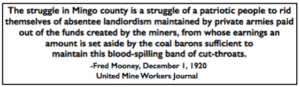
Quote Fred Mooney, Mingo Co Gunthugs, UMWJ p15, Dec 1, 1920—————

Hellraisers Journal – Monday October 9, 1922
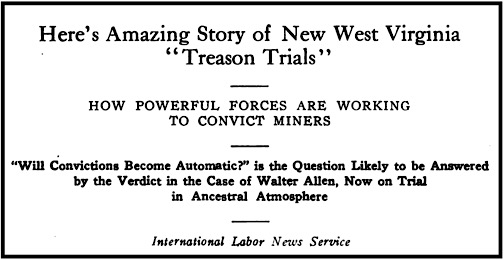
Charles Town, West Virginia – Powerful Forces Work to Covict Union Miners

From The Bottle Maker of October 1922:

HdLn WV Treason Trials, Bottle Maker p27, Oct 1922

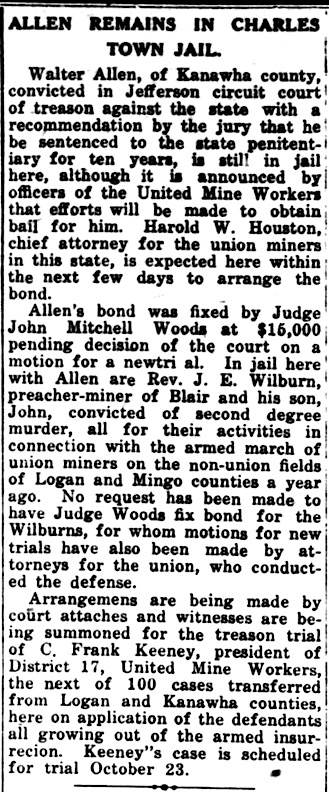
Newsclip WV Treason Trial, W Allen Convicted, Charles Town Spirit of Jefferson p2, Oct 3, 1922
Charles Town Spirit of Jefferson
October 3, 1922

Charlestown, W. Va., Sept. 5.—Industrial feudalism, allied with and enthroned upon a local aristocracy, and exploiting the naivette of guileless farmers and and unsuspecting rural population, is moving mercilessly and relentlessly in the ancient court house of this town to defeat and destroy organized labor in West Virginia, drive labor unions from the borders of the State, and take a new lease upon control and domination of government in West Virginia.

In this undertaking, industrial oppression and vengence is masquerading behind the law and the prosecuting power of the State, utilizing the executive machinery of the State, and subsidizing newspapers and news dispatches, to accomplish the end sought.

Walter Allen, a young official of the United Mine Workers in West Virginia, is on trial in Charles Town on a charge of treason against the State. Allen is one of twenty-three officials of this union who were indicted in the coal-tainted courts of Logan county last year on the charge of treason. More than 500 others are indicted on charges of conspiracy or murder. These indictments were found after the union miners of Kanawha, Fayette, and Raleigh counties rebelling against the venal industrial conditions of Logan and Mingo counties, and finding that gunmen of the coal operators prevented peaceful union organization, had attempted to right their wrongs by an invasion of those counties directed against company gunmen.

William Blizzard, president of sub-district No. 2 of this union, was another of the twenty-three. Blizzard was acquitted last May after a trial of five weeks, but no such fortune seems to be in prospect for Allen. Every resource at the command of a great and entrenched industrial feudalism in West Virginia-a feudalism that makes governors, elects legislatures, and controls political parties and newspapers—is being brought to bear to convict Allen and all of his associates, and through their confinement in the State prison, break up the miners’ union, and drive unionism as a whole from the State.

Continue reading “Hellraisers Journal: The West Virginia Treason Trials, Powerful Forces Work to Convict Union Miners in Charles Town”

Hellraisers Journal: “The Battle Ground of Coal” by James M. Cain-Union Organization and the Miners’ War in West Virginia

Share

Quote Fred Mooney, Mingo Co Gunthugs, UMWJ p15, Dec 1, 1920—————

Hellraisers Journal – Sunday October 8, 1922
“The Battle Ground of Coal” by James M. Cain

From The Atlantic Monthly of October 1922:

THE BATTLE GROUND OF COAL

BY JAMES M. CAIN

I
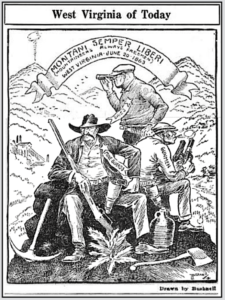
Battle of Blair Mt, WV Today by Bushnell, Guards, Gunthugs, Spies, UMWJ p5, Sept 15, 1921

As you leave the Ohio River at Kenova, and wind down the Norfolk and Western Railroad beside the Big Sandy and Tug rivers, you come into a section where there is being fought the bitterest and most unrelenting war in modern industrial history. The country furnishes a suitable setting. Rocky hills, small mountains, rise on each side. They are gashed by ‘creeks’; looking up these, you see that the wild region extends for miles back from the railroad. There is no soft, mellow outline about these hills. They are sharp and jagged; about their tops grows a stunted, scraggly forest. Their color is raw: glaring reds and yellows, hard, waterstreaked grays. Here and there you see the blue-black ribbon of coal.

In this untamed section of West Virginia two tremendous forces have staked out a battle ground. These are the United Mine Workers of America and the most powerful group of nonunion coal-operators in the country. It is a battle to the bitter end; neither side asks quarter, neither side gives it. It is a battle for enormous stakes, on which money is lavished; it is fought through the courts, through the press, with matching of sharp wits to secure public approval. But more than this, it is actually fought with deadly weapons on both sides; many lives have already been lost; many may yet be forfeited.

As the train carries you southeastward, you see some signs of it. You pass many coal mines, and some of these are closed down. At the stations, pairs of men in military uniform scrutinize all who alight. These are the West Virginia State Police; a strong force of them is on duty here, for bloodshed became so frequent that one of these counties, Mingo, was placed under martial law. You pass occasional clusters of tents-squalid, wretched places, where swarms of men, women, and children are quartered. Everywhere you are sensible of an atmosphere of tension, covert alertness, sinister suspicion. It is not by accident that these State policemen appear always in pairs.

If you get off the train at Williamson, county seat of Mingo, you will be at the fighting front. People there will tell you that this struggle has been going on for three years. They will tell you of the bloody day at Matewan, May 1920, when ten men, including the mayor of the town, fell in a pistol battle that lasted less than a minute.They will tell you of guerrilla warfare that went on for months; how Federal troops had to be called in twice. They will tell you of the ‘three days’ battle,’ which resulted, in May, 1921, in the declaration of martial law. Union partisans will tell you of the exercises on May 30 last, when the graves of a score of union fallen were decorated with all the ceremony accorded soldiers who have died for the flag. The operators will tell you of attacks from ambush: how their men have been shot down from behind; how witnesses for trials were mysteriously killed before they could testify. The atrocity list and quantity of propaganda give this war quite an orthodox flavor. It is very hard to sift out the truth.

II

Back in 1898, when the coal industry was quite as unsettled as it is now, the union and the big operators evolved a working plan to stabilize conditions and equalize opportunity. This was the conference in the Central Competitive Field, whereby a wage scale was arrived at for this region, and scales in all other union districts were computed by using this scale as a basis and making allowances for different operating conditions, freight rates, and so forth. This was in order to give all districts an equal chance at the market. Coal is probably the most fluid commodity sold: coal from one section competes with coal from another section remote from the first. It is not analogous to a trade-marked article, for which an arbitrary price can be obtained by advertising campaigns and kindred methods. No amount of advertising can make coal of a given grade from one section outsell the same grade from another section at a higher price. This peculiarity of the coal market was the reason for the basic wage-scale arrangement which gave all districts as nearly equal chances as possible, and precluded the possibility that a miscalculated rate might put whole mining fields out of business altogether.

The plan worked fairly well for a time. Within a few years, however, it was discovered that large new areas of coal lands had been developed, and that most of these were being worked with nonunion labor. They had been left out of the original calculation, largely because the existence of such large virgin fields was not known until after the opening of the present century. Some of them were in Pennsylvania, but most, and by far the largest, were in southern West Virginia. Employing nonunion labor, they worked at a lower wage-scale than the union areas, and had become a formidable factor in the industry, for they were underselling union coal constantly. In the years just preceding the war, their effect on the market-and particularly the greater number of days their labor worked during the year-had become definitely noticeable. During the war, there was demand for everybody’s coal, and there was no pinch then. The pinch came, however, in the year following the peace.

Continue reading “Hellraisers Journal: “The Battle Ground of Coal” by James M. Cain-Union Organization and the Miners’ War in West Virginia”

Hellraisers Journal: Nine of Grabow Defendants, Members of Brotherhood of Timber Workers, Will Be Tried Together

Share

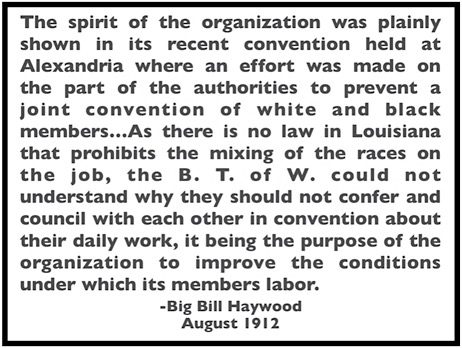
Quote BBH re BTW LA White n Black Unity, ISR p106 , Aug 1912

Hellraisers Journal – Monday October 7, 1912
Lake Charles, Louisiana – Nine of Grabow Defendents Will Be Tried Together

From the New Orleans Times-Democrat of October 6, 1912:

SEVERANCE IS GRANTED
———-
Nine of Grabow Defendants
To Be Heard Together.
———-

[…..]

Special to The Times-Democrat.

BTW Prisoners of Grabow Massacre, NO Tx Dem p17, Oct 6, 1912
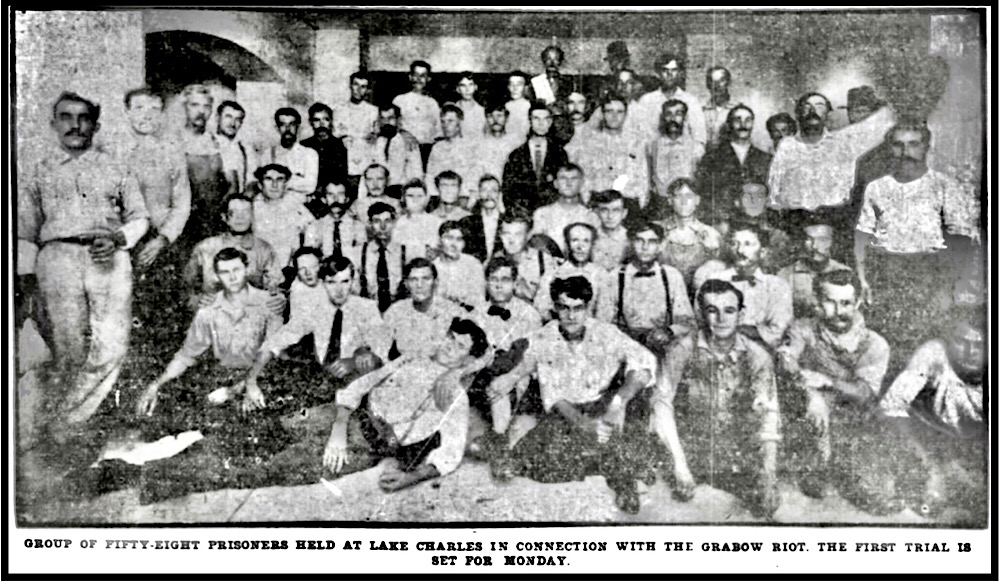
Group of Fifty-Eight Prisoners Held at Lake Charles in Connection with
the Grabow Riot. The First Trial is Set for Monday.

Lake Charles, La., Oct. 5-After hearing the motion argued for more than an hour this afeternoon, Judge Overton rendered a deciaion granting the motion for severance in the Grabow riot murder cases, asked for by the district attorney. Accordingly the nine men named in the motion will be placed on trial Monday morning [October 7th]…..

The nine men who will be placed on trial Monday are: A. L. Emerson, president of the Brotherhood of Timber Workers; Jack Payne, alias Charles Gibbon, Louis Brown, Ed Lehman, Edgar Holingsworth, John Hilton, Doc Havens, F. E. Ezell and W. A. Chatman.

It is conceded that these are the men against whom the State has the striongest case…..

[Emphais added.]

Continue reading “Hellraisers Journal: Nine of Grabow Defendants, Members of Brotherhood of Timber Workers, Will Be Tried Together”

Hellraisers Journal: “The New Woman of The Old South” by Covington Hall, Heroic Stand with Brotherhood of Timber Workers

Share

Quote C Hall, Women of BTW Grabow, Prg Wmn p6, Oct 1912—————

Hellraisers Journal – Sunday October 6, 1912
Lake Charles Jail, Louisiana – Heroic Women Stand by Fighting Lumberjacks

From The Progressive Woman of October 1912:

THE NEW WOMAN of THE OLD SOUTH
By Covington Hall
———-

Grabow, Union Prisoners Lake Charles Jail, Dinner, Prg Wmn p6, Oct 1912
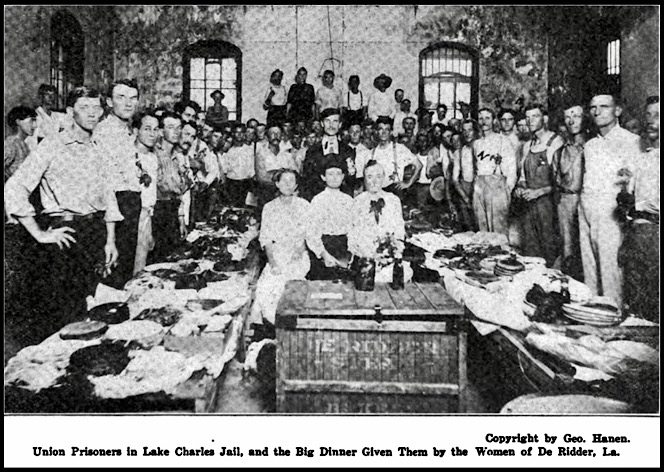
Union Prisoners in Lake Charles Jail, and the Big Dinner Given Them
by the Women of De Ridder, La.

IN the long and bitter struggle of the Brotherhood of Timber Workers against the Southern Lumber Operators’ Association none have suffered more or borne their part in the battle more heroically than the wives, mothers and daughters of the fighting lumberjacks of the south.

In the long and terrible lockout, lasting from July, 1911, to February, 1912, when hundreds of families were reduced to the direst want and misery by the silken savages of the lumber trust in its brutish effort to starve the men out of the union and back into submission, the women, with their babies living on cornbread and molasses, still urged their husbands, fathers and brothers to keep up the battle for “A man’s life for all the workers in the mills and forests,” no matter what the cost, no mater what Kirby, Long and their brother wolves demanded as the price of liberty.

When the blacklist was added to the lockout, when thousands of workers were hounded from state to state, when the only way a man could get a job was to dishonor himself by taking an oath of allegiance to the lumber trust, by swearing obedience and loyalty to his sworn enemies, the women took up that other battle cry of the Union: “Don’t be a peon-be a MAN!” and the desperate fight for justice still went on.

When all law was suspended, when the states of Louisiana and Texas abdicated their authority to the Southern Lumber Operators’ Association and allowed this combine of grafters and gunmen to proclaim martial law throughout the timber belt, when the worst in this scum and slum class came to the surface and the reign of terror that reached its climax in the “riot” at Grabow was inaugurated, when no one’s life or person was safe anywhere in the empire of the lumber trust, the women still urged the men on to battle and in many instances took their places beside them on the “firing line.”

When sixty-five of our best and bravest boys were arrested, thrown into jail and charged with murder on account of the “riot” at Grabow, when men were torn from their sick mothers, wives and children, taken from their homes in the dead of the night by the deputy sheriffs of the Association, still the women did not quail but shrieked defiance at their enemies, still louder rose the cry of the Brotherhood: “ONE BIG UNION, life and freedom for ALL the workers!

Continue reading “Hellraisers Journal: “The New Woman of The Old South” by Covington Hall, Heroic Stand with Brotherhood of Timber Workers”

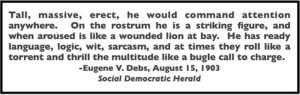
Hellraisers Journal: International Socialist Review: Father Thomas Hagerty, “I am as much a priest to-day as I ever was.”

Share

Quote EVD, Father Hagerty, SDH p1, Aug 15, 1903—————

Hellraisers Journal – Sunday October 5, 1902
Father Hagerty Corrects the Record: Is as Much a Catholic as the Pope Himself

From the International Socialist Review of October 1902:

A Correction.
———-

Van Buren, Ark., Aug. 25, 1902.

A. M. Simons, Editor International Socialist Review.

Father Hagerty, Comrade p6, Oct 1902

My Dear Comrade : The Cincinnati Enquirer, of the edition of August 22d, publishes a scare-head article anent my so-called resignation from the Catholic priesthood and asserts that “the reason assigned for his withdrawal from the ministry and communion of the Catholic Church, Father Hagerty states, is the church’s stand against Socialism and the incompatibility of her teachings with the doctrines of his economic creed.” I have never made such a statement. While it is true that I have with drawn from the technical work of the ministry, the withdrawal implies no derogation of my sacerdotal character. I am as much a priest to-day as I ever was. I have not separated myself from the communion of the Catholic Church ; and I hold myself as much a member thereof as the Pope himself.

The enemies of Socialism will stop at nothing to discredit its mission. The political bigot seeks always some prejudice or pretext of religion to warrant his attack upon the adversaries of his party; and the lines of Boileau need no new rendition for our day:

“Qui mèprise Cotin n’estime point son roi,
Et n’a selon Cotin, ni Dieu, ni foi, ni loi.”

I have no economic creed. A creed supposes faith; and faith is the receiving of doctrine upon authority. Knowledge, on the contrary, is the direct recognition of truth by the intellect. One may have a religious belief, but not an economic creed. I do not believe in any economic creed, but I know the definite philosophy of Socialism. It is the utmost absurdity to speak of the incompatibility of Catholicism and Socialism. No one would dream of going into a meat market and asking for a Catholic beef steak, a Methodist mutton chop, or a Presbyterian ham. Religion has no more to do with Socialism than it has with meat and bread. Socialism is an economic science, not a system of dogmatic beliefs. It is wholly beyond the scope of the church’s mission to deal with questions of social economy, just as it is beyond the purpose of the Republican party to advance a new exegesis of the Davidic Psalms.

Bishops and priests exceed their authority when they use the influence of their position to oppose a movement whose highest purpose is the industrial liberation of the wage slaves of the world. According to the strictest interpretations of moral theology, Catholics are not bound to pay any attention to them in such matters. The Pope’s encyclicals on the question have no more authority than that which attaches to the opinions of any private theologian. The function of his office is confined strictly to matters of faith and morals. His judgment upon a canvas of Fra Angelico or a fragment of the Tel-el-Armana tablets is as much open to criticism as that of any other scholar.

It is to be regretted that a few bishops and priests, out of the abundance of their ignorance, have seen fit to attack the principles of Socialism, but it does not, therefore, follow that the doctrines of the church, as such, are in conflict with the truths of Socialism. The churchmen of the primitive days were genuine Socialists—men like St. John Chrysostom, who denounced the Capitalism of his day in the most acid words of the wondrous Greek in which he preached. With Whittier, rightly may

“Whittier.

“I sigh for men as bold
As those bearded priests of old.

Now too oft the priesthood wait
At the threshold of the state—
Waiting for the beck and nod
Of its power as law and God.

Nevertheless, I thank God that such men as Father McGrady are gradually opening the eyes of Catholics to a sense of their rights in the field of industry and to a recognition of their individual freedom in all things outside of the fixed lines of dogma and revelation.

THOS. J. HAGERTY, A. M., S. T. B.
[Artium Magister, Sacrae Theologiae Baccalaureus
Master of Arts, Bachelor of Sacred Theology]

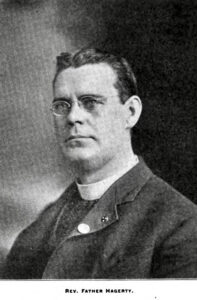
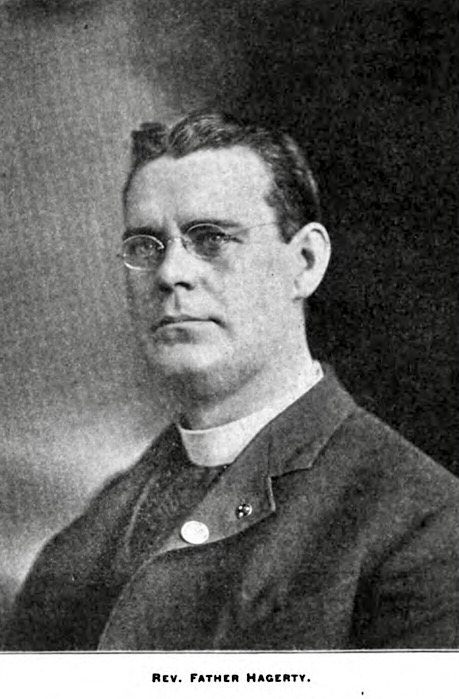
[Photograph and emphasis added.]

Continue reading “Hellraisers Journal: International Socialist Review: Father Thomas Hagerty, “I am as much a priest to-day as I ever was.””

Hellraisers Journal: From The Comrade: “How I Became a Socialist” by Father Thomas Hagerty, Seventh in Series

Share

Quote EVD, Father Hagerty, SDH p1, Aug 15, 1903—————

Hellraisers Journal – Saturday October 4, 1902
“How I Became a Socialist” by Father Thomas Joseph Hagerty

From The Comrade of October 1902:

How I Became a Socialist.

VII. [of Series]

By Rev. T. [J]. HAGERTY.

A CONVICTION grew upon me in my boyhood days-which has broadened and deepened with the out-going years—that human nature is inherently good. In the old Hebraic records, composite of earlier documents which register the world’s notion of creation, I was caught by the reiteration of the idea of the goodness of all things. The after-development of tribe and nation, however, seems to give the lie to this primal verity. Prophets and philosophers in the cuneiform script and Vedic hymn of Egypt and India, singers and sculptors in the psalm and glistening marble of Palestine and Greece, throughout the centuries have sought to keep alive the sense of goodness in the brain of man. Yet all the time murder and rapine, disease and wretchedness flaunted denial in the face of truth. Pariah, slave, and bond-servant groaned in hopeless toil the while Kung-fu-sdu and Gotamma the Buddha proclaimed kindness and justice and David and Homer sang of high emprise.

Father Hagerty, Comrade p6, Oct 1902

Christianity came, with a catholic breadth of goodness, teaching the brotherhood of man, gathering up the treasures of foregoing ages wherewith to enrich the race, and sending messengers of peace through all the turbulent highways in every land. Far-reaching deeds of love marked its growth in palace and hovel: yet the clash of swords and the snarl of the slave-driver’s lash broke in upon its holiness; and, ever and anon, hunger drove some mother to insane slaughter of the anæmic babe at her breast. The rich in high places rose up against a Savonarola and a Sir Thomas More and tried to silence the reproach of their goodness in death:

“And in such indexes, although small pricks
To their subsequent volumes, there is seen
The baby figure of the giant mass
Of things to come at large.”

Within reach of every banquet’s savor crouched the gaunt figure of Poverty; and the shadows of the Universities swept athwart the bleak paths of Ignorance and intensified the darkness. Gradually, through all the travail of the earth’s growth, came the machine to lift the burden from the straining muscles of men; and its only effect was to change the servitude of the many into an equally galling wage-slavery without surcease of misery and hate and crime. Meanwhile, the inherent goodness of human nature asserted itself in large heroism and patient bravery. Republics were builded out of the strength of the common people; and fine philosophies of liberty were engrossed upon the parchment of history, but humanity failed to reach the heights where gladness holds her breathing-places. The goodness of human nature seemed to be spent in the Sisyphus-like task of rolling some needless burden up the hill of Time and falling ever backward to the bottom in a futile renewal of toil.

As I read the annals of civilization in books and traced their later chapters in field and shop and factory, my early conviction of the inherent goodness of human nature was sharpened by its contrast with the physical evils everywhere so blatant. I saw the tragic waste of life wherewith the commerce of to-day stands crimsoned in the blood of the proletariat. I noticed little children slowly murdering by the loom and sewing-machine. In the disease-sodden tenements of the slums I saw hundreds of men and women dragging out a living death their lives foreshortening by the vilest adulteration of food and drink and by the foul air and reeking bodies of their fellow-men in the low, narrow rooms in which they huddled together. Drunkenness, insanity, and sexual perversions were all too common: nevertheless self-sacrifice, kindness, and wondrous patience were equally in evidence.

Continue reading “Hellraisers Journal: From The Comrade: “How I Became a Socialist” by Father Thomas Hagerty, Seventh in Series”

Hellraisers Journal: From the International Socialist Review: “The Battling Miners of West Virginia” by Edward H. Kintzer, Part II

Share

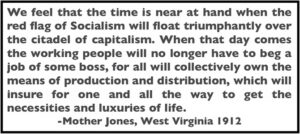
Quote Mother Jones, Red Flag of Socialism, ISR p303, Oct 1912—————

Hellraisers Journal – Thursday October 3, 1912
“The Battling Miners of West Virginia” by Edward H. Kintzer, Part II

From the International Socialist Review of October 1912:

The Battling Miners of West Virginia

By EDWARD H. KINTZER
Socialist Candidate for State Auditor of West Virginia.

[Part II of II]

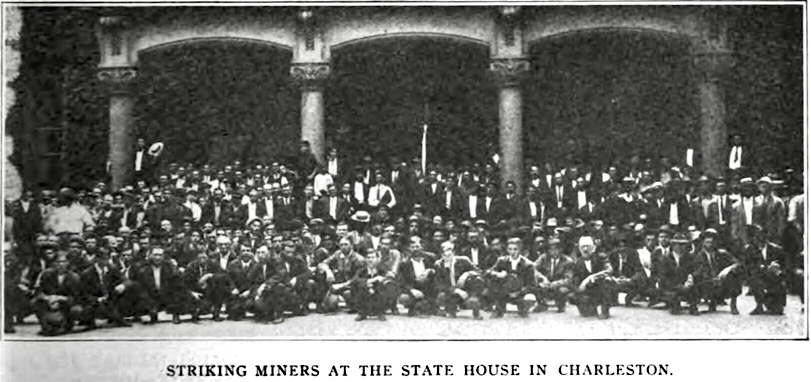
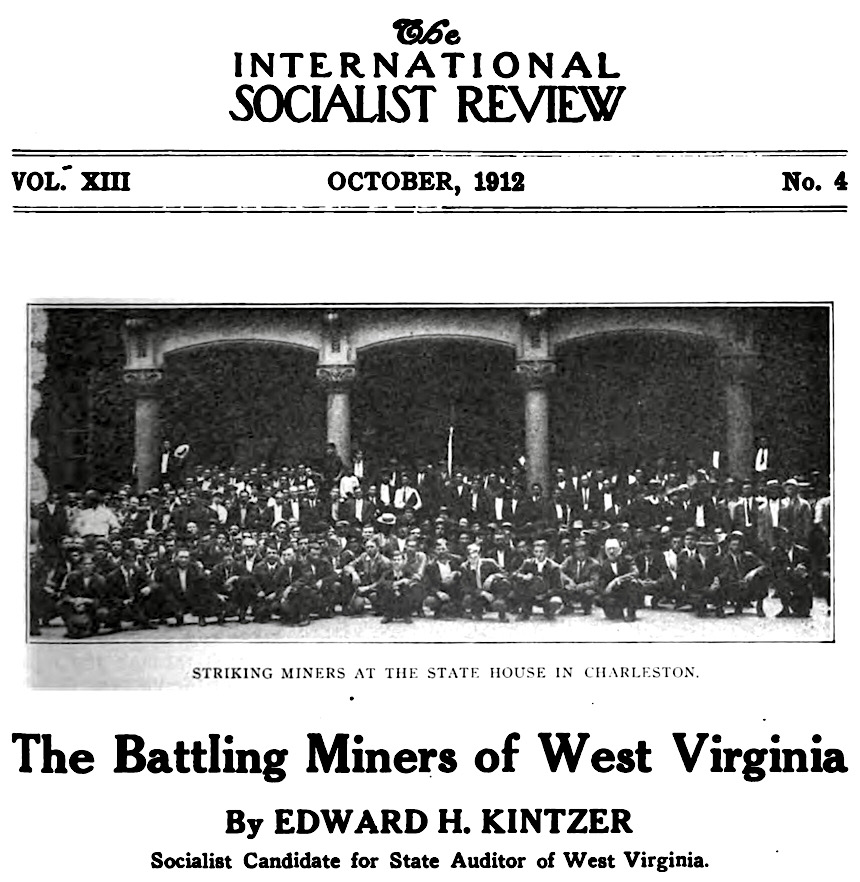
WV Miners State Courthouse, ISR p295, Oct 1912

———-

Send the Politicians Here.

In this situation the pure and simple politicians could learn a lesson in tactics. It is one of the unusual conditions in America’s industrial wars, in which are engaged men who understand the importance of political action, but who feel how hopelessly lost they would be to depend solely upon this in the present crisis. Many of these strikers are members of the Socialist party. To suggest to them that sabotage or other than political acts or taking a timely vacation from work would exclude them from the sacred circle where politics is crowned king, would cause them to question your sanity.

Nor are the miners alone in this fight. There is a bond of sympathy between workers in the region that is worthy of note. It is an example of the class consciousness that is permeating industry all over the world.

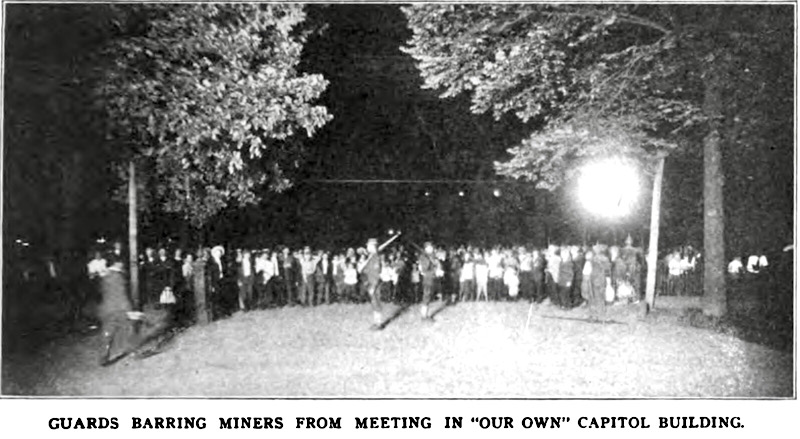
WV Mine Guards v Miners, ISR p301, Oct 1912

The railroaders who haul the mine guards understand that they (the mine guards) are not spying upon them; that it is the miners who are being hounded, but their hatred for the guards has precipitated several fatalities.

Dead bodies of two guards were found under a structural steel bridge, apparently having fallen while walking the ties. Yet it is the boast of train crews that they loathe these human bloodhounds. Numerous such circumstances have come to light.

The favorite position of the guards while traveling the coal region is to perch themselves on the pilot of the engine. On one occasion three guards boarded the pilot. The engineer of the freight train was particularly hostile to them. He opened wide the throttle and went at a speed that none of his crew knew the train to make before. But they understood. Anything that could happen was welcome. Sharp curves had no terrors for the engineer. What this mad race meant might only be guessed at. Whether or not what happened was by design or accident, all the miners and most of the railroaders considered it more than just. Rounding a curve, with the complacency of the guards taxed to the utmost, the strain upon the crew being unusual, a cow attempted to cross the track. The guards say there was plenty of time to slow down and allow her to cross. The engineer declared that it was impossible unless he unbuckled his train. Result: Before the bovine could wink her tranquil eye she was unrecognizable, with quantities of her blood, hair and what-not covering the three guardsmen, who were otherwise unharmed. A hasty bath in a nearby creek restored the appearance of the guards, and with knowing winks among the crew, the train moved on.

Continue reading “Hellraisers Journal: From the International Socialist Review: “The Battling Miners of West Virginia” by Edward H. Kintzer, Part II”

Hellraisers Journal: From the International Socialist Review: “The Battling Miners of West Virginia” by Edward H. Kintzer, Part I

Share

Quote Mother Jones, Sleep Guard House, ISR p295, Oct 1912—————

Hellraisers Journal – Wednesday October 2, 1912
“The Battling Miners of West Virginia” by Edward H. Kintzer, Part I

From the International Socialist Review of October 1912:

HdLn WV Miners,ISR p295, Oct 1912———-

[Part I of II]

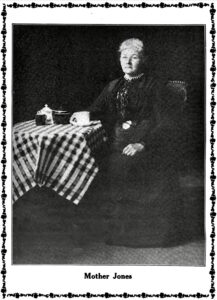
Mother Jones Sits by Table, ISR p294, Oct 1912

WEST VIRGINIA is living under martial law in the mining war that has been raging in that state for several years. Mother Jones, the veteran of many labor battles, is the central and inspiring figure. In her eightieth year she is today leading the fight in the strike, which started last April. In her characteristic way, she has has more than once defied the military authorities who are making and executing the mine-owner-made laws. When informed that the militia were endeavoring to arrest her for what they called inflammatory speeches, she said:

If they want the chance, I will give it to them. I’d just as soon sleep in a guard house as in a hotel.

At Pratt and Holly Grove Junction guard houses are being filled with miners for the slightest offenses. The militia has taken control, making and executing the laws without regard for the civil code, in all favor to the mine owners, just as have the judicial courts since Capitalism has ruled in the mining industry.

Martial Law Welcomed.

Fierce were the conflicts of 1897 when Eugene V. Debs led the striking miners in the Fairmont district and in 1902, when Mother Jones played a prominent part in that great strike. But never before has any part of the state been under martial law.

When it came it was welcomed by the strikers, for they had suffered such outrages at the hands of a private army in the employ of the coal barons that anything was preferable-even death-to a continuation of the horrors they had perpetrated.

Governor Glasscock appointed a commission to “examine” into the private army system and the wages and working conditions of the miners. The United Mine Workers demanded that the intense over-capitalization of the companies also be considered.

Later the governor issued a proclamation, ordering the mine guards and the strikers to lay down their arms. This was resented by the strikers who claimed that if they obeyed this order the guards would not and they would be helpless before armed thugs. In reply to this proclamation Mother Jones led 10,000 miners to Charleston, where they demanded that the governor order the mine guards out of the region. She declared that he would be to blame for any trouble that might follow if the guards were not sent away. So horrible had been the acts of the guards that the miners were ready to kill on sight.

America has no better example of the conflict between the two important economic classes than this one in the Kanawah coal mining district. Here Capitalism has mocked the sentiment of the founders of the state and by force of a private army abrogated the constitution this new state adopted. Born in the stress of a civil conflict over a question of bondage, the native coal miners of West Virginia have never learned to submit tamely to an interference with their liberties. .

And yet no people have been more thoroughly exploited than the workers of West Virginia. Mine workers that have been on strike since April are desperate over their frightful condition of starvation and disease. Yet every one is loyal and will die rather than submit to the mine guards.

Continue reading “Hellraisers Journal: From the International Socialist Review: “The Battling Miners of West Virginia” by Edward H. Kintzer, Part I”

Hellraisers Journal: From the Appeal to Reason: Women, Socialists, Suffragists, and Working Class Economic Struggles

Share

Quote EVD, re Woman Suffrage, Ptt KS Dly Hdlt p4, Aug 20, 1908—————

Hellraisers Journal- Tuesday October 1, 1912
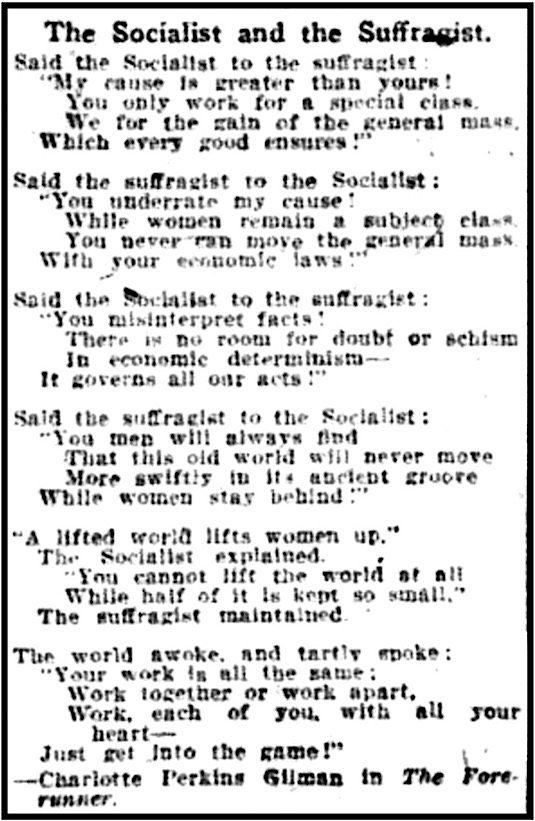
Ryan Walker and Charlotte Perkins Gilman on Women, Socialists and Suffrage

From the Appeal to Reason of September 28, 1912:

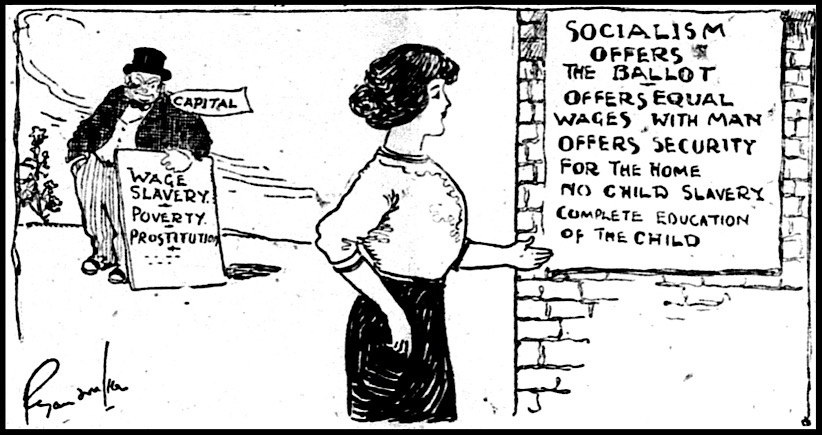
-What Socialism Offers Women by Ryan Walker

Socialism and Women by Ryan Walker

-“The Socialist and the Suffragist” by Charlotte Perkins Gilman

Poem, Socialist n Suffragist by CP Gilman, AtR p3, Sept 28, 1912

Continue reading “Hellraisers Journal: From the Appeal to Reason: Women, Socialists, Suffragists, and Working Class Economic Struggles”

Hellraisers Journal: John P. White, President of U. M. W of A., Will Not Participate in Glasscock’s Sham Conference

Share

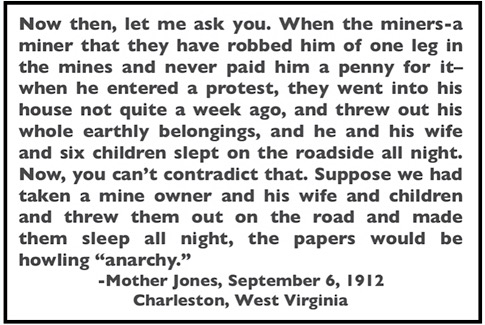
Quote Mother Jones, Howling Anarchy, Cton WV, Sept 6, 1912—————

Hellraisers Journal – Monday September 30, 1912
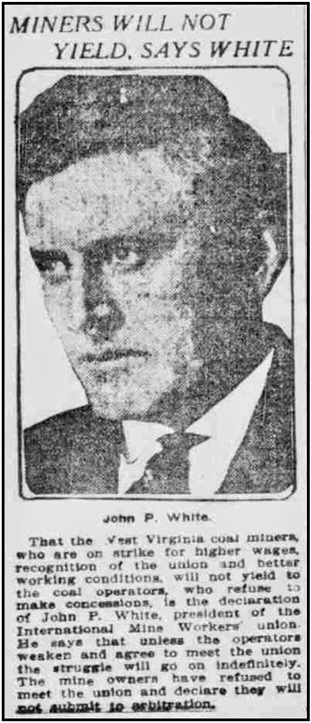
Charleston, West Virginia – President White Issues Statement

From The Farmer and Mechanic (Raleigh, N. C.) of September 24, 1912:

MEETING TO PLAN PACIFIC OUTCOME
MET WITH REBUFF
———-
Mine-Workers’ Organization Officials
Refused to Participate In It
———-

CONFERENCE IS POSTPONED
———-
Excitement Attended Gathering to Settle
Mine Labor Dispute in West Virginia
———-

STATEMENT TO GOVERNOR

(By the Associated Press.)

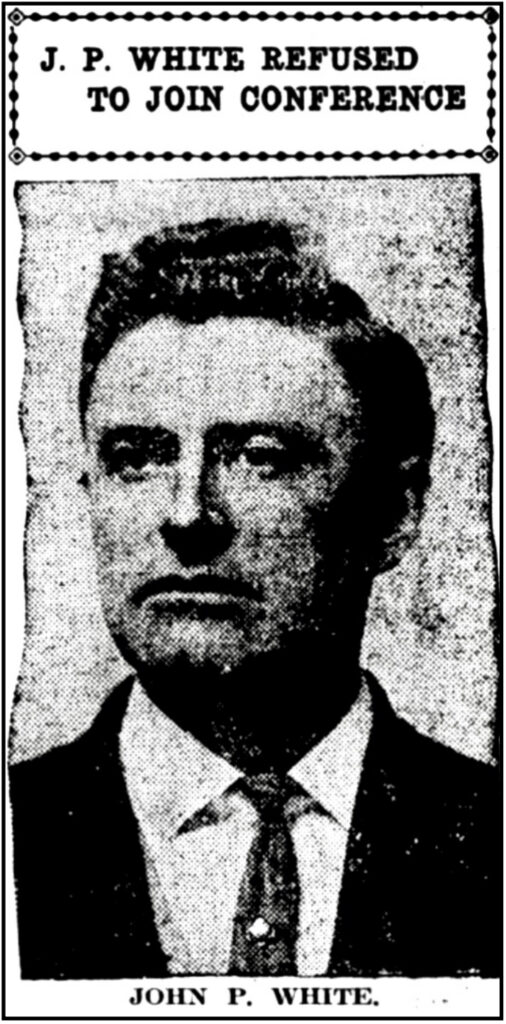
John P White, Lake Co Tx IN p1, Sept 26, 1912
Lake County Times
Hammond, Indiana
September 26, 1912

Charleston, W. Va., Sept 21.-Excitement attended the meeting here today of representatives of the commercial and civic bodies of West Virginia, called by Gov. Glasscock, to consider the labor situation.

International President John P. White, of the United Mine-workers of America, with Vice-President Hayes, announced early in the day that they would have nothing to do with the conference because they had learned that it was not the purpose of those in charge of the meeting to permit a discussion of the strike situation in the Kanawha coal field, where 2,200 West Virginia militiamen are maintaining martial law.

Why It Was Twice Postponed.

The meeting was postponed in an effort to bring the leaders of the miners and the operators together, and later in the day it was postponed again, but when it finally convened there was nothing to indicate that an agreement had been reached by which a discussion of existing labor difficulties might be taken up.

President White’s Statement.

President White prepared a statement for presentation to the governor in which he said:

We were led to believe that the conference called by the governor was for the purpose of discussing the present strike, and to find some method by which it might be amicably adjusted, but in a preliminary conference in the governor’s office which brought to our attention by the parties who appealed to the governor to call the conference, that its purpose was solely for the discussion of an industrial dispute act to be submitted to the next legislature and it was not contemplated in any way to enter into a discussion of the real problem of the problem of the present hour, an honorable solution of the difference existing at this time between miners and operators. We are much disappointed that this conference does not contemplate such discussion and in view of this fact we have nothing to discuss at this time.

John P White, Lbr Wld p1, Sept 28, 1912

Hayes Addresses Strikers.

This statement did not change the situation so far as White was concerned and while efforts were being made to outline a course of action for the conference, Vice-President Hayes addressed a large number of striking miners and their sympathizers and Mother Jones talked to another audience almost with the shadow of the state capitol.

Belated Conference Short One.

When the governor called the conference to order late in the afternoon the house of delegates in the capitol building was crowded. The governor stated that the conference would consider the question of a minimum wage, high cost of living and settlement of future labor troubles by arbitration but the miners strike on Paint and Cabin Creeks would not be discussed.

Adjourned in Confusion.

C. Burgess Taylor of Wheeling, was introduced as chairman and the question of who had a right to sit in the meeting arose, it having been given out that only West Virginians could take part. A statement presented by coal operators of the State that their “presence in this conference is not to be taken as recognition of the United Mine Workers of America,” finally created such confusion that a motion to adjourn was put and carried.

(Newsclips clips and emphasis added.

Continue reading “Hellraisers Journal: John P. White, President of U. M. W of A., Will Not Participate in Glasscock’s Sham Conference”