Dagos are cheaper than props.
-C. F. & I. Mine Manager
Hellraisers Journal, Tuesday September 4, 1906
From the International Socialist Review: “The Rebel at Large”

Dagos are cheaper than props.
-C. F. & I. Mine Manager
Hellraisers Journal, Tuesday September 4, 1906
From the International Socialist Review: “The Rebel at Large”

I have no country to fight for;
my country is the earth;
and I am a citizen of the world.
-Eugene Victor Debs
Hellraisers Journal, Sunday September 3, 1916
From The Masses: A Comment on War by Maurice Becker
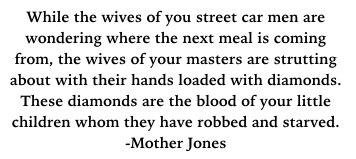
Cats and parasites of the woman’s clubs
and the temperance brigade.
We dont want ’em yowling for us.
-Mother Jones
Hellraisers Journal, Saturday September 2, 1916
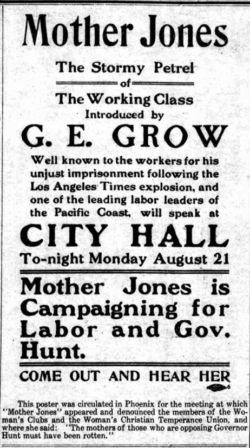
State of Arizona – Mother Jones Stumps for Governor Hunt
Hellraisers Journal, Friday September 1, 1916
For the Review: Debs Reflects on Labor Day
LABOR DAY is drawing near and I have been asked by the Review to say a word for the special number to be issued for the celebration of that day. Labor Day this year will furnish abundant material and inspiration for its celebration.
At this writing twenty thousand iron workers are fighting for their lives on the Misaba Range. We see scarcely a mention of this desperate battle in the capitalist press and, if it were not for our own papers, chiefly the INTERNATIONAL SOCIALIST REVIEW, we would know little about the fierce industrial conflict raging in that section of the country.
Hellraisers Journal, Thursday August 31, 1916
Mesabi Range, Minnesota – “Injustices, Large and Small”
From The Outlook of August 30, 1916:
THE MINING STRIKE IN MINNESOTA
-FROM THE MINERS’ POINT OF VIEWSPECIAL CORRESPONDENCE OF THE OUTLOOK
[Report of Mary Heaton Vorse, Part II]
Under the contract system, the miner contracts to mine ore for a certain price a car load. The price of this car-load may be, and is, varied at any time according to the conditions encountered. It is the mine captain who fixes the price. According to the miners, it has been the custom to sell the best places for prices varying from the virtue of the miners’ wives and daughters to presents of drinks and cigars. So universal is this custom that any reference to the graft of the captain is received in any meeting of miners by laughter and applause.
There are at present in the hands of the Federal investigators affidavits sworn to before a notary public concerning all these forms of grafts, from insulting propositions made to the women of miners’ families to affidavits that drinks or money were paid for the job.
Continue reading “Hellraisers Journal: Mary Heaton Vorse on the Mesabi Iron Miners’ Strike in Minnesota, Part II”
Hellraisers Journal, Wednesday August 30, 1916
Mesabi Range, Minnesota – “A Fierce and Important Struggle”
From The Outlook: Report of Mary Heaton Vorse, Part I:
THE MINING STRIKE IN MINNESOTA
-FROM THE MINERS’ POINT OF VIEWSPECIAL CORRESPONDENCE OF THE OUTLOOK
ONE of the most sinister aspects of life in this country is the failure of the serious and thinking people to obtain prompt information about the various industrial struggles and to get at the causes which are at the root of our industrial unrest.
Since June 3 a strike has been waged on the Mesaba Range, Minnesota, whose largest single owner is the Oliver Iron Mining Company, an arm of the Steel Trust. This strike has affected the life, not only of the twelve thousand miners employed on the Range, but of ten towns and villages from Aurora to Hibbing, a distance of sixty miles. The strike has been characterized by the prompt deputizing of a large force of gunmen, numbering, according to Sheriff J. R. Meining, of Duluth, over a thousand; more, according to residents of the Range towns.
Continue reading “Hellraisers Journal: Mary Heaton Vorse on the Mesabi Iron Miners’ Strike in Minnesota, Part I”
Hellraisers Journal, Tuesday August 29, 1916
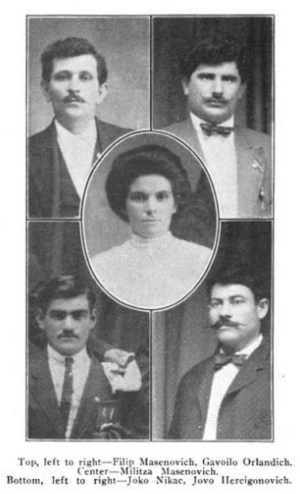
Virginia, Minnesota – Mrs. Masonovitch Held in County Jail
From the Duluth Labor World of August 26, 1916:
STUDY CONDITIONS OF MINERS WIVES
—–
Women’s Welfare League Would Relieve
Suffering In Strike Zone.
—–
VIRGINIA, Aug. 26.-Mrs. L. A. Hamlin of St. Paul, a member of the executive board of the Women’s Welfare league of that city, visited in Virginia and Biwabik recently, making an investigation of the strike conditions for the St. Paul club and for the charities and correction committee of the Minnesota Federation of Women’s Clubs, of which Mrs. V. F. Kinney of Minneapolis is chairman.
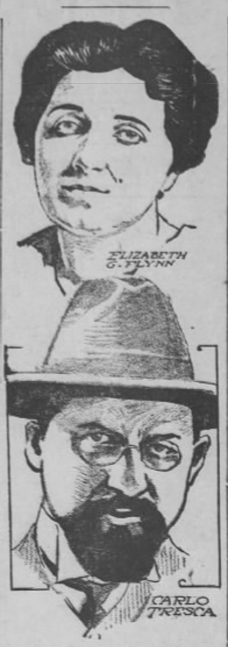
Mrs. Hamlin is making the investigation for the purpose of reporting on the manner in which the women of the range are treated, especially by the special deputy sheriffs employed by the mining companies. The women’s Welfare league was recently addressed by Miss Elizabeth Gurley Flynn of the I. W. W. and Marie Heaton Vorst [Mary Heaton Vorse], who visited on the range to secure news of the strike for Harper’s magazine and other eastern publications.
Continue reading “Hellraisers Journal: Flynn, Vorse, and Women’s Welfare League Fight for Wives of Striking Miners”
Hellraisers Journal, Monday August 28, 1916
Mesabi Range, Minnesota-Strike Investigators on the Scene
From The Survey of August 26, 1916:
When Strike-Breakers Strike
The Demands of the Miners on the Mesaba Range
By Marion B. Cothren
[Part II]The crux of the trouble, is the demand of the underground miners, for a minimum of $3 for dry work and $3.50 for wet. The underground men are paid either by the foot or by the carload, the rate depending upon the quality of the ore mined and conditions of work—hard and wet mining for instance bringing more than soft ore and dry mining. Thus, although the captain (boss) of the mine agrees beforehand upon the rate to be given a miner, this contract price may be changed from time to time as the character of the ore changes.
Continue reading “Hellraisers Journal: On the Mesabi, “When Strike-Breakers Strike” by Marion B Cothren, Part II”
Hellraisers Journal, Sunday August 27, 1916
Mesabi Range, Minnesota-“To Hell With Such Wages!”
From The Survey of August 26, 1916:
When Strike-Breakers Strike
The Demands of the Miners on the Mesaba Range
By Marion B. Cothren
[Part I]
THE strike-breakers of 1907 have become the strikers of 1916 in the iron mines of Minnesota. Coming over in boatloads from south eastern Europe nine years ago and hired by the United States Steel Corporation to break the iron strike called at that time by the Western Federation of Miners, these polyglot nationalities speaking thirty-six different tongues have become Americanized in the melting pot of the Mesaba mines. Today Finns, Slavs, Croats, Bulgars, Italians, Rumanians, have laid down picks and shovels and are demanding an 8-hour day, a minimum wage of $3 for dry work and $3.50 for wet work in underground mines and $2.73 in open pit mines, abolition of the contract labor system, pay-day twice a month.
The last of May, so the story goes, Joe Greeni, an Italian employed underground in the Alpena mine at Virginia, Minn., opened his pay envelope to find a sum much less than he had under stood his contract called for. “To hell with such wages”, cried he, throwing his pick in the corner, whereupon he vowed never to mine another foot of ore. Second thought, however, convinced Greeni, that action was deadlier than inaction. For three days he stayed at his post, going from stope to stope, saying, “We’ve been robbed long enough, it’s time to strike!” Then he left for Aurora to begin agitation at the extreme eastern end of the range in the little St. James’ mine with its force of 40 miners.
Continue reading “Hellraisers Journal: On the Mesabi, “When Strike-Breakers Strike” by Marion B Cothren, Part I”
Hellrasiers Journal, Sunday August 26, 1906
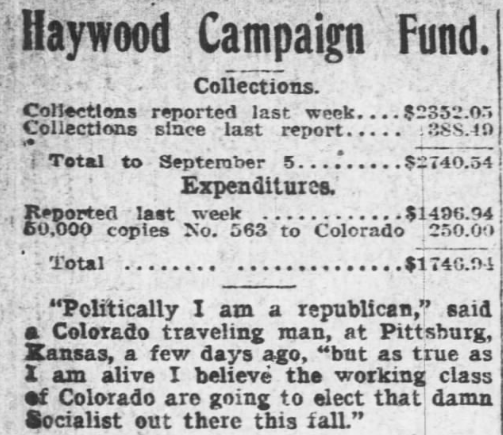
From the Appeal to Reason: Big Bill Haywood, Socialist for Governor
From this week’s Appeal, a drawing by Ryan Walker: