
Don’t worry, Fellow Worker,
all we’re going to need
from now on is guts.
-Frank Little
~~~~~~~~~~~~~~~~~~~~~~~~~~~~~~~~~~~~~~~~~~~~~
Hellraisers Journal – Tuesday November 19, 1918
Laredo, Texas – A. F. of L. Defeats Plan to Assist I. W. W.
From El Paso Morning Times of November 16, 1918:
DEFEAT PLAN TO ASSIST
MEMBERS OF I.W.W.
—–
Labor Leaders at Pan-American Labor Conference
Attack Resolution Offered by Mexican
Delegates That Was Intended
to Aid Imprisoned Men.
—–
GOMPERS AND MOYER DENOUNCERS OF MOVE
—–
President of Mine Workers Bitter
in His Arraignment of Haywood,
Secretary of Organization,
Who Is Serving a Sentence
for Espionage.
—–
By Associated Press.
From the Appeal to Reason of February 16, 1907
Laredo, Texas, Nov. 15.-An attempt by Mexican delegates to the pan-American labor conference to have adopted a resolution aiming at the release from prison of Industrial Workers of the World today brought forth an attack on that organization by American labor leaders, who defeated the plan.
Hellraisers Journal – Friday November 18, 1898
Bitter Strike of Miners at Virden Ends in Victory
From the Chicago Daily Inter Ocean of November 16, 1898:
VIRDEN STRIKE ENDS
—–
Mine Operators Agree to
Meet Demands of Men.
—–
TO PAY UNION WAGES
—–
Conference Is Held at Company’s
Chicago Offices.
—–
Leaders of Coal Miner’s Organization
Rejoice at the Outcome of
the Bitter Fight.
—–
Striking Miners Gather at O’Neill House after Battle of Virden
The conference between the representatives of the Chicago-Virden Coal company and the striking miners, held yesterday, resulted in an agreement which ends the Virden strike. The demands to the miners have been acceded to in full. The scale agreed upon is 40 cents per ton for hand mining and 33 cents for machine mining.
A formal agreement will be drawn up this morning, which will be signed by President Loucks of the coal company and President Hunter of the Illinois Mine-Workers’ union. The men who have been idle at Virden since April will return to work immediately.
Hellraisers Journal – Monday November 16, 1908
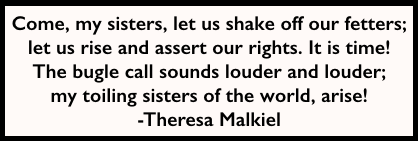
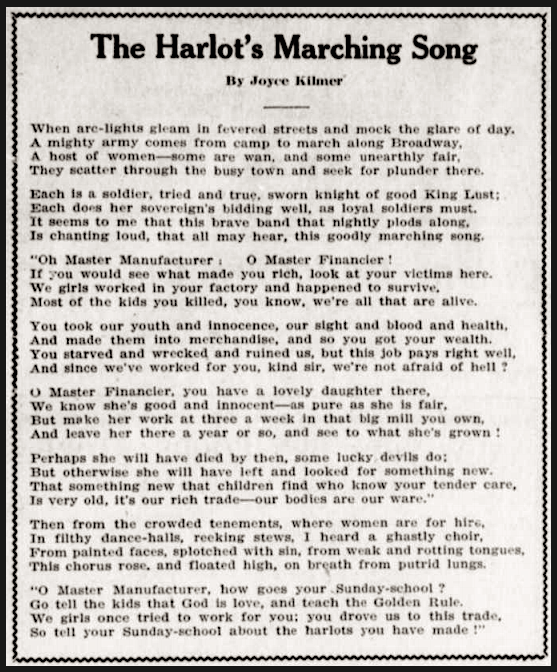
Theresa Malkiel: “Prostitution is very seldom a voluntary choice…”
From The Socialist Woman of November 1908:
Our Unfortunate Sisters
THERESA MALKIEL
The quality of mercy is not strain’d, It droppeth as the gentle rain from heaven Upon the place beneath: it is twice blest; It blesseth him that gives and him that takes.
It has been estimated that there are six hundred thousand women in the United States who sell their bodies for a living. I know that many of you will shudder reading of this number of unfortunates and will think of them with hatred and disgust.
But be merciful, women, those sisters of yours are not bond slaves like the prostitutes of ancient times, nor are they aliens like the medieval woman of the street. They are gathered from your very midst, from the girls who have by adverse circumstances been impelled to turn to prostitution as a means of livelihood.
Like ourselves, these unfortunates have been carried under a mother’s heart, like ourselves they have been born and destined for an honest life, but victims of force and fraud, or economic conditions, they soon reached the point where society held out nothing better for them than the life of shame.
Prostitution is very seldom a voluntary choice on the part of the fallen. Girls do not elect to cast themselves away, they are driven to the haunts of vice. A young working girl is an easy mark for a man’s designing. And the designers are not wanting. Their most fruitful recruiting grounds are the stores where girls work long hours for small pay; the homes that have few comforts and no pleasures; the streets where girls are often cast while still unknown to sin, but are in want and without shelter; in places where distress and temptation stand ever present.
Hellraisers Journal – Sunday November 15, 1908
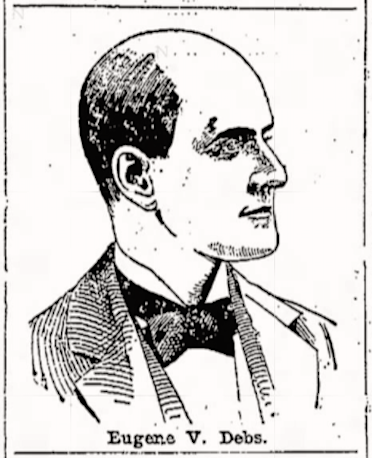
Eugene Debs on the Campaign’s “true spirit of Socialist comradeship.”
From the Socialist Montana News of November 12, 1908:
TO OUR COMRADES: GREETING
—–
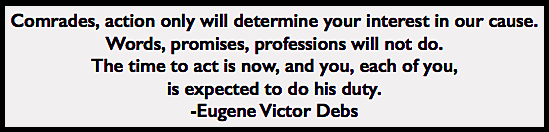
By Eugene V. Debs.
The campaign is ended and my very first thought is of the kindness shown me and the loyal support given me in every part of the country. While at times the exactions were trying I was sustained every hour by the loving care and unflagging support of comrades. To me this was the most beautiful and satisfying feature of the campaign. It expressed the true spirit of Socialist comradeship which is the making of our movement and which will sustain it through every ordeal till it is finally triumphant.
The one incident we all deeply regretted was the illness of Comrade Ben Hanford. With all his heart he yearned to be where he always has been, in the thick of battle, but he had given himself too freely all his life, utterly forgetful of self, until at last his physical powers succumbed and he was compelled to see others on the firing line while he was reserved for less strenuous service that he might have some chance for physical recuperation. His very illness bears testimony to his many years of service in the past when it required courage and sacrifice to be a Socialist, and all of us join most fervently in the hope that he may recuperate his impaired powers and again take his wonted place in the activities of the movement.
Truly this has been a magnificent campaign for the Socialist Party. Our meetings from coast to coast have been the marvel of all, and such enthusiasm has never been displayed in any political campaign.
Hellraisers Journal – Thursday November 14, 1918
“One of Them” by Elizabeth Hasanovitz, Union Garment Worker
“One of Them” describes lingering remnants of the old sweat-shop in the every-day shop vernacular.
From The Ladies’ Garment Worker of October 1918:
The Garment Worker offers a review of a new book by Elizabeth Hasanovitz, member of Ladies’ Waist and Dressmakers’ Union, Local No. 25.
“One of Them”
By Elizabeth Hasanovitz,
Just Published by Houghton Mifflin Company, Price $2.00
[Book Review by Aaron Rosebury]
From The Liberator of November 1918.
This book is described by the publishers as “The pilgrimage of a Russian girl to the Land of Freedom and her life in the garment factories of New York; an unforgettable picture of an unconquerable soul.” But to us who live, move and have our being in the very union referred to in its pages the book is not only the individual experience of one unconquerable soul. It typifies thousands of souls who united in soul and effort to conquer sweat-shop conditions and modern shop slavery and finally succeeded in effecting a great industrial change.
Don’t worry, Fellow Worker,
all we’re going to need
from now on is guts.
-Frank Little
~~~~~~~~~~~~~~~~~~~~~~~~~~~~~~~~~~~~~~~~~~~~~
Hellraisers Journal – Wednesday November 13, 1918
Legal Defense of Industrial Workers of the World Sabotaged
From The Liberator of November 1918:
IN the midst of our rejoicing over the second disagreement in the Masses case, comes news of continued persecution of the I. W. W. Not content with its power to arrest and hold in prison for months under outrageous bail, workingmen known to be penniless, agents of the Department of Justice, aided by Post Office officials, deliberately prevent the friends of these men from collecting the funds which are absolutely necessary to ensure them a fair hearing. This discrimination against men “presumed to be innocent” was notorious in the Chicago case. We learn from the Civil Liberties Bureau that the same methods are being employed to weaken the defense in the remaining I. W. W. cases. And we know from our own experience that letters to I. W. W. branches are returned as “unmailable” under the supreme power exercised by Mr. Burleson under the second Espionage Act. Words cannot be found to express the indignation that any real Democrat must feel at this continued reign of terror.
We print below a memorandum recently sent to the President by the National Civil Liberties Bureau.
I. Interference by Agents of the Department of Justice
Hellraisers Journal – Tuesday November 12, 1918
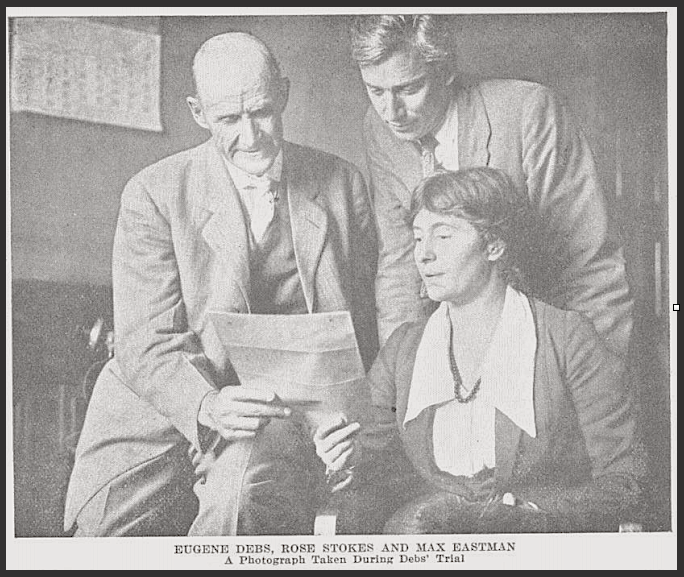
Max Eastman on the Federal Trial of Eugene Debs at Cleveland
From The Liberator of November 1918:
-Note: Comrade Debs was convicted of violating the Espionage Act in Federal Court in Cleveland on September 12, 1918.
The Trial of Eugene Debs
By Max Eastman
AT a Russian Socialist convention held in Stockholm in 1907 it was estimated that the delegates-140 of them-had spent, collectively, one hundred and thirty-eight years, three months and fifteen days in prison. They had been in exile one hundred and forty-eight years, six months and fifteen days. The length of time the convention as a whole had been active in Socialist propaganda was 942 years.
“It follows,” says Trotsky in a preface to one of his books, “that the time spent in prison and exile is about one-third of the time a Social-Democrat is active.” Reading that preface on my way west to attend the trial of Eugene Debs, I was struck by Trotsky’s unconscious assertion that the time spent in prison is part of the time that a Socialist is “active.” It is often the time that his influence is most active. And though the government may succeed in accelerating the immediate war program by imprisoning Debs, they will also accelerate the effect of his life-long service to the social revolution.
Whatever else he may be, Debs is the spiritual chief and hero of American Socialism, and I find myself in a very real perplexity in trying to report his trial on a charge of obstructing the war program. I believe that the postal authorities will recognize the necessity I am under, as a Socialist editor, of giving this news to the readers of the LIBERATOR. And, of course, I cannot write the news without some special appreciation of his life and character and the elevation of his motives. Yet, on the other hand, I recognize the necessity that the postal authorities are under of keeping out of circulation anything designed to obstruct the war program of the government. Therefore I assure the reader in advance, not only that I shall not quote or refer to anything that Debs said about the war, but that I shall not in any indirect way imply any such quotation or reference; or any discussion of what he said. As a Socialist, bidding a kind of temporary hail and farewell to a companion who is dear to the hearts and minds of millions of Americans-whether pro-war or anti-I write the news of his trial for Socialists.
When I slipped into the court-room at Cleveland a pretty young man in a pressed suit and a bow tie was reading Debs’ speech at Canton to the jury. He was manifestly embarrassed to find so much eloquence in his mouth. Debs was never younger, more spirited, more full of love and irony, than he was in that speech of June 16th.
You ought to be out raising hell.
This is the fighting age.
Put on your fighting clothes.
-Mother Jones
~~~~~~~~~~~~~~~~~~~~~~~~~~~~~~~~~~~~~~~~~~~~~
Hellraisers Journal – Tuesday November 10, 1908
Chicago, Illinois – 5,000 Children Go to School Hungry
From The Socialist Woman of November 1908:
American School Children Starving
Chicago Tribune of October 5, 1908
When we are talking of the number of men who are tramping the country looking for work—hungry, broken-spirited, abject creatures, who once thought themselves men, as good as any of their kind—let us not forget the women, and the little children of these men.
Last winter in Chicago after the first flurry of the panic, I had occasion to visit a number of the “homes” of those who had been thrown out of work. In every case the men were out, hunting feverishly for the chance to make even a little money by any kind of hard labor. And in every case my heart ached and my soul grew sick when I thought of the future of the women and children of those families.
“It is awful when the children cry for food, and we cant give it to them,” said one woman who had never before known what it was to be down and out. Another mother, about thirty, and strong and handsome, had to sit by and watch her seven-year-old daughter burning with fever, and without the care of a doctor because she had lost her job in a department store, and there was no money even to buy food. She had applied for work at all the large stores again and again. She had tried everywhere—and was told that they might need her during the holidays. But the holidays were weeks away. Already she had moved into a questionable quarter because rent was cheap. And unless that mother got work within two weeks, there was but one resource left her, if she would save herself and her child from death through starvation. And that was the sale of her body.
It was for a charitable institution I was working—and I knew that those institutions were crowded to their utmost with destitute cases.
Such, indeed, was the condition of the poor in Chicago last winter, that the superintendent of compulsory education, W. Lester Bodine, took up the case of hungry school children, followed his investigations for six months, and finally ascertained that there are 5,000 starving children, and 10,000 that are underfed, in the schools of the city.